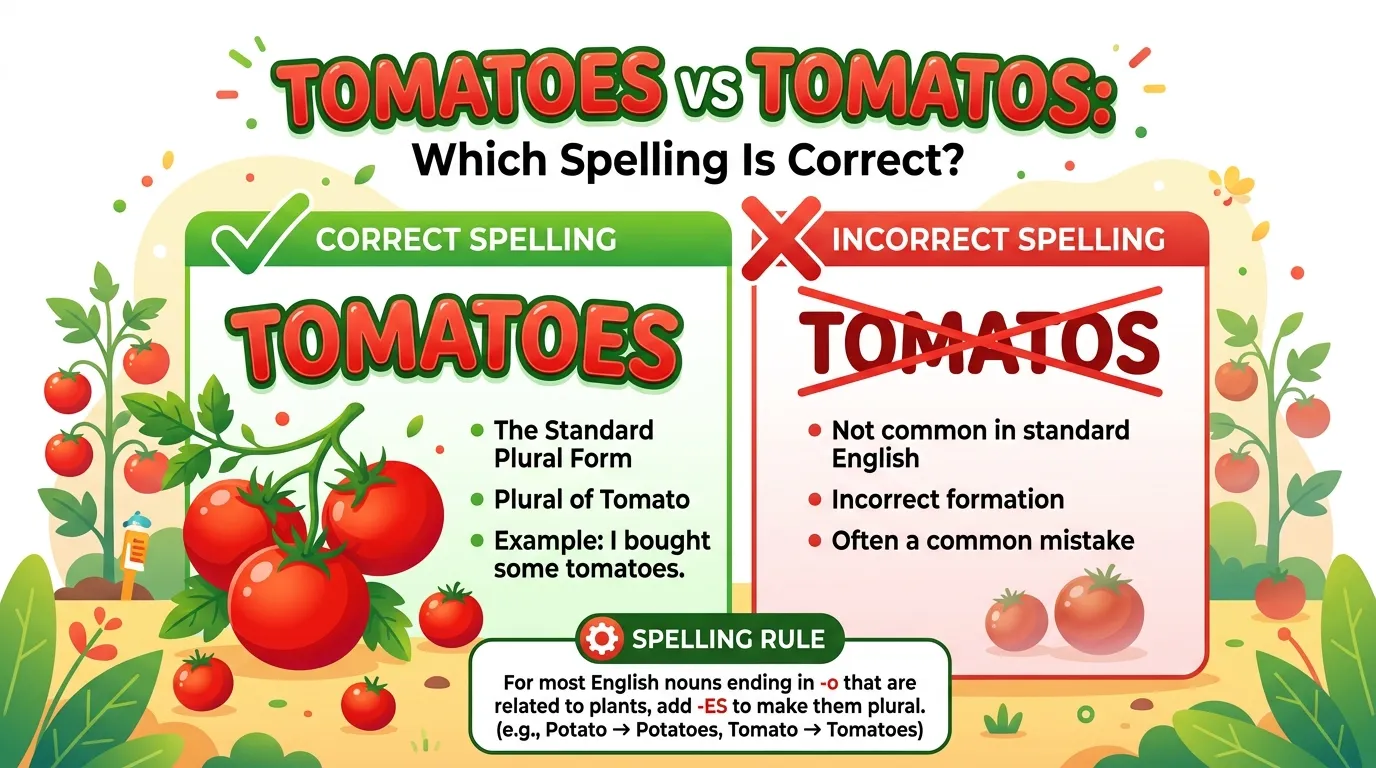
If you are wondering about tomatoes vs tomatos, the correct spelling is tomatoes. Tomatos is a spelling mistake in standard English. The word tomatoes is the plural form of tomato, meaning more than one tomato.
People often confuse these two forms because many English words ending in -o simply add -s to make the plural. For example, we write photos and pianos. However, tomato follows a different and very common plural pattern: tomato → tomatoes.
This spelling is the same in UK and US English. The main difference between British and American English is usually pronunciation, not spelling. Americans commonly pronounce tomato as “tuh-MAY-toh,” while British speakers commonly say “tuh-MAH-toh.”
So, whether you are writing an email, school assignment, recipe, report, invoice, or social media post, use tomatoes, not tomatos. In this guide, we will explain the tomatoes vs tomatos grammar difference, pronunciation, history, examples, common mistakes, and correct usage in simple English.
Quick Answer: Tomatoes vs Tomatos
Here is the answer at a glance:
- ✅ Tomatoes — correct
- ❌ Tomatos — incorrect
- Singular: tomato
- Plural: tomatoes
- US spelling: tomatoes
- UK spelling: tomatoes
Example
- ✅ I bought five tomatoes.
- ❌ I bought five tomatos.
The word tomatos is not a standard plural form in modern English.
What Does “Tomatoes” Mean?
Tomatoes is the plural noun form of tomato.
A tomato is a round or oval fruit commonly used as a food in salads, sauces, sandwiches, soups, and many other dishes.
The grammar is simple:
one tomato → two tomatoes
Because tomatoes names things, it is a plural countable noun.
Examples of “tomatoes” in a sentence
- I bought three tomatoes from the market.
- The tomatoes are fresh.
- Please chop the tomatoes for the salad.
- These tomatoes are very sweet.
- We grow tomatoes in our garden.
You can use tomatoes when you are talking about two or more individual tomatoes.
Tomatoes vs Tomatos: The Grammar Difference
The main grammar rule is about forming plurals.
Many nouns ending in -o take -s, but some take -es.
For example:
| Singular | Plural |
|---|---|
| tomato | tomatoes |
| potato | potatoes |
| hero | heroes |
| echo | echoes |
| photo | photos |
| piano | pianos |
The important point is that English does not have one universal rule for every noun ending in -o.
Tomato belongs to the group that traditionally forms the plural with -es.
Therefore:
- tomato + es = tomatoes
- tomato + s = tomatos ❌
The extra e is part of the correct plural spelling.
Why Is “Tomatos” Wrong?
Tomatos is wrong because standard English dictionaries and spelling conventions use tomatoes as the plural of tomato.
A common reason for the mistake is overgeneralization. Learners may see words such as:
- photo → photos
- piano → pianos
- radio → radios
and assume:
- tomato → tomatos
But English has many exceptions and historical patterns.
Incorrect and corrected examples
❌ I need two tomatos for the recipe.
✅ I need two tomatoes for the recipe.
❌ The shop sells fresh tomatos.
✅ The shop sells fresh tomatoes.
❌ She planted six tomatos.
✅ She planted six tomatoes.
❌ Please add the chopped tomatos.
✅ Please add the chopped tomatoes.
Tomatoes in American English
In American English, the spelling is tomatoes.
Here are five natural American English examples:
- I bought fresh tomatoes at the grocery store.
- We need two tomatoes for the sandwich.
- The farmer grows organic tomatoes.
- Please put the tomatoes in the refrigerator.
- These tomatoes taste better than the canned ones.
Ten American English examples
- The recipe calls for four tomatoes.
- I sliced the tomatoes for the burger.
- Our garden produced many tomatoes this summer.
- The store has a sale on fresh tomatoes.
- She added chopped tomatoes to the soup.
- We bought red and yellow tomatoes.
- The chef uses local tomatoes.
- Can you wash the tomatoes?
- The tomatoes are ready to harvest.
- I forgot to buy tomatoes for dinner.
Tomatoes in British English
British English also uses tomatoes as the plural spelling.
Five British English examples include:
- I bought some fresh tomatoes from the supermarket.
- These tomatoes are ready for the salad.
- We need three tomatoes for dinner.
- She grows tomatoes in her garden.
- Please chop the tomatoes before cooking.
Ten British English examples
- I picked up some tomatoes on the way home.
- The tomatoes are in the fridge.
- We need more tomatoes for the recipe.
- He grows tomatoes in his greenhouse.
- These tomatoes are lovely and ripe.
- Please slice the tomatoes thinly.
- The shop has fresh tomatoes today.
- She added tomatoes to the pasta.
- The children helped pick the tomatoes.
- I bought a bag of tomatoes this morning.
Notice that the spelling does not change between the two varieties of English.
Tomatoes vs Tomatos Comparison Table
| Feature | Tomatoes | Tomatos |
|---|---|---|
| Correct spelling | ✅ Yes | ❌ No |
| Meaning | More than one tomato | Not a standard English word |
| Singular form | Tomato | Tomato |
| Plural form | Tomatoes | Incorrect |
| Part of speech | Plural noun | Misspelling |
| US usage | Standard | Incorrect |
| UK usage | Standard | Incorrect |
| Formal writing | Correct | Avoid |
| Informal writing | Correct | Still incorrect |
| Example | Five tomatoes | Five tomatos ❌ |
Pronunciation: Tomatoes vs Tomatos
Interestingly, the pronunciation can also cause confusion.
American English
Tomato: /təˈmeɪtoʊ/
Sounds roughly like: tuh-MAY-toh
Tomatoes: /təˈmeɪtoʊz/
Sounds roughly like: tuh-MAY-tohz
British English
Tomato: /təˈmɑːtəʊ/
Sounds roughly like: tuh-MAH-toh
Tomatoes: /təˈmɑːtəʊz/
Sounds roughly like: tuh-MAH-tohz
So, the famous difference is:
- 🇺🇸 US: to-MAY-to
- 🇬🇧 UK: to-MAH-to
However, both countries spell the plural tomatoes.
Why Do People Confuse the Spelling?
There are several reasons.
First, English plural rules are not completely predictable.
Second, many nouns ending in -o take -s. This makes tomatos look reasonable at first glance.
Third, pronunciation does not clearly tell you how to spell the plural.
Finally, fast typing, autocorrect, and casual social media writing can make spelling mistakes more common.
The key is to remember that tomato has an -es plural: tomatoes.
Word Origin and Etymology
The word tomato has an interesting history.
English borrowed the word through Spanish tomate, which came from tomatl, a word from Nahuatl, a language spoken by the Aztecs and other peoples of Mesoamerica.
As the word moved through languages, its spelling and pronunciation changed.
English eventually adopted tomato. The plural form developed as tomatoes, following an established English plural pattern for certain nouns ending in -o.
So, the spelling is not random. It reflects the history of how English has formed and borrowed words over time.
“Tomatoes” Synonyms and Related Words
There is no perfect everyday synonym for tomatoes because the word names a specific food.
However, depending on context, you may use related expressions.
| Alternative | Best use | Example |
|---|---|---|
| tomato fruit | More descriptive | The tomato fruit is ripe. |
| fresh produce | General food context | The shop sells fresh produce. |
| garden produce | Home-growing context | We have plenty of garden produce. |
| salad ingredients | Recipe context | Buy salad ingredients. |
| vegetables* | Casual/general context | We need more vegetables. |
*Botanically, tomatoes are fruits, although they are commonly treated as vegetables in cooking.
In both American and British English, tomatoes is the preferred specific term.
Seven Common Mistakes With “Tomatoes”
1. Writing “tomatos”
❌ We bought five tomatos.
✅ We bought five tomatoes.
2. Using the singular after a plural number
❌ I bought three tomato.
✅ I bought three tomatoes.
3. Adding an unnecessary apostrophe
❌ The tomato’s are fresh.
✅ The tomatoes are fresh.
An apostrophe does not normally make a noun plural.
4. Confusing “tomatoes” with possession
Tomatoes means more than one tomato.
Tomato’s usually means something belonging to one tomato.
Example:
- The tomatoes are ripe.
- The tomato’s skin is damaged.
5. Using “tomatos” in formal writing
❌ The invoice includes 20 tomatos.
✅ The invoice includes 20 tomatoes.
6. Forgetting the plural ending
❌ Add two tomato to the salad.
✅ Add two tomatoes to the salad.
7. Assuming US and UK spelling are different
❌ US: tomatos
❌ UK: tomatos
✅ US: tomatoes
✅ UK: tomatoes
The UK vs US difference is mainly pronunciation here, not spelling.
Real-Life Examples of Correct Usage
Emails
Please purchase ten tomatoes before the meeting.
Offices
The office cafeteria needs more tomatoes for the lunch menu.
Banking
The payment for 25 crates of tomatoes has been processed.
Invoices
Fresh tomatoes — 10 boxes — $80.
Schools
Students brought tomatoes for the cooking lesson.
Social Media
Just picked these beautiful tomatoes from my garden! 🍅
Rent Payments
If you are discussing a rental payment, the word would still be spelled tomatoes when relevant:
I paid the rent and bought some tomatoes on my way home.
Everyday Conversation
“Can you grab some tomatoes from the shop?”
“Sure. How many do you need?”
Tomatoes in a Sentence
If you are searching for tomatoes in a sentence, these examples show several common uses:
- Tomatoes are healthy and versatile.
- I washed the tomatoes before cutting them.
- We planted tomatoes last spring.
- The soup contains fresh tomatoes.
- She bought six tomatoes.
The word can be the subject, object, or part of a larger noun phrase.
Parts of Speech and Grammar
Tomato is a noun.
Its plural is tomatoes.
Singular
The tomato is ripe.
Plural
The tomatoes are ripe.
Notice the verb changes too:
- The tomato is fresh.
- The tomatoes are fresh.
You can also use adjectives before the noun:
- fresh tomatoes
- red tomatoes
- ripe tomatoes
- organic tomatoes
- chopped tomatoes
- canned tomatoes
There is no verb form called tomatoes. In standard usage, tomatoes is primarily the plural noun.
Five Easy Memory Tricks
1. Think “potatoes”
Tomato and potato follow the same plural pattern:
tomato → tomatoes
potato → potatoes
2. Remember “-es”
Say:
Tomato needs ES.
So:
tomato + es = tomatoes
3. Picture a basket
Imagine a basket labeled:
🍅🍅🍅 TOMATOES
The extra e is part of the label.
4. Compare with “photos”
Do not assume every -o word behaves like photo.
- photo → photos
- tomato → tomatoes
5. Use the sentence test
If you can replace the word with more than one tomato, write tomatoes.
I bought four ______.
The answer is:
I bought four tomatoes.
Formal vs Informal Usage
Tomatoes is correct in both formal and informal English.
Use it in:
- academic writing
- business emails
- reports
- invoices
- recipes
- schoolwork
- websites
- social media
- everyday conversation
Tomatos should not be used as an informal alternative. It is simply a misspelling.
Tomatoes vs Related Words
It is useful to distinguish tomatoes from nearby forms.
| Word | Meaning |
|---|---|
| tomato | One tomato |
| tomatoes | More than one tomato |
| tomato’s | Something belonging to one tomato |
| tomatoes’ | Something belonging to multiple tomatoes |
| tomato-based | Made with or containing tomato |
| tomato sauce | Sauce made mainly from tomatoes |
For example:
The tomatoes are fresh.
But:
The tomato’s color is unusual.
And:
The tomatoes’ skins were removed.
FAQs About Tomatoes vs Tomatos
Is “tomatoes” the correct spelling?
Yes. Tomatoes is the correct plural spelling of tomato. Tomatos is a misspelling.
What is the meaning of “tomatoes”?
Tomatoes means two or more tomato fruits. It is the plural form of the noun tomato.
Is “tomatos” ever correct?
No, not in standard modern English. Use tomatoes instead.
How do you pronounce “tomatoes”?
In American English, it is commonly pronounced /təˈmeɪtoʊz/. In British English, it is commonly /təˈmɑːtəʊz/.
Is the spelling different in the UK and US?
No. Both British and American English use tomatoes. The pronunciation of tomato is the more noticeable difference.
What is the synonym for tomatoes?
There is no exact everyday synonym. Depending on context, phrases such as fresh produce, garden produce, or salad ingredients may work, but tomatoes is the clearest word.
Is “tomatoes” formal or informal?
It is suitable for both formal and informal writing. You can safely use tomatoes in business documents, school assignments, emails, and casual messages.
Why does tomato become tomatoes?
English traditionally forms the plural of tomato by adding -es, giving tomatoes. This is one of the plural patterns used for certain nouns ending in -o.
Is “tomatoes” a noun?
Yes. Tomatoes is a plural countable noun.
People Also Ask
What is the plural of tomato?
The plural of tomato is tomatoes.
Which is correct, tomatoes or tomatos?
Tomatoes is correct. Tomatos is incorrect.
Why do we spell tomatoes with “es”?
The spelling follows a traditional English plural pattern. Some nouns ending in -o take -es, including tomato.
Do British people say “tomatoes” differently?
Often, yes. British speakers commonly use the “tuh-MAH-toh” pronunciation, while Americans commonly use “tuh-MAY-toh.” The plural spelling remains tomatoes.
Is tomato a fruit or vegetable?
Botanically, a tomato is a fruit because it develops from a flower and contains seeds. In cooking, it is commonly treated as a vegetable.
What is the correct usage in a sentence?
A simple example is:
We bought three tomatoes for dinner.
Should I write “tomato’s” for more than one tomato?
No. Tomato’s normally shows possession, not a plural. The plural is tomatoes.
Final Takeaway
When choosing between tomatoes vs tomatos, the answer is simple: tomatoes is correct, and tomatos is incorrect. The word tomatoes is the plural of tomato, and it refers to more than one tomato.
The spelling is the same in American and British English, although the pronunciation of tomato often differs. Americans commonly say “tuh-MAY-toh,” while British speakers commonly say “tuh-MAH-toh.”
The main grammar rule to remember is that tomato takes -es in the plural:
tomato → tomatoes
Do not write tomatos, even in casual messages. Also remember that tomatoes, tomato’s, and tomatoes’ have different grammatical functions.
If you remember just one thing from this guide, remember this: one tomato, two tomatoes. That simple pattern will help you avoid one of the most common spelling mistakes involving words ending in -o.