If you are unsure about vendor vs vender, you are not alone. These two words look almost identical, sound very similar, and both can refer to someone who sells goods or services. That is why even fluent English speakers sometimes hesitate when writing an email, invoice, business document, or school assignment.
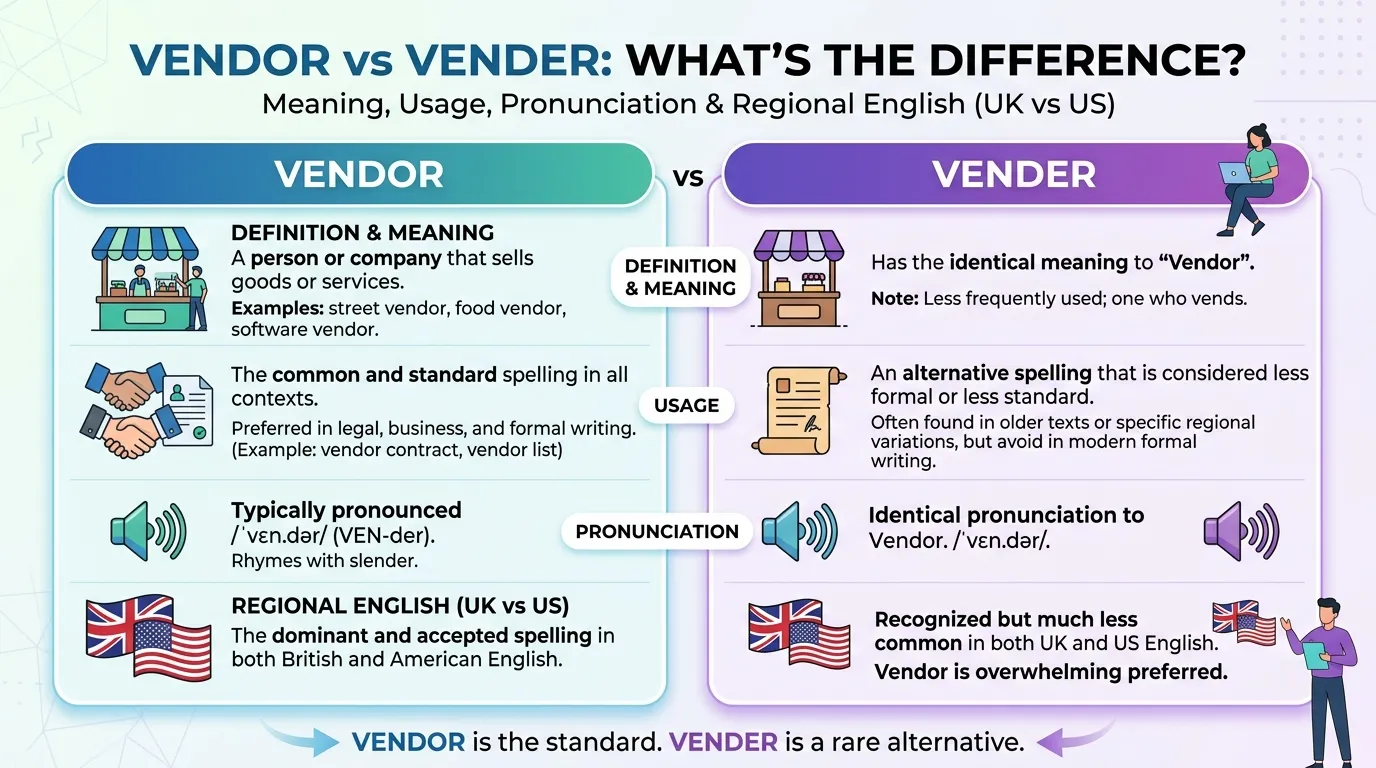
The good news is simple: vendor is the standard and far more common spelling. Vender is also a real English word, but it is mainly used in American English as an alternative spelling of vendor. Cambridge lists vender as a US commerce term that points readers to vendor.
So, when choosing between vendor vs vender, use vendor in almost all situations. It works naturally in both UK and US English. In British English, vendor is the normal choice. In American English, vendor is also strongly preferred, although vender is recognized.
Understanding this small grammar difference can help you avoid common spelling mistakes and sound more polished in professional and everyday English.
Quick Answer: Vendor or Vender?
- ✅ Vendor — the standard spelling and the best choice in most writing.
- ⚠️ Vender — a legitimate alternative spelling, mainly recognized in US English, but much less common.
- 🇬🇧 UK English: vendor is the normal form.
- 🇺🇸 US English: vendor is standard; vender is also recognized in some dictionaries.
Best rule: If you are not sure, write vendor.
What Does Vendor Mean?
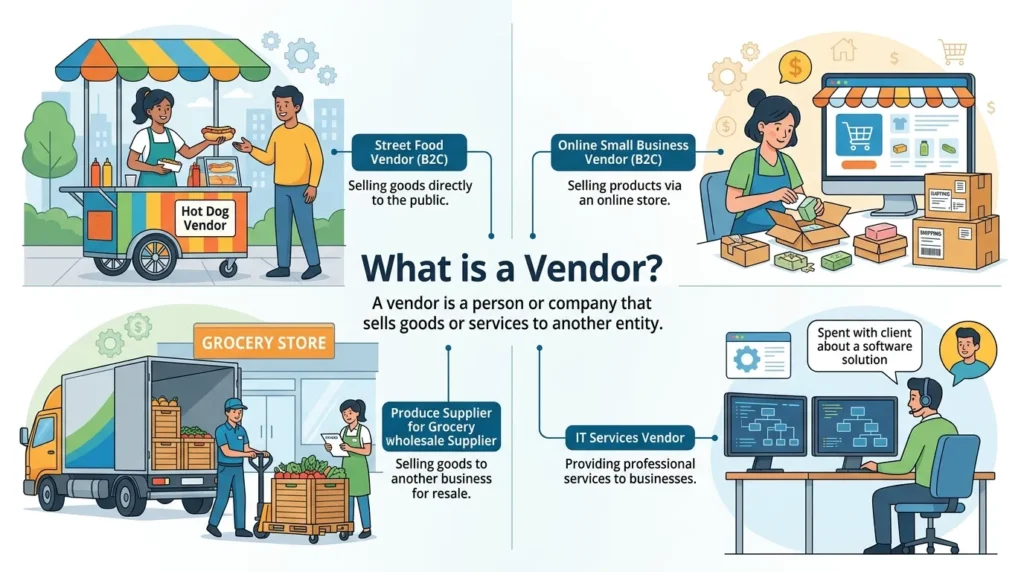
Vendor is a noun. It means a person, business, or company that sells goods or services.
Cambridge defines a vendor as someone who sells something. In business English, it can also mean a company or person selling a particular product or service.
For example:
- A street vendor sells food or goods in a public place.
- A software vendor sells software.
- A property vendor is someone selling a property.
- A food vendor sells food.
- A business vendor supplies products or services to another business.
Vendor as a grammatical noun
Because vendor is a noun, it can be singular or plural:
- Singular: The vendor sent the invoice.
- Plural: The vendors sent their invoices.
You can use articles before it:
- a vendor
- the vendor
- several vendors
- our vendor
- their vendor
The word does not normally function as a verb in modern everyday English. The related verb is vend, meaning “to sell,” although vend is formal and less common in ordinary conversation.
Vendor vs Vender: Detailed Comparison
| Feature | Vendor | Vender |
|---|---|---|
| Part of speech | Noun | Noun |
| Meaning | Person or company that sells something | Same basic meaning |
| Standard spelling | Yes | Less common alternative |
| UK English | Standard | Rare/unusual |
| US English | Standard and preferred | Recognized alternative |
| Business writing | Strongly preferred | Usually avoided |
| Formal writing | Preferred | Less preferred |
| Pronunciation | /ˈven.dər/ US; /ˈven.də/ UK | /ˈven.dər/ |
| Example | The vendor sent the invoice. | The vender sent the invoice. |
| Best choice for learners | Vendor | Usually avoid |
Cambridge specifically labels vender as a US commerce word and directs readers to vendor.
Why Is Vender Sometimes Considered Correct?
This is an important point.
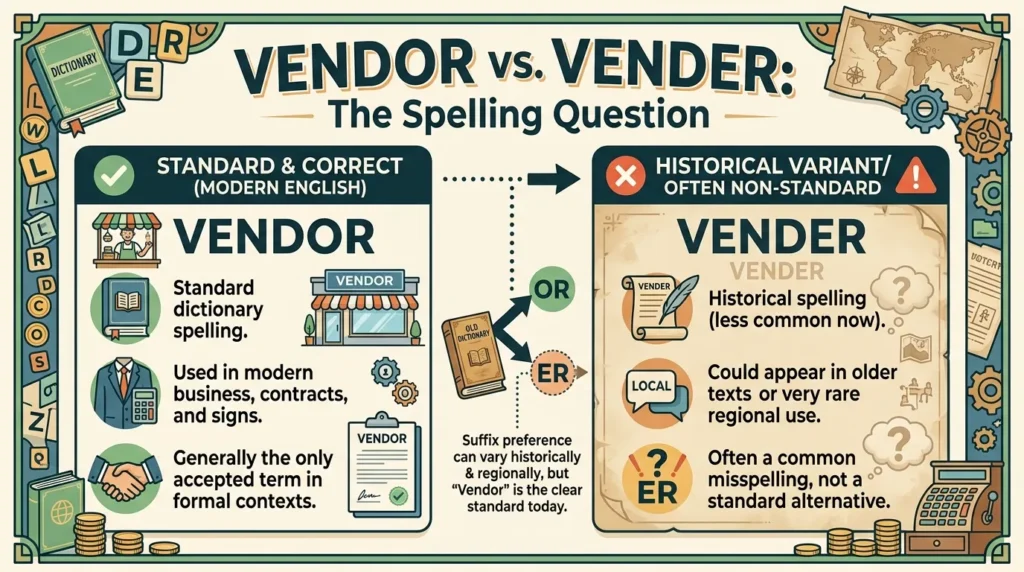
It would be inaccurate to say that vender is completely wrong. It is a dictionary-recognized spelling. Cambridge lists it as a US commerce noun and gives vendor as the main reference form.
The problem is that vender is much less common.
Therefore:
Vendor = standard, common, and safest.
Vender = accepted alternative, mainly American and uncommon.
If you are writing a résumé, academic paper, business email, contract, invoice, or website, vendor is the better choice.
Vendor Examples in American English
Here are natural vendor examples in US English:
- The vendor delivered the equipment yesterday.
- We need to contact the software vendor.
- The street vendor sells fresh tacos.
- Our company works with several local vendors.
- Please send the invoice to the vendor.
- The vendor offered us a discount.
- The food vendor was busy all afternoon.
- We are looking for a reliable clothing vendor.
- The vendor provides technical support.
- The bank approved the new vendor.
These examples show that vendor works for both individual sellers and companies.
Vendor Examples in British English
In British English, vendor is also the normal spelling:
- The vendor agreed to the price.
- We contacted the supplier and the vendor.
- The property vendor accepted the offer.
- The market vendor sells handmade crafts.
- Please speak to the vendor about the invoice.
- The vendor has supplied the school for years.
- We need to choose a new software vendor.
- The vendor will deliver the equipment tomorrow.
- The company is looking for a trusted vendor.
- The purchaser and vendor signed the agreement.
In British property language, vendor can be especially useful for the person selling a property. Cambridge gives this legal/property use as an example.
Vendor in a Sentence: Real-Life Examples
Knowing the vendor meaning is useful, but seeing the word in context makes the rule easier.
Emails
Please contact the vendor and ask for an updated quotation.
Offices
Our office has changed its preferred stationery vendor.
Banking
The bank is reviewing the vendor’s payment details.
Invoices
The vendor sent the invoice to our accounts department.
Schools
The school selected a new food vendor for the cafeteria.
Social media
We found a local vendor through Instagram.
Rent payments
The property vendor provided the required documents.
Everyday conversation
I bought lunch from a street vendor.
These examples show why vendor appears often in business, commerce, technology, property, and everyday life.
Why Vender Can Be Confusing
There are several reasons people confuse vendor vs vender.
1. The words sound almost the same
In American English, both are generally pronounced /ˈven.dər/.
2. Both come from the same word family
Both are connected to vend, meaning “to sell.”
3. The spelling feels logical
English learners may think:
vend + er = vender
That pattern makes sense because English often forms nouns by adding -er to verbs.
For example:
- teach → teacher
- drive → driver
- work → worker
So vender looks perfectly logical.
4. Vendor is historically older as a borrowed form
The word vendor came into English through Anglo-French, while vender developed as an agent noun directly from vend. Both appeared around the 1590s.
Pronunciation Guide
Vendor
US: /ˈven.dɚ/
UK: /ˈven.dər/
A simple guide is:
VEN-dər
Vender
US: /ˈven.dər/
A simple guide is:
VEN-dər
The pronunciation is essentially the same in ordinary speech, especially in American English. Cambridge gives the US pronunciation of vendor as /ˈven.dɚ/ and vender as /ˈvendər/.
This is one major reason people confuse the spellings: you usually cannot hear the difference.
Word Origins and Etymology
The history of these words is surprisingly interesting.
Vendor
Vendor dates from the 1590s. It came from Late Anglo-French vendor, related to vendre, meaning “to sell,” and ultimately from Latin vendere, meaning “to sell.”
Vender
Vender also dates from the 1590s. It developed as an agent noun from the English verb vend.
Vend
The verb vend dates from the 1600s and comes from Latin vendere, “to sell.” The Latin word was connected with the idea of offering something for sale.
So the two spellings have a shared historical connection. The difference is mainly about form, frequency, and modern usage, rather than meaning.
Vendor Synonyms: What Else Can You Say?
There are many alternatives to vendor.
| Synonym | Meaning | Best use |
|---|---|---|
| Seller | Someone who sells | General English |
| Supplier | Someone who provides goods/services | Business |
| Merchant | Person involved in trade | Formal/traditional |
| Retailer | Business selling directly to consumers | Commerce |
| Trader | Person or business involved in buying/selling | UK and international business |
| Dealer | Person/company selling a particular product | Cars, equipment, goods |
| Salesperson | Individual who sells products | People |
| Provider | Person/company providing a service | Services/technology |
Which synonym is best?
Seller is usually the easiest word for beginners.
Supplier is often better when a company provides materials or products to another company.
Retailer is precise when the business sells directly to customers.
Vendor is especially common in business, technology, events, procurement, and property.
Cambridge also lists seller as a synonym for vendor.
Seven Common Mistakes With Vendor and Vender
Mistake 1: Thinking vender is always wrong
❌ Vender is not an English word.
✅ Vender is a recognized US alternative spelling of vendor.
Mistake 2: Using vender in formal UK writing
❌ The vender sent the contract.
✅ The vendor sent the contract.
Mistake 3: Confusing vendor with customer
❌ The vendor bought the product from us.
Usually, that person would be the customer, not the vendor.
✅ The vendor sold the product to us.
Mistake 4: Using vendor as the normal verb
❌ The company vendors computer equipment.
Better:
✅ The company sells computer equipment.
Or, in formal contexts:
✅ The company vends computer equipment.
Mistake 5: Forgetting the plural
❌ We work with many vendor.
✅ We work with many vendors.
Mistake 6: Confusing vendor with supplier
The words overlap, but they are not always identical.
A supplier usually emphasizes providing goods or materials. A vendor can be any person or business selling goods or services.
Mistake 7: Choosing the unusual spelling just to sound American
❌ We selected a new vender.
✅ We selected a new vendor.
Being American does not require using vender. Vendor is completely normal in US English.
Grammar Rule: Why Vendor Is a Noun
The basic grammar is easy:
Vendor = noun
It names a person, company, or business.
Singular
The vendor is waiting.
Plural
The vendors are waiting.
Possessive
The vendor’s contract is ready.
With an adjective
We selected a reliable vendor.
With a preposition
We spoke with the vendor.
The related verb is vend:
- vend
- vends
- vended
- vending
However, vend is formal. Cambridge labels it a formal commerce verb meaning “to sell something.”
Vendor vs Vender in American English
In US English, both spellings can be found.
However, vendor is the safer and more common spelling.
For example:
Our vendor sent the invoice.
This sounds completely natural in American business English.
You may also encounter:
Our vender sent the invoice.
The second sentence is understandable and dictionary-recognized, but it is less common and may look unusual to many readers.
For professional writing, choose vendor.
Vendor vs Vender in British English
In UK English, vendor is clearly the better choice.
British English commonly uses vendor for:
- property sellers
- street sellers
- business suppliers
- commercial sellers
- people selling goods
Using vender in British writing may look unusual or like a spelling error.
Therefore, the easiest UK vs US English rule is:
🇬🇧 UK: vendor
🇺🇸 US: vendor is preferred; vender is also recognized.
Five Easy Memory Tricks
1. Think “vendor = standard”
The O in vendor can remind you:
O = Official choice
2. Connect it with “vendor contract”
Business contracts almost always make vendor feel natural.
3. Remember the UK rule
If you are writing British English, choose vendor.
4. Think “vend → vendor”
Although vender looks like the obvious form, English borrowed and developed vendor as the established noun.
5. When in doubt, use vendor
This is the simplest trick of all.
Vendor works almost everywhere.
Vendor vs Related Words and Expressions
Here are some useful distinctions:
- Vendor: person or company selling goods/services.
- Seller: general word for someone who sells.
- Supplier: provides goods or materials.
- Retailer: sells products to consumers.
- Merchant: someone involved in trade.
- Dealer: sells a particular type of product.
- Provider: supplies a service.
- Customer: buys goods or services.
- Buyer: purchases something.
A useful way to remember the relationship is:
Vendor → sells → customer buys.
Ten More American English Sentences
- The vendor gave us a better price.
- Our technology vendor upgraded the system.
- The vendor requested payment by Friday.
- We added the company to our approved vendor list.
- A local vendor provided the catering.
- The vendor’s website is easy to use.
- The school hired a new lunch vendor.
- Please review the vendor agreement.
- The vendor offers free delivery.
- We need to find another vendor.
Ten More British English Sentences
- The vendor accepted the offer.
- We contacted the vendor yesterday.
- The vendor supplied the materials.
- The property vendor is ready to exchange contracts.
- The market vendor sells fresh fruit.
- The vendor sent the paperwork.
- The council approved the new vendor.
- We have used the same vendor for years.
- The vendor agreed to reduce the price.
- The company is looking for a local vendor.
Formal vs Informal Usage
Vendor is suitable for both formal and informal situations.
Formal
Please contact the vendor regarding the outstanding invoice.
Neutral
I need to call the vendor.
Informal
That vendor sells great food.
However, in everyday conversation, seller may sound more natural:
I bought it from a seller online.
In business writing, vendor is often more precise:
Please update the vendor information in our system.
FAQs About Vendor vs Vender
Is vendor or vender correct?
Both are recognized, but vendor is the standard and preferred spelling. Vender is mainly recognized as a US alternative.
What is the vendor meaning?
A vendor is a person or company that sells goods or services.
Is vender a misspelling of vendor?
Not exactly. Vender is a legitimate alternative spelling, although it is much less common than vendor.
Is vendor British or American English?
It is used in both British and American English. It is the normal spelling in British English and the preferred spelling in American English.
How do you pronounce vendor?
In US English, it is /ˈven.dɚ/. In UK English, it is commonly /ˈven.də/.
What is a good vendor synonym?
Seller is the simplest general synonym. Supplier, retailer, merchant, and dealer may be better depending on context.
Is vendor formal or informal?
Vendor is neutral to formal. It is especially common in business, commerce, law, technology, and property.
Can vendor be a verb?
The related verb is vend, meaning “to sell.” Vend is formal and is much less common than sell.
Do dictionaries accept vender?
Yes. Cambridge lists vender as a US commerce noun and directs readers to vendor.
Which spelling should ESL learners use?
Use vendor. It is the safest spelling across American and British English.
People Also Ask
Is “vender” a word in the USA?
Yes. Vender is recognized in American English, especially in commerce, but vendor is more common and is the better default choice.
Is “vendor” British English?
Yes. Vendor is standard British English. It is commonly used for sellers, businesses, and property sellers.
What is the difference between a vendor and a seller?
The meanings overlap. Seller is a broad everyday term, while vendor is especially common in business and commercial contexts.
What is the opposite of vendor?
Depending on the context, the opposite can be buyer, customer, or purchaser.
What is the correct usage: vendor or vender?
For almost every situation, choose vendor.
Is “vendor” more formal than “seller”?
Usually, yes. Vendor often sounds more business-like, while seller is more general and conversational.
Final Verdict: Vendor vs Vender
The vendor vs vender question has a simple answer once you understand the history and modern usage. Vendor is the standard spelling and the best choice for almost all English writing. It works naturally in both UK and US English, including business emails, invoices, contracts, school assignments, websites, and everyday conversations.
Vender is not simply a spelling mistake. It is a legitimate but much less common US alternative. Cambridge recognizes it as a US commerce term and points readers to vendor.
So, if you need one reliable rule, remember this:
When in doubt, use vendor.
Whether you mean a street seller, software company, property seller, food business, or service provider, vendor is clear, correct, professional, and widely understood. Once you remember that vender is only an uncommon alternative, the grammar difference becomes easy to handle. For students, ESL learners, and professionals, vendor is the spelling worth choosing.


