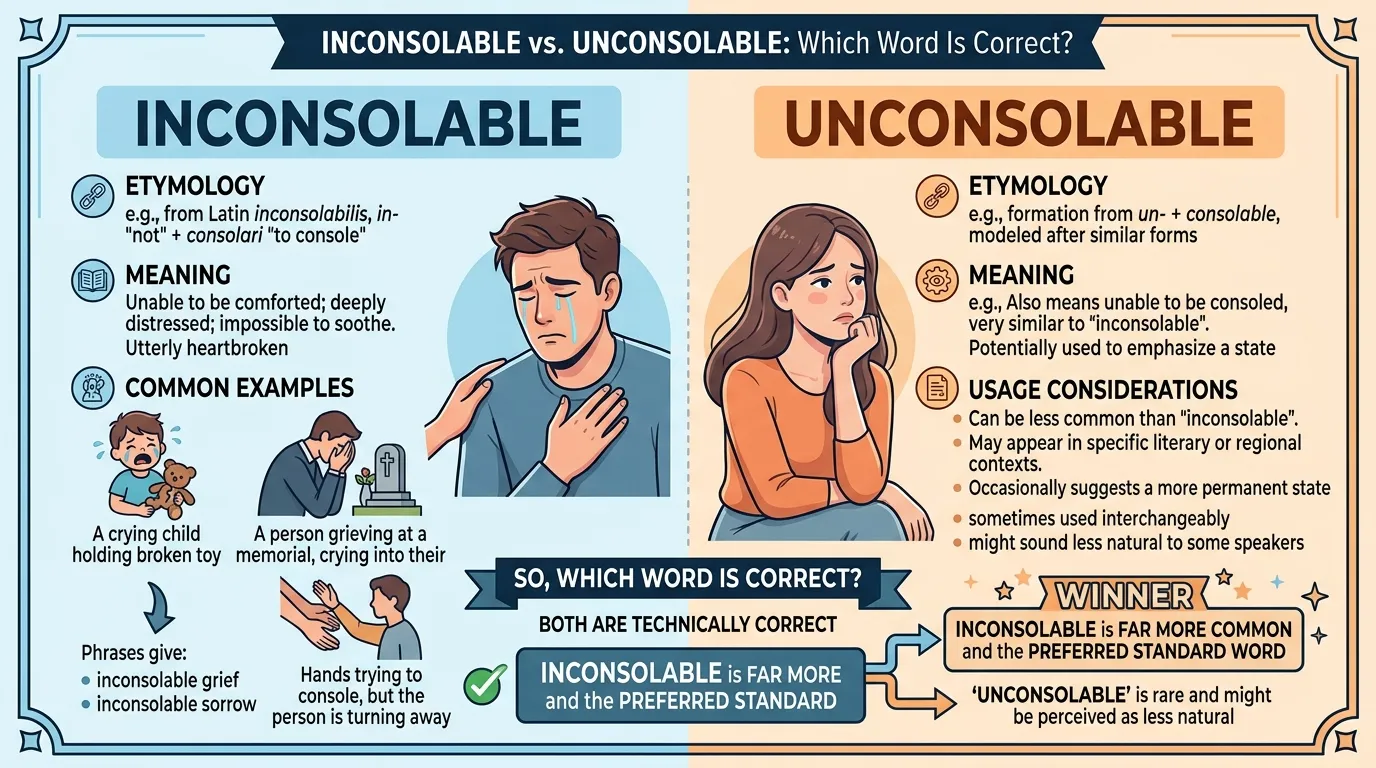
Have you ever wondered whether inconsolable or unconsolable is the right word? Both forms can be found in English, but they are not equally common. Inconsolable is the standard and much more widely used adjective in both American and British English. It describes someone who is so upset, sad, or distressed that they cannot be comforted. Unconsolable also has a logical meaning and appears in dictionaries and real usage, but it is much less common and is often treated as an uncommon alternative.
This is why inconsolable vs unconsolable can be confusing. Both words contain consolable, meaning capable of being comforted. The difference comes from the prefixes in- and un-. In everyday writing, especially in professional, academic, and general communication, inconsolable is the safer choice.
There is no major UK vs US English difference in the basic meaning. American and British speakers overwhelmingly use inconsolable. Understanding the inconsolable vs unconsolable grammar difference will help you choose the natural form with confidence.
Quick Answer
| Form | Correct? | Commonness | Meaning |
|---|---|---|---|
| Inconsolable | ✅ Yes | Very common | Unable to be comforted |
| Unconsolable | ✅ Yes, but uncommon | Rare | Unable to be comforted |
| Inconsolable in formal writing | ✅ Preferred | Very common | Natural and standard |
| Unconsolable in formal writing | ⚠️ Possible but unusual | Rare | May sound less natural |
The simple rule
Use “inconsolable” in most situations.
✅ The child was inconsolable after losing her favorite toy.
⚠️ The child was unconsolable after losing her favorite toy.
The second sentence is understandable and not necessarily grammatically wrong, but the first sounds much more natural to most English speakers.
What Does Inconsolable Mean?
Inconsolable is an adjective that means unable to be comforted, calmed, or made less sad.
When someone is inconsolable, ordinary attempts to make them feel better do not work.
For example:
She was inconsolable after hearing the news.
This means she was extremely upset and could not be comforted.
The word is often used for strong emotions such as:
- Deep sadness
- Grief
- Shock
- Emotional pain
- Disappointment
- Distress
- Loss
It can describe people, children, animals, and sometimes emotional reactions.
Grammar and part of speech
Inconsolable is an adjective.
It usually describes a noun or follows a linking verb such as be, seem, become, remain, or appear.
Examples:
- The baby was inconsolable.
- She became inconsolable.
- He seemed inconsolable.
- The grieving family remained inconsolable.
It does not normally function as a verb.
You should not say:
❌ She inconsolabled after the accident.
Instead, say:
✅ She became inconsolable after the accident.
Inconsolable Examples in American English
Here are natural inconsolable examples in American English:
- The baby was inconsolable after waking from the nightmare.
- She became inconsolable when her dog died.
- He was inconsolable after hearing the disappointing news.
- The little boy was inconsolable when his parents left.
- She seemed inconsolable after the breakup.
- The family was inconsolable after the tragic loss.
- His mother found him inconsolable after the accident.
- The child remained inconsolable for several hours.
- She was almost inconsolable with grief.
- The puppy was inconsolable after being separated from its owner.
Inconsolable Examples in British English
The word is used in much the same way in British English:
- The child was inconsolable after losing his favourite toy.
- She was inconsolable when she heard the news.
- He became inconsolable after the death of his friend.
- The baby was inconsolable throughout the night.
- She appeared inconsolable after the argument.
- The family were inconsolable following the tragedy.
- The young girl was inconsolable with grief.
- He remained inconsolable despite everyone’s efforts.
- The dog was inconsolable when its owner left.
- She seemed completely inconsolable after the loss.
Notice that British English may use favourite instead of the American favorite, and British English can use plural agreement with collective nouns such as the family were. The word inconsolable, however, remains the same.
Is Unconsolable Wrong?
Not exactly.
This is one of the most important points in the inconsolable vs unconsolable debate.
Unconsolable is an understandable and attested English adjective. It means essentially the same thing as inconsolable: unable to be consoled or comforted.
However, unconsolable is far less common.
Because English speakers overwhelmingly choose inconsolable, unconsolable may look like a mistake or may sound unusual to many readers.
Compare:
✅ She was inconsolable after her father’s death.
⚠️ She was unconsolable after her father’s death.
The second sentence communicates the intended meaning, but the first is the natural choice for general English.
Why does unconsolable exist?
English has several prefixes that can create words with negative meanings.
The prefix un- often means “not” or “the opposite of.”
Examples include:
- happy → unhappy
- certain → uncertain
- comfortable → uncomfortable
- able → unable
So unconsolable is easy to understand as:
un- + consolable = not consolable
However, English does not always create or prefer words in a perfectly predictable way. Inconsolable became the established form for this particular meaning.
Incorrect and Correct Examples
Because unconsolable is not simply nonsense, it is better to describe it as uncommon rather than automatically calling it incorrect.
| Less Natural | Preferred |
|---|---|
| She was unconsolable after the loss. | She was inconsolable after the loss. |
| The baby became unconsolable. | The baby became inconsolable. |
| He looked unconsolable. | He looked inconsolable. |
| The child remained unconsolable. | The child remained inconsolable. |
| They were unconsolable with grief. | They were inconsolable with grief. |
Inconsolable vs Unconsolable Comparison
| Feature | Inconsolable | Unconsolable |
|---|---|---|
| Part of speech | Adjective | Adjective |
| Meaning | Unable to be comforted | Unable to be comforted |
| Standard usage | Yes | Less common |
| Frequency | Very high | Very low |
| American English | Preferred | Rare |
| British English | Preferred | Rare |
| Formal writing | Strong choice | Usually avoid unless context supports it |
| Everyday speech | Natural | Unusual |
| Meaning difference | Essentially none | Essentially none |
| Best choice for learners | Yes | Usually no |
Pronunciation Guide
Inconsolable
American English: /ˌɪnkənˈsoʊləbəl/
It sounds roughly like:
in-kuhn-SOH-luh-buhl
British English: /ˌɪnkənˈsəʊləbəl/
The main difference is the vowel sound in sol.
Unconsolable
American English: /ˌʌnkənˈsoʊləbəl/
British English: /ˌʌnkənˈsəʊləbəl/
It sounds roughly like:
un-kuhn-SOH-luh-buhl
Why are they easy to confuse?
Both words share the same ending:
consolable
They also have nearly identical meanings. The main difference is the prefix:
- in-
- un-
Since both prefixes can express negation in English, learners may naturally assume that either form is equally common.
That assumption is understandable, but English vocabulary is shaped by history and usage, not just logical word formation.
Word Origins and Etymology
Understanding the history of these words makes the difference easier to remember.
Consolable
The base word is consolable, which comes from the verb console.
Console comes from Latin consolari, meaning to comfort or encourage.
The Latin root developed through French and eventually entered English.
The related noun consolation also refers to comfort given during sadness or trouble.
Inconsolable
Inconsolable combines:
in- + consolable
The prefix in- can express a negative meaning, while consolable means capable of being comforted.
So the basic idea is:
inconsolable = not able to be consoled
The word has a long history in English and became the established adjective for someone who cannot be comforted.
Unconsolable
Unconsolable uses a different negative prefix:
un- + consolable
This formation is perfectly understandable because un- commonly creates negative adjectives.
However, historical usage favored inconsolable much more strongly.
This is a useful lesson for English learners: a word can be logically formed without becoming the most common word in actual English.
Inconsolable Synonyms
If you need an inconsolable synonym, you have several choices.
| Synonym | Meaning | Typical Use |
|---|---|---|
| Distraught | Extremely upset | Common in general English |
| Heartbroken | Deeply sad because of loss | Emotional and informal |
| Devastated | Extremely shocked or saddened | Very common |
| Grief-stricken | Deeply affected by grief | Formal or emotional |
| Despairing | Feeling little or no hope | More literary |
| Miserable | Very unhappy | General and informal |
| Upset | Troubled or unhappy | Everyday English |
| Comfortless | Without comfort | Less common, literary |
Which synonym should you choose?
For everyday American English, devastated, heartbroken, distraught, and upset are very natural.
British English also commonly uses these words.
For formal writing, distressed, grief-stricken, or devastated may fit better depending on context.
Seven Common Mistakes
Mistake 1: Assuming unconsolable is the normal form
❌ She was unconsolable.
✅ She was inconsolable.
While unconsolable can be found in English, inconsolable is much more established.
Mistake 2: Treating inconsolable as a verb
❌ The news inconsolabled him.
✅ The news left him inconsolable.
Remember that inconsolable is an adjective.
Mistake 3: Using “inconsolable” for ordinary sadness
Inconsolable suggests very strong emotional distress.
❌ I was inconsolable because my coffee was cold.
This is possible as exaggeration or humor, but in literal formal writing, it sounds too strong.
Mistake 4: Confusing inconsolable with uncomfortable
The words are unrelated in meaning.
Inconsolable means impossible or extremely difficult to comfort.
Uncomfortable means causing physical or emotional discomfort.
Mistake 5: Forgetting the spelling
A common spelling mistake is:
❌ inconsolible
The correct spelling is:
✅ inconsolable
It contains solable, not solible.
Mistake 6: Assuming UK and US English use different words
Both varieties strongly prefer inconsolable.
There is no major UK vs US grammar difference here.
Mistake 7: Choosing a rare word to sound formal
Using unconsolable may seem more sophisticated because it looks unusual.
However, unusual does not automatically mean formal or better.
In most contexts, inconsolable is clearer and more natural.
Real-Life Examples
Emails
We were deeply saddened to hear about your loss. We understand that you may feel inconsolable at this difficult time.
Offices
The employee was inconsolable after receiving the news about the sudden closure.
Banking
The customer became inconsolable after discovering that the payment had been rejected.
Invoices
The supplier was extremely upset about the unpaid invoice, but calling the situation inconsolable would be too dramatic for a normal business report.
Schools
The young student was inconsolable after learning that her classmate was moving away.
Social Media
I was absolutely inconsolable after watching the final episode.
Here, the word may be used dramatically for effect.
Rent Payments
The tenant was distraught after receiving the notice about overdue rent.
In this context, distraught may sound more natural than inconsolable unless the person truly cannot be comforted.
Everyday Conversation
She was inconsolable after her cat went missing.
The baby was inconsolable all night.
He looked completely inconsolable.
Inconsolable in a Sentence: American English
Here are ten additional examples:
- My sister was inconsolable after losing her wedding ring.
- The child was inconsolable after waking up alone.
- She became inconsolable when she heard the result.
- He was nearly inconsolable after the breakup.
- The grieving father appeared inconsolable.
- The puppy was inconsolable when separated from its owner.
- She looked inconsolable after the accident.
- The family was inconsolable with grief.
- The little girl remained inconsolable despite our efforts.
- He seemed inconsolable after hearing the final decision.
Inconsolable in a Sentence: British English
Here are ten more examples:
- The child was inconsolable after losing his favourite book.
- She was inconsolable when her friend moved away.
- He became inconsolable after hearing the sad news.
- The baby was inconsolable throughout the evening.
- The family were inconsolable after the tragedy.
- She appeared inconsolable with grief.
- The boy remained inconsolable despite everyone’s efforts.
- He looked completely inconsolable after the defeat.
- The dog was inconsolable when its owner disappeared.
- She seemed inconsolable following the loss.
Inconsolable vs Related Expressions
Several expressions can describe a person who is deeply upset, but they are not identical.
Inconsolable vs Distraught
Distraught means extremely worried, upset, or emotionally disturbed.
Inconsolable focuses more strongly on being impossible or extremely difficult to comfort.
She was distraught after the accident.
She was inconsolable after her husband died.
Inconsolable vs Heartbroken
Heartbroken usually refers to deep emotional sadness, especially after loss or the end of a relationship.
He was heartbroken after the breakup.
The person may still be able to accept comfort, so heartbroken does not necessarily mean inconsolable.
Inconsolable vs Devastated
Devastated means extremely shocked or saddened.
She was devastated by the news.
Someone who is devastated may be inconsolable, but the two words describe slightly different aspects of the experience.
Inconsolable vs Unconsolable
This is the closest comparison.
Both mean essentially:
unable to be comforted
But inconsolable is the normal, widely preferred form.
The Grammar Rule Behind Inconsolable
The easiest way to understand the grammar is to identify the word’s role.
Inconsolable = adjective
It describes a person, animal, or emotional state.
Common structures include:
Subject + be + inconsolable
The baby was inconsolable.
Subject + become + inconsolable
She became inconsolable.
Subject + seem + inconsolable
He seemed inconsolable.
Subject + remain + inconsolable
The child remained inconsolable.
You can also use it before a noun:
an inconsolable child
an inconsolable mother
an inconsolable grieving family
Does inconsolable have verb forms?
No.
You do not conjugate inconsolable because it is an adjective.
The related verb is console:
- Present: console
- Past: consoled
- Present participle: consoling
- Past participle: consoled
Examples:
Her friends tried to console her.
Her friends consoled her.
They were consoling the grieving family.
She was consoled by her friends.
Five Memory Tricks
Memory Trick 1: Remember “inconsolable” as the established word
Think:
Sad + cannot be comforted = inconsolable
Memory Trick 2: Connect it with “consolation”
Consolation means comfort.
If someone cannot receive consolation, they are inconsolable.
Memory Trick 3: Think “in = impossible”
The in- prefix can suggest something is not possible.
So:
inconsolable = not able to be consoled
Memory Trick 4: Use the phrase “inconsolable grief”
This common combination can help fix the word in your memory.
She was inconsolable with grief.
Memory Trick 5: Choose the familiar form
When deciding between the two forms, remember:
Inconsolable is the familiar choice.
If you are writing an essay, email, report, article, or school assignment, use inconsolable unless you have a specific reason to use the rarer form.
FAQs
Is inconsolable the correct word?
Yes. Inconsolable is the standard and much more common word for someone who cannot be comforted.
Is unconsolable a real word?
Yes. Unconsolable is an attested adjective meaning unable to be consoled. However, it is uncommon compared with inconsolable.
What is the meaning of inconsolable?
Inconsolable means extremely upset or distressed and unable to be comforted.
What is an inconsolable synonym?
Common synonyms include distraught, devastated, heartbroken, grief-stricken, miserable, and despairing, depending on the context.
How do you pronounce inconsolable?
In American English, it is commonly pronounced /ˌɪnkənˈsoʊləbəl/. In British English, a common pronunciation is /ˌɪnkənˈsəʊləbəl/.
Is inconsolable used in British English?
Yes. Inconsolable is common in both British and American English.
Is unconsolable wrong in American English?
It is better described as uncommon rather than simply wrong. American English strongly favors inconsolable.
Is inconsolable formal or informal?
It works in both formal and informal English. Its emotional meaning can be serious, but people also use it casually for dramatic effect.
Which form do dictionaries prefer?
Major dictionaries generally recognize inconsolable as the established adjective. Unconsolable is much less common, so learners should normally choose inconsolable.
Can I use inconsolable in a professional email?
Yes, but use it when the emotional situation is genuinely severe. In business writing, words such as distressed, upset, or devastated may sometimes be more appropriate.
People Also Ask
What is the difference between inconsolable and unconsolable?
Both can mean unable to be comforted, but inconsolable is far more common and is the preferred choice in normal English.
Which is correct, inconsolable or unconsolable?
Inconsolable is the standard choice. Unconsolable is an uncommon alternative, so English learners should generally use inconsolable.
Can a person be inconsolable?
Yes. A person can be described as inconsolable when they are extremely distressed and cannot be comforted.
What does “I am inconsolable” mean?
It means the speaker is extremely upset and feels unable to be comforted. In casual speech, it can also be an exaggeration.
What is the opposite of inconsolable?
Depending on the context, possible opposites include comforted, consoled, reassured, calm, or content.
Is inconsolable a negative word?
It usually describes a painful or very emotional situation. However, its tone depends on context. On social media, people sometimes use it humorously or dramatically.
Is inconsolable stronger than sad?
Yes. Inconsolable usually suggests a much stronger emotional reaction than simply being sad or upset.
Final Verdict
When choosing between inconsolable vs unconsolable, the safest answer is simple: use inconsolable.
Inconsolable is the standard, familiar, and widely preferred adjective in both American and British English. It describes someone who is so deeply upset or distressed that they cannot be comforted. It works naturally in conversations, stories, news writing, academic work, and many formal contexts.
Unconsolable is not simply a meaningless spelling error. It is a real but uncommon form built from un- and consolable. Because it appears much less often, it can sound unusual to modern readers.
The key grammar difference is actually very small because both forms function as adjectives and carry essentially the same meaning. The main difference is usage and frequency.
So, when in doubt, remember: inconsolable is the natural choice. Use it in your essays, emails, schoolwork, professional writing, and everyday English. Once you connect it with consolation and comfort, the correct form becomes much easier to remember.


