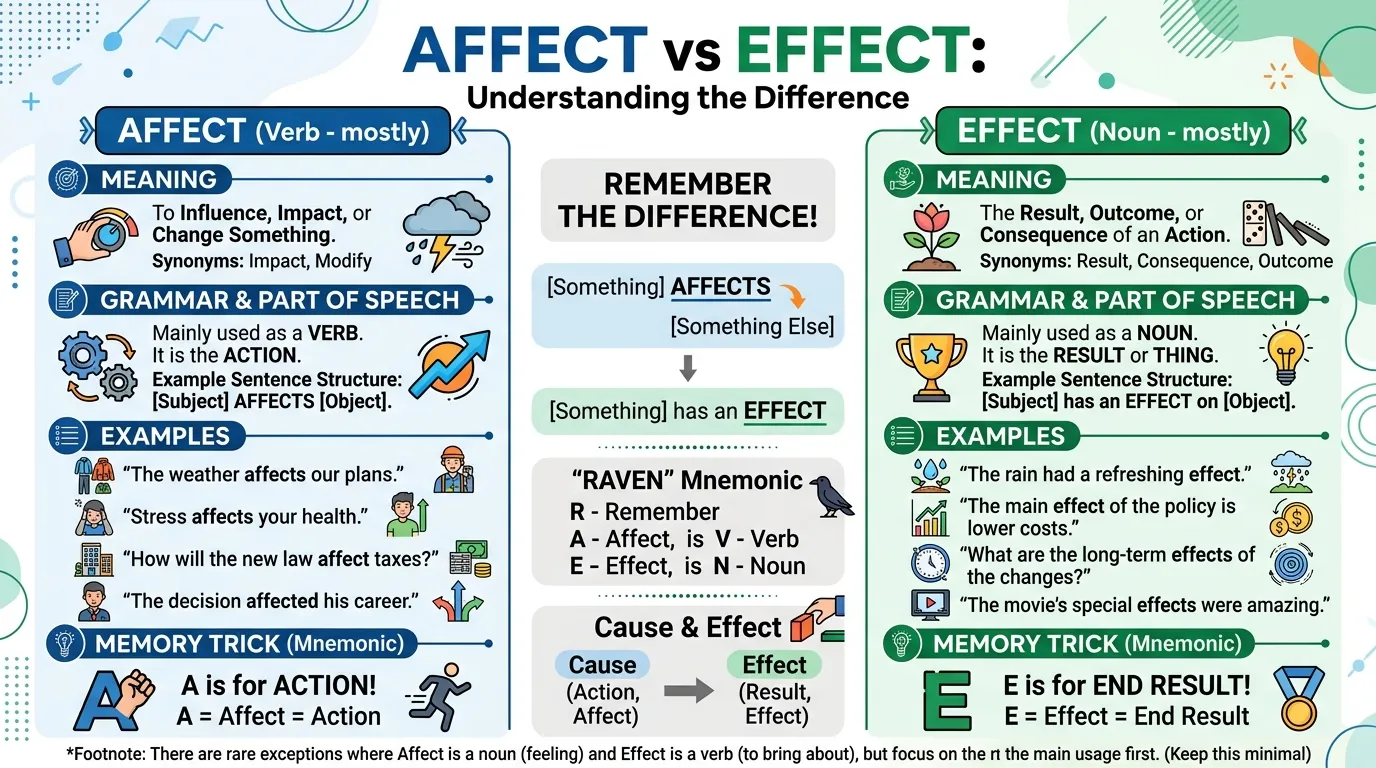
If you often pause over affect vs effect, you are not alone. These two words sound similar, look similar, and are closely related in meaning, so even strong English speakers sometimes mix them up. The good news is that the basic grammar difference is simple: affect is usually a verb, while effect is usually a noun. In everyday English, you can often remember it as: something affects something, and something has an effect.
For example, Lack of sleep can affect your mood, but lack of sleep can have an effect on your mood. Both sentences express a similar idea, but the grammar is different.
The affect vs effect distinction is almost the same in UK vs US English. British and American dictionaries generally follow the same rules, although both varieties allow some less common uses. This guide explains the affect vs effect meaning, pronunciation, origins, common mistakes, real-life examples, and correct usage so you can use each word with confidence.
Quick Answer: Affect vs Effect
- ✅ Affect — usually a verb meaning to influence or change something.
- ❌ Affect — usually not the noun you want when you mean a result.
- ✅ Effect — usually a noun meaning a result or consequence.
- ❌ Effect — usually not the verb you want when you mean influence.
- ⚠️ Affect can be a noun in psychology, but this is a specialized use.
- ⚠️ Effect can be a verb meaning to bring about or cause something, but this is more formal.
The easiest rule
Affect = influence
Effect = result
Think of this pattern:
Something affects you.
Something has an effect on you.
For example:
- The rain affected our plans.
- The rain had an effect on our plans.
Both are correct.
What Does Affect Mean?
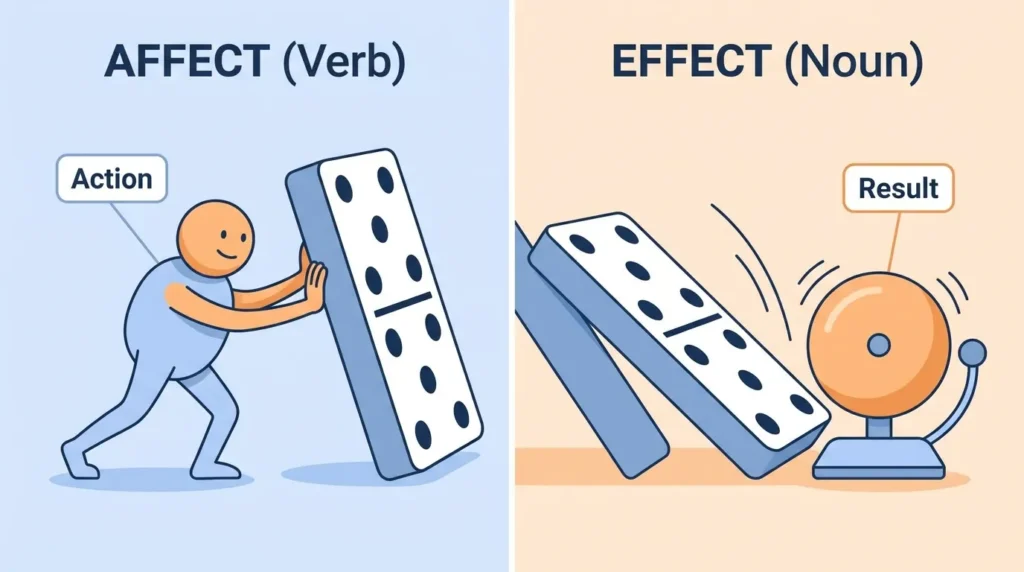
The most common affect meaning is to influence, change, or have an impact on something or someone.
It is normally used as a verb.
Examples
- Loud noise can affect your concentration.
- The new policy will affect all employees.
- Her decision affected the entire team.
- Exercise can affect your energy level.
- The weather affected our travel plans.
In each example, affect describes an action or influence.
Affect in a sentence
A simple example is:
The high rent affected our budget.
Here, affected means influenced or changed the budget.
What Does Effect Mean?
The most common effect meaning is a result, consequence, or change caused by something.
It is normally used as a noun.
Examples
- The medicine had a positive effect.
- The storm caused serious effects on local businesses.
- The new rule had little effect on attendance.
- Exercise can have a strong effect on your health.
- The tax increase had an immediate effect on prices.
Here, effect names the result.
Effect in a sentence
The new schedule had a positive effect on productivity.
The word effect means the result of the new schedule.
Affect vs Effect: The Main Grammar Difference
| Feature | Affect | Effect |
|---|---|---|
| Usual part of speech | Verb | Noun |
| Basic meaning | To influence | A result |
| Example | Stress can affect sleep. | Stress can have an effect on sleep. |
| Common pattern | affect + object | effect + on |
| Past form | affected | effected, when used as a verb |
| Common use | Everyday | Everyday |
| UK vs US English | Same basic rule | Same basic rule |
The biggest difference is grammatical.
Affect usually performs the action. Effect usually names the result.
Consider:
The teacher affected my confidence.
Here, affected is the verb.
Now compare:
The teacher had a strong effect on my confidence.
Here, effect is a noun.
Affect vs Effect Pronunciation
Pronunciation makes these words even easier to confuse.
| Word | Common pronunciation | IPA |
|---|---|---|
| affect, verb | uh-FEKT | /əˈfekt/ |
| effect, noun | ih-FEKT | /ɪˈfekt/ |
| affect, psychology noun | AF-ekt | /ˈæfɛkt/ |
| effect, formal verb | ih-FEKT | /ɪˈfekt/ |
The most common forms of affect and effect both end with the stressed -fect sound.
That is one reason learners confuse them.
There is also a useful pronunciation clue:
- Affect as a verb usually begins with a softer uh- sound.
- Effect as a noun usually begins with an ih- sound.
However, pronunciation alone is not enough. Grammar and meaning are much safer guides.
Why Are Affect and Effect So Commonly Confused?
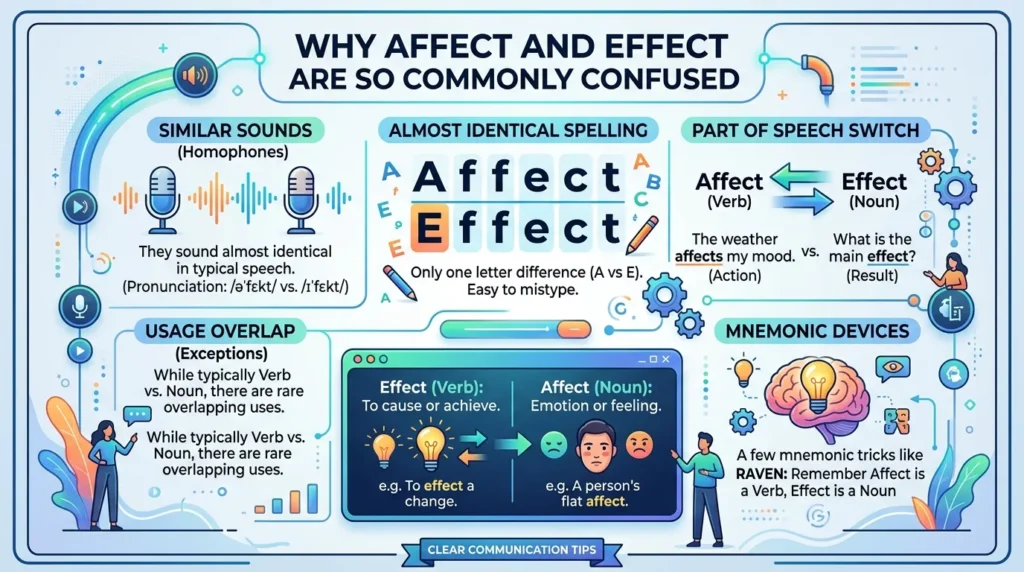
There are several reasons.
First, the words have similar spellings.
Second, they sound very similar.
Third, both words are connected with the idea of change or influence.
Finally, both can have less common grammatical uses.
For everyday writing, though, the simple rule works extremely well:
Affect = influence.
Effect = result.
Affect vs Effect in American English
Here are examples of common American English usage:
- The price increase will affect customers.
- The new law affected small businesses.
- Lack of sleep can affect your memory.
- The cold weather affected sales.
- Her words affected me deeply.
- The medicine had an immediate effect.
- The change had a positive effect.
- The storm had a major effect on travel.
- The training had little effect on performance.
- The new system had a noticeable effect on productivity.
These examples follow the standard rule used in American English.
Affect vs Effect in British English
British English uses the same basic distinction:
- The decision will affect local residents.
- The weather affected our journey.
- The delay affected the meeting.
- Stress can affect your health.
- The news affected her greatly.
- The new policy had little effect.
- The change had a positive effect.
- The medicine produced a strong effect.
- The accident had a lasting effect.
- The announcement had an unexpected effect.
So, in normal everyday use, there is no major UK-US difference in this grammar rule.
UK vs US English: Is There a Difference?
Not really.
Both American English and British English normally use:
- affect as a verb meaning influence
- effect as a noun meaning result
For example:
US: The weather affected our plans.
UK: The weather affected our plans.
US: The weather had an effect on our plans.
UK: The weather had an effect on our plans.
The spelling and grammar remain the same.
Some specialized meanings may appear more often in particular academic or professional contexts, but they do not create a general UK-US difference.
Why Effect Can Sometimes Be a Verb
This is where the grammar becomes more advanced.
Effect can be used as a verb meaning to cause something to happen or bring about a result.
For example:
The new manager hopes to effect major changes.
This means the manager hopes to bring about major changes.
This use is formal and is less common in everyday conversation.
Another example:
The organization effected several important reforms.
This means the organization brought about several reforms.
Do not confuse this with:
The organization affected several reforms.
That sentence would normally sound incorrect if you mean brought about.
Can Affect Be a Noun?
Yes, but this is a specialized use.
In psychology and psychiatry, affect can describe the observable expression of emotion.
For example:
The patient showed a flat affect.
This does not mean the patient was simply affected by something. It refers to the outward display of emotion.
For beginners, you do not need to use this meaning often. In ordinary writing, affect is usually a verb.
Common Mistakes With Affect and Effect
Mistake: Using effect when you mean influence
❌ The noise effected my concentration.
✅ The noise affected my concentration.
Here, you mean influenced, so affected is correct.
Mistake: Using affect when you mean result
❌ The new rule had a strong affect on employees.
✅ The new rule had a strong effect on employees.
You are naming a result, so use effect.
Mistake: Writing affect of
❌ The affect of the storm was severe.
✅ The effect of the storm was severe.
Mistake: Writing effect on when you mean the verb influence
❌ The storm will effect on our plans.
✅ The storm will affect our plans.
Mistake: Confusing effected with affected
❌ The company effected customer satisfaction.
✅ The company affected customer satisfaction.
If the meaning is influenced, choose affected.
Mistake: Assuming effect is always a noun
This is not completely true.
Effect can be a formal verb meaning bring about.
However, in normal beginner and intermediate writing, the noun use is much more common.
Mistake: Assuming affect is always a verb
Again, this is not completely true.
Affect is a specialized noun in psychology.
For general writing, however, remember that affect is usually a verb.
Real-Life Examples of Affect vs Effect
Understanding the words in real situations makes the rule easier to remember.
Emails
Correct: The delay may affect the delivery date.
Correct: The delay may have an effect on the delivery date.
Offices
Correct: The new schedule will affect all employees.
Correct: The new schedule will have a positive effect on productivity.
Banking
Correct: The interest-rate change may affect your monthly payment.
Correct: The rate change could have an effect on your savings.
Invoices
Correct: The missing payment will affect your account balance.
Correct: The late payment may have an effect on your account status.
Schools
Correct: Poor sleep can affect a student’s grades.
Correct: Poor sleep can have a negative effect on academic performance.
Social Media
Correct: Social media can affect how people communicate.
Correct: Social media has had a major effect on communication.
Rent Payments
Correct: A late rent payment may affect your rental history.
Correct: A late payment can have an effect on your financial record.
Everyday Conversation
Correct: That movie really affected me.
Correct: The movie had a powerful effect on me.
Affect vs Effect: Ten More American English Examples
- Too much screen time can affect your sleep.
- The announcement affected everyone at work.
- High gas prices can affect family budgets.
- The medicine may affect your appetite.
- The change had little effect on sales.
- The decision had a lasting effect on the company.
- The rain had no effect on our plans.
- Her kindness had a positive effect on me.
- The repair will affect the total cost.
- The new price had an immediate effect on demand.
Affect vs Effect: Ten More British English Examples
- The delay could affect the train service.
- The weather affected our plans.
- The decision will affect local businesses.
- Noise can affect your ability to sleep.
- The news affected him deeply.
- The change had a noticeable effect.
- The policy had little effect on costs.
- The incident had a serious effect on morale.
- The medicine had a beneficial effect.
- The announcement had an unexpected effect.
Affect vs Effect Synonyms
The best affect vs effect synonyms depend on the grammatical role.
| Word | Possible synonym | Best for |
|---|---|---|
| Affect | influence | General writing |
| Affect | change | Simple explanations |
| Affect | alter | Formal writing |
| Affect | impact | Business and modern writing |
| Effect | result | Everyday English |
| Effect | consequence | Formal writing |
| Effect | outcome | Business, school, and reports |
| Effect | impact | General and professional writing |
Which synonyms are preferred in US and UK English?
Most of these synonyms work in both varieties.
Influence, change, result, and outcome are especially clear for learners.
Impact is common in both American and British English, although some traditional style guides have debated its use as a verb. Modern English widely accepts impact as both a noun and a verb.
The Grammar Rule Behind Correct Usage
Here is the beginner-friendly version:
A verb usually tells us what someone or something does.
A noun names a person, place, thing, idea, or result.
So:
The heat affected the plants.
Affected is the verb. It tells us what the heat did.
Now:
The heat had an effect on the plants.
Effect is the noun. It names the result.
Verb forms of affect
- affect
- affects
- affected
- affecting
Example:
The policy affects workers.
Verb forms of effect
When effect is used as a verb:
- effect
- effects
- effected
- effecting
Example:
The new plan effected major changes.
This is formal and much less common.
Five Easy Memory Tricks
Remember A = Action
Affect starts with A, and a verb describes an action.
Affect = Action
Remember E = End Result
Effect can remind you of the end result.
Effect = End result
Use the Influence Test
Replace the word with influence.
If the sentence still makes sense, use affect.
The heat influenced the plants.
So:
The heat affected the plants.
Use the Result Test
Replace the word with result.
If it works, use effect.
The result of the storm was serious.
So:
The effect of the storm was serious.
Memorize One Sentence
Affect changes things; effect is the change.
It is not perfect for every advanced use, but it is an excellent starting rule.
Affect vs Effect Compared With Related Expressions
Several expressions are closely related.
Have an effect on
This is one of the most common patterns.
Exercise has an effect on your health.
Affect
Use the verb when you want to say something influences something.
Exercise affects your health.
Cause
Cause means make something happen.
The storm caused flooding.
Impact
Impact can mean influence or effect.
The storm impacted local businesses.
In careful writing, however, affect and effect often make the relationship clearer.
Dictionary and Formal Usage
Major English dictionaries recognize the standard meanings of affect and effect.
For everyday writing, the safest choices are:
- affect = influence
- effect = result
The less common uses are real, but they are usually marked by context.
If you are writing a school essay, business email, report, application, or professional document, using the standard meanings will almost always be the clearest choice.
Frequently Asked Questions
What is the difference between affect and effect?
Affect is usually a verb meaning influence. Effect is usually a noun meaning result. For example, stress can affect sleep, while stress can have an effect on sleep.
Is it affect or effect on?
Usually, use effect on when effect is a noun.
The change had an effect on sales.
If you use affect, you normally do not need on.
The change affected sales.
What is an easy affect vs effect example?
The weather affected our plans.
The weather had an effect on our plans.
The first uses the verb affected. The second uses the noun effect.
Is affect or effect used in American English?
Both are used. American English normally uses affect as a verb and effect as a noun, just like British English.
Is affect or effect used in British English?
British English follows the same basic grammar rule. The standard everyday distinction is affect = influence and effect = result.
What is the synonym of affect?
Common synonyms include influence, change, alter, and impact.
What is the synonym of effect?
Common synonyms include result, outcome, consequence, and impact.
How do you pronounce affect and effect?
The common verb affect is /əˈfekt/. The common noun effect is /ɪˈfekt/. They sound very similar, which is one reason learners confuse them.
Can effect be a verb?
Yes. Effect can be a formal verb meaning to bring about or cause something.
The reform effected major changes.
Can affect be a noun?
Yes. In psychology, affect can refer to the visible expression of emotion. This is a specialized meaning.
People Also Ask
Which is correct: affect or effect?
Both are correct words, but they have different jobs. Use affect when you mean influence. Use effect when you mean result.
Does affect mean impact?
Usually, yes. As a verb, affect can mean influence or have an impact on something.
Does effect mean change?
Often, yes. As a noun, effect can describe a change or result caused by something.
Is it a negative affect or negative effect?
Usually, negative effect is correct when you mean a harmful result.
The decision had a negative effect on sales.
Is it affect my life or effect my life?
Affect my life is correct when you mean influence my life.
That experience affected my life.
Is it have an affect or have an effect?
The standard expression is have an effect.
The medicine had an effect on her symptoms.
Is affect vs effect different in the UK?
No major difference exists in normal usage. British and American English use the same basic distinction.
Which word should ESL learners learn first?
Learn the everyday rule first:
Affect = influence.
Effect = result.
Once this feels natural, you can learn the specialized noun affect and formal verb effect.
Final Conclusion
The affect vs effect difference becomes much easier once you focus on grammar instead of spelling. In everyday English, affect is usually a verb meaning to influence or change something. Effect is usually a noun meaning the result of that change. For example, Stress can affect your health, while stress can have an effect on your health.
The same basic correct usage applies in both American and British English. Although advanced writing includes exceptions, beginners do not need to memorize every unusual case at once. Start with the simple rule: Affect = influence; effect = result.
Use the influence test, the result test, or the memory trick Affect = Action and Effect = End result. With regular practice, these two commonly confused words will become much easier to recognize and use correctly in school, work, emails, and everyday conversation.


