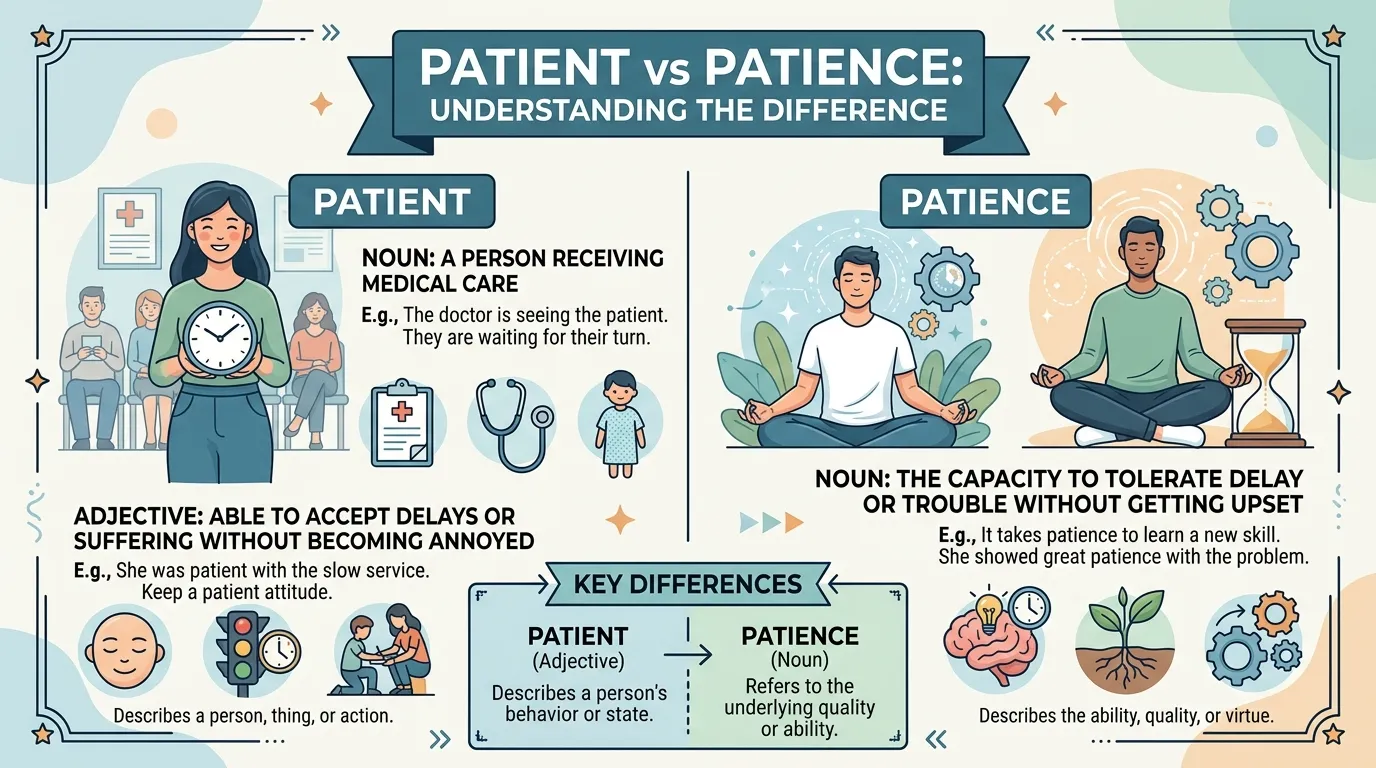
If you often confuse patient vs patience, you are not alone. These two words look and sound almost the same, but they have different meanings and different jobs in a sentence. Patient is usually an adjective that describes someone who can wait calmly. It can also be a noun for a person receiving medical care. Patience is a noun that means the ability to stay calm while waiting, dealing with problems, or handling difficult people.
For example, you can say, She is very patient, but you cannot say, She has a lot of patient. The correct sentence is, She has a lot of patience.
The patient vs patience difference is the same in both American and British English. There is no major UK vs US English spelling difference here. The main challenge is knowing whether you need an adjective, a medical noun, or an abstract noun. Once you understand that grammar difference, choosing the right word becomes much easier.
Quick Answer
Both patient and patience are correct English words. They are not interchangeable.
- ✅ Patient — an adjective meaning calm and able to wait; also a noun meaning a person receiving medical treatment.
- ❌ Patience as an adjective — incorrect.
- ✅ Patience — a noun meaning the ability to wait or deal with difficulty calmly.
- ❌ Patient when you mean the quality of calm waiting — incorrect.
Simple rule
Patient = a person or a quality describing a person
Patience = the quality or ability to wait calmly
Compare:
- She is patient.
- She has patience.
- The doctor examined the patient.
- His patience impressed everyone.
So, the correct choice depends on what you want to say.
Patient Meaning and Grammar
Patient has two main meanings.
First, it is an adjective. It describes someone who can wait without becoming angry, upset, or annoyed.
Examples:
- My teacher is very patient.
- Please be patient while we process your request.
- He is patient with young children.
- You need to be patient when learning a new language.
- She remained patient during the long meeting.
Second, patient is a noun. In medical English, a patient is someone who receives care from a doctor, nurse, dentist, therapist, or other healthcare professional.
Examples:
- The patient is waiting for the doctor.
- The nurse called the next patient.
- The doctor spoke with the patient.
- Each patient received a follow-up appointment.
- The hospital admitted a new patient.
Is patient a verb?
No. Patient is not normally used as a verb in modern standard English.
The related verb is wait.
- ❌ I patient for the bus.
- ✅ I wait for the bus.
The related adjective is patient, while the related noun is patience.
Patience Meaning and Grammar
Patience is a noun. It refers to the ability to remain calm when something takes a long time or when a situation is difficult.
It can describe emotional self-control, tolerance, or the ability to wait.
Examples:
- You need patience to learn a new skill.
- Her patience helped the children feel comfortable.
- I am running out of patience.
- Thank you for your patience.
- Teaching young students requires patience.
Because patience is a noun, it often appears after words such as have, show, need, require, lose, test, and thank.
Common patterns include:
- have patience
- show patience
- need patience
- require patience
- lose patience
- test someone’s patience
- thank you for your patience
Patient vs Patience Comparison
| Feature | Patient | Patience |
|---|---|---|
| Part of speech | Adjective or noun | Noun |
| Main meaning | Calm and willing to wait; medical-care recipient | Ability to wait calmly |
| Describes | A person or medical-care recipient | A quality or ability |
| Example | She is patient. | She has patience. |
| Medical meaning | Yes, as a noun | No |
| Can follow very? | Yes: very patient | No: very patience |
| Common phrase | Be patient | Have patience |
| UK usage | Standard | Standard |
| US usage | Standard | Standard |
| Pronunciation | PAY-shənt | PAY-shəns |
Patient vs Patience Pronunciation
The pronunciation is one reason these words cause confusion.
Patient
IPA: /ˈpeɪʃənt/
It sounds roughly like PAY-shunt.
Examples:
- patient teacher
- patient person
- hospital patient
Patience
IPA: /ˈpeɪʃəns/
It sounds roughly like PAY-shuns.
The endings are different:
- patient → -shənt
- patience → -shəns
Listen for the final sound. Patient ends with a sound similar to shunt, while patience ends with a sound similar to shuns.
Why Are Patient and Patience Commonly Confused?
There are several reasons.
First, they begin with the same letters: p-a-t-i-e-n.
Second, their pronunciation is very similar.
Third, they are related in meaning. Someone who has patience is usually patient.
The grammar difference is the most useful clue.
Ask yourself:
Am I describing someone?
Use patient.
Am I naming the quality of staying calm?
Use patience.
Compare:
- Maria is patient.
- Maria has patience.
Patient vs Patience Examples in American English
Here are natural American English examples:
- Please be patient while the website loads.
- My mother is very patient with children.
- The doctor called the next patient.
- You must be patient when learning to drive.
- He was patient during the long interview.
- Good customer service requires patience.
- Thank you for your patience.
- I have very little patience for rude behavior.
- Her patience helped solve the problem.
- The delay tested everyone’s patience.
These examples show that patient describes a person or identifies someone receiving medical care, while patience names a quality.
Patient vs Patience Examples in British English
The same basic grammar applies in British English:
- Please be patient while we check your account.
- She is a very patient teacher.
- The patient was taken to the hospital.
- You need to be patient with new learners.
- He remained patient throughout the discussion.
- Thank you for your patience.
- Her patience was remarkable.
- The situation tested his patience.
- Teaching requires considerable patience.
- I have lost my patience with the delays.
There is no important UK vs US English distinction in the basic use of these words. British and American speakers use patient and patience in essentially the same way.
Why Patient Is Wrong in Some Sentences
It is important to say that patient is not an incorrect word. The problem occurs when it is used where patience is required.
For example:
- ❌ Thank you for your patient.
- ✅ Thank you for your patience.
Here, you are thanking someone for a quality, so you need the noun patience.
Another example:
- ❌ Her patient was impressive.
- ✅ Her patience was impressive.
However, patient is correct in a medical context:
- ✅ The doctor examined the patient.
More incorrect and corrected examples
| Incorrect | Correct |
|---|---|
| Thank you for your patient. | Thank you for your patience. |
| I need more patient. | I need more patience. |
| His patient is running out. | His patience is running out. |
| She has a patient with children. | She is patient with children. |
| Please have patient. | Please have patience. |
The fourth example shows another important point: sometimes you need to change the entire grammar structure, not simply replace one word.
Common Mistakes With Patient and Patience
Mistake: Thank you for your patient
This is very common in emails and customer service.
❌ Thank you for your patient.
✅ Thank you for your patience.
Patience is the quality you are thanking someone for.
Mistake: Please be patience
Here, you need an adjective after be.
❌ Please be patience.
✅ Please be patient.
The verb be is followed by the adjective patient.
Mistake: She has patient
After has, you usually need the noun patience when discussing the quality.
❌ She has patient with children.
✅ She has patience with children.
Even more naturally:
✅ She is patient with children.
Mistake: I am running out of patient
The expression is run out of patience.
❌ I am running out of patient.
✅ I am running out of patience.
Mistake: His patience is very patient
These words cannot be used this way.
❌ His patience is very patient.
✅ He is very patient.
Or:
✅ He has a lot of patience.
Mistake: The patient of the teacher
If you mean calm behavior, use patience.
❌ The patient of the teacher helped the students.
✅ The teacher’s patience helped the students.
Mistake: I need to patient
Use wait as the verb.
❌ I need to patient.
✅ I need to wait.
Or:
✅ I need to be patient.
Patient vs Patience in Real-Life Situations
Emails
Formal emails often use patience:
Thank you for your patience while we resolve this issue.
But you might tell someone:
Please be patient while we review your request.
Offices
- Please be patient; the manager will be here shortly.
- Your patience during this busy period is appreciated.
Banking
- Please be patient while we verify your identity.
- Thank you for your patience while we process the transfer.
Invoices
- Thank you for your patience regarding the delayed invoice.
- Please be patient while our accounting team reviews the payment.
Schools
- Teachers need patience.
- A good teacher is patient with students.
Social Media
Someone might write:
Be patient. The update is coming soon!
Or:
Thanks for your patience, everyone!
Rent Payments
A landlord might say:
Thank you for your patience while we correct the payment record.
A tenant might say:
Please be patient while my bank processes the transfer.
Everyday Conversations
- Be patient. Dinner will be ready soon.
- I don’t have much patience today.
- She’s very patient with her brother.
- My patience is being tested.
Patient vs Patience Synonyms
The best synonym depends on the word’s grammatical role.
| Word | Possible synonym | Best use |
|---|---|---|
| Patient | Calm | Describing a calm person |
| Patient | Tolerant | Describing someone who accepts difficulty |
| Patient | Understanding | Describing someone who gives others time |
| Patient | Composed | More formal |
| Patience | Tolerance | Ability to tolerate something |
| Patience | Endurance | Ability to continue through difficulty |
| Patience | Self-control | Emotional control |
| Patience | Forbearance | Formal or literary use |
In both American and British English, calm, tolerant, and understanding are common alternatives to patient.
For patience, tolerance and self-control are often useful alternatives. Forbearance is more formal and less common in everyday conversation.
Word Origins and Etymology
The two words are closely related.
Patient comes through Old French from Latin patiens, meaning suffering, enduring, or bearing. It is related to the Latin verb pati, meaning to suffer or endure.
This history explains both modern meanings.
A patient in a hospital is someone who undergoes or endures medical treatment. A patient person is someone who can endure delay or difficulty calmly.
Patience developed from the same linguistic family. It came into English through French and ultimately traces back to Latin roots associated with enduring or suffering.
So, the two words are not unrelated spellings. They share a historical connection.
Five Easy Memory Tricks
Think: Patient = Person
A patient can be a person in a hospital.
Patient = person.
Think: Patience = Quality
If you can have it, you probably need patience.
- have patience
- lose patience
- show patience
Watch the ending
Patient ends like -shunt.
Patience ends like -shuns.
Use the adjective test
If you can put very before the word, use patient:
- very patient ✅
- very patience ❌
Remember the sentence pair
I am patient.
I have patience.
This simple pair covers a large part of the grammar difference.
Patient vs Patience in a Sentence
Here are two sentences that make the distinction clear:
The patient teacher has great patience.
In this sentence, patient describes the teacher, while patience names the quality the teacher possesses.
Another example:
The patient thanked the nurse for her patience.
The first patient is a person receiving medical care. The second patience means calm tolerance.
Patient vs Patience: Related Words and Expressions
Several expressions are closely connected to these words.
Be patient
Use this when telling someone to wait calmly.
Be patient. Your turn will come soon.
Have patience
Use this when referring to the quality itself.
You need to have patience when teaching beginners.
Lose patience
This means to stop being calm.
I finally lost patience with the repeated delays.
Test someone’s patience
This means to make someone feel less calm.
The constant interruptions tested her patience.
Run out of patience
This means to have no patience left.
We are running out of patience with the delays.
Patiently
Patiently is the adverb form.
She waited patiently.
Impatient
Impatient is the opposite of patient.
He became impatient after waiting for an hour.
Grammar Rule in Simple English
The easiest grammar rule is:
Patient = adjective
It describes someone.
He is patient.
Patient = noun
It can mean a person receiving medical care.
The patient is resting.
Patience = noun
It names the ability to wait or remain calm.
Her patience is admirable.
The related forms are:
- patient — adjective/noun
- patiently — adverb
- patience — noun
- impatient — adjective
- impatience — noun
Notice that patience does not normally describe a person directly.
You say:
She is patient.
Not:
She is patience.
FAQs About Patient vs Patience
Is it patient or patience?
Both are correct words, but they have different uses. Patient is an adjective meaning calm and willing to wait, and it can also be a medical noun. Patience is a noun meaning the ability to remain calm while waiting or dealing with difficulty.
What is the difference between patient and patience?
The main difference is grammar. Patient describes someone or refers to a person receiving medical care. Patience names the quality of being able to wait calmly.
Is patient a noun or adjective?
It can be both. As an adjective, it means calm and tolerant. As a noun, it means someone receiving medical treatment.
What is the synonym of patience?
Common synonyms include tolerance, endurance, self-control, calmness, and forbearance. The best choice depends on the sentence.
How do you pronounce patient and patience?
Patient is /ˈpeɪʃənt/, while patience is /ˈpeɪʃəns/. Their similar pronunciation makes them easy to confuse.
Is patient the same in UK and US English?
Yes. There is no major difference in standard UK vs US English usage. Both varieties use patient and patience in the same basic ways.
Which word is formal: patient or patience?
Neither is automatically more formal. Both are standard English words. Patience appears frequently in polite and formal expressions such as Thank you for your patience.
Can patient be used as a verb?
No, not in normal modern English. Use wait as the verb or be patient as the expression.
Is Thank you for your patient correct?
No. The standard expression is Thank you for your patience.
People Also Ask
Should I say be patient or be patience?
Say be patient. After the linking verb be, you need the adjective patient.
Do you have patience or patient?
You have patience. The word after have is the noun patience.
Is it patience is a virtue?
Yes. Patience is a virtue is a common English saying. It means that staying calm and waiting without anger is a valuable quality.
Is a patient a person?
In medical English, yes. A patient is someone receiving medical care.
What is the opposite of patient?
The usual opposite is impatient. The noun opposite of patience is impatience.
Is patient a personality trait?
Yes. When patient is an adjective, it can describe a personality trait. Someone who is patient can wait calmly and handle difficult situations without becoming easily annoyed.
Can I say I need patient?
Usually no, if you mean the ability to wait calmly. Say I need patience or I need to be patient.
Is patience countable?
Patience is normally an uncountable noun when it means the quality of being patient.
For example:
She has a lot of patience.
You generally do not say two patiences in ordinary English.
Final Conclusion
The difference between patient vs patience is simple once you focus on grammar. Patient is usually an adjective that describes someone who can wait calmly. It is also a noun for someone receiving medical care. Patience is a noun that names the ability to remain calm during waiting, stress, or difficulty.
Remember these two basic patterns: I am patient and I have patience. They will help you choose the correct word in most situations.
There is no major difference between American and British English in this area. Both varieties use the words in the same way. When writing an email, handling a banking issue, speaking at school, discussing rent, or chatting online, check whether you are describing a person or naming a quality. If you are describing someone, choose patient. If you mean the quality, choose patience. Once this grammar difference becomes familiar, this common mistake becomes much easier to avoid.


