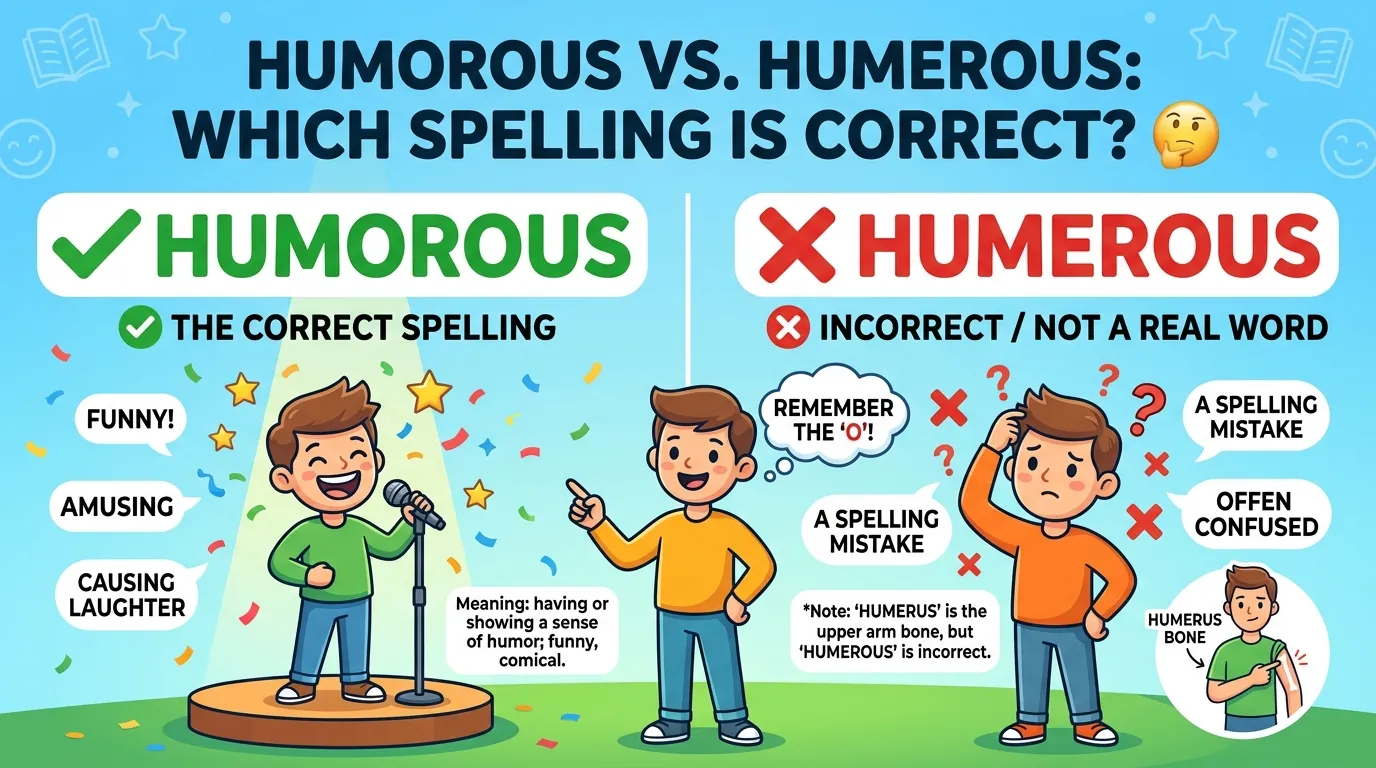
Have you ever typed “humerous” when you meant something was funny? You are not alone. The spelling humorous vs humerous confuses many English learners, students, and even native speakers because the two forms look and sound very similar. However, when you want to say that something is funny, amusing, or entertaining, the correct spelling is humorous. Humerous is normally treated as a misspelling of humorous.
There is also an interesting reason for the confusion: humerus is a real English word. It refers to the upper-arm bone. Because humerus, humerous, and humorous look alike, they are easy to mix up.
In US English, the spelling is humorous, while British English also uses humorous. The main UK vs US difference is found in the related noun: Americans usually write humor, while British writers normally write humour. The adjective remains humorous in both varieties.
Quick Answer: Humorous vs Humerous
- ✅ Humorous = correct spelling when you mean funny or amusing.
- ❌ Humerous = usually an incorrect spelling of humorous.
- ✅ Humerus = the bone in the upper arm.
- 🇺🇸 US English: humor → humorous
- 🇬🇧 UK English: humour → humorous
So, if you are looking for the humorous vs humerous meaning, remember this simple rule:
Funny = humorous. Bone = humerus.
What Does “Humorous” Mean?
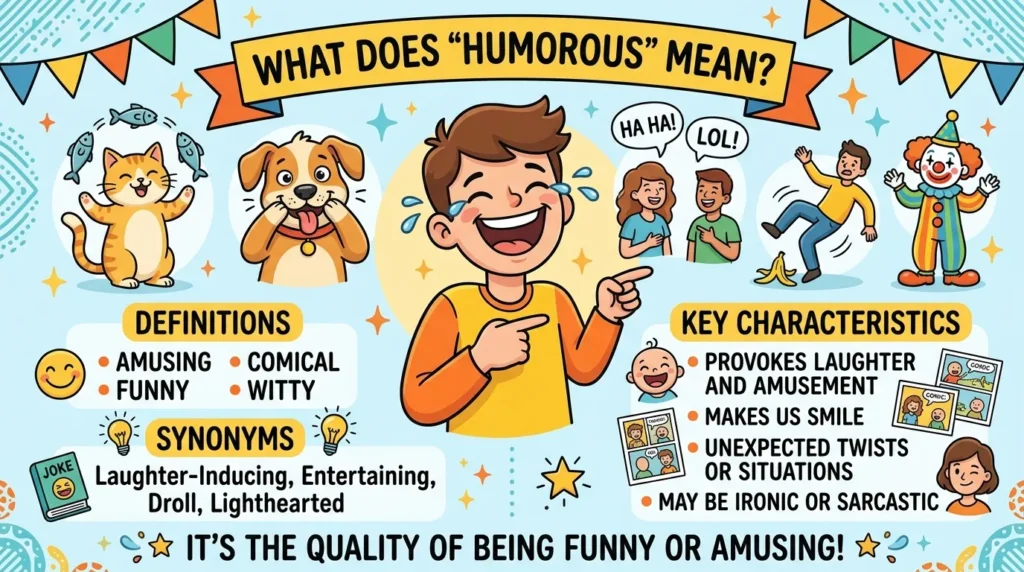
Humorous is an adjective. It describes a person, story, comment, situation, book, movie, image, or other thing that is funny or designed to make people laugh.
Merriam-Webster defines humorous as something characterized by humor or possessing an ability to be funny. Cambridge likewise defines it as “funny, or making you laugh.”
Humorous meaning in simple English
Humorous = funny, amusing, playful, or entertaining.
For example:
- She wrote a humorous story.
- His humorous comment made everyone smile.
- The teacher gave a humorous example.
- It was a serious meeting, but his humorous remark relaxed everyone.
Because humorous is an adjective, it usually describes a noun.
Pattern:
humorous + noun
- humorous story
- humorous speech
- humorous email
- humorous advertisement
- humorous character
You can also use it after linking verbs:
- The story was humorous.
- His presentation was humorous.
- Her response sounded humorous.
Humorous: Grammar and Part of Speech
The word humorous is an adjective.
Its common forms include:
| Word | Part of speech | Example |
|---|---|---|
| humor / humour | Noun | I enjoy his humor. |
| humorous | Adjective | He is a humorous writer. |
| humorously | Adverb | She spoke humorously. |
| humorousness | Noun | The humorousness of the article was obvious. |
There is no normal verb form “humorous.” Instead, the verb is humor in American English and humour in British English.
- US: Please humor me.
- UK: Please humour me.
The spelling humorous does not change between US and UK English.
Humorous Examples in American English

Here are five clear examples:
- The comedian gave a humorous speech at the event.
- My manager sent a humorous email after the long meeting.
- The movie has several humorous scenes.
- She wrote a humorous post about working from home.
- His humorous personality makes him easy to work with.
More American English examples
- The teacher used a humorous story to explain the lesson.
- I received a humorous message from my brother.
- The advertisement takes a humorous approach to banking.
- His presentation was informative but also humorous.
- We laughed at her humorous description of the situation.
Humorous Examples in British English
The adjective is spelled the same way in British English:
- She wrote a humorous account of her school days.
- The programme included several humorous moments.
- He made a humorous comment during the meeting.
- It was a surprisingly humorous book.
- The teacher used a humorous example in class.
More examples:
- His humorous speech entertained the audience.
- The article has a light and humorous tone.
- She is known for her humorous writing style.
- The advert used a humorous character.
- His humorous reply made everyone laugh.
Notice that British writers may write humour in related expressions, but they still write humorous.
Why Is “Humerous” Wrong?
If you mean funny or amusing, humerous is not the standard spelling. It is generally treated as a misspelling of humorous.
The problem often happens because English has another word:
humerus = the upper-arm bone.
This creates a tempting but incorrect spelling:
❌ The movie was humerous.
Correct:
✅ The movie was humorous.
Incorrect and corrected examples
| Incorrect | Correct |
|---|---|
| The teacher was humerous. | The teacher was humorous. |
| She wrote a humerous story. | She wrote a humorous story. |
| His comment was very humerous. | His comment was very humorous. |
| It was a humerous advertisement. | It was a humorous advertisement. |
| He posted a humerous video. | He posted a humorous video. |
Humorous vs Humerous vs Humerus
This is where many learners get caught.
| Word | Meaning | Grammar | US/UK usage | Example |
|---|---|---|---|---|
| humorous | funny or amusing | adjective | Both | It was a humorous story. |
| humerous | usually a misspelling | — | Not standard | ❌ The joke was humerous. |
| humerus | upper-arm bone | noun | Both | He fractured his humerus. |
| humor | amusement or comic quality | noun | Mainly US | I like his humor. |
| humour | amusement or comic quality | noun | Mainly UK | I like his humour. |
| humorously | in a funny way | adverb | US spelling | She spoke humorously. |
The key grammar difference is simple: humorous describes something, while humerus names a body part.
Pronunciation: Humorous vs Humerous
Humorous is commonly pronounced approximately:
- US: /ˈhjuː.mər.əs/
- UK: /ˈhjuː.mə.rəs/
Cambridge gives /ˈhjuː.mə.rəs/ for UK pronunciation and /ˈhjuː.mə.rəs/ for US pronunciation.
A simple learner-friendly pronunciation is:
HUM-uh-rus
The spelling humerous is often confused with humorous because people hear the same or nearly the same sounds and then spell the word according to how it seems to sound.
That is a common English problem: pronunciation does not always tell you the spelling.
Why Do People Confuse These Words?
There are several reasons.
1. They look almost identical
Compare:
- humorous
- humerous
- humerus
Only a few letters separate them.
2. The sounds are very similar
In normal speech, the difference may not be obvious to a learner.
3. “Humerus” is a real word
The word humerus refers to the upper-arm bone. That makes the spelling feel believable.
4. English spelling is not fully phonetic
English has many words whose spelling cannot be predicted perfectly from pronunciation.
5. The word “humor” creates another spelling pattern
American English uses humor, while British English uses humour. This may make learners wonder whether the adjective should also change.
It does not.
Correct:
- US: humor → humorous
- UK: humour → humorous
UK vs US English: What Changes?
The adjective humorous is standard in both American and British English.
The difference appears mainly in the noun:
| American English | British English |
|---|---|
| humor | humour |
| humorous | humorous |
| humorously | humorously |
| humorless | humourless |
So it would be wrong to assume that British English uses humourous simply because it uses humour. The standard adjective is humorous.
Cambridge lists humor as the US spelling of British humour, while its entry for humorous uses the same adjective spelling for both varieties.
Word Origins and Etymology
The history of humorous is surprisingly interesting.
The word comes from humor, which has roots in Latin humor or umor, meaning moisture or bodily fluid. In medieval and ancient medicine, people believed that four bodily fluids, known as the four humors, affected a person’s health and temperament.
Over time, humor developed meanings connected with a person’s mood, temperament, and disposition. Later, it became associated with the ability to recognize or create things that are amusing.
The modern meaning of humorous = funny developed in English much later. Etymonline dates this sense to around 1705, while Merriam-Webster records humorous as a word used from the 15th century, with older meanings that differed from today’s main sense.
The history of humerus is completely different. It comes from Latin humerus, meaning shoulder, and eventually became the anatomical name for the upper-arm bone.
So although the words look related, humorous and humerus have different histories.
Humorous Synonyms
Looking for a humorous synonym? The best choice depends on the situation.
| Synonym | Meaning / tone | Best use |
|---|---|---|
| funny | generally amusing | Everyday US and UK English |
| amusing | pleasantly funny | Polite and neutral writing |
| comical | noticeably funny | Situations, behavior, stories |
| comic | related to comedy | Formal or literary contexts |
| witty | clever and funny | Remarks, people, writing |
| playful | light and fun | Tone, language, behavior |
| hilarious | extremely funny | Informal, strong reaction |
| entertaining | enjoyable, not always funny | Formal and general writing |
Merriam-Webster lists funny, comedic, amusing, comical, and entertaining among common synonyms of humorous.
For everyday American English, funny is often the easiest choice. In formal writing, humorous or amusing may sound more polished.
Seven Common Mistakes and Their Corrections
Mistake 1: Writing “humerous” for funny
❌ The article is humerous.
✅ The article is humorous.
Mistake 2: Writing “humourous”
British English uses humour, but the adjective is still:
✅ humorous
Not:
❌ humourous
Mistake 3: Confusing “humerus” and “humorous”
❌ The doctor examined his humorous.
✅ The doctor examined his humerus.
Mistake 4: Assuming British English changes the adjective
❌ British: humourous
✅ British: humorous
Mistake 5: Using “humorous” as a noun
❌ I enjoyed the humorous.
✅ I enjoyed the humor.
✅ I enjoyed the humour.
Mistake 6: Using “humorous” when you mean “extremely funny”
Humorous means funny, but it does not necessarily mean very funny.
For stronger meaning, use:
- hilarious
- extremely funny
- very amusing
Mistake 7: Forgetting the adjective role
❌ She humorous wrote the email.
✅ She wrote a humorous email.
✅ She responded humorously.
Real-Life Examples of Correct Usage
Emails
Thanks for the humorous email. It made my morning.
Office conversations
Our manager gave a humorous example during the meeting.
Banking
The bank’s social-media team posted a humorous explanation of the new service.
Invoices
The invoice itself was formal, but the accompanying note was humorous.
Schools
The teacher used a humorous story to help students understand the grammar rule.
Social media
She shared a humorous video about working from home.
Rent payments
My roommate sent a humorous message reminding me about the rent.
Everyday conversation
“That was a humorous way to explain it,” Jake said.
These examples show an important point: humorous works well in both casual and professional settings when you want to describe something as funny or amusing.
“Humorous” in a Sentence: A Simple Formula
If you are unsure how to use the word, use this formula:
Subject + be + humorous
- The story is humorous.
- His presentation was humorous.
- The advertisement was humorous.
Or:
humorous + noun
- a humorous story
- a humorous comment
- a humorous article
- a humorous character
- a humorous conversation
This makes the correct usage easy to remember.
Five Memory Tricks for “Humorous”
1. Funny needs “O”
Think:
humOR → humORous
The adjective grows from humor.
2. “Humerus” belongs in the hospital
If you are talking about a bone, think humerus.
If you are talking about laughter, think humorous.
3. “-ous” often makes adjectives
Words such as:
- famous
- nervous
- curious
- dangerous
- humorous
So humorous looks like the adjective it is.
4. Remember the pair
🇺🇸 humor → humorous
🇬🇧 humour → humorous
Both lead to humorous.
5. Use the “funny or bone?” test
Ask yourself:
Am I describing something funny?
→ humorous
Am I naming the upper-arm bone?
→ humerus
Humorous vs Related Words
Do not confuse humorous with these expressions:
- funny — amusing, but can also mean strange or unusual.
- witty — clever and amusing, often through language.
- comic — connected with comedy or causing laughter.
- amusing — entertaining or mildly funny.
- hilarious — extremely funny.
- humorless / humourless — lacking a sense of humor.
For example, a person can be witty without being especially humorous in every situation. Likewise, something can be entertaining without being funny.
Frequently Asked Questions
Is “humerous” correct?
No, not when you mean funny or amusing. The standard spelling is humorous. Humerous is generally treated as a misspelling.
What is the meaning of humorous?
Humorous means funny, amusing, or likely to make people laugh. It is an adjective.
Is it “humorous” or “humerous”?
It is humorous when you mean funny.
Example: She told a humorous story.
Is “humorous” British or American?
It is used in both British and American English. The related noun differs: humor is American, while humour is British.
How do you pronounce humorous?
A common pronunciation is approximately HUM-uh-rus, with IPA around /ˈhjuː.mər.əs/ in American English and /ˈhjuː.mə.rəs/ in British English.
What is a synonym for humorous?
Common synonyms include funny, amusing, comical, comic, witty, playful, and entertaining. The best synonym depends on the exact context.
Is humorous formal or informal?
Humorous works in both formal and informal English. It is often more polished than funny in professional or academic writing.
Is “humourous” correct in British English?
No. British English spells the noun humour, but the standard adjective is humorous, not humourous.
Is “humerus” the same as “humorous”?
No. Humerus is the name of the upper-arm bone. Humorous means funny or amusing.
People Also Ask
Is it humorous or humerous?
Humorous is correct when you mean funny or amusing.
Why do people spell humorous as humerous?
The error probably comes from the very similar spelling and pronunciation of humorous and humerus. English spelling also does not always match pronunciation perfectly.
What is the difference between humorous and funny?
Both can mean amusing. Funny is more common in everyday speech, while humorous can sound slightly more formal or descriptive.
What is the difference between humorous and witty?
Humorous is a broad word for something funny. Witty usually suggests clever, quick, or sharp humor.
Does British English spell humorous differently?
No. British English uses humorous. The noun is usually humour, rather than American humor.
Which dictionary spelling should I use?
For standard English writing, use humorous when describing something funny. Major dictionaries such as Merriam-Webster and Cambridge list humorous as the standard adjective.
Can I use humorous in a business email?
Yes. For example:
Thank you for the humorous explanation.
However, make sure the tone fits the situation. A serious complaint, legal notice, or sensitive business message may call for more neutral wording.
Final Takeaway
The humorous vs humerous question has a simple answer: when you mean funny, amusing, or entertaining, use humorous. The spelling humerous is generally considered a misspelling, not a standard alternative.
Also remember the related word humerus, which is the upper-arm bone. This three-way similarity explains why the spelling can be confusing.
The UK vs US English difference is easy once you know the rule. Americans usually write humor, while British writers use humour, but both use humorous for the adjective.
So when you need the word in an email, essay, school assignment, office message, social-media post, or everyday conversation, choose humorous. If you remember just one thing, remember this:
Funny = humorous. Bone = humerus.
That simple distinction will help you avoid one of the most common spelling mistakes in English.


