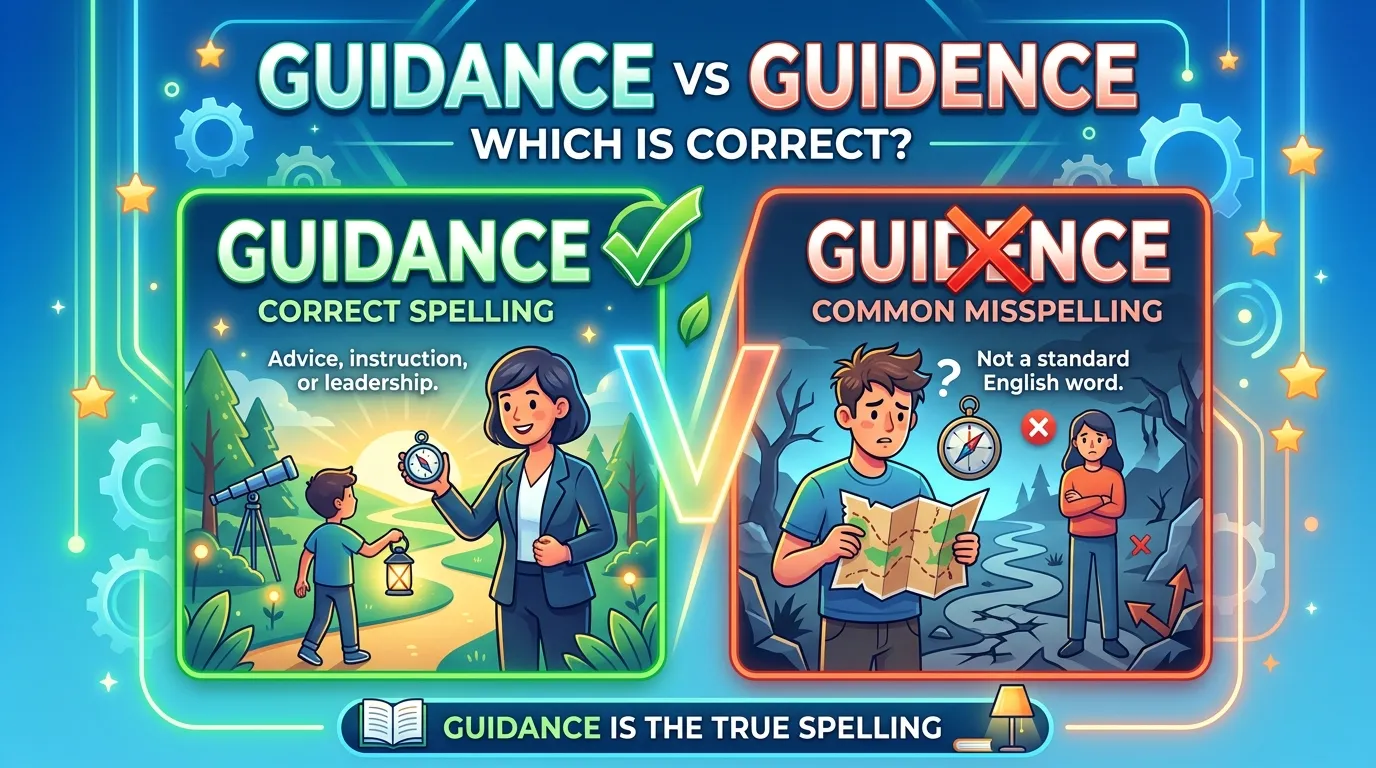
If you are unsure about guidance vs guidence, the answer is simple: guidance is the correct spelling. Guidence is a common spelling mistake and is not accepted as the standard English form. The word guidance means advice, direction, help, or support that helps someone make a decision or take the right action.
People often confuse guidance and guidence because the word comes from guide, and English spelling does not always follow the way words sound. When we say guidance aloud, the middle vowel can be easy to miss, especially for ESL learners and students writing quickly.
The good news is that the spelling is the same in American and British English. Both use guidance, not guidence. Whether you are writing an email at work, a school assignment, a bank request, or an everyday message, guidance is the correct choice.
This guide explains the guidance vs guidence grammar difference, meaning, pronunciation, history, examples, common mistakes, synonyms, and simple memory tricks so you can use the word with confidence.
Quick Answer
- ✅ Guidance = correct spelling
- ❌ Guidence = incorrect spelling
- ✅ Guidance is used in both US and UK English
- ✅ Guidance is a noun
- ❌ Guidence is not the standard English spelling
Example:
I need some guidance before I make a decision.
Guidance Meaning
Guidance is a noun. It means advice, direction, instruction, or help given to someone.
It is often used when a person needs help deciding what to do or understanding how to do something.
For example:
The teacher gave me guidance on my project.
Here, guidance means helpful advice or direction.
The word can describe personal advice, professional support, educational help, financial information, or official instructions.
Common meanings include:
- Advice about what to do
- Help with making a decision
- Direction toward a goal
- Instruction about a process
- Support from someone with more knowledge or experience
Guidance in a Sentence
Please give me some guidance on how to complete this form.
The counselor offered guidance to the students.
We need legal guidance before signing the agreement.
Guidance: Grammar and Part of Speech
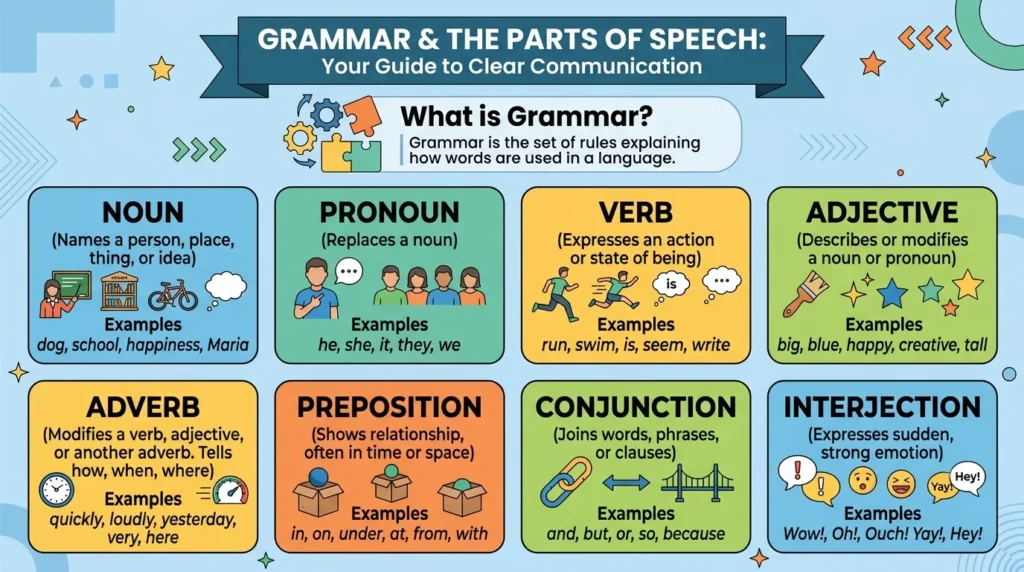
The word guidance is a noun.
It usually refers to advice or help rather than one specific instruction.
For example:
I need your guidance.
You can also use it with common noun phrases:
- some guidance
- helpful guidance
- professional guidance
- expert guidance
- financial guidance
- career guidance
- practical guidance
- clear guidance
- further guidance
The related verb is guide.
| Word | Part of speech | Example |
|---|---|---|
| guide | Verb | She will guide us. |
| guide | Noun | He is our guide. |
| guidance | Noun | She gave us useful guidance. |
| guided | Past tense/adjective | He guided the team. |
| guiding | Present participle/adjective | She has a guiding role. |
Notice that guidance does not normally work as a verb.
❌ Please guidance me.
✅ Please guide me.
Guidance vs Guidence: The Grammar Difference
The main difference is not really a grammar difference. It is a spelling difference between a correct word and a misspelling.
Guidance is an established English noun.
Guidence is not the standard form.
The spelling guidance is connected to the verb guide. The ending -ance appears in many English nouns.
Compare:
- guide → guidance
- assist → assistance
- attend → attendance
- perform → performance
- appear → appearance
This pattern can help explain why guidance ends in -ance, not -ence.
Guidance vs Guidence Comparison Table
| Feature | Guidance | Guidence |
|---|---|---|
| Correct spelling | ✅ Yes | ❌ No |
| Part of speech | Noun | Not a standard English word |
| Meaning | Advice, help, or direction | No standard meaning |
| Grammar | Standard noun | Incorrect spelling |
| US English | Used | Not accepted |
| UK English | Used | Not accepted |
| Formal writing | Appropriate | Incorrect |
| Example | We need guidance. | We need guidence. ❌ |
| Dictionary status | Standard word | Misspelling |
Guidance Pronunciation
The standard pronunciation of guidance is:
IPA: /ˈɡaɪ.dəns/
It sounds roughly like:
GUY-duns
The first part sounds like guide, while the ending sounds like -duns.
What About Guidence?
Guidence has no standard dictionary pronunciation because it is not a standard English word.
Someone who reads the misspelling aloud might pronounce it similarly to guidance, which can make the spelling problem harder to notice.
That is one reason people often type guidence without realizing that it is wrong.
Why Do People Confuse Guidance and Guidence?
There are several reasons.
First, English spelling and pronunciation do not always match perfectly. The sound in guidance does not clearly tell you whether the ending should be -ance or -ence.
Second, English contains many words ending in -ence, such as:
- difference
- confidence
- experience
- patience
- evidence
Because -ence is common, writers may incorrectly apply that pattern to guidance.
Third, the word is related to guide, but the spelling changes when the noun is formed. This can cause uncertainty for students.
The key point is simple:
Guide + -ance = guidance
Not:
Guide + -ence = guidence
Word Origin and Etymology of Guidance
The history of guidance is connected to the older word guide.
Guide entered English through French and is ultimately connected with older Germanic and Romance language forms associated with leading or directing someone. English later developed guidance from the idea of guiding someone.
The suffix -ance is used in English to create nouns connected with an action, state, or result.
Over time, guidance developed the meaning of providing direction, advice, or help.
So the basic idea remains closely connected to its history:
guide → the act or process of guiding → guidance
This history also helps explain the spelling.
Guidance Examples in American English
Here are five natural examples of guidance in American English:
- The counselor gave me guidance about choosing a college.
- Please contact your manager if you need further guidance.
- The bank provides financial guidance to new customers.
- I asked my teacher for guidance on the assignment.
- The company offers career guidance to employees.
More American English Examples
- We need some guidance before making this purchase.
- Her advice gave me the guidance I needed.
- The website provides clear guidance for new users.
- My parents gave me valuable guidance growing up.
- The doctor offered guidance about healthy habits.
Guidance Examples in British English
Here are natural examples in British English:
- The teacher gave pupils guidance on the project.
- Please seek professional guidance before making a decision.
- The council published guidance for local residents.
- I need some guidance about applying for the course.
- The manager provided clear guidance to the staff.
More examples:
- The school offers career guidance to students.
- We received guidance from the housing office.
- The government issued new guidance for businesses.
- She asked her tutor for guidance.
- The adviser gave us practical guidance.
UK vs US English
There is no spelling difference here.
Both American English and British English use:
✅ guidance
Both reject:
❌ guidence
The difference between British and American English may appear in the context in which guidance is used.
For example, British English often uses terms such as council guidance, pupils, and housing guidance, while American English may use local government guidance, students, and housing advice.
However, the spelling itself stays the same.
Guidance Synonyms
If you are looking for a guidance synonym, several words may work depending on the context.
| Synonym | Best use | Example |
|---|---|---|
| Advice | General help or recommendations | She gave me useful advice. |
| Direction | Help showing what to do | We need direction from management. |
| Instruction | Specific steps | Follow the instructions. |
| Help | General support | Thanks for your help. |
| Counsel | Formal or professional advice | He sought legal counsel. |
| Support | Emotional or practical assistance | She offered support. |
| Recommendation | Suggested choice or action | I followed his recommendation. |
In both American and British English, advice is often the simplest everyday alternative to guidance.
Counsel sounds more formal and is common in legal or professional settings.
Common Mistakes With Guidance
Using guidence
❌ I need some guidence.
✅ I need some guidance.
Writing guidances
Guidance is generally an uncountable noun when talking about advice in general.
❌ The teacher gave me three guidances.
✅ The teacher gave me three pieces of guidance.
Using guidance as a verb
❌ Can you guidance me?
✅ Can you guide me?
Confusing guidance with instructions
Guidance can be broad advice, while instructions often give exact steps.
The manager gave us guidance about the project.
The manager gave us instructions for installing the software.
Using an unnecessarily formal expression
Sometimes people use guidance when simple advice would sound more natural.
Can you give me some advice?
This is often more conversational than:
Can you provide me with some guidance?
Both can be correct.
Forgetting the final e
❌ guidanc
✅ guidance
Mixing guidance with guide
These words are related but have different grammatical roles.
❌ I need a guide about what to do.
This could mean you need a person or book called a guide.
✅ I need some guidance about what to do.
Guidance in Real-Life Situations
Emails
Could you please provide some guidance on the next steps?
This sounds professional and polite.
Offices
I would appreciate your guidance before I respond to the client.
Banking
I need some guidance about opening a savings account.
Invoices
Please provide guidance on how to correct the invoice.
Schools
Students can ask teachers for guidance when they need help.
Social Media
Thanks for the guidance. This really helped me understand the issue.
Rent Payments
Could you give me some guidance about the rent payment process?
Everyday Conversation
I am not sure what to do. Can you give me some guidance?
These examples show that guidance works in both formal and everyday English.
Guidance vs Related Words
Guidance vs Advice
Both mean helpful suggestions. Advice is often more direct and common in casual conversation.
Guidance vs Direction
Direction focuses more on showing someone where to go or what path to take.
Guidance vs Instruction
Instruction usually tells someone exactly how to complete a task.
Guidance vs Counseling
Counseling often involves ongoing professional help, especially with education, careers, or personal matters.
Five Memory Tricks for Guidance
Remember Guide + Ance
Think:
GUIDE + ANCE = GUIDANCE
The word guide is already inside guidance.
Think of Advice
If you can replace the word with advice, you probably need guidance.
I need some advice.
I need some guidance.
Remember the A
Think:
Guidance gives Advice.
Both contain the helpful A sound association.
Connect It to Guide
If you know how to spell guide, connect it directly to guidance.
guide → guidance
Avoid the False E
When you see guidence, ask:
Is this connected to guide?
Yes.
Then remember:
guide → guidance
Guidance in American English: Ten Sentences
- I need some guidance before I sign the contract.
- My teacher gave me helpful guidance.
- The company provides career guidance.
- We asked our accountant for guidance.
- The bank offers financial guidance.
- She gave me the guidance I needed.
- Please read the official guidance carefully.
- His guidance helped the team succeed.
- I appreciate your guidance.
- The website contains useful guidance for customers.
Guidance in British English: Ten Sentences
- I asked my tutor for some guidance.
- The council issued new guidance.
- The school provides career guidance.
- We need professional guidance.
- She offered helpful guidance.
- Please follow the official guidance.
- His guidance was very useful.
- The adviser gave us practical guidance.
- I would appreciate your guidance.
- The organisation published guidance for staff.
FAQs About Guidance vs Guidence
Is guidance or guidence correct?
Guidance is correct. Guidence is a misspelling.
What does guidance mean?
Guidance means advice, direction, help, or support that helps someone decide what to do.
How do you pronounce guidance?
It is pronounced /ˈɡaɪ.dəns/, roughly like GUY-duns.
Is guidance used in American English?
Yes. Guidance is the standard spelling in American English.
Is guidance used in British English?
Yes. British English also uses guidance.
Is guidence in the dictionary?
Guidence is not the standard dictionary spelling of the word. Major English dictionaries use guidance.
Is guidance formal or informal?
Guidance can be used in both formal and everyday English. It is especially common in professional, educational, legal, financial, and official contexts.
What is a synonym for guidance?
Common synonyms include advice, direction, instruction, support, counsel, and recommendation. The best choice depends on the context.
Can I say pieces of guidance?
Yes. Because guidance is normally uncountable, you can say:
I received two pieces of guidance.
rather than:
I received two guidances.
What is the difference between guidance and advice?
Both can mean helpful suggestions. Advice is often more direct and common in everyday speech, while guidance can suggest broader direction or ongoing support.
People Also Ask
What is the correct spelling, guidance or guidence?
The correct spelling is guidance. The spelling guidence is incorrect.
Why is guidance spelled with an A?
The word is formed from guide with the noun-forming ending -ance, giving us guidance.
Is guidance the same in UK and US English?
Yes. Both varieties spell the word guidance.
Can guidance be plural?
Usually, guidance is uncountable when it means advice or direction in general. Use pieces of guidance when you need to count individual items of advice.
What is guidance in a sentence?
The teacher gave me useful guidance on my assignment.
Is guidance a noun?
Yes. Guidance is a noun. Its related verb is guide.
Is guidence a word?
No. Guidence is a common misspelling of the standard word guidance.
Final Takeaway
The guidance vs guidence question has a clear answer: guidance is the correct form, while guidence is a spelling mistake. Guidance is a noun meaning advice, direction, help, or support. It is common in schools, offices, banks, professional services, government documents, and everyday conversations.
The spelling is the same in American and British English, so there is no UK vs US English spelling difference to remember. The easiest memory trick is to connect the word directly to guide: guide → guidance.
If you are writing an email, assignment, report, invoice, application, or social media post, always choose guidance. Once you remember the -ance ending, this common spelling problem becomes much easier to avoid. In short, when you need help, advice, or direction, you need guidance, never guidence.


