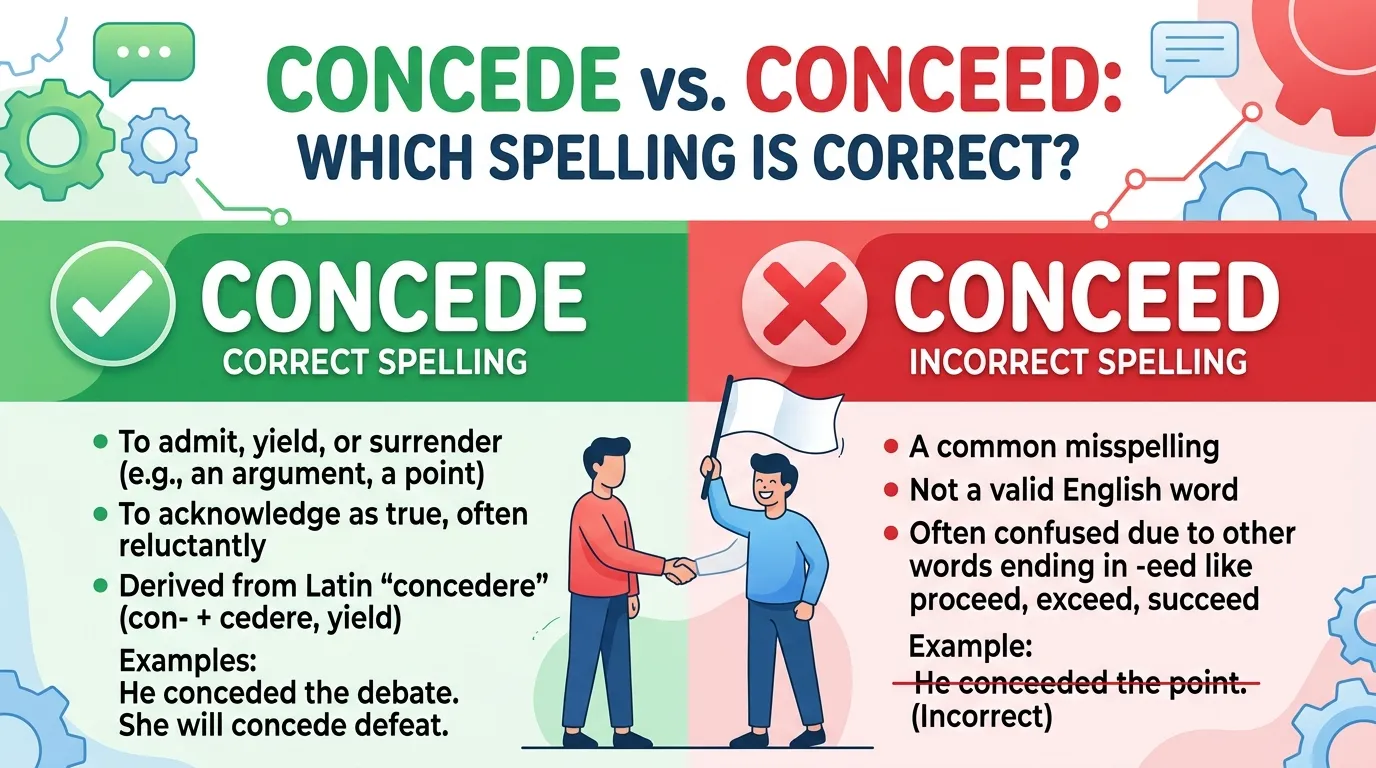
If you are unsure about concede vs conceed, you are not alone. These two forms look almost identical, but only one is a standard English word. The correct spelling is concede. Conceed is a misspelling and should not be used in formal or informal English.
The confusion happens because many English verbs ending in -cede or -ceed have similar sounds. For example, words such as proceed, succeed, and exceed use -ceed, while concede uses -cede. When people hear the word rather than see it written, the spelling can be hard to remember.
There is no important UK vs US English difference here. Both American and British English use concede as the correct spelling. If you are searching for concede vs conceed, concede meaning, or concede examples, the answer is simple: choose concede.
Quick Answer
- ✅ Concede — correct spelling
- ❌ Conceed — incorrect spelling
- ✅ He had to concede that she was right.
- ❌ He had to conceed that she was right.
Concede is a verb. It can mean to admit that something is true, accept that someone has won, or give something up.
What Does Concede Mean?
The verb concede has several related meanings.
Most often, it means to admit that something is true, especially after first disagreeing with it.
- She conceded that her argument was weak.
- The manager conceded that the customer had a valid complaint.
It can also mean to accept defeat or admit that another person or team has won.
- The team conceded defeat after the final goal.
- He conceded that his opponent had played better.
In another use, concede means to give something to someone, often unwillingly.
- The company conceded a small discount.
- The landlord conceded to the tenant’s request.
Grammar and Part of Speech
Concede is a verb.
Common forms include:
| Form | Example |
|---|---|
| Base form | concede |
| Third-person singular | concedes |
| Present participle | conceding |
| Past tense | conceded |
| Past participle | conceded |
Notice the spelling:
concede → conceded
The final e is dropped before adding -ed.
Concede in American English: Examples
Here are natural American English examples:
- The candidate conceded that his opponent had won.
- She conceded that the report contained an error.
- The company conceded to the customer’s request.
- He finally conceded defeat.
- The coach conceded that the other team played better.
- I concede that you made a good point.
- The seller conceded a few dollars on the price.
- The bank conceded that the fee had been charged incorrectly.
- The student conceded that she had misunderstood the question.
- The landlord conceded after several tenants complained.
Concede in British English: Examples
The spelling is the same in British English:
- The minister conceded that changes were necessary.
- The team conceded defeat after the second goal.
- She conceded that her colleague was correct.
- The company conceded to the union’s demand.
- He conceded that the decision had been unfair.
- The shop conceded a discount after the customer complained.
- The teacher conceded that the instructions were unclear.
- The player conceded the match.
- The landlord conceded that the rent increase was too high.
- The newspaper conceded that its earlier report was inaccurate.
There is no spelling change between these varieties. Concede is correct in both UK and US English.
Why Is Conceed Wrong?
Conceed is not the standard spelling of the verb. It is usually created by adding an extra e before the final d or by confusing concede with words such as proceed and succeed.
Incorrect and Correct Examples
❌ The player conceeded defeat.
✅ The player conceded defeat.
❌ She conceeded that she was wrong.
✅ She conceded that she was wrong.
❌ The company has conceeded to our request.
✅ The company has conceded to our request.
❌ He will conceed the point.
✅ He will concede the point.
❌ The team conceeded the match.
✅ The team conceded the match.
The important rule is simple: concede has only one e before the final d in conceded.
Concede vs Conceed: Comparison Table
| Feature | Concede | Conceed |
|---|---|---|
| Spelling | Correct | Incorrect |
| Part of speech | Verb | Not a standard word |
| Meaning | Admit, accept, or give up | No standard English meaning |
| Present form | concede | — |
| Past form | conceded | ❌ conceeded |
| Pronunciation | /kənˈsiːd/ | Not standard |
| US English | Correct | Incorrect |
| UK English | Correct | Incorrect |
| Formal writing | Appropriate | Avoid |
| Dictionary status | Standard word | Misspelling |
How Do You Pronounce Concede?
The standard pronunciation of concede is:
IPA: /kənˈsiːd/
It sounds roughly like:
kuhn-SEED
The stress falls on the second syllable.
The past tense conceded is pronounced:
/kənˈsiːdɪd/
It sounds like:
kuhn-SEE-did
Because concede ends with a long ee sound, some writers incorrectly imagine that the word should contain -ceed. However, pronunciation does not always tell you the spelling.
Why Do People Confuse Concede and Conceed?
Several spelling patterns cause this mistake.
Words such as:
- proceed
- succeed
- exceed
- recede
- concede
look and sound similar. However, their spellings differ.
The ending -ceed appears in words such as proceed, succeed, and exceed. Meanwhile, concede uses -cede.
This is why relying only on sound can lead to a spelling mistake.
Concede: Word Origin and Etymology
Concede comes from Latin concedere, meaning to withdraw, yield, grant, or give way.
It was formed from Latin elements associated with moving or giving way. The word later entered English through French and developed meanings connected with admitting something, yielding, or granting something.
This history helps explain its modern meanings. When you concede, you essentially give way in an argument, competition, negotiation, or discussion.
The spelling became established as concede, not conceed.
Concede Synonyms
Looking for a concede synonym? The best choice depends on the context.
| Concede | Possible synonym | Best context |
|---|---|---|
| admit | acknowledge | Accepting a fact |
| concede | accept | Accepting a result |
| concede defeat | surrender | Giving up a contest |
| grant | allow | Giving someone something |
| yield | give way | Negotiation or conflict |
| acknowledge | recognize | Formal writing |
| confess | admit | Personal wrongdoing |
| accept | agree | General situations |
In both American and British English, admit, acknowledge, and accept are common alternatives. Yield and grant may sound more formal depending on the sentence.
Common Mistakes With Concede
Adding an Extra E
❌ conceed
✅ concede
This is the main spelling error.
Writing Conceeded
❌ The team conceeded the game.
✅ The team conceded the game.
The past form is conceded, not conceeded.
Confusing Concede With Proceed
Proceed means to continue or move forward.
Concede means to admit, yield, or give something up.
- We will proceed with the meeting.
- We must concede that the plan failed.
Using Concede When You Mean Continue
❌ We conceded with the project.
✅ We proceeded with the project.
These words have different meanings.
Using the Wrong Verb Form
❌ She is concede the point.
✅ She is conceding the point.
After is, use the -ing form when describing an action in progress.
Using Conceded After Will
❌ He will conceded the argument.
✅ He will concede the argument.
After will, use the base verb.
Confusing Concede With Confess
To concede is to admit a point, accept defeat, or yield.
To confess usually means to admit something you did or reveal something you have kept secret.
- She conceded that he was right.
- He confessed that he had taken the money.
Concede in Real-Life Situations
Emails
A manager might write:
I concede that the original deadline was unrealistic.
This sounds professional and formal.
Offices
I concede your point about the budget.
Here, the speaker accepts that another person’s argument has merit.
Banking
The bank conceded that the transaction fee was applied incorrectly.
This means the bank admitted that the customer was right.
Invoices
The supplier conceded that the invoice contained an incorrect charge.
Again, conceded means admitted or acknowledged.
Schools
The student conceded that she had used the wrong formula.
The word works well in formal academic writing.
Social Media
Okay, I concede. Your argument makes more sense.
This is grammatically correct, although I admit may sound more casual.
Rent Payments
The landlord conceded that the rent increase had been announced too quickly.
Here, the landlord accepts that the tenant’s criticism has some truth.
Everyday Conversation
I concede that you were right.
This is correct but can sound slightly formal. In casual speech, I admit you were right is often more natural.
Concede in a Sentence
Here are more examples showing correct usage:
- I concede that you were right.
- She conceded the argument.
- The team conceded two goals.
- He conceded defeat.
- The company conceded the customer’s point.
- The government conceded that the policy needed review.
- They conceded a discount.
- She conceded that the evidence was strong.
- The player conceded the match.
- We reluctantly conceded the request.
UK vs US English
There is no spelling difference between American and British English.
| Usage | American English | British English |
|---|---|---|
| Present | concede | concede |
| Past | conceded | conceded |
| -ing form | conceding | conceding |
| Pronunciation | /kənˈsiːd/ | /kənˈsiːd/ |
| Standard spelling | concede | concede |
Both major varieties use concede.
One difference may appear in context and frequency, rather than spelling. British news and sports writing often uses phrases such as concede defeat or concede a goal, while American English may also use admit defeat or allow a goal, depending on the context.
Grammar Rule Behind Concede
The simplest grammar rule is:
Concede is a regular verb.
You can use it in several common patterns:
Concede + that-clause
- She conceded that she was wrong.
Concede + noun
- He conceded the point.
Concede + something + to someone
- The company conceded the request to the workers.
Concede to + noun
- They conceded to the demand.
The exact construction can vary by meaning, so always consider the context.
Five Memory Tricks for Concede
Think of CEDE as Give Way
Cede means to give or surrender something. Concede carries a related idea of yielding.
Remember One E Before D
Think:
concede → conceded
Not:
conceed → conceeded
Compare It With Recede
Both recede and concede use -cede.
Associate It With Admitting
Think:
concede = admit
If you admit someone has a good point, you can often say you concede the point.
Say It Slowly
Break it into:
con-cede
This can help you avoid automatically adding the e found in proceed or succeed.
Related Words and Expressions
Concede vs Admit
These words can be close in meaning.
- I admit that I was wrong.
- I concede that you have a strong argument.
Admit is more common in everyday conversation. Concede can sound more formal.
Concede vs Accept
Accept is broader.
- I accept your apology.
- I concede that your argument is stronger.
Concede vs Surrender
Surrender suggests giving up, especially in a conflict.
Concede can be much less dramatic. You may simply admit that another person has a valid point.
FAQs About Concede vs Conceed
Is concede or conceed correct?
Concede is correct. Conceed is a spelling error and is not the standard English form.
What is the meaning of concede?
Concede means to admit something is true, accept that someone has won, or give something up, often reluctantly.
How do you spell the past tense of concede?
The past tense is conceded, not conceeded.
Is concede used in American English?
Yes. Concede is standard in American English.
Is concede used in British English?
Yes. British English also uses concede. There is no UK spelling variant such as conceed.
What is a synonym for concede?
Depending on the context, synonyms include admit, acknowledge, accept, yield, grant, and surrender.
How is concede pronounced?
It is pronounced /kənˈsiːd/, approximately kuhn-SEED.
Is concede formal or informal?
Concede is grammatically suitable in both casual and formal English, but it often sounds more formal than admit.
Is conceed in the dictionary?
Conceed is not the standard dictionary spelling of this verb. If you mean the word meaning admit or yield, use concede.
What is the difference between concede and proceed?
Concede means admit, yield, or give up. Proceed means continue or move forward. They are different verbs despite their similar endings.
People Also Ask
What is correct, concede or conceed?
Concede is the correct spelling. Conceed is an error.
Why is concede spelled with cede?
The spelling reflects the word’s historical development from Latin concedere. English spelling preserves this -cede pattern.
Can I say I concede your point?
Yes. I concede your point means you accept that the other person’s point is valid.
Is conceded a correct word?
Yes. Conceded is the regular past tense and past participle of concede.
What is the opposite of concede?
Depending on the context, opposites can include deny, reject, resist, dispute, or refuse.
Is concede a good word for formal writing?
Yes. It is especially useful in essays, reports, debates, business writing, and professional discussions.
Conclusion
When comparing concede vs conceed, there is a clear winner: concede is the correct English spelling, while conceed is a misspelling. The word concede is a verb meaning to admit something is true, accept defeat, or yield something. Its common forms are concede, concedes, conceding, and conceded.
The spelling is the same in UK and US English, so you do not need to learn two different versions. Remember that the past tense is conceded, with no extra e before d.
If you are writing an email, school assignment, business report, social media post, or everyday message, use concede. When in doubt, remember the simple pattern: concede → conceded. Once you learn that pattern, the concede vs conceed confusion becomes much easier to avoid.


