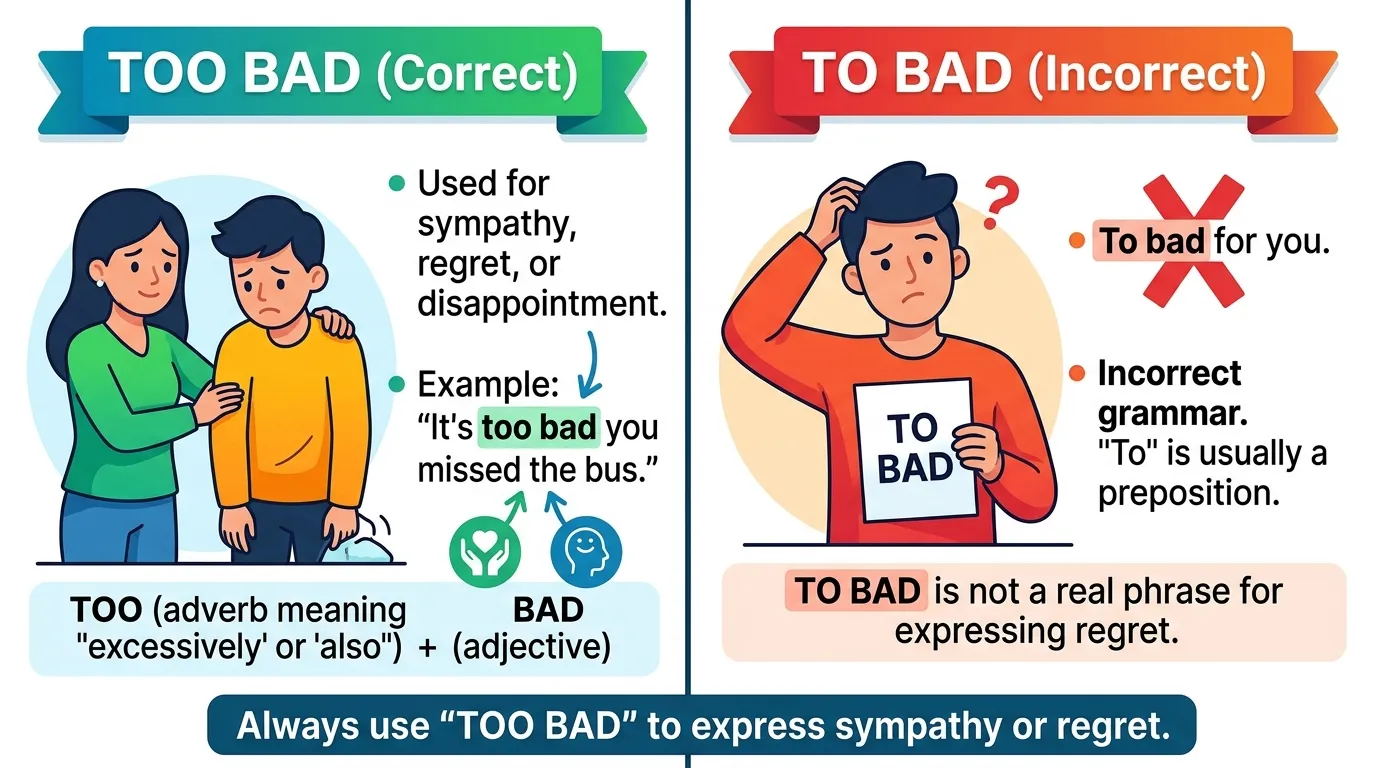
Have you ever wondered whether the correct phrase is too bad vs to bad? If so, you are not alone. These two forms sound similar when spoken, especially because to and too can be pronounced alike in some situations. However, they have very different grammatical jobs.
The correct phrase is too bad. The form to bad is generally incorrect when you want to express disappointment, sympathy, or that something is unfortunate. For example, you should write, That’s too bad, not That’s to bad.
The grammar difference is simple once you know what each word does. Too is an adverb that can mean excessively or unfortunately, while to is usually a preposition or part of an infinitive. This rule is the same in both US and UK English. British and American speakers both use too bad in everyday speech.
In this guide, you will learn the too bad meaning, correct usage, pronunciation, examples, common mistakes, synonyms, etymology, and practical ways to remember the difference.
Quick Answer
- ✅ Too bad — correct
- ❌ To bad — incorrect when expressing disappointment or describing something as unfortunate
Example
- ✅ It’s too bad that you missed the train.
- ❌ It’s to bad that you missed the train.
Remember:
Too means excessively or unfortunately in this expression.
To normally shows direction, connection, or an infinitive.
For example:
- I went to school.
- She wants to leave.
- The coffee is too hot.
- That’s too bad.
What Does Too Bad Mean?
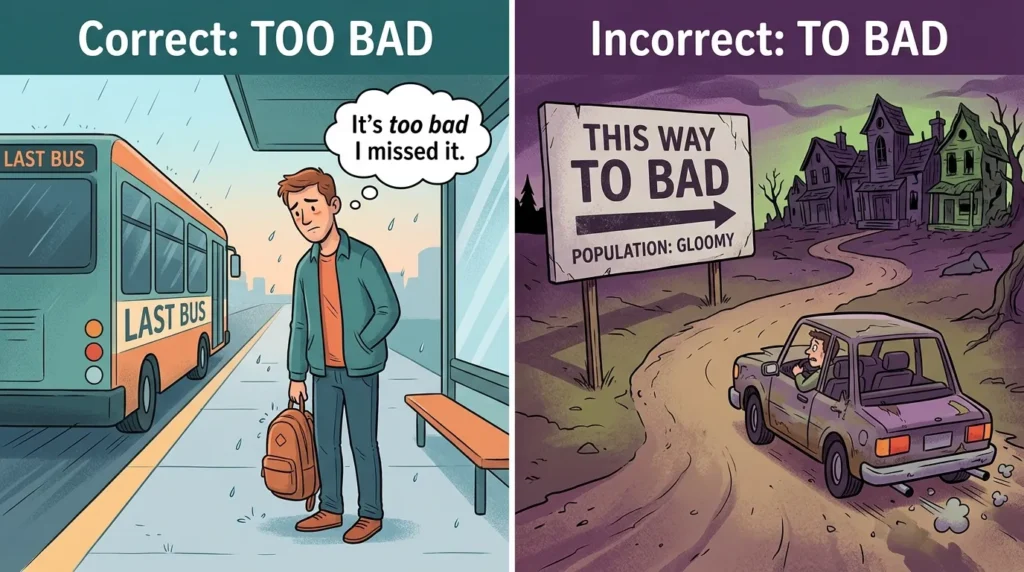
The phrase too bad has several related meanings.
The most common meaning is that is unfortunate, disappointing, or regrettable.
For example:
- You missed the concert? That’s too bad.
- The store is closed? That’s too bad.
- It’s too bad that she cannot come.
In these sentences, too bad expresses sympathy or disappointment.
However, too bad can also mean excessively bad.
For example:
- The weather was too bad to go outside.
- His injury was too bad for him to continue playing.
Here, too means more than is acceptable or desirable.
There is also an informal use where too bad can mean something like that is unfortunate, but there is nothing I can do about it.
For example:
- You forgot your ticket? Too bad.
Depending on tone, this can sound sympathetic, neutral, sarcastic, or dismissive.
Why Is Too Bad Correct?
The key is the word too.
In too bad, the word too is an adverb modifying the adjective bad.
Parts of speech
- too = adverb
- bad = adjective
An adverb can modify an adjective:
- too expensive
- too difficult
- too cold
- too late
- too bad
The phrase too bad therefore follows a normal English grammar pattern.
By contrast, to does not normally work directly before an adjective like bad in this structure.
That is why:
- It is too bad. ✅
- It is to bad. ❌
is the correct grammar.
Too Bad vs To Bad: Grammar Difference
The words to and too may sound similar, but their grammar is different.
| Feature | Too bad | To bad |
|---|---|---|
| Correct phrase? | Yes | No, in this meaning |
| Main word | Too | To |
| Part of speech | Adverb | Preposition or infinitive marker |
| Meaning | Excessively bad or unfortunate | No standard meaning in this phrase |
| Example | That’s too bad. | That’s to bad. ❌ |
| UK English | Common | Incorrect in this use |
| US English | Common | Incorrect in this use |
| Formal writing | Correct | Avoid |
| Informal writing | Correct | Usually a typo |
The important point is that to bad is not a normal English phrase.
You may see those two words next to each other in unusual grammatical structures, but that does not make to bad a replacement for too bad.
The Meaning of Too
The word too has two major uses.
Too means excessively
In this use, too means more than is wanted, needed, or acceptable.
Examples:
- The box is too heavy.
- The soup is too hot.
- The rent is too expensive.
- The test was too difficult.
- The music is too loud.
Here, too modifies an adjective.
Too means also
Too can also mean also or as well.
Examples:
- I want to go too.
- She likes coffee too.
- We are coming too.
This meaning is different from the too in too bad, but the spelling is the same.
What Does To Mean?
The word to has several important grammatical uses.
It can show direction:
- We went to school.
- She walked to the bank.
- He drove to work.
It can also introduce an infinitive:
- I want to learn.
- They need to leave.
- She hopes to win.
Notice the difference:
- to learn ✅
- to leave ✅
- to win ✅
The word to is followed by a base-form verb in an infinitive.
But bad is an adjective, not a base-form verb.
That is another reason to bad does not work as a substitute for too bad.
Too Bad Examples in American English
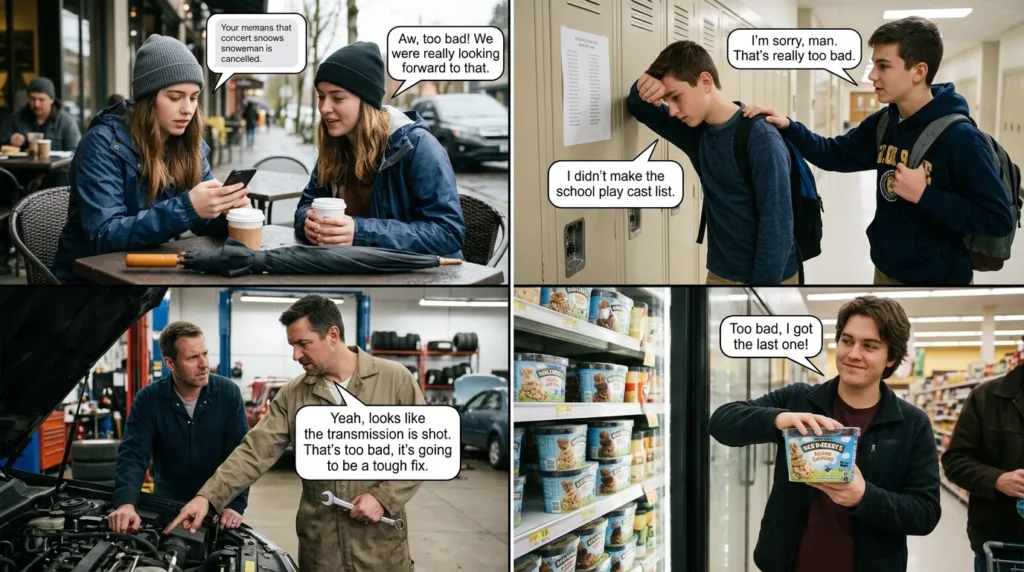
Here are natural too bad examples commonly heard or written in American English:
- That’s too bad about your broken phone.
- It’s too bad you missed the meeting.
- The weather is too bad for a picnic.
- It’s too bad that the restaurant is closed.
- That was too bad for the home team.
- It’s too bad we cannot stay longer.
- The traffic was too bad to drive safely.
- That’s too bad, but we can try again tomorrow.
- The damage was too bad to repair cheaply.
- It’s too bad she had to cancel her trip.
American English uses too bad in both casual speech and ordinary writing.
Too Bad Examples in British English
British English uses the same phrase and grammar.
Examples include:
- That’s too bad about your car.
- It’s too bad you missed the train.
- The weather was too bad for us to go out.
- It’s too bad the shop is closed.
- That’s too bad, but there is always next week.
- The traffic was too bad this morning.
- It’s too bad that he cannot join us.
- The damage was too bad to ignore.
- That’s too bad about the cancelled flight.
- It was too bad that the match was postponed.
So, there is no major UK vs US English difference in the spelling or basic grammar of this phrase.
Too Bad in a Sentence
If you want to understand too bad in a sentence, look at the role it plays.
Expressing sympathy
You lost your wallet? That’s too bad.
Here, the speaker expresses regret.
Expressing disappointment
It’s too bad that we cannot attend the wedding.
Here, the speaker feels disappointed.
Showing excessive degree
The road was too bad to use.
Here, too means excessively.
Showing a strong negative condition
The injury was too bad for him to play.
Here, the injury was severe enough to prevent an action.
Why Is To Bad Wrong?
The most common reason people write to bad is simple spelling confusion.
When spoken quickly, to and too may sound alike:
- to = /tuː/ or weak /tə/
- too = /tuː/
Because too bad is a spoken phrase that people often hear before they see it written, learners may choose the wrong spelling.
Another reason is that to is an extremely common English word. Beginners often use it automatically.
However, the meaning tells you which word you need.
If you mean unfortunate or excessively, use too.
Incorrect and corrected examples
- ❌ That’s to bad.
- ✅ That’s too bad.
- ❌ It’s to bad that you lost your job.
- ✅ It’s too bad that you lost your job.
- ❌ The weather is to bad for swimming.
- ✅ The weather is too bad for swimming.
- ❌ That was to bad to watch.
- ✅ That was too bad to watch.
Pronunciation Guide
The pronunciation adds to the confusion.
Too
IPA: /tuː/
Example:
too bad → /tuː bæd/
The vowel sound in too is the same long /uː/ sound heard in words such as blue and food.
To
Strong form: /tuː/
Weak form: /tə/
For example:
- to school → often /tə skuːl/
- to work → often /tə wɝːk/ in American English
When people pronounce to strongly, it can sound exactly like too.
That is why spelling can be difficult for English learners.
Why Do People Confuse Too and To?
There are several reasons.
They can sound the same
In careful speech, too is /tuː/, while to can also be /tuː/ when stressed.
Both are very common
Learners see to constantly:
- to school
- to work
- to eat
- to sleep
This can lead to overuse of the spelling to.
English spelling is not fully phonetic
English has many words that sound alike but have different spellings.
These are called homophones when they share pronunciation but have different meanings or grammatical functions.
Word Origins and Etymology
Understanding word history can make the difference easier to remember.
Origin of to
To comes from Old English tō. It was used to express movement, direction, relationship, and other grammatical ideas.
Over centuries, it remained one of the most important small words in English.
Modern examples include:
- go to work
- give it to me
- want to eat
Origin of too
Too also has roots in Old English. It developed from forms related to tō, with meanings connected to also and excessively.
Over time, spelling helped distinguish the modern word too from to.
Today, too has two major meanings:
- also
- excessively
In too bad, it carries the idea of an excessive degree or an unfortunate situation.
Origin of bad
Bad is an old English adjective with a long history. Its exact early origin is less certain than that of many common English words, but the modern meaning developed around ideas of something being poor, harmful, unpleasant, or undesirable.
Together, these words form the modern expression too bad.
Synonyms for Too Bad
The best too bad synonym depends on the context.
| Alternative | Meaning | Formality | Common use |
|---|---|---|---|
| Unfortunately | Sadly or regrettably | Formal/neutral | Writing and speech |
| That’s unfortunate | Something is regrettable | Neutral | Professional speech |
| What a shame | Something is disappointing | Informal/neutral | UK and US |
| What a pity | Something is regrettable | Neutral | Especially common in UK English |
| Sadly | With regret | Neutral | Writing and speech |
| Regrettably | With regret | Formal | Professional writing |
| That’s disappointing | Something failed to meet expectations | Neutral | Work and everyday speech |
| What a bummer | Something is disappointing | Informal | More common in US English |
For professional emails, unfortunately or that’s unfortunate may sound better than too bad.
For casual conversation, too bad, what a shame, and that’s disappointing are natural choices.
Seven Common Mistakes
Writing to bad instead of too bad
❌ It is to bad that she left.
✅ It is too bad that she left.
Confusing too with also
Too can mean also, but that is not its only meaning.
In too bad, it expresses degree or regret.
Using too when to is needed
❌ I went too the office.
✅ I went to the office.
Here, to shows direction.
Using to before an adjective
❌ The weather is to cold.
✅ The weather is too cold.
Using too bad in formal writing without considering tone
Too bad is grammatically correct, but it can sound casual.
In a formal email, Unfortunately may be better.
Assuming UK English uses to bad
It does not. British English also uses too bad.
Thinking too always means excessively
Sometimes too means also.
For example:
I want one too.
The context determines the meaning.
Real-Life Examples
Emails
It’s too bad that the meeting had to be cancelled. We can reschedule for Friday.
Offices
It’s too bad the manager is away today.
Banking
It’s too bad the bank could not approve the application.
Invoices
It’s too bad the invoice was sent to the wrong department.
Schools
It’s too bad you missed the exam, but speak with your teacher about the next step.
Social media
Too bad I missed the concert!
Rent payments
It’s too bad the payment was delayed, but we can check the transaction history.
Everyday conversation
You cannot come tonight? That’s too bad.
These examples show that too bad is useful in many everyday settings.
Ten American English Sentences
- That’s too bad about your new car.
- It’s too bad we missed the movie.
- The traffic is too bad to drive right now.
- That’s too bad, but we have another option.
- It’s too bad the store closed early.
- The weather was too bad for the game.
- It’s too bad you cannot stay for dinner.
- That’s too bad about the cancelled flight.
- The damage was too bad to fix quickly.
- It’s too bad that the project was delayed.
Ten British English Sentences
- That’s too bad about your train being cancelled.
- It’s too bad you missed the bus.
- The weather was too bad for a walk.
- That’s too bad, but we can try again tomorrow.
- It’s too bad the shop has already shut.
- The traffic was too bad this morning.
- It’s too bad he cannot come along.
- The road was too bad to travel on safely.
- That’s too bad about the match being postponed.
- It’s too bad that the holiday had to be cancelled.
Related Expressions
Several expressions are closely related to too bad.
Too good
Too good means excessively good or so good that something seems hard to believe.
The offer sounds too good to be true.
Too much
Too much means more than necessary or acceptable.
That coffee has too much sugar.
Too late
Too late means after the appropriate or useful time.
We arrived too late to buy tickets.
To do
Here, to introduces an infinitive.
I have work to do.
To be
To be is another infinitive structure.
She wants to be a doctor.
These examples show why context matters. To and too are not interchangeable.
Five Memory Tricks
Think of the extra O
Too has an extra o.
Think:
Too = extra
The extra o can remind you of something being extra or excessive.
Too means more
Remember:
too much, too cold, too expensive, too bad
All express an idea of degree.
To goes toward
Think of to when something goes toward a place:
go to school
drive to work
Too can mean also
Remember:
I want to come too.
The extra o can remind you of an extra person or thing.
Use the sentence test
Ask:
Am I talking about direction or an infinitive?
If yes, you probably need to.
Ask:
Do I mean excessively, or unfortunately in too bad?
If yes, use too.
Too Bad vs To Bad: Formal and Informal Usage
Too bad is grammatically correct in both formal and informal English.
However, tone matters.
In casual speech:
That’s too bad.
sounds completely natural.
In a formal business email, you might write:
Unfortunately, the payment could not be processed.
instead of:
That’s too bad about the payment.
Neither is grammatically wrong. The difference is mainly one of tone and context.
Dictionary Preferences
Major English dictionaries recognize too and to as separate words with different meanings and grammatical roles.
The standard form for expressing regret or an excessive degree is too bad.
If you search for to bad because you are unsure of the spelling, you should not treat search results containing those two words separately as evidence that to bad is a standard phrase.
Always consider the sentence as a whole.
FAQS
Is it too bad or to bad?
The correct phrase is too bad when you mean unfortunate, regrettable, or excessively bad.
What is the too bad meaning?
Too bad can mean unfortunate or regrettable. It can also mean excessively bad, depending on context.
Is to bad ever correct?
The words to and bad can appear next to each other in unusual sentence structures, but to bad is not the correct spelling of the common expression too bad.
Is too bad formal or informal?
It is grammatically correct in both settings, but it is more natural in everyday speech. Formal writing may prefer unfortunately or that is unfortunate.
How do you pronounce too bad?
Too bad is pronounced approximately /tuː bæd/.
Do British people say too bad?
Yes. Too bad is used in British English as well as American English.
What is a synonym for too bad?
Depending on context, alternatives include unfortunately, that’s unfortunate, what a shame, what a pity, and that’s disappointing.
Is too bad an adjective?
No. In the phrase too bad, too is an adverb and bad is an adjective.
Can too bad be sarcastic?
Yes. Tone can make too bad sound sympathetic or dismissive.
For example, Oh, you forgot your wallet? Too bad. may sound sarcastic.
People Also Ask
Is it too bad or to bad?
Too bad is correct when expressing regret or excessive degree. To bad is normally a spelling or grammar error in this context.
Why is too bad spelled with two Os?
The spelling too distinguishes it from to, which has different grammatical functions. The extra o can also serve as a useful memory clue.
What does too bad mean in texting?
In texting, too bad usually means that’s unfortunate or that’s disappointing. The tone depends on the conversation.
Is too bad rude?
Not necessarily. That’s too bad can be kind and sympathetic. However, simply saying Too bad can sound cold or sarcastic in some situations.
Is too bad American or British?
It is used in both varieties. There is no major UK vs US English difference in its basic spelling or meaning.
Can I use too bad in an email?
Yes, especially in a friendly or informal email. For a formal business message, unfortunately may be a better choice.
What is the opposite of too bad?
Depending on meaning, possible opposites include good, not bad, or fortunate.
How can I remember too versus to?
Use to for direction and infinitives. Use too for also or excessively. In too bad, always choose too.
Final Takeaway
The difference between too bad vs to bad is simple once you understand the grammar. Too bad is the correct expression when you mean something is unfortunate, disappointing, or excessively bad. To bad is not the standard form for this meaning.
The word too is an adverb, while bad is an adjective. Together, they form a normal English phrase. The word to, on the other hand, usually shows direction or introduces an infinitive, as in go to school or want to learn.
This rule works the same way in American and British English. If you are writing an email, school assignment, social media post, or professional document, use too bad when the meaning calls for it.
The easiest memory trick is simple: too has an extra o, just like something can be extra. Once you connect that idea with the grammar, you will be much less likely to write to bad by mistake.


