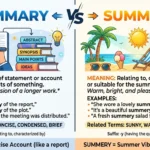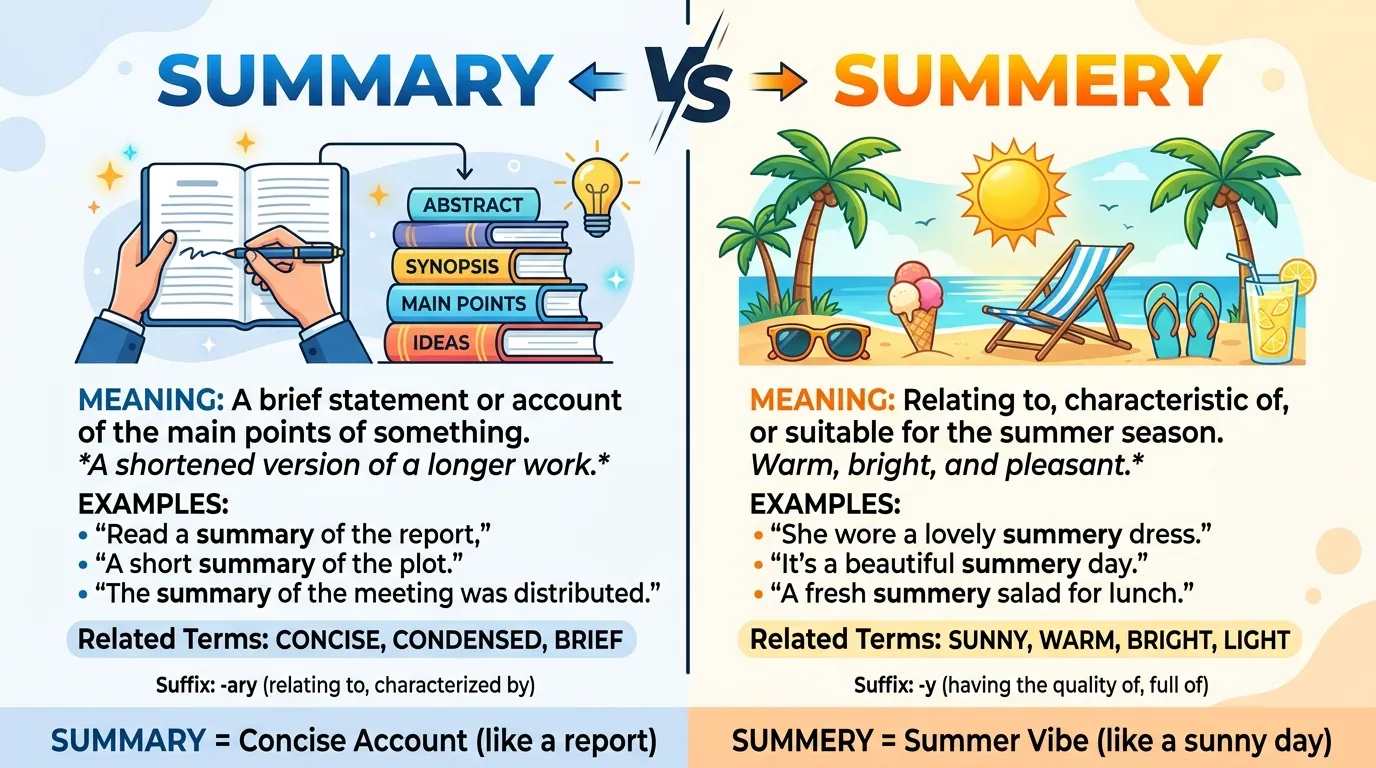
Have you ever typed summary and wondered whether summery might be the right spelling? You are not alone. The two words look almost identical and are pronounced very similarly, but they have completely different meanings. Summary is the word you normally need when you mean a short version of a longer text, report, meeting, event, or idea. Summery is a real English word, but it relates to the season of summer.
The key summary vs summery difference is therefore simple: summary is mainly a noun meaning a brief account of something, while summery is an adjective meaning characteristic of summer.
This distinction is the same in US and UK English. There is no major American-versus-British spelling difference here. Once you understand the meanings, the correct usage becomes much easier to remember.
Quick Answer
- ✅ Summary — correct when you mean a short version or brief account.
- ❌ Summery — incorrect when you mean a short version or brief account.
- ✅ Summery — correct when describing something that feels or looks like summer.
Example:
Please send me a summary of the meeting.
But:
The bright flowers gave the room a summery feel.
So, if you are writing a report, school assignment, email, or business document, you will usually want summary, not summery.
Summary vs Summery: The Main Difference
| Word | Part of speech | Meaning | Example | UK vs US English |
|---|---|---|---|---|
| summary | Noun, sometimes adjective | A short account of something | I read the summary. | Same in both |
| summery | Adjective | Like or characteristic of summer | The weather feels summery. | Same in both |
The biggest grammar difference is the meaning and role of each word.
Summary is most often a noun:
I wrote a summary of the article.
Summery is an adjective:
We enjoyed the summery weather.
What Does Summary Mean?
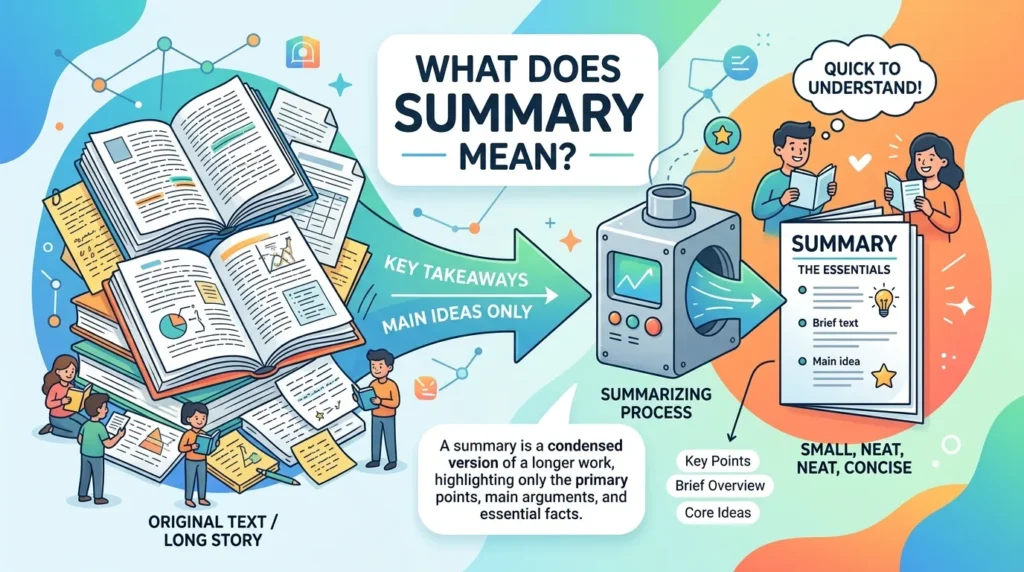
The summary meaning is a short statement that gives the main points of something without including every detail.
A summary can describe:
- A book
- A movie
- A report
- A meeting
- A speech
- A news story
- A research paper
- An account or document
- A conversation
- A set of results
For example:
The teacher asked us to write a summary of the chapter.
The summary should contain the important ideas, not every sentence from the original chapter.
Summary as a Noun
In everyday English, summary is usually a countable noun.
Examples include:
I need a summary of the report.
She prepared a summary for her manager.
The summary explains the main findings.
You can also use common phrases such as:
- brief summary
- executive summary
- meeting summary
- book summary
- case summary
- summary report
- summary statement
- summary of events
Summary as an Adjective
Summary can also work as an adjective in some formal expressions. It can mean something done quickly or without following a full process.
For example:
The judge ordered summary judgment.
This use is more specialized and is common in legal language.
For beginners, however, the most important meaning to learn is summary = a short version containing the main points.
Summary Examples in American English
Here are natural summary examples in American English:
- Please give me a summary of the meeting.
- I read the summary before starting the full report.
- The teacher asked for a one-page summary.
- Can you send me a summary of the project?
- Her summary explained the main problem clearly.
- I wrote a short summary of the book.
- The news article includes a useful summary at the end.
- We need an executive summary for the client.
- His summary helped me understand the situation.
- Please include a summary with your application.
Summary Examples in British English
The word is used in much the same way in British English:
- Could you send me a summary of the meeting?
- I need a brief summary of the report.
- She wrote a summary of the novel.
- The document begins with a short summary.
- Please provide a summary of the findings.
- His summary was clear and easy to follow.
- The teacher asked for a summary of the article.
- I have attached a summary of the discussion.
- The report contains an executive summary.
- We received a detailed summary of the case.
There is no important UK vs US English spelling change for this word. Summary is standard in both varieties.
What Does Summery Mean?
Summery is a real word. It is not simply a misspelling of summary.
It is an adjective that means typical of summer or resembling summer.
For example:
The garden has a bright, summery atmosphere.
Here, summery describes the atmosphere. It suggests things such as warmth, sunshine, bright colors, flowers, outdoor activities, or a relaxed summer mood.
You might describe something as summery if it has:
- Bright colors
- Warm weather
- Light clothing
- Floral designs
- Sunshine
- Fresh fruit
- Beach imagery
- Outdoor activities
- A relaxed seasonal feeling
Summery in Sentences
Here are some examples:
She wore a summery yellow dress.
The restaurant has a summery atmosphere.
We decorated the room with summery colors.
The warm breeze made the evening feel summery.
This song has a cheerful, summery sound.
Notice that summery describes a person, thing, place, sound, feeling, or atmosphere. That is why it functions as an adjective.
Why Is Summery Wrong in Many Sentences?
The word summery is not wrong by itself. The problem occurs when writers use it instead of summary.
Incorrect:
Please send me the summery of the report.
Correct:
Please send me the summary of the report.
Incorrect:
I need a summery of the meeting.
Correct:
I need a summary of the meeting.
The writer is talking about a short account of information, so summary is required.
However, this sentence is correct:
The beach has a summery atmosphere.
Here, the writer is describing something related to summer.
Common Mistakes With Summary and Summery
Mistake 1: Using summery for a report
❌ Please prepare a summery of the report.
✅ Please prepare a summary of the report.
A report can have a summary, but it does not normally have a summery.
Mistake 2: Confusing a book summary with summer
❌ I wrote a summery of the novel.
✅ I wrote a summary of the novel.
The first sentence accidentally suggests something related to summer.
Mistake 3: Using summary to describe summer weather
❌ We had a very summary afternoon.
✅ We had a very summery afternoon.
Here, you need an adjective describing a summer-like afternoon.
Mistake 4: Confusing summary and summery in email
❌ Here is the summery of today’s discussion.
✅ Here is the summary of today’s discussion.
Business emails commonly use summary.
Mistake 5: Writing summery in schoolwork
❌ Write a summery of the story.
✅ Write a summary of the story.
Teachers usually ask students to summarize a text.
Mistake 6: Thinking summery is always a spelling mistake
❌ Summery is never a real word.
✅ Summery is a real adjective meaning like summer.
This is an important point. Do not automatically mark summery as wrong.
Mistake 7: Assuming US and UK English use different spellings
❌ British English uses summery for a short report.
✅ Both American and British English use summary for a short account.
The distinction is about meaning, not nationality.
Summary vs Summery Pronunciation
The pronunciation is one reason these words cause confusion.
| Word | IPA | Approximate pronunciation |
|---|---|---|
| summary | /ˈsʌməri/ | SUM-uh-ree |
| summery | /ˈsʌməri/ | SUM-uh-ree |
In many standard pronunciations, the words are pronounced the same or very nearly the same. They are therefore homophones or near-homophones, depending on the speaker and dictionary pronunciation.
This creates a classic spelling problem. You may know exactly which word you mean when speaking, but you cannot hear the difference.
The solution is to remember the meaning rather than the sound.
Word Origins and Etymology
The two words developed from different sources.
Origin of Summary
Summary comes through French and Latin. It is related to Latin summarium, meaning a summary or collection of the main points. It is also connected with Latin summus, meaning highest or chief.
The historical idea is linked to bringing the most important points together.
That fits the modern meaning well: a summary gives you the main or essential information.
Origin of Summery
Summery has a much simpler formation. It comes from summer plus the adjective-forming suffix -y.
The suffix -y often creates adjectives meaning characterized by or full of something.
For example:
- sun → sunny
- cloud → cloudy
- rain → rainy
- summer → summery
So summery literally describes something with qualities associated with summer.
Summary Synonyms
If you are looking for a summary synonym, several choices are available.
| Synonym | Meaning | Common use |
|---|---|---|
| overview | General picture of a subject | Business, academic |
| outline | Main points arranged clearly | School, writing |
| abstract | Short account of research or academic work | Academic |
| synopsis | Brief account of a book, film, or work | Formal |
| recap | Short review of what happened | Informal |
| brief | Short set of important information | Business, professional |
| digest | Condensed version of information | Formal or specialized |
American and British English generally share these synonyms. The best choice depends more on context and level of formality than on geography.
For example, recap sounds more conversational, while abstract is common in academic writing.
Real-Life Examples
Emails
Subject: Meeting Summary
I have attached a summary of today’s meeting for everyone to review.
Offices
Please prepare a summary of the project’s progress before Friday.
Banking
The bank sent me a summary of my recent transactions.
Invoices
The invoice includes a summary of all charges.
Schools
Students must submit a summary of the assigned chapter.
Social Media
Here is a quick summary of what happened during the event.
Rent Payments
The landlord sent a summary of my rent payments for the year.
Everyday Conversation
Can you give me a quick summary of the movie?
By contrast:
The room had a summery look with yellow cushions and fresh flowers.
The Grammar Rule Behind the Difference
A simple grammar rule can help:
Summary = usually a noun
I read the summary.
Summery = adjective
I like the summery design.
Ask yourself what job the word is doing.
If you need the name of a short explanation, use summary.
If you need a word that describes something as being like summer, use summery.
The related verb is summarize in American English and summarise is also common in British English.
Examples:
Please summarize the article.
Please summarise the article.
The noun is still summary in both varieties.
Summary vs Summery in a Sentence
Compare these sentences:
I wrote a summary of the summer vacation.
Here, summary means a short account.
We had a summery vacation by the beach.
Here, summery describes the vacation as having a summer-like quality.
You can even use both words in one sentence:
I wrote a summary of our summery vacation.
That sentence clearly shows the difference.
Five Memory Tricks to Remember
Think of the letter A
Summary has an a.
Think:
A = Account
A summary is a short account of information.
Think of summer
Summery contains summer:
summer + y = summery
If the meaning involves sunshine, warmth, or the season, think summery.
Ask a simple question
Are you talking about information?
Use summary.
Are you talking about summer?
Use summery.
Remember the noun-adjective rule
Summary = thing or document.
Summery = description.
Use the two-word test
Try saying:
short summary
This makes sense.
Try:
short summery
This usually does not mean a short report. It suggests something related to summer.
Related Words and Expressions
Do not confuse summary with these related terms:
- summarize — to give the main points
- summarized — past tense or past participle of summarize
- summarizing — giving the main points
- summarization — the process of creating a summary
- summery — like summer
- summer — the season itself
Examples:
Can you summarize this article?
I need a summary of this article.
The article was summarized in two paragraphs.
We used an automated summarization tool.
The bright colors create a summery feeling.
FAQs
Is summary or summery correct?
Both are correct English words, but they have different meanings. Summary means a short account of something. Summery means like or characteristic of summer.
What is the difference between summary and summery?
The main difference is meaning and grammar. Summary is usually a noun, while summery is an adjective related to summer.
Is summery a real word?
Yes. Summery is a standard English adjective. For example, a summery dress means a dress that looks or feels suitable for summer.
What is a synonym for summary?
Common synonyms include overview, outline, synopsis, abstract, recap, brief, and digest. The best option depends on the context.
How do you pronounce summary?
Summary is commonly pronounced /ˈsʌməri/, roughly like SUM-uh-ree.
How do you pronounce summery?
Summery is commonly pronounced /ˈsʌməri/, also roughly SUM-uh-ree. This similar pronunciation is a major reason for spelling confusion.
Is summary different in British English?
No major spelling difference exists. Summary is standard in both British and American English.
Is summery formal or informal?
Summery is a normal adjective and can be used in both casual and formal writing when the meaning is appropriate. For example, a summery atmosphere is perfectly natural.
Is summary formal or informal?
Summary works in both formal and informal English. It is common in schoolwork, business documents, reports, emails, news writing, and everyday conversation.
Can summary and summery be used together?
Yes. For example:
The report contains a summary of our summery holiday campaign.
The first word refers to a brief account, while the second describes something related to summer.
People Also Ask
Is it a summer summary or summer summery?
Usually, summer summary is correct if you mean a short account of something that happened during summer.
The teacher requested a summer summary.
What is the adjective form of summer?
Summery is an adjective meaning like or characteristic of summer.
The bright colors look very summery.
What is the noun form of summarize?
The noun is summary.
Please provide a summary of the article.
Why do people confuse summary and summery?
They look and sound very similar. Their meanings, however, are completely different. Summary relates to condensed information, while summery relates to summer.
Is summary the correct word for a short version of a document?
Yes. If you mean a shortened version containing the main points, summary is the correct word.
Conclusion
The summary vs summery difference is easy once you connect each word with its meaning. Summary is usually a noun meaning a short account of the main points of something. It is the correct word for a report summary, meeting summary, book summary, school assignment, banking document, or email. Summery, on the other hand, is an adjective meaning like summer or characteristic of summer.
Both words are correct, and both are used in American and British English. The main difference is not regional spelling but meaning, grammar, and context. When you need a short version of information, choose summary. When you are describing a warm, bright, or summer-like quality, choose summery.
Remember the easiest trick: summary = a short account; summery = summer-like. Once you learn that connection, this common spelling confusion becomes much easier to avoid.