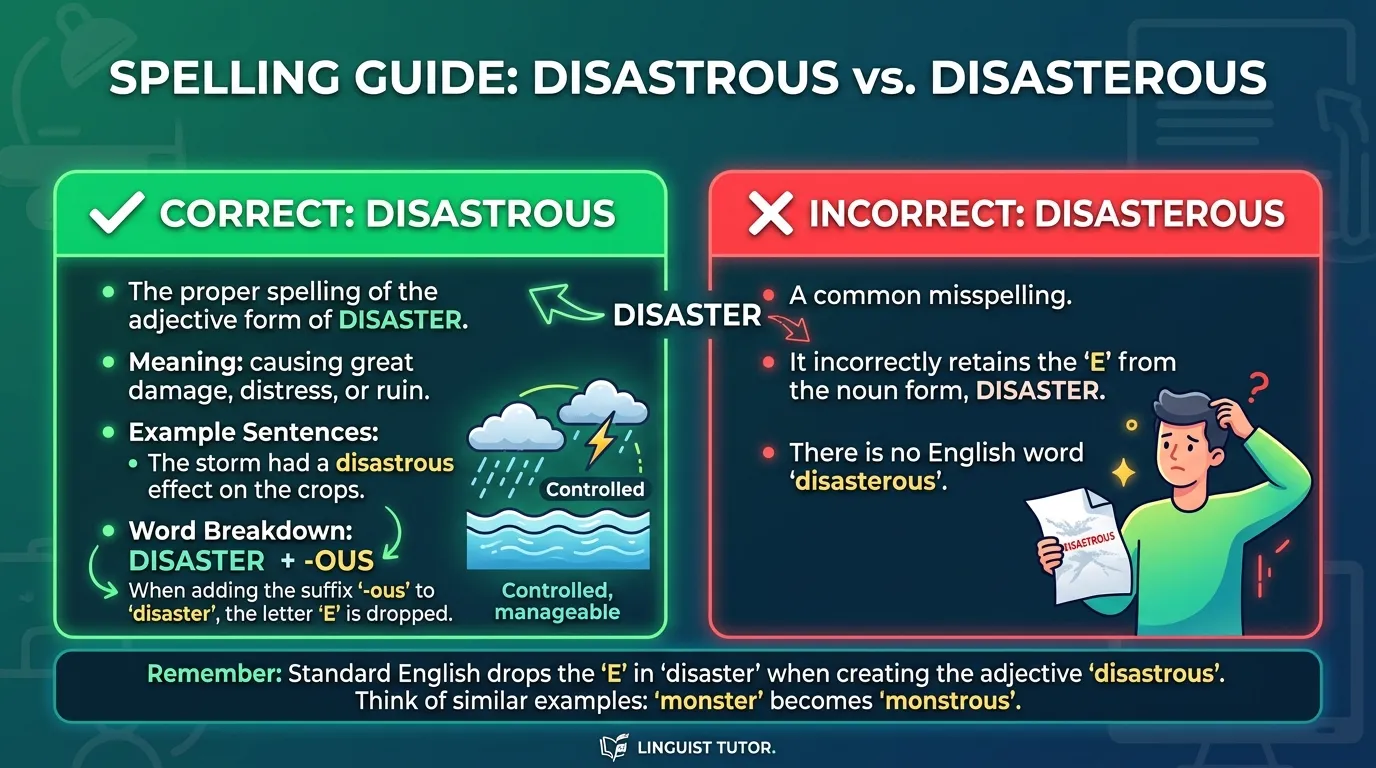
If you are unsure whether disastrous or disasterous is the correct spelling, you are not alone. The correct form is disastrous. The spelling disasterous is incorrect in standard English. The confusion happens because the noun disaster clearly contains the letters -aster-, so it feels natural to add -ous and write disasterous. However, English does not form this adjective that way.
Disastrous is an adjective that means extremely bad, harmful, or unsuccessful. It can describe an event, decision, result, mistake, or situation. The word is used in both American and British English, and there is no UK vs US spelling difference here.
For example, you can say, “The company had a disastrous year,” or “The trip was disastrous from beginning to end.”
This guide explains the disastrous vs disasterous grammar difference, pronunciation, meaning, origin, common mistakes, synonyms, and real life usage. By the end, you will know exactly when and how to use disastrous with confidence.
Quick Answer
| Form | Correct? | Explanation |
|---|---|---|
| disastrous | ✅ Correct | Standard English adjective |
| disasterous | ❌ Incorrect | Common spelling mistake |
Correct: The business suffered a disastrous loss.
Incorrect: The business suffered a disasterous loss.
The correct spelling is always disastrous in standard American and British English.
Disastrous Meaning
Disastrous is an adjective meaning very harmful, unsuccessful, damaging, or terrible in its results.
It comes from the noun disaster, but the spelling changes when the adjective is formed.
Disastrous in a sentence
- The company made a disastrous decision.
- The storm had disastrous effects on the town.
- His first attempt was disastrous.
- The project became disastrous because of poor planning.
- Missing the deadline could have disastrous consequences.
The word is often stronger than simply saying bad. If something is disastrous, it has caused or is likely to cause serious problems.
Is Disastrous an Adjective?

Yes. Disastrous is an adjective.
An adjective describes a noun or gives information about it.
For example:
It was a disastrous mistake.
Here, disastrous describes the noun mistake.
You can use it before a noun:
a disastrous accident
You can also use it after a linking verb:
The results were disastrous.
Grammar rule
The noun is:
disaster
The adjective is:
disastrous
The ending is -ous, but the spelling does not become disasterous.
There is no standard verb disastrous. Related forms include:
- disaster — noun
- disastrous — adjective
- disastrously — adverb
For example:
The plan was disastrous.
The plan failed disastrously.
Disastrous Examples in American English
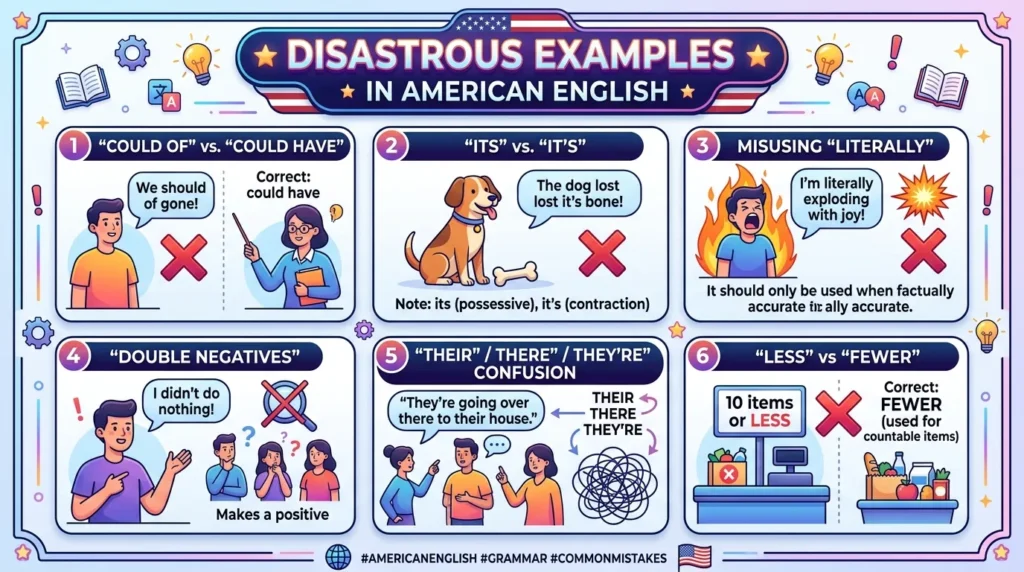
Here are natural examples commonly suitable for American English:
- The company had a disastrous financial year.
- The decision could have disastrous consequences.
- The meeting turned into a disastrous argument.
- The restaurant received poor reviews after a disastrous opening night.
- His attempt to fix the computer was disastrous.
- The team suffered a disastrous defeat.
- The storm caused disastrous damage.
- Their marketing campaign was disastrous.
- Forgetting the contract was a disastrous mistake.
- The project became disastrous because the budget was too small.
Disastrous Examples in British English
The word has the same spelling and meaning in British English:
- The journey was disastrous from the beginning.
- The government faced criticism after the disastrous decision.
- The match ended in a disastrous defeat.
- The weather caused disastrous delays.
- It was a disastrous start to the new school term.
- The business suffered a disastrous decline.
- His attempt at cooking was completely disastrous.
- The policy had disastrous consequences.
- The concert was considered a disastrous failure.
- Poor planning led to a disastrous outcome.
Notice that UK vs US English does not change the spelling. Both use disastrous.
Disastrous vs Disasterous: Detailed Comparison
| Feature | Disastrous | Disasterous |
|---|---|---|
| Spelling | Correct | Incorrect |
| Part of speech | Adjective | Not a standard English word |
| Meaning | Extremely bad or harmful | Intended to mean disastrous |
| Standard dictionaries | Listed | Generally not accepted as the standard form |
| American English | Used | Incorrect |
| British English | Used | Incorrect |
| Formal writing | Appropriate | Avoid |
| Academic writing | Appropriate | Avoid |
| Business writing | Appropriate | Avoid |
| Example | a disastrous result | a disasterous result ❌ |
So, the main grammar difference is simple: disastrous is the recognized adjective. Disasterous is a spelling error.
Why Is Disasterous Wrong?
The mistake is easy to understand.
English speakers see:
disaster + ous
and naturally expect:
disasterous
But English word formation does not always work by simply attaching a suffix to the complete spelling of a noun.
The accepted adjective is disastrous, not disasterous.
Incorrect and corrected examples
❌ The project was disasterous.
✅ The project was disastrous.
❌ We had a disasterous meeting.
✅ We had a disastrous meeting.
❌ The plan produced disasterous results.
✅ The plan produced disastrous results.
❌ It was a disasterous mistake.
✅ It was a disastrous mistake.
Pronunciation of Disastrous
The pronunciation can also help you remember the spelling.
American English
disastrous: /dɪˈzæstrəs/
It sounds roughly like:
dih-ZAS-trus
British English
disastrous: /dɪˈzɑːstrəs/
It sounds roughly like:
dih-ZAH-strus
The vowel sound can differ between American and British pronunciation, but the spelling remains the same.
The word is commonly confused with disaster because both words begin with disast-. When people say the words quickly, the middle sounds can also make the spelling harder to remember.
Word Origin and Etymology
The history of disastrous helps explain why its spelling is not simply disasterous.
The word is related to disaster, which came into English through French and ultimately traces back to Italian disastro. The older idea was connected with an unfavorable star or bad influence from the stars.
The parts have roots associated with:
- dis- meaning something negative or unfavorable
- astro meaning star
The adjective disastrous developed from this family of words.
Over time, English speakers came to use disastrous more broadly for something that produces extremely bad results.
This is why the modern meaning is not limited to astronomy or stars. Today, a disastrous decision simply means a decision with very bad consequences.
Disastrous Synonyms
If you are searching for a disastrous synonym, you have several choices. The best option depends on how serious the situation is.
| Synonym | Meaning | Common use |
|---|---|---|
| terrible | Very bad | Everyday English |
| awful | Extremely unpleasant or bad | Informal English |
| catastrophic | Causing extreme damage | Serious situations |
| devastating | Causing great harm or sadness | Emotional or serious contexts |
| ruinous | Causing financial or practical ruin | Business and finance |
| calamitous | Causing major trouble or disaster | Formal English |
| tragic | Causing great sadness or loss | Death and serious events |
| damaging | Causing harm | Formal and professional writing |
In both American and British English, terrible, awful, catastrophic, and devastating are widely understood.
Ruinous is especially useful when discussing money, business, or financial damage.
Seven Common Mistakes
Using Disasterous
❌ The decision was disasterous.
✅ The decision was disastrous.
Adding the Extra E
❌ disasterouse
✅ disastrous
The adjective ends in -ous, not -ouse.
Confusing the Noun and Adjective
❌ The situation was a disasterous.
✅ The situation was disastrous.
A disaster is a noun. Disastrous is an adjective.
Using Disaster as an Adjective
❌ It was a disaster decision.
✅ It was a disastrous decision.
Assuming UK English Uses Disasterous
It does not. Disastrous is correct in both varieties.
Using Disastrously as an Adjective
❌ It was a disastrously event.
✅ It was a disastrous event.
Disastrously is an adverb, not an adjective.
Using Disastrous When You Mean Slightly Bad
Disastrous is a strong word. A small inconvenience is usually not disastrous.
For example, losing a pencil is usually unfortunate, not disastrous.
Disastrous in Real Life
Emails
Unfortunately, the launch was disastrous because several systems failed.
Offices
The meeting became disastrous after the main presentation stopped working.
Banking
The customer said the unexpected charge could have disastrous financial consequences.
Invoices
Sending the invoice to the wrong account created a disastrous delay in payment.
Schools
Poor preparation led to a disastrous result on the final project.
Social Media
That post was disastrous for the company’s public image.
Rent Payments
Missing several rent payments could have disastrous financial consequences.
Everyday Conversation
I tried to bake a cake yesterday, but the result was disastrous!
These examples show that disastrous can describe serious events as well as humorous everyday failures.
Disastrous in American English vs British English
There is no spelling difference between the two varieties.
| Expression | American English | British English |
|---|---|---|
| disastrous decision | ✅ | ✅ |
| disastrous result | ✅ | ✅ |
| disastrous mistake | ✅ | ✅ |
| disastrous failure | ✅ | ✅ |
| disasterous | ❌ | ❌ |
The pronunciation of the word can vary, especially in the vowel sound, but the correct usage stays the same.
Related Words and Expressions
It is useful to compare disastrous with related words.
Disaster
Disaster is a noun.
The flood was a disaster.
Disastrous
Disastrous is an adjective.
The flood had disastrous effects.
Disastrously
Disastrously is an adverb.
The project ended disastrously.
Catastrophic
Catastrophic often suggests extremely serious damage.
The earthquake caused catastrophic damage.
Unfortunate
Unfortunate is much softer than disastrous.
It was unfortunate that we missed the train.
You would not normally use disastrous for every small problem.
Five Memory Tricks
Here are simple ways to remember the correct spelling.
Think of “disastrous” as a shortened-looking form of “disaster.” Do not copy every letter of the noun.
Remember the ending:
disastr + ous = disastrous
Think of the sound:
dih-ZAS-trus, not “dih-ZAS-ter-us.”
Use the word family:
disaster → disastrous → disastrously
Remember the rule:
When in doubt, choose disastrous. Never add the extra e before -ous.
Disastrous in a Sentence
For quick practice, study these examples:
- The storm created a disastrous situation.
- It was a disastrous business decision.
- His first presentation was disastrous.
- The company avoided a disastrous financial loss.
- The accident had disastrous consequences.
- Poor communication caused a disastrous error.
- The weather made the trip disastrous.
- Their campaign was disastrous.
- The new policy could be disastrous for small businesses.
- What started as a small mistake became disastrous.
FAQs
Is disastrous the correct spelling?
Yes. Disastrous is the correct spelling. Disasterous is a common spelling mistake.
What does disastrous mean?
Disastrous means extremely bad, harmful, damaging, or unsuccessful.
Is disasterous a word?
Disasterous is not the standard spelling of the adjective. Use disastrous instead.
How do you pronounce disastrous?
In American English, it is commonly pronounced /dɪˈzæstrəs/. British pronunciation commonly uses /dɪˈzɑːstrəs/.
Is disastrous used in British English?
Yes. Disastrous is standard in both British and American English.
What is a synonym for disastrous?
Common synonyms include terrible, catastrophic, devastating, ruinous, and calamitous.
Is disastrous formal or informal?
Disastrous can be used in both formal and informal English. It is suitable for essays, reports, emails, conversations, and news writing.
What is the noun form of disastrous?
The related noun is disaster. The adverb is disastrously.
Why do people spell it disasterous?
People often build the adjective mentally from disaster + ous, which makes disasterous look logical. However, the accepted spelling is disastrous.
People Also Ask
Is it disastrous or disasterous?
It is disastrous. The form disasterous is incorrect.
Is disastrous a real word?
Yes. Disastrous is a standard English adjective meaning extremely bad or harmful.
What is the difference between disaster and disastrous?
Disaster is a noun referring to a terrible event or situation. Disastrous is an adjective describing something that causes or involves very bad results.
Can I use disastrous in an essay?
Yes. Disastrous is suitable for formal writing, including essays, reports, academic work, and professional documents.
Is disastrous stronger than bad?
Usually, yes. Disastrous suggests very serious harm, failure, or negative consequences.
Which is correct: disastrous consequences or disasterous consequences?
Disastrous consequences is correct.
Does American English spell disastrous differently?
No. American English and British English both use disastrous.
Conclusion
The answer to disastrous vs disasterous is clear: disastrous is the correct spelling, while disasterous is a common spelling mistake. The word disastrous is an adjective that means extremely bad, harmful, damaging, or unsuccessful. It works in everyday conversations as well as formal writing.
The key grammar point is simple: disaster is the noun, disastrous is the adjective, and disastrously is the adverb. Both American and British English use disastrous, so there is no UK vs US spelling difference to remember.
If you remember only one thing, remember this:
Disastrous = correct ✅
Disasterous = incorrect ❌
Whenever you need the adjective, choose disastrous. With a little practice, this common spelling mistake will become easy to avoid.


