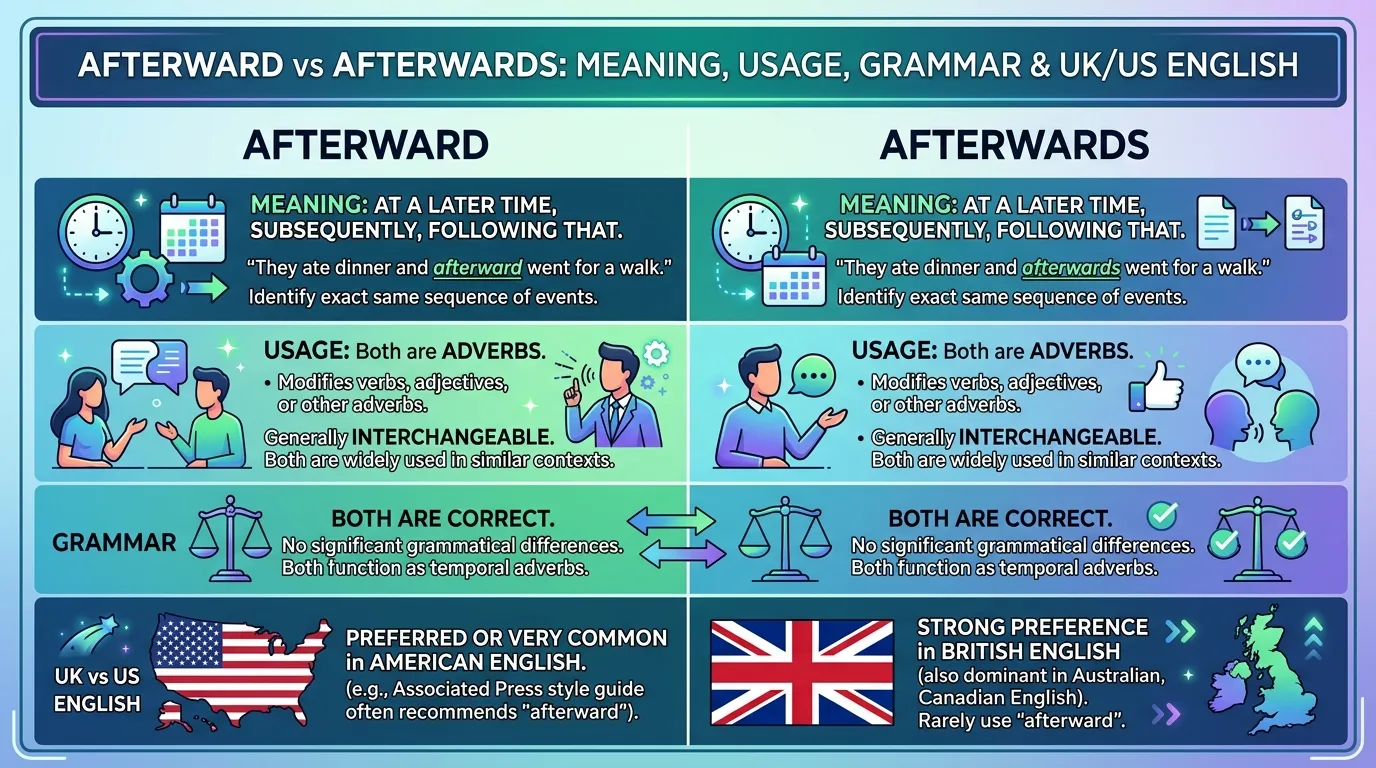
Have you ever wondered whether afterward vs afterwards is the correct spelling? The good news is that both words are correct. They have the same basic meaning: later, after something happens, or at a later time. The main difference is one of regional preference and style, not meaning or grammar.
In general, afterward is more common in American English, while afterwards is especially common in British English. However, both forms are understood and accepted in both varieties of English. So, if you write We went home afterward or We went home afterwards, your sentence is grammatically correct.
People often confuse afterward vs afterwards because the words look almost identical. The only difference is the final s, and many learners assume that one must be wrong. It is not. The best choice often depends on whether you are following US or UK English and whether you want to stay consistent with a particular style.
Quick Answer
| Form | Correct? | Common preference |
|---|---|---|
| afterward | ✅ Correct | More common in US English |
| afterwards | ✅ Correct | More common in UK English |
Quick rule: Use afterward or afterwards when you mean later or after that.
- ✅ We went out for coffee afterward.
- ✅ We went out for coffee afterwards.
- ❌ There is no general grammar rule saying afterwards is wrong.
- ❌ There is no general grammar rule saying afterward is wrong.
Afterward Meaning
Afterward is an adverb. It means later, after that, or at a later time following an event.
For example:
We finished the meeting and talked about the project afterward.
Here, afterward tells us when the second action happened. The meeting happened first, and the discussion happened later.
The word can appear at the beginning or end of a sentence, although it often comes at the end.
- Afterward, we went home.
- We went home afterward.
- She called me afterward.
The word does not describe a noun. Therefore, it is not an adjective.
Afterward Examples in American English
- We had dinner afterward.
- I will call you afterward.
- She felt better afterward.
- We discussed the problem afterward.
- They went to the bank afterward.
- He apologized afterward.
- I realized my mistake afterward.
Afterward Examples in British English
British speakers also use afterward, although afterwards is often preferred.
- We went home afterward.
- She spoke to her teacher afterward.
- They discussed the matter afterward.
- I saw him afterward.
- We had tea afterward.
So, afterward is not an American-only word. It is simply more strongly associated with American usage.
Afterwards Meaning
Afterwards is also an adverb and has exactly the same basic meaning as afterward.
It means:
- later
- after that
- at a later time
For example:
We went shopping and had lunch afterwards.
The shopping happened first. Lunch happened later.
Afterwards is especially common in British English, but it is also perfectly acceptable in American English.
Afterwards Examples in American English
- We went home afterwards.
- I called my mother afterwards.
- She felt tired afterwards.
- We talked about it afterwards.
- They went for coffee afterwards.
- He apologized afterwards.
- I understood what happened afterwards.
Afterwards Examples in British English
- We went to the pub afterwards.
- She called me afterwards.
- They had dinner afterwards.
- I spoke to the manager afterwards.
- We went back to school afterwards.
- He explained everything afterwards.
- They returned home afterwards.
Afterward vs Afterwards: Detailed Comparison
| Feature | Afterward | Afterwards |
|---|---|---|
| Meaning | Later; after that | Later; after that |
| Part of speech | Adverb | Adverb |
| Grammar | Correct | Correct |
| US English | Very common | Also used |
| UK English | Used | Very common |
| Formal writing | Acceptable | Acceptable |
| Informal writing | Acceptable | Acceptable |
| Pronunciation | /ˈæftərwərd/ | /ˈæftərwərdz/ |
| Meaning difference | None | None |
| Main difference | Regional/style preference | Regional/style preference |
The key grammar difference is actually very small: there is no difference in grammatical function. Both words work as adverbs of time.
Pronunciation Guide
The pronunciation can vary slightly depending on accent.
Afterward
IPA: /ˈæftərwərd/
It sounds roughly like:
AF-ter-wurd
Afterwards
IPA: /ˈæftərwərdz/
It sounds roughly like:
AF-ter-wurdz
The final s in afterwards is pronounced as a /z/ sound in normal speech.
Why Are They So Commonly Confused?
There are several reasons.
First, the words are almost identical in spelling. Second, they have exactly the same basic meaning. Third, English has many words that can take an s in one variety but not another.
Learners may also assume that afterwards is somehow a plural form of afterward. It is not. The s does not change the grammatical number because these words are adverbs, not plural nouns.
Afterward vs Afterwards: Word Origins and Etymology
Both words developed from the idea of something happening after another event.
The older English word after comes from an early Germanic word family connected with the idea of following or being later in time.
The element ward means something like in the direction of or toward. We can see the same pattern in words such as:
- forward
- backward
- homeward
- eastward
Therefore, afterward developed with the sense of moving or progressing to a time after an event.
The form afterwards developed by adding the adverbial -s ending. English has used similar forms for a long time. This is why afterwards is not a modern mistake or an informal corruption of afterward.
Both forms have a long history in English.
Afterward vs Afterwards Synonyms
If you are looking for an afterward vs afterwards synonym, several alternatives work well.
| Synonym | Meaning | US Usage | UK Usage |
|---|---|---|---|
| later | At a later time | Very common | Very common |
| after that | Following that event | Very common | Very common |
| subsequently | After something else | Formal | Formal |
| thereafter | From that time onward | Formal | Formal |
| following that | After that event | Common | Common |
| next | Immediately following | Common | Common |
| then | At that time or next | Very common | Very common |
For everyday conversation, later and after that are usually the easiest choices.
For formal reports, subsequently or thereafter may be suitable, although they can sound more formal than necessary.
Common Mistakes With Afterward and Afterwards
Mistake: Thinking Afterwards Is Wrong
❌ We went home afterwards.
Some learners mark this as wrong because they were taught that afterward is the only correct form.
✅ We went home afterwards.
Afterwards is correct.
Mistake: Thinking Afterward Is Wrong in British English
❌ British people cannot use afterward.
That is not true.
✅ British speakers can use afterward.
However, afterwards is often more natural in British English.
Mistake: Treating Afterwards as a Plural Noun
❌ The afterwards were difficult.
Neither afterward nor afterwards is normally a plural noun.
Instead:
✅ The events afterward were difficult to understand.
Mistake: Using the Word as an Adjective
❌ We discussed the afterward meeting.
This does not work.
Instead:
✅ We discussed the meeting afterward.
Mistake: Using It When You Mean Before
❌ We went home afterward the meeting.
Here, the structure is wrong because afterward is not normally followed directly by a noun in this way.
Better:
✅ We went home after the meeting.
Or:
✅ We went home afterward.
Mistake: Assuming the Final S Changes the Meaning
The s in afterwards does not make the word mean something different.
- I called him afterward.
- I called him afterwards.
Both mean that the call happened later.
Mistake: Mixing Regional Styles Without a Reason
This is not a grammar error, but consistency can improve polished writing.
If your document is written in American English, afterward may fit the style better. If it follows British English conventions, afterwards may feel more natural.
Afterward vs Afterwards in Real-Life Situations
Emails
American English:
Thank you for attending the meeting. I will send the documents afterward.
British English:
Thank you for attending the meeting. I will send the documents afterwards.
Both are correct.
Offices
We can discuss the budget afterward.
Or:
We can discuss the budget afterwards.
Banking
Please complete the application and contact the bank afterward.
Invoices
We will review the invoice and process the payment afterwards.
Schools
The students took the test and spoke with their teacher afterward.
Social Media
I was nervous before the presentation, but I felt great afterwards!
Rent Payments
I paid my rent and checked my bank account afterward.
Everyday Conversation
Let’s get coffee afterwards.
Or:
Let’s get coffee afterward.
Both sound natural.
Afterward in a Sentence: American English Examples
Here are ten useful afterward in a sentence examples:
- I went to the store afterward.
- We talked about the movie afterward.
- She called me afterward.
- He felt much better afterward.
- I sent an email afterward.
- They went home afterward.
- We cleaned the room afterward.
- She apologized afterward.
- I realized the truth afterward.
- We had lunch afterward.
Afterwards in a Sentence: British English Examples
Here are ten useful examples:
- We went home afterwards.
- I spoke to my teacher afterwards.
- She had a cup of tea afterwards.
- They went shopping afterwards.
- He called his friend afterwards.
- We discussed the issue afterwards.
- I felt relaxed afterwards.
- She explained the situation afterwards.
- They returned to the office afterwards.
- We had dinner afterwards.
Grammar Rule for Beginners
The easiest rule is this:
Afterward and afterwards are adverbs of time.
An adverb can tell us when, where, how, or to what degree something happens.
In these examples, the words answer the question When?
When did you call her?
I called her afterward.
When did you call her?
I called her afterwards.
Neither word is a verb.
Neither word is an adjective.
Neither word needs to agree with a noun.
What About Verb Forms?
You do not change afterward or afterwards according to the verb.
- I went afterward.
- She went afterward.
- They went afterward.
- We will go afterward.
The adverb stays the same.
Related Expressions
Several expressions are closely related to afterward and afterwards.
After
After can be a preposition, conjunction, or adverb.
We left after the meeting.
After that
This means the same general thing as afterward.
We finished the meeting. After that, we went home.
Later
Later is one of the simplest synonyms.
I will call you later.
Subsequently
This means afterward but is more formal.
The company subsequently changed its policy.
Thereafter
This means from that time forward.
The agreement was signed, and thereafter the new rules applied.
Five Memory Tricks
Remember the Simple Meaning
Think:
afterward = after + later
If something happens after another event, it happens afterward.
Think About the American Preference
Remember:
US → afterward
This is a useful shortcut, although Americans also use afterwards.
Think About the British Preference
Remember:
UK → afterwards
Again, this is a preference rather than an absolute rule.
Remember That Both Are Adverbs
If you remember that both words are adverbs, you will not mistakenly treat afterwards as a plural noun.
Focus on Meaning, Not the S
The final s does not create a new meaning.
Afterward = afterwards = later
FAQs
Is afterward or afterwards correct?
Both are correct. They have the same meaning and grammatical function. Afterward is more common in American English, while afterwards is especially common in British English.
Is afterward American or British?
Afterward is used in both American and British English. It is more strongly associated with American English, while British writers and speakers often prefer afterwards.
Is afterwards American English?
Yes. Afterwards is also used in American English, although afterward is generally more common in US usage.
What is the synonym of afterward?
Common synonyms include later, after that, subsequently, thereafter, and following that.
How do you pronounce afterward?
Afterward is commonly represented in IPA as /ˈæftərwərd/. The exact sound varies slightly by accent.
How do you pronounce afterwards?
Afterwards is commonly represented as /ˈæftərwərdz/. The final s is generally pronounced with a /z/ sound.
Is afterwards formal or informal?
Afterwards can be both formal and informal. It is perfectly normal in conversation, emails, essays, and professional writing.
Do American dictionaries accept afterwards?
Yes. Afterwards is a legitimate English word and is recognized by major English dictionaries. It is not an incorrect spelling.
Which should I use in formal writing?
Either can work. The best choice depends on your preferred variety of English and your style guide. In American English, afterward is often the natural choice. In British English, afterwards is often preferred.
Does afterward have a different meaning from afterwards?
No. In normal usage, they mean the same thing: later or after that.
People Also Ask
Is it better to say afterward or afterwards?
Neither is universally better. For US English, afterward is often preferred. For UK English, afterwards is often more common.
Is afterward grammatically correct?
Yes. Afterward is grammatically correct and functions as an adverb of time.
Is afterwards grammatically correct?
Yes. Afterwards is also grammatically correct and has the same basic function and meaning.
Can I use afterward in British English?
Yes. British English speakers can use afterward. It is simply less common than afterwards in many British contexts.
Can I use afterwards in American English?
Yes. Americans understand and use afterwards. However, afterward is often the more typical US choice.
Which is more common: afterward or afterwards?
Usage depends on the region. Afterward tends to be more common in American English, while afterwards tends to be more common in British English.
Is afterward one word?
Yes. Afterward is normally written as one word.
Is afterwards one word?
Yes. Afterwards is also written as one word.
Conclusion
When comparing afterward vs afterwards, the most important thing to remember is that both forms are correct. They both mean later, after that, or at a later time. The main difference is regional preference. Afterward is more common in American English, while afterwards is especially common in British English.
Both words are adverbs, so they can describe when an action happens. Neither is a verb, adjective, or plural noun. You can use either one in conversations, emails, school writing, professional documents, and everyday sentences.
If you write mainly in American English, afterward is a safe and natural choice. If you follow British English, afterwards may sound more familiar. Still, there is no need to call either form incorrect.
So the simple rule is:
Afterward = correct. Afterwards = correct.
Choose the form that matches your preferred variety of English, and most importantly, use it consistently.


