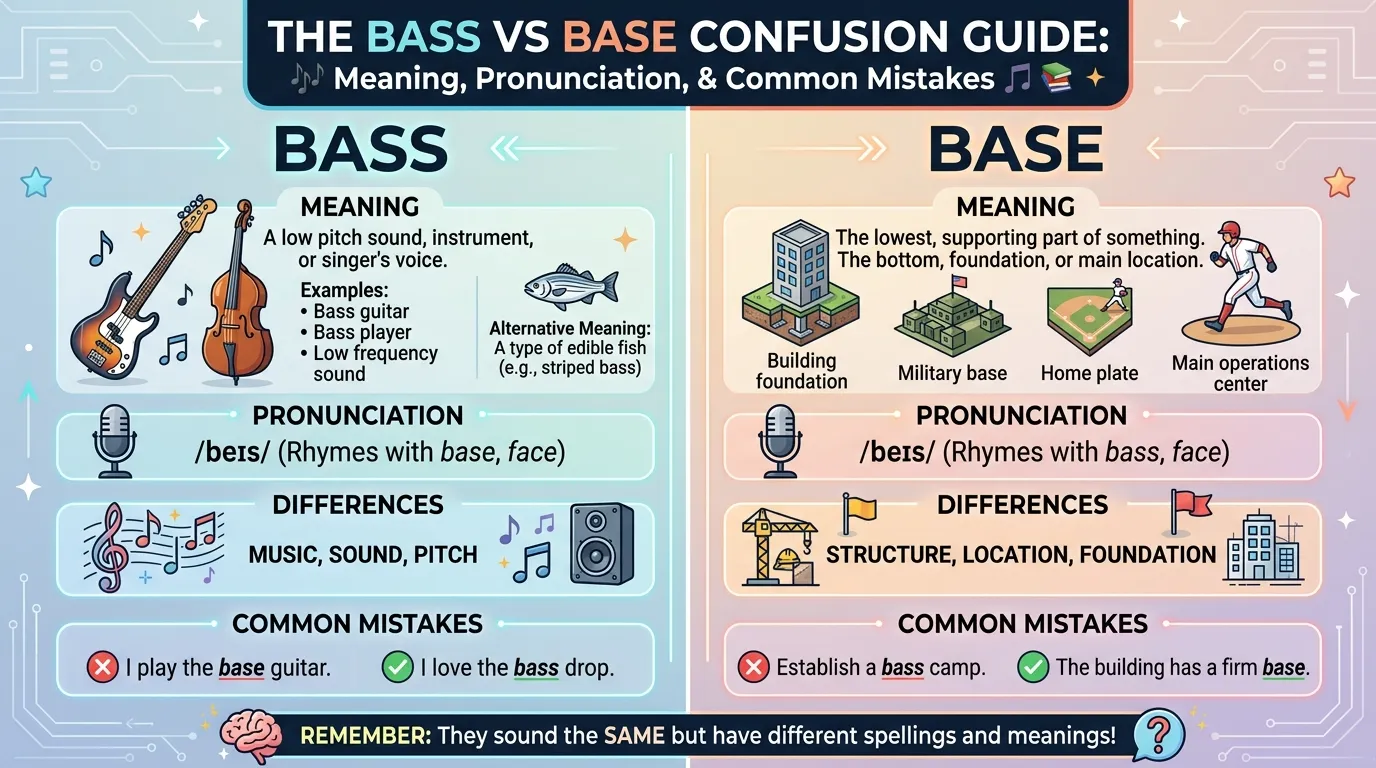
If you are unsure about bass vs base, you are not alone. These two words look and sound similar, but they have very different meanings. Bass can refer to a low musical sound, a musical instrument, or certain types of fish. Base usually refers to a bottom, foundation, starting point, or the main place from which someone or something operates. The key point is that bass and base are not interchangeable.
The confusion becomes stronger because musical bass is pronounced exactly like base: /beɪs/. However, bass can also be pronounced /bæs/ when it refers to certain fish. This pronunciation difference often surprises English learners.
The spelling is the same in UK and US English, and the main meanings are also the same. There is no major British-versus-American spelling change here. Still, some everyday expressions and word choices may vary slightly between British and American speakers.
In this guide, you will learn the bass vs base meaning, pronunciation, grammar, origins, correct usage, common mistakes, real-life examples, and easy memory tricks. By the end, choosing the right word should feel simple.
Quick Answer: Bass vs Base
| Word | Correct meaning | Pronunciation | Example |
|---|---|---|---|
| ✅ Bass | A low musical sound, instrument, or type of fish | /beɪs/ or /bæs/ | The bass guitar sounds deep. |
| ✅ Base | A foundation, bottom, starting point, or main location | /beɪs/ | The lamp has a heavy base. |
| ❌ Bass for foundation | Incorrect | — | ❌ The table has a strong bass. |
| ❌ Base for musical instrument | Usually incorrect | — | ❌ She plays the base guitar. |
So, if you mean music or a low sound, use bass.
If you mean a foundation, bottom, starting point, or central location, use base.
What Does Bass Mean?
Bass is a noun and, in some contexts, an adjective.
In music, bass means a low musical range, low sound, or instrument that produces low notes. Common examples include the bass guitar, bass drum, and bass clef.
Bass can also describe certain freshwater and saltwater fish.
Bass in American English: Examples
- I can hear the bass clearly in this song.
- He plays the bass guitar in a local band.
- Turn down the bass on the speakers.
- We caught a large bass at the lake.
- The song has a powerful bass line.
Bass in British English: Examples
- The bass gives the song a rich, deep sound.
- She plays bass in a school band.
- The speakers have strong bass.
- He went fishing for bass at the weekend.
- The musician adjusted the bass before the concert.
The meaning is essentially the same in British and American English.
Bass as a Musical Term
In music, bass can refer to:
- The lowest musical range
- A low-pitched sound
- A bass guitar
- A bass instrument
- A bass singer
- The bass part of a musical composition
For example:
The bass makes the song sound deeper.
What Does Base Mean?
Base is mainly a noun and verb. It can also work as an adjective in certain uses.
As a noun, base often means a bottom part, foundation, starting point, or central location.
For example:
The statue has a wide base.
Here, base means the bottom or supporting part of the statue.
It can also describe a place where people work or operate:
The soldiers returned to their base.
As a verb, base means to establish or develop something from a particular place, idea, fact, or principle.
The company is based in London.
Base in American English: Examples
- The vase has a wide base.
- Our office is based in Chicago.
- The decision was based on the available data.
- The building has a strong concrete base.
- We use this location as our main base.
Base in British English: Examples
- The table has a solid base.
- The company is based in Manchester.
- The report was based on recent research.
- The team returned to its base after the match.
- The statue stands on a stone base.
Again, the basic meaning does not change between UK and US English.
Bass vs Base: Detailed Comparison
| Feature | Bass | Base |
|---|---|---|
| Main meanings | Low sound, musical instrument, fish | Foundation, bottom, starting point, location |
| Part of speech | Mainly noun; also adjective | Mainly noun and verb; sometimes adjective |
| Musical use | Very common | Usually incorrect |
| Foundation meaning | Incorrect | Correct |
| Fish meaning | Correct | Incorrect |
| Musical pronunciation | /beɪs/ | /beɪs/ |
| Fish pronunciation | /bæs/ | — |
| UK usage | Same spelling and core meanings | Same spelling and core meanings |
| US usage | Same spelling and core meanings | Same spelling and core meanings |
| Example | The bass is too loud. | The base is too heavy. |
The biggest grammar difference is not simply pronunciation. The words belong to different meaning groups.
Bass vs Base Pronunciation Guide
Pronunciation is one of the most interesting parts of bass vs base.
Bass
Musical bass: /beɪs/
It sounds like base.
bass = “base”
Bass fish: /bæs/
It sounds like mass with a “b.”
bass = “bass” rhyming with “class”
Base
Base: /beɪs/
It rhymes with:
- face
- place
- case
- race
So:
- Musical bass → /beɪs/
- Base → /beɪs/
- Fish bass → /bæs/
This is why context matters.
The bass was loud. → music
I caught a bass. → fish
The statue has a stone base. → foundation
Why Are Bass and Base Commonly Confused?
There are three main reasons.
1. They sound identical in one common use
Musical bass and base are both pronounced /beɪs/.
2. They look almost identical
Both contain the letters bas followed by a different final letter.
3. English spelling is not always phonetic
English has many words whose spelling does not clearly reveal pronunciation.
For example:
- bass
- base
- case
- face
The spelling of bass is especially unusual because its pronunciation changes according to its meaning.
Word Origins and Etymology
Understanding word history can make the difference easier to remember.
Origin of Bass
The musical word bass comes from forms related to Italian basso, meaning “low.” It entered English through the language of music and developed into the modern term for low musical sounds and parts.
The fish meaning has a separate history. It comes from an older English word related to the name of the fish. This means the two meanings of bass are not simply two versions of the same original word.
Origin of Base
Base comes through French from Latin basis, meaning “foundation” or “support,” which ultimately comes from Greek basis, related to the idea of stepping or standing.
This history fits its modern meaning well. A base is something on which another thing stands or from which something begins.
Bass vs Base Synonyms
A useful bass vs base synonym comparison depends on the meaning you want.
| Word | Possible synonym | Best context |
|---|---|---|
| Bass | Low tones | Music |
| Bass | Low frequency | Audio |
| Bass | Low end | Informal music/audio |
| Base | Foundation | Buildings, ideas, structures |
| Base | Bottom | Physical objects |
| Base | Headquarters | Organization or operation |
| Base | Starting point | Plans, projects, activities |
| Base | Basis | Ideas, decisions, arguments |
For example, in American English, low end is common in casual audio talk:
The speakers have a strong low end.
In British English, low frequencies or bass may sound more neutral in technical or formal discussion.
However, foundation, basis, and headquarters are not perfect replacements in every sentence. Always choose a synonym based on context.
Seven Common Bass vs Base Mistakes
Mistake 1: “Base guitar”
❌ She plays the base guitar.
✅ She plays the bass guitar.
A musical instrument uses bass.
Mistake 2: “Bass of the building”
❌ The bass of the building is made of concrete.
✅ The base of the building is made of concrete.
Here, you mean the foundation or bottom.
Mistake 3: “Bass of the argument”
❌ That is the bass of my argument.
✅ That is the basis of my argument.
Here, basis is the better word because you mean the underlying reason or foundation of an idea.
Mistake 4: “Based” for music
❌ The song is based is very strong.
✅ The song has strong bass.
Mistake 5: Confusing the fish
❌ We caught a large base.
✅ We caught a large bass.
Mistake 6: Using “base” for low sound
❌ Increase the base on the speakers.
✅ Increase the bass on the speakers.
Mistake 7: Assuming bass always sounds like “mass”
❌ Musical bass is pronounced /bæs/.
✅ Musical bass is pronounced /beɪs/.
Remember that the fish and music meanings have different pronunciations.
Real-Life Bass vs Base Examples
These words appear in many everyday situations.
Emails
Please increase the bass slightly before sending the audio file.
The new office will be based in Boston.
Offices
Our regional base is in Denver.
The presentation uses a recording with very strong bass.
Banking
The interest calculation is based on the account balance.
Here, based comes from base, not bass.
Invoices
The tax is based on the total invoice amount.
Schools
The science project is based on a simple experiment.
The music teacher asked him to practice the bass part.
Social Media
This track has amazing bass!
Rent Payments
The rent increase is based on the terms of the lease.
Everyday Conversation
Turn down the bass.
Put the lamp on a stronger base.
Bass vs Base in a Sentence: American English
Here are ten natural examples:
- The bass in this song is fantastic.
- She plays bass in a jazz band.
- The table has a wide base.
- The company is based in Texas.
- We caught a bass during our fishing trip.
- The speaker produces deep bass.
- The decision was based on evidence.
- The statue sits on a marble base.
- He adjusted the bass on his headphones.
- The team uses the building as its main base.
Bass vs Base in a Sentence: British English
Here are ten natural examples:
- The bass sounds excellent on these speakers.
- He plays bass in a local band.
- The lamp has a heavy base.
- The firm is based in Bristol.
- We went fishing and caught a bass.
- The music has a deep bass line.
- The report is based on recent figures.
- The statue has a stone base.
- Could you turn down the bass?
- The team returned to its base after the match.
Grammar Rule: How to Choose the Correct Word
The easiest beginner rule is:
Ask what you mean before you choose the spelling.
Use bass when you mean:
- low musical sound
- bass instrument
- bass singer or musical part
- certain kinds of fish
Use base when you mean:
- foundation
- bottom
- starting point
- main location
- underlying support
- something from which another thing develops
Verb Forms of Base
Because base can be a verb, you may see:
- base
- bases
- based
- basing
Examples:
We base our decision on facts.
She bases her opinion on experience.
The plan is based on research.
They are basing their estimate on current prices.
There is no equivalent verb “bassed” for these meanings.
Five Easy Memory Tricks
1. Base = Bottom
Both base and bottom begin with the idea of support.
2. Bass = Sound
Think of bass when you hear music.
3. Bass Guitar Has Two S’s
The extra s can remind you of the deep sound.
4. Base = Basis
The words are closely related in meaning:
base → basis → foundation
5. Remember the Fish
The fish is bass, pronounced /bæs/.
The musical sound is also bass, but pronounced /beɪs/.
Related Words and Expressions
Several words can cause confusion alongside bass vs base.
Basis vs Base
Basis means the reason, foundation, or principle behind something.
The decision was made on the basis of cost.
Base can mean the physical or conceptual foundation.
The argument has a strong base.
In many abstract sentences, basis is the more natural choice.
Based vs Bass
Based means located, founded, or developed from something.
The company is based in London.
Bass relates to low sound, music, or fish.
The bass is too loud.
Baseline vs Base
A baseline is a starting level used for comparison.
We need a baseline before measuring progress.
It contains base, not bass.
FAQs About Bass vs Base
Is bass and base the same word?
No. They are different words with different meanings. Musical bass and base happen to have the same pronunciation, /beɪs/.
What is the difference between bass and base?
Bass usually refers to low musical sound, a bass instrument, or certain fish. Base usually means a foundation, bottom, starting point, or main location.
Is bass pronounced like base?
When bass refers to music, yes. Both are pronounced /beɪs/. When bass refers to the fish, it is pronounced /bæs/.
What is the synonym of base?
Depending on context, synonyms include foundation, bottom, basis, headquarters, starting point, and support.
What is the synonym of bass?
In music, possible alternatives include low tones, low frequencies, low end, or deep sound. The exact synonym depends on context.
Is bass British or American English?
Both British and American English use bass with the same spelling and the same main meanings. The musical pronunciation is /beɪs/ in both varieties.
Is base more formal than bass?
No. Neither word is automatically more formal. Formality depends on the sentence and context.
Which is correct: bass guitar or base guitar?
Bass guitar is correct. A base guitar is a spelling mistake when referring to the musical instrument.
Which is correct: base of a building or bass of a building?
Base of a building is correct when you mean its bottom or foundation.
Why does bass have two pronunciations?
English inherited the word bass from different historical sources and meanings. As a result, the spelling stayed the same while the pronunciations developed differently.
People Also Ask
What does bass mean?
Bass can mean a low musical sound, a musical instrument or part, or a type of fish.
What does base mean?
Base means a foundation, bottom, starting point, main location, or underlying support. It can also be a verb meaning to develop or establish something from a particular source.
Why do bass and base sound the same?
They sound the same when bass is used in its musical sense. Both are pronounced /beɪs/.
Is “bass” ever pronounced “bass” like “mass”?
Yes. When referring to the fish, bass is pronounced /bæs/.
Is there a UK vs US English difference?
There is no major spelling difference between bass and base in British and American English. Their core meanings and standard pronunciations are also the same.
Which word should I use in formal writing?
Use the word that matches your meaning. Use bass for musical or fish meanings and base for foundation, location, or starting-point meanings.
Final Thoughts
The easiest way to understand bass vs base is to focus on meaning rather than appearance. Bass is connected with low music, bass instruments, and certain fish. Base is connected with foundations, bottoms, starting points, locations, and things that support an idea or structure.
The most important pronunciation fact is simple: musical bass and base sound the same, /beɪs/. Fish bass is different and sounds like /bæs/. This is why context matters so much.
There is no major UK vs US English spelling difference. Both varieties use bass and base in essentially the same ways. When writing an email, report, invoice, school assignment, social media post, or everyday message, ask yourself what you mean first.
If you mean low sound or music, choose bass. If you mean foundation, bottom, location, or starting point, choose base. Once you connect each spelling with its meaning, this common mistake becomes much easier to avoid.