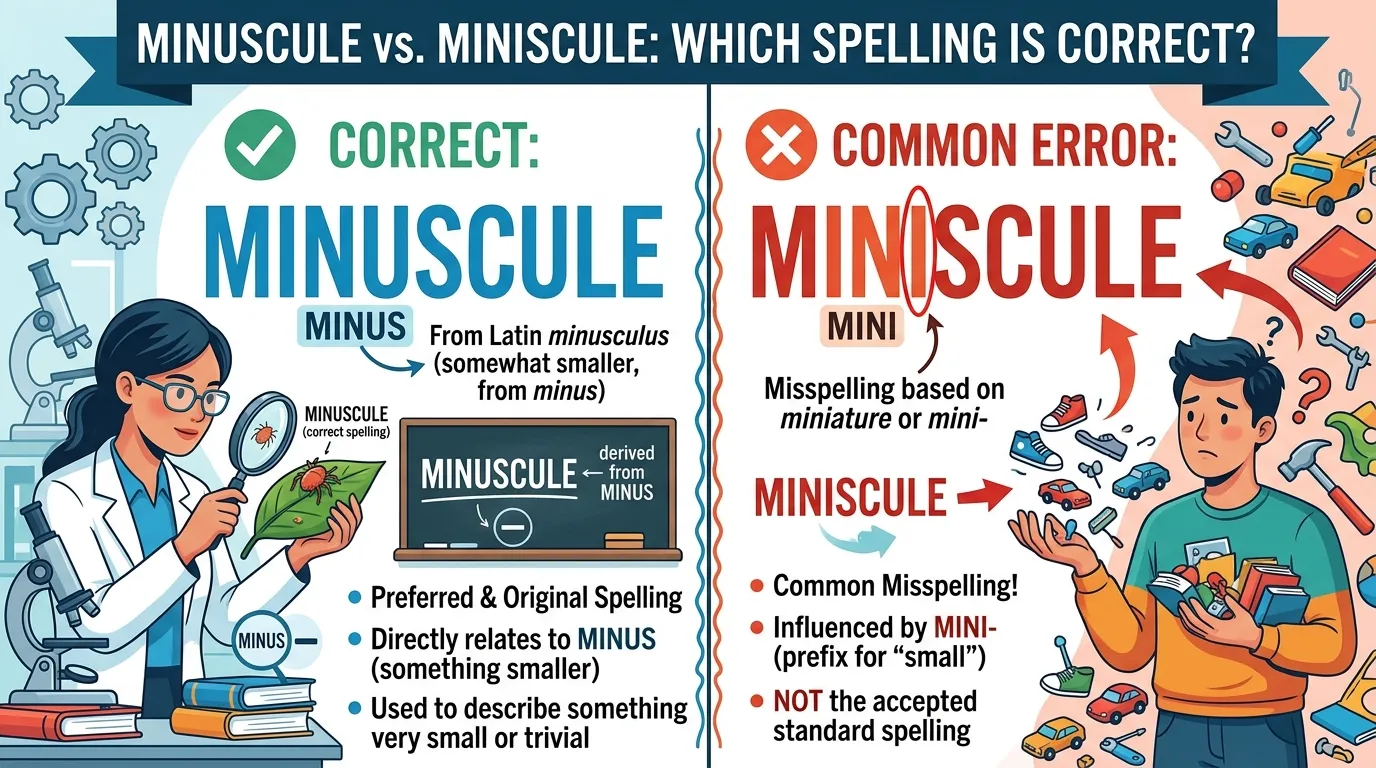
If you are unsure about minuscule vs miniscule, the standard spelling you should use is minuscule. The form miniscule is widely seen, but it is generally treated as a misspelling or nonstandard variant in careful edited English. This is true in both US and UK English: the preferred spelling is minuscule.
People often confuse minuscule vs miniscule because the word is pronounced in a way that can make the middle letters hard to hear. Many speakers naturally write mini- because they connect the word with mini, meaning small. However, minuscule did not develop from the modern English word mini. It comes from Latin and has a different historical spelling.
Understanding the minuscule meaning, pronunciation, origin, and grammar makes the correct spelling much easier to remember. Whether you are writing an email, school assignment, business report, invoice, or social media post, minuscule is the safest and most widely accepted choice.
Quick Answer
- ✅ Correct: minuscule
- ❌ Usually considered incorrect/nonstandard: miniscule
- 🇺🇸 US English: minuscule
- 🇬🇧 UK English: minuscule
- Meaning: extremely small; tiny; very slight
- Part of speech: mainly an adjective; also a noun in specialized contexts
Example
The difference in price was minuscule.
Not:
The difference in price was miniscule.
What Does Minuscule Mean?
The word minuscule means extremely small, tiny, or very slight.
It can describe something that is physically small:
- a minuscule insect
- a minuscule piece of paper
- minuscule text
It can also describe something that is small in amount or importance:
- a minuscule amount of money
- a minuscule difference
- a minuscule chance
- a minuscule error
So, minuscule does not always mean something you can physically see. It can describe a very small quantity, degree, effect, or possibility.
Minuscule as an adjective
The most common grammatical use is as an adjective.
The company made a minuscule profit.
Here, minuscule describes the size of the profit.
Minuscule as a noun
In specialized writing, minuscule can also be a noun. It refers to a style of small-letter handwriting or type, especially historical handwriting used in medieval manuscripts.
For example:
The manuscript was written in medieval minuscule.
This noun use is much less common in everyday English.
Minuscule Examples in American English
Here are natural minuscule examples in US English:
- The price increase was minuscule.
- We found only a minuscule amount of dust.
- She made a minuscule mistake in the report.
- The apartment has a minuscule kitchen.
- There is a minuscule chance of rain tonight.
- The difference between the two products is minuscule.
- He earned a minuscule amount from the sale.
- The print on the document was minuscule.
- The bank charged a minuscule processing fee.
- A minuscule insect was sitting on the window.
Minuscule Examples in British English
The spelling is also minuscule in standard British English.
- The cottage has a minuscule garden.
- The increase in rent was minuscule.
- We noticed a minuscule crack in the wall.
- The difference was minuscule compared with last year.
- He had only a minuscule amount of time left.
- The writing was so minuscule that I could barely read it.
- There was a minuscule error on the invoice.
- The chance of success seemed minuscule.
- She made a minuscule contribution to the project.
- The room felt minuscule after the furniture arrived.
Minuscule vs Miniscule: Comparison Table
| Feature | Minuscule | Miniscule |
|---|---|---|
| Standard spelling | ✅ Yes | ❌ Generally no |
| Meaning | Extremely small | Intended to mean extremely small |
| Part of speech | Adjective; sometimes noun | Usually used as an attempted adjective |
| US English | Preferred | Common misspelling |
| UK English | Preferred | Common misspelling |
| Formal writing | Recommended | Avoid |
| Academic writing | Recommended | Avoid |
| Business writing | Recommended | Avoid |
| Pronunciation | Similar to MIN-uh-skool | Often pronounced the same |
| Example | A minuscule amount | A miniscule amount |
The key grammar difference is actually not between two different meanings. The two spellings are usually intended to represent the same word. The important difference is standard spelling and correct usage.
Why Is Miniscule Considered Wrong?
The spelling miniscule is easy to understand because English has the word mini, which means small.
That creates a natural spelling trap.
However, minuscule comes from a different historical source. The spelling contains -usc-, not -isc-.
Because miniscule appears often in informal writing, it can look correct. Search engines, social media, emails, and user-generated content all contain the spelling. Frequent use, however, does not automatically make a spelling standard.
Some dictionaries may record miniscule as a variant or acknowledge its widespread use. Still, if you want the safest choice for school, professional, academic, or formal writing, use minuscule.
Incorrect and corrected examples
❌ The difference was miniscule.
✅ The difference was minuscule.
❌ We paid a miniscule fee.
✅ We paid a minuscule fee.
❌ The error was miniscule.
✅ The error was minuscule.
❌ She had a miniscule amount of cash.
✅ She had a minuscule amount of cash.
Pronunciation of Minuscule vs Miniscule
The pronunciation is one reason people make this spelling mistake.
Minuscule
IPA: /ˈmɪnəskjuːl/
A simple pronunciation guide is:
MIN-uh-skool
Depending on accent, the middle vowel may sound slightly different.
Miniscule
When people write miniscule, they generally intend to pronounce it like minuscule.
That is why hearing the word does not always help you choose the spelling.
The sound can encourage people to connect the word with mini, but the historical spelling is minuscule.
Why Are Minuscule and Miniscule So Commonly Confused?
There are several reasons.
The word sounds like it contains mini
English speakers know mini means small. Since minuscule also means very small, it is natural to assume the word is built from mini.
It is not.
The middle letters are difficult to hear
In normal speech, the middle syllable is unstressed. As a result, the difference between the written forms is not obvious when someone says the word.
Miniscule looks logical
English has many words containing mini-:
- miniature
- minivan
- miniskirt
- miniseries
- minibus
So miniscule can look perfectly reasonable even though minuscule is the standard form.
Word Origin and Etymology
The history of minuscule explains the spelling.
It ultimately comes from Latin minusculus, meaning rather small or somewhat smaller. This word is related to Latin minus, meaning less.
The word entered English through the history of writing and typography. It became associated with small letters and handwriting, especially medieval forms of script.
Later, its meaning expanded into the everyday adjective we use today: extremely small.
This history is important because it shows that minuscule was not formed from the modern English word mini.
That is the main reason the spelling is minuscule, not miniscule.
Minuscule Synonyms
If you are looking for a minuscule synonym, several choices work well.
| Synonym | Meaning | Common Use |
|---|---|---|
| Tiny | Very small | Everyday English |
| Very small | Small in size | Simple, clear writing |
| Minute | Extremely small | Formal and technical |
| Microscopic | Extremely small | Physical size |
| Tiny little | Very small | Informal |
| Slight | Small in degree | Changes or differences |
| Negligible | Too small to matter | Business and technical writing |
| Trivial | Very small in importance | Formal or critical contexts |
| Infinitesimal | Extremely, almost impossibly small | Technical/formal |
| Insignificant | Not important or large | Formal writing |
For beginners and ESL learners, tiny and very small are usually the easiest alternatives.
In business writing, negligible may be better when you mean that something is too small to have a meaningful effect.
For scientific or technical writing, microscopic or infinitesimal may be more precise.
Common Mistakes With Minuscule
Using miniscule because it sounds like mini
❌ The fee was miniscule.
✅ The fee was minuscule.
Remember that mini is not the source of the word.
Adding unnecessary endings
❌ The difference was minusculely small.
✅ The difference was minuscule.
The adjective already means extremely small.
Using minuscule when you mean unimportant
Minuscule primarily describes size, amount, or degree. If you mean something has no importance, insignificant may be more precise.
❌ His opinion was minuscule.
✅ His opinion was insignificant.
Confusing minuscule with miniature
These words are related in meaning but are not identical.
Miniature often describes something made in a smaller version of a normal object.
Minuscule simply means extremely small.
Assuming miniscule is the US spelling
It is not a US-versus-UK spelling difference.
Both varieties of standard English prefer minuscule.
Avoiding the word because it seems too formal
Minuscule is perfectly normal in modern English. You can use it in conversation, emails, articles, and everyday writing.
Treating minuscule as a verb
Minuscule is not normally used as a verb.
You can say:
The amount is minuscule.
You would not normally say:
We minuscule the amount.
Minuscule in Real-Life Writing
Emails
The remaining balance is minuscule, so we can close the account.
Offices
There is a minuscule difference between the two figures.
Banking
The bank charged a minuscule service fee.
Invoices
The invoice contains a minuscule calculation error.
Schools
The student made a minuscule spelling error.
Social media
The update made a minuscule difference to the app.
Rent payments
The increase in monthly rent was minuscule.
Everyday conversation
The scratch is minuscule. You can barely see it.
These examples show that minuscule works naturally in both casual and formal contexts.
Minuscule in a Sentence: American English
Here are ten more examples showing correct usage:
- The apartment was minuscule but comfortable.
- The amount of sugar in the drink was minuscule.
- We saw a minuscule bird near the fence.
- The change in temperature was minuscule.
- Her chance of winning was not minuscule after all.
- The company reported a minuscule increase in sales.
- The font was minuscule on my phone.
- He received a minuscule discount.
- The scratch on the screen was minuscule.
- The mistake had a minuscule effect on the final result.
Minuscule in a Sentence: British English
Here are ten examples suitable for British English:
- The flat has a minuscule bathroom.
- The increase in the bill was minuscule.
- The error on the form was minuscule.
- She noticed a minuscule mark on the page.
- The difference between the prices was minuscule.
- We had a minuscule amount of time remaining.
- The garden is minuscule but charming.
- The fee was minuscule compared with the total cost.
- His contribution was minuscule.
- The crack in the window was minuscule.
UK vs US English: Is There a Difference?
There is no major UK vs US English spelling difference here.
The standard spelling is:
minuscule
This applies to both American and British English.
You may encounter miniscule in writing from either country, but it should not be treated as a normal American spelling versus a British spelling.
For formal work, choose minuscule regardless of which variety of English you are using.
Minuscule vs Miniature vs Minute
These related words can cause another type of confusion.
| Word | Main Meaning | Example |
|---|---|---|
| Minuscule | Extremely small | A minuscule error |
| Miniature | A small version of something | A miniature car |
| Minute | Extremely small; also a unit of time | A minute detail |
| Microscopic | Too small or extremely small to see easily | Microscopic organisms |
| Negligible | So small that it has little effect | A negligible cost |
The context determines the best word.
If you are talking about a small amount, minuscule is often a good choice.
If you are talking about a small model or copy, miniature is usually better.
The Grammar Rule Behind Minuscule
The easiest grammar rule is simple:
Minuscule is an adjective that describes something extremely small.
It usually comes before a noun:
a minuscule amount
a minuscule error
a minuscule room
It can also come after a linking verb:
The amount was minuscule.
The difference seems minuscule.
As a noun, it has a specialized meaning connected with handwriting and typography.
There is no normal everyday verb form of minuscule. You should not try to create one.
Five Memory Tricks for Minuscule
Think of minus
Minuscule begins with minus, and minus relates to something less or smaller.
Remember the U
Picture the word as:
MIN-U-SCULE
The U helps separate the correct spelling from miniscule.
Mini is the trap
When you think mini, stop. Ask yourself:
Is the word actually spelled with mini?
No. It is minuscule.
Say MIN-uh-skool
Breaking the pronunciation into parts can help you remember the spelling:
MIN + U + SCULE
Write it three times
Try:
minuscule — minuscule — minuscule
Writing the correct form repeatedly can make the unusual spelling familiar.
Frequently Asked Questions
Is minuscule or miniscule correct?
Minuscule is the standard spelling. Miniscule is widely used but is generally considered a misspelling or nonstandard variant in careful writing.
What is the meaning of minuscule?
Minuscule means extremely small, tiny, or very slight.
Is miniscule ever accepted?
Some dictionaries and usage references acknowledge miniscule as a variant because it is widely used. However, minuscule remains the safest choice for formal, academic, and professional writing.
How do you pronounce minuscule?
It is commonly pronounced approximately MIN-uh-skool, with the IPA /ˈmɪnəskjuːl/.
Is minuscule a formal word?
It can be used in both everyday and formal English. It is especially useful when you want to emphasize that something is extremely small.
What is a good synonym for minuscule?
Good synonyms include tiny, very small, minute, microscopic, negligible, slight, and infinitesimal. The best choice depends on context.
Is minuscule the same in UK and US English?
Yes. Minuscule is the preferred spelling in both standard British and American English.
Can minuscule be a noun?
Yes. In specialized contexts, minuscule can refer to a style of small-letter handwriting or type, especially in historical manuscripts.
Is minuscule appropriate in professional writing?
Yes. It is a standard English word and can be used in reports, emails, invoices, financial documents, academic work, and other professional writing.
People Also Ask
Is miniscule a spelling mistake?
Usually, yes. Miniscule is commonly treated as a misspelling of minuscule, although some dictionaries recognize it as a variant because of its widespread use.
Why is minuscule spelled with a U?
The spelling comes from Latin minusculus, related to minus, meaning less or smaller. It was not created from the English word mini.
Does minuscule mean very small?
Yes. Its most common meaning is extremely small or slight.
What is the opposite of minuscule?
Depending on context, possible opposites include huge, enormous, massive, substantial, significant, or considerable.
Should I use minuscule in an essay?
Yes. Minuscule is appropriate for academic essays and formal writing. Avoid miniscule if you want to follow standard edited spelling.
Final Takeaway
When choosing between minuscule vs miniscule, remember one simple rule: use minuscule. It is the standard spelling in both American and British English and means extremely small, tiny, or very slight.
The confusion happens because minuscule sounds as if it might be connected to mini, but its real history comes from Latin minusculus, related to minus. That history explains the unusual -usc- spelling.
You can use minuscule before a noun, as in a minuscule amount, or after a linking verb, as in the difference was minuscule. It works in casual conversation as well as professional and academic writing.
So whether you are writing about a bank fee, rent payment, invoice, school assignment, business report, or everyday situation, choose minuscule. Once you connect the word with minus and remember the U, the spelling becomes much easier to remember.


