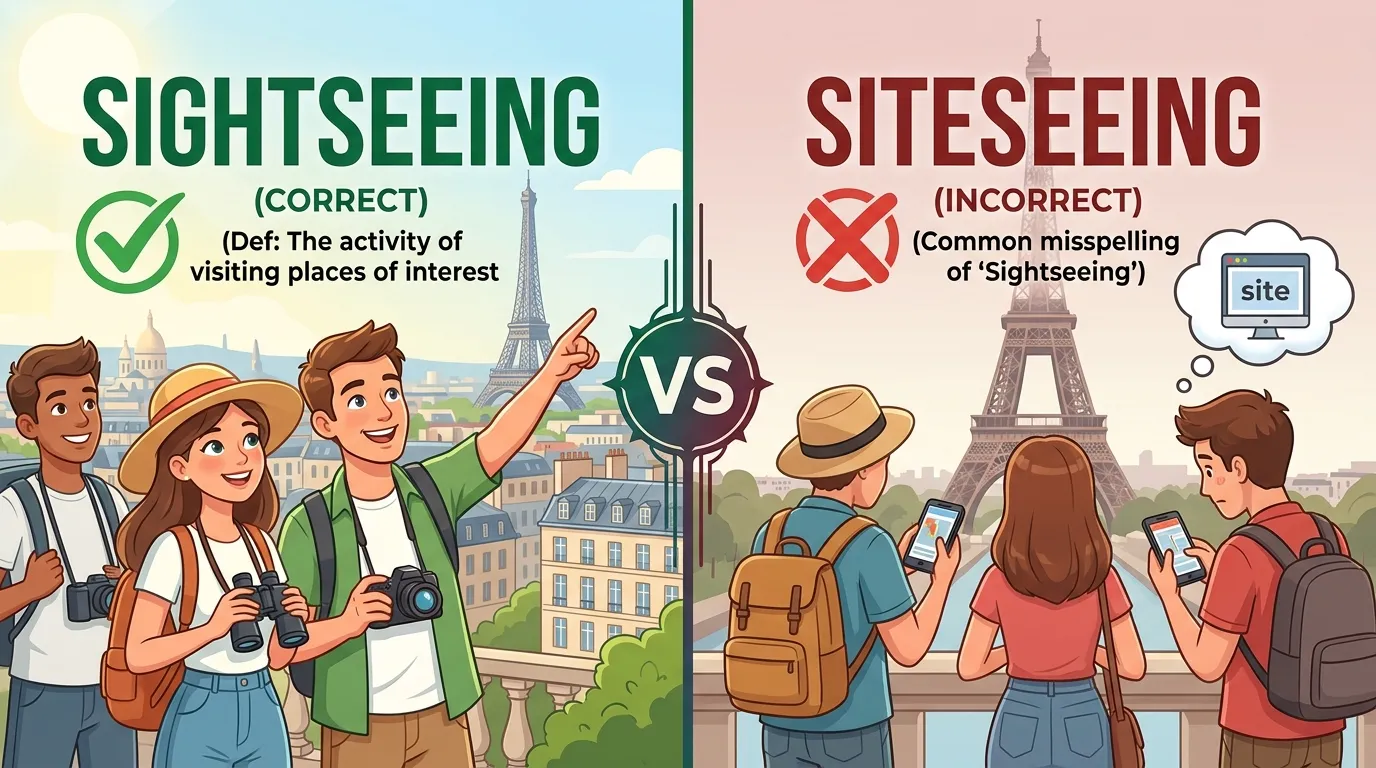
If you have ever wondered about sightseeing vs siteseeing, you are not alone. These two spellings look very similar, but only one is the standard English word. The correct spelling is sightseeing, while siteseeing is generally considered a misspelling when you mean visiting interesting places and attractions.
The word sightseeing combines sight, meaning something worth seeing, with seeing, meaning looking at or visiting things. It is used in both American English and British English, so there is no major UK vs US English spelling difference here.
For example, you can say, “We went sightseeing in London,” or “They spent the afternoon sightseeing in New York.” You should not normally write, “We went siteseeing.”
People often confuse sightseeing vs siteseeing because the activity involves visiting different sites, such as museums, landmarks, parks, and historic buildings. However, the traditional word is based on sight, not site. Once you understand this simple grammar and spelling rule, the difference becomes much easier to remember.
Quick Answer
| Form | Correct? | Meaning |
|---|---|---|
| Sightseeing | ✅ Correct | Visiting or looking at interesting places and attractions |
| Siteseeing | ❌ Usually incorrect | Not the standard spelling for tourism or visiting attractions |
| Sight-seeing | ⚠️ Usually unnecessary | An older or less common form; modern English normally uses sightseeing |
Correct usage:
✅ We went sightseeing during our vacation.
Incorrect usage:
❌ We went siteseeing during our vacation.
The important point is simple: Use sightseeing when you mean visiting interesting places for pleasure or tourism.
Sightseeing Meaning
The sightseeing meaning is the activity of visiting or looking at interesting, famous, beautiful, or historic places.
A person who travels to another city may go sightseeing to see:
- Famous buildings
- Historic landmarks
- Museums
- Natural attractions
- Monuments
- Parks
- Castles
- Beaches
- Cultural sites
- Tourist attractions
Sightseeing is usually used as a noun or as part of a compound expression.
For example:
- We went sightseeing after breakfast.
- Sightseeing is popular in Rome.
- They booked a sightseeing tour.
- She spent the day sightseeing.
The word can describe both the general activity and organized tourist trips.
Is Sightseeing One Word?
Yes. In modern standard English, sightseeing is normally written as one word.
The spelling is:
sight + seeing = sightseeing
The first part is sight, not site.
This distinction matters because sight and site have different meanings.
Sight means something that can be seen or the ability to see.
The mountain was an amazing sight.
Site means a place or location.
The company chose a new site for its office.
Although tourists often visit different sites, the name of the activity is sightseeing.
Why Is Siteseeing Wrong?
The spelling siteseeing seems logical at first. After all, tourists often visit different sites. However, English words do not always form compounds from the most obvious related word.
Sightseeing is an established word with a long history. It refers to looking at sights or attractions.
Therefore:
❌ We spent the weekend siteseeing.
✅ We spent the weekend sightseeing.
❌ She loves siteseeing in European cities.
✅ She loves sightseeing in European cities.
The spelling siteseeing may occasionally appear online as a typo or as an intentional wordplay based on site, but it is not the normal standard spelling for tourism.
Sightseeing vs Siteseeing: Grammar Difference
The main grammar difference is actually a spelling and word formation issue.
Sightseeing is a compound formed from sight + seeing.
It can function as a noun:
Sightseeing is one of my favorite travel activities.
It can also appear in common compound expressions:
We joined a sightseeing tour.
The word seeing comes from the verb see, while sight is a noun.
Common Forms
| Expression | Correct? | Example |
|---|---|---|
| sightseeing | ✅ | We went sightseeing. |
| sightseeing tour | ✅ | We booked a sightseeing tour. |
| sightseeing bus | ✅ | The sightseeing bus stopped downtown. |
| sightseeing trip | ✅ | They planned a sightseeing trip. |
| sightseeing activities | ✅ | The city offers many sightseeing activities. |
| siteseeing | ❌ | Avoid this spelling for tourism. |
Sightseeing Examples in American English
Here are natural sightseeing examples commonly used in American English:
- We went sightseeing in Chicago.
- They spent Saturday sightseeing around Washington, D.C.
- I want to go sightseeing when I visit California.
- The hotel offers a free sightseeing tour.
- We took a sightseeing bus around the city.
- New York is a great place for sightseeing.
- She spent the morning sightseeing and the afternoon shopping.
- Our family planned several sightseeing activities.
- We stopped for lunch during our sightseeing trip.
- The guide showed us the best sights in the city.
Sightseeing Examples in British English
The same standard spelling is used in British English:
- We went sightseeing around London.
- They spent the afternoon sightseeing in Edinburgh.
- We booked a sightseeing tour of the city.
- She enjoys sightseeing when she travels abroad.
- The hotel is close to several popular sights.
- We went sightseeing after visiting the museum.
- They took a sightseeing bus through central London.
- There are plenty of sightseeing opportunities nearby.
- We spent our first day sightseeing.
- The guide recommended several places for sightseeing.
So, there is no important UK vs US English difference in the spelling of this word.
Sightseeing in a Sentence
Here are more examples of sightseeing in a sentence:
We went sightseeing as soon as we arrived in Paris.
The family spent the entire day sightseeing.
I enjoy sightseeing more than shopping when I travel.
Our sightseeing tour included several historic buildings.
She took pictures while sightseeing downtown.
They planned a sightseeing trip for the weekend.
The city is famous for its beautiful sightseeing attractions.
We had enough time for sightseeing before our flight.
He joined a guided sightseeing tour.
After checking into the hotel, we went sightseeing.
These examples show that sightseeing commonly follows verbs such as go, enjoy, plan, spend, and join.
Sightseeing vs Siteseeing Comparison
| Feature | Sightseeing | Siteseeing |
|---|---|---|
| Standard spelling | ✅ Yes | ❌ No |
| Meaning | Visiting or viewing attractions | Not the standard tourism term |
| Word formation | Sight + seeing | Site + seeing |
| Common in US English | Yes | No |
| Common in UK English | Yes | No |
| Dictionary form | Yes | Generally not accepted as the standard form |
| Example | We went sightseeing. | We went siteseeing. ❌ |
| Formal writing | Appropriate | Avoid |
| Informal writing | Appropriate | Usually a spelling mistake |
Sightseeing Pronunciation
The pronunciation of sightseeing is:
/ˈsaɪtˌsiːɪŋ/
It sounds roughly like:
SYTE-see-ing
The word contains two recognizable parts:
- sight → /saɪt/
- seeing → /ˈsiːɪŋ/
The pronunciation of siteseeing, if someone reads the spelling literally, may sound similar. This is one reason the spelling can be confusing.
However, pronunciation should not be used to decide the spelling. English has many words that sound alike or almost alike but have different spellings and meanings.
Compare:
- sight = something seen
- site = a place
- seeing = looking or observing
The correct compound is sightseeing.
Word Origins and Etymology
Understanding the etymology makes the spelling easier to remember.
The word sight comes from Old English siht, related to the act or ability of seeing. Over time, sight developed several meanings connected with vision, something visible, and an impressive or notable thing to see.
The word see has very old Germanic roots and has been part of English since its earliest stages. Its form seeing is the present participle of see.
The compound sightseeing developed from the idea of seeing sights. In other words, sightseeing literally involves going out to see notable or interesting things.
The spelling therefore connects naturally with sight, not site.
Sightseeing Synonyms
If you are looking for a sightseeing synonym, several alternatives can work depending on the context.
| Synonym or Alternative | Meaning | Common Use |
|---|---|---|
| touring | Traveling around places of interest | US and UK |
| exploring | Discovering a place | Very common |
| visiting attractions | Going to tourist attractions | Clear and formal |
| touring the city | Visiting important parts of a city | US and UK |
| looking around | Informal exploration | More conversational |
| taking a tour | Joining an organized trip | US and UK |
| seeing the sights | Visiting notable attractions | Very natural |
In both American and British English, sightseeing and seeing the sights are especially natural.
Common Mistakes and Corrections
Using Siteseeing
❌ We went siteseeing in London.
✅ We went sightseeing in London.
Confusing Sight and Site
❌ The activity is called siteseeing because you visit sites.
✅ The activity is called sightseeing because the traditional compound is based on sight.
Adding a Hyphen
❌ We went sight-seeing.
✅ We went sightseeing.
The hyphenated form may appear in older writing, but modern standard usage generally prefers the closed compound.
Using Sightseeing as a Regular Verb
❌ We sightseeing every weekend.
✅ We go sightseeing every weekend.
Sightseeing does not normally work as a standalone base verb.
Writing Sight Seeing as Two Words
❌ We went sight seeing.
✅ We went sightseeing.
The standard form is one word.
Confusing Sightseeing With Site Visits
A site visit is different.
The engineer made a site visit to the construction project.
That is not the same as tourism or sightseeing.
Assuming UK English Uses Siteseeing
It does not. British English also uses sightseeing.
Real-Life Examples
Emails
We will have some free time for sightseeing after the conference.
Offices
The team is planning a sightseeing tour after the business meeting.
Banking
The bank’s international staff enjoyed sightseeing during their trip.
Invoices
The invoice includes transportation for the sightseeing tour.
Schools
Students will have an afternoon of sightseeing during the field trip.
Social Media
Had an amazing day sightseeing around the city!
Rent Payments
I will make my rent payment before leaving for a weekend of sightseeing.
Everyday Conversation
What are you doing today?
We are going sightseeing.
These examples show that sightseeing works naturally in formal, professional, academic, and casual contexts.
Sightseeing and Related Expressions
Some expressions are closely related to the focus keyword but are not identical.
Sightseeing means the activity of visiting or viewing attractions.
Site visit means going to a particular location, often for work, construction, research, or inspection.
Tourism is the broader activity of traveling for pleasure or recreation.
Traveling is broader still and does not necessarily involve visiting attractions.
Exploring can be used more widely and may involve discovering neighborhoods, nature, food, or culture.
For example:
We went sightseeing in Rome.
The architect made a site visit.
Tourism supports many local businesses.
We spent two weeks traveling through Europe.
Five Memory Tricks for Sightseeing
Remember Sight Comes First
Think:
SIGHT = something you see.
Then:
SIGHT + SEEING = SIGHTSEEING.
Think About Tourist Sights
Tourists go to see famous sights.
So remember:
See sights → sightseeing.
Separate Sight and Site
Sight = see
Site = place
Since sightseeing is about seeing attractions, choose sight.
Use the Phrase Seeing the Sights
If you can remember:
We are seeing the sights.
You can easily convert it to:
We are sightseeing.
Picture a Tourist
Imagine a tourist taking pictures of famous sights. The person is sightseeing, not siteseeing.
Is Sightseeing Formal or Informal?
Sightseeing is neutral and widely accepted. You can use it in casual conversations, school assignments, travel writing, emails, and professional communication.
For very formal writing, you may sometimes choose visiting attractions or visiting places of interest, depending on the context.
However, there is nothing informal or incorrect about sightseeing itself.
FAQs About Sightseeing vs Siteseeing
Is sightseeing the correct spelling?
Yes. Sightseeing is the standard spelling when you mean visiting or viewing tourist attractions.
Is siteseeing a word?
Siteseeing is not the standard spelling for the tourism activity. It is usually a misspelling of sightseeing.
What does sightseeing mean?
Sightseeing means visiting or viewing interesting, famous, historic, cultural, or natural attractions.
Is sightseeing one word?
Yes. Modern standard English normally writes sightseeing as one word.
Is sightseeing different in British and American English?
No significant spelling difference exists. Sightseeing is standard in both American and British English.
What is a synonym for sightseeing?
Common alternatives include touring, exploring, seeing the sights, and visiting attractions.
How do you pronounce sightseeing?
It is pronounced /ˈsaɪtˌsiːɪŋ/, approximately SYTE-see-ing.
Can I use sightseeing in formal writing?
Yes. Sightseeing is acceptable in formal and informal writing.
Why do people spell sightseeing as siteseeing?
People often connect tourism with visiting different sites. However, the established word is based on sight, meaning something worth seeing.
Should sightseeing be hyphenated?
Usually no. Sightseeing is normally written as one word in modern English.
People Also Ask
Is it sightseeing or siteseeing?
It is sightseeing. The spelling siteseeing is generally incorrect when referring to tourism.
Why is it called sightseeing?
The word comes from the idea of seeing sights, meaning notable or interesting things that are worth viewing.
What is the difference between sight and site?
Sight relates to seeing or something seen. Site means a place or location. This difference explains why sightseeing is correct.
Do Americans say sightseeing?
Yes. Sightseeing is very common in American English.
Do British people say sightseeing?
Yes. British English also uses sightseeing.
What is another way to say sightseeing?
You can say seeing the sights, touring, exploring, or visiting attractions, depending on the situation.
Conclusion
When comparing sightseeing vs siteseeing, the choice is clear: sightseeing is the correct standard form. It means visiting or viewing interesting places, landmarks, attractions, and other things worth seeing. The word is used naturally in both American and British English, so there is no major UK vs US English spelling difference to remember.
The easiest way to remember the correct usage is to connect the word with sight. Tourists go out to see sights, which gives us sightseeing. Although siteseeing may look logical because travelers often visit different sites, it is not the standard spelling for this activity.
So, whenever you write about travel, tourism, vacations, landmarks, or attractions, choose sightseeing. Once you connect the word with sight rather than site, this common spelling mistake becomes much easier to avoid.


