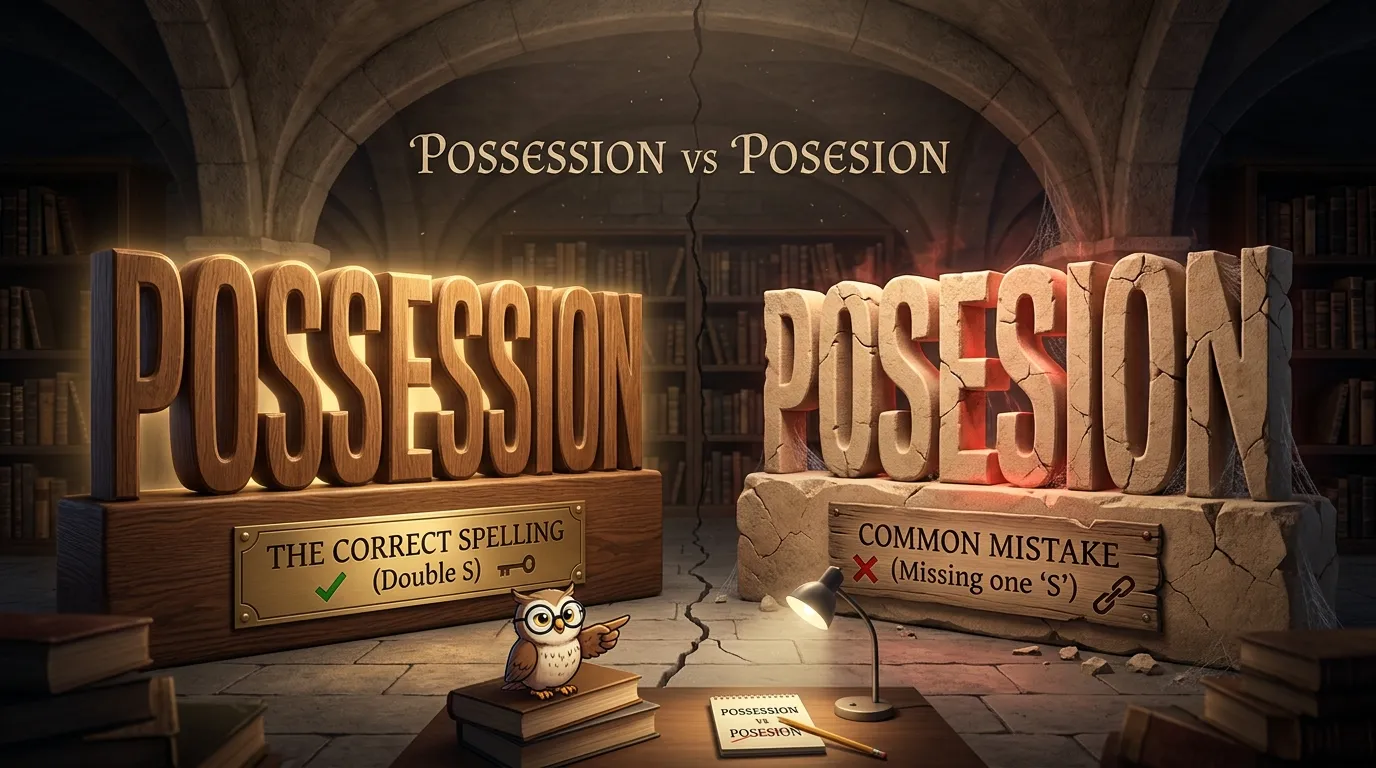
English spelling often becomes difficult when a word contains double letters, especially when those letters are not strongly heard in pronunciation. One common example is possession vs. posession. Many English learners and even native speakers accidentally leave out one s when writing this word. The two spellings look almost identical, but only one is correct in standard English.
The correct spelling is possession. The spelling posession is a common misspelling and should be avoided in professional, academic, and everyday writing.
The word possession is important because it has several meanings and appears in many different areas of English. In everyday conversations, it can describe something that a person owns, such as a phone, car, house, or personal item. In legal writing, possession can refer to having control or custody of something. In sports, especially soccer, basketball, and football, possession describes control of the ball. The word is also connected to grammar through the related words possess and possessive.
Learning the correct spelling is easier when you understand the structure of the word. Possession contains four s’s, arranged into two pairs of double s’s. Looking at the word as POS + SESSION can help you remember why the second s should not be removed.
In this guide, we will explain possession vs. posession, define the word, explore its grammar and pronunciation, provide real-world examples, discuss common mistakes, and give you simple memory tricks and practice exercises. By the end, you will know exactly when and how to use possession correctly.
What Is the Correct Spelling?
The correct spelling is:
Possession ✅
The incorrect spelling is:
Posession ❌
The correct spelling is:
P-O-S-S-E-S-S-I-O-N
A useful way to remember it is:
POS + SESSION = POSSESSION
What Does Possession Mean?
Possession is a noun that generally refers to owning, having, or controlling something.
It can have different meanings depending on the context.
For example:
This laptop is my personal possession.
Here, possession means something that a person owns.
In another situation:
The documents are in her possession.
Here, possession means that she has physical control or custody of the documents.
In sports:
Our team had possession of the ball.
Here, possession means control of the ball.
Why Is “Posession” Incorrect?
The spelling posession is incorrect because it leaves out one s.
Compare the two:
❌ POSESION
✅ POSSESSION
The correct word contains SS after po and another SS later in the word.
Think of it as:
PO + SS + E + SS + ION
This gives:
POSSESSION
Possession vs. Posession
| Word | Correct? | Meaning |
|---|---|---|
| Possession | ✅ Correct | Ownership, control, or something owned |
| Posession | ❌ Incorrect | Common spelling mistake |
If you are writing an email, essay, article, report, or professional document, always use possession.
How to Remember the Spelling of Possession
One of the easiest memory tricks is:
Possession has two sets of double S’s.
Look closely:
PO-SS-E-SS-ION
You can remember:
SS + SS = POSSESSION
Another helpful trick is to connect the word with session:
POS + SESSION
When you put them together:
POSSESSION
This makes it easier to remember the double s.
Possession as a Noun
Possession is a noun.
It can describe something owned by someone.
Examples
- My phone is my personal possession.
- The painting is one of her most valuable possessions.
- He packed all his personal possessions.
- The property is now in their possession.
The plural form is:
possession → possessions
Possession in Everyday English
The word is frequently used when talking about personal belongings.
For example:
She lost one of her most important possessions.
Please keep your personal possessions with you.
The bag is currently in my possession.
His books are among his most valuable possessions.
In these examples, possession refers to something someone owns or has with them.
Possession in Legal English
Possession is especially common in legal contexts.
It can refer to having physical control or custody of something, and in some contexts it can also relate to legal ownership.
Examples include:
The documents were found in his possession.
The property remains in her possession.
The court considered whether the item was in the defendant’s possession.
The exact legal meaning can depend on the law and circumstances.
Possession in Sports
In sports, possession means control of the ball or another object used in play.
For example:
The team maintained possession for most of the match.
The player lost possession of the ball.
Our team had more possession during the second half.
This use is especially common in soccer, basketball, football, and other team sports.
Possession and Grammar
The word possession is connected to the idea of ownership in grammar.
English uses possessive forms to show that something belongs to someone or something.
For example:
Sarah’s book
The ‘s shows that the book belongs to Sarah.
Other examples include:
John’s car
The dog’s bowl
Maria’s phone
The related words are:
- Possess — verb
- Possession — noun
- Possessive — adjective/noun related to ownership
- Possessor — someone who possesses something
Possess vs. Possession
Although these words are related, they have different grammatical roles.
Possess
Possess is a verb.
She possesses excellent communication skills.
Possession
Possession is a noun.
Her skills are valuable possessions.
More commonly, possession refers to an owned item, control, or custody.
Possession vs. Ownership
Possession and ownership are closely related, but they do not always mean exactly the same thing.
Ownership usually focuses on the legal or recognized right to own something.
He has ownership of the property.
Possession can focus more on having or controlling something.
The keys are in her possession.
A person may sometimes have possession of an object without being its legal owner.
Possession vs. Property
These words can also overlap.
Property can refer to something owned by a person or organization.
The house is private property.
Possession can refer to the act or state of having something, or the thing that is owned.
The house is one of his most valuable possessions.
Common Spelling Mistakes
1. Posession
❌ Posession
✅ Possession
One s is missing.
2. Possesion
❌ Possesion
✅ Possession
The second pair of s’s is missing one letter.
3. Posesssion
❌ Posesssion
✅ Possession
There should not be three s’s together.
Pronunciation of Possession
Possession is commonly pronounced approximately:
puh-ZESH-un
The pronunciation may vary slightly depending on accent.
Because the four s’s are not pronounced as four separate sounds, it is easy to forget one of them when spelling the word.
That is why remembering the written pattern is more useful than trying to spell the word from pronunciation.
Examples of Possession in Sentences
Here are several examples from different contexts:
- The phone is in my possession.
- She packed her personal possessions.
- The police found the item in his possession.
- The team maintained possession of the ball.
- The painting is one of his most valuable possessions.
- The keys were left in her possession.
- He lost possession of the ball.
- Please take care of your personal possessions.
Practice: Fill in the Blanks
Choose possession or posession.
- The documents are in her ________.
- He packed all of his personal ________.
- The team kept ________ of the ball.
- This watch is one of my most valuable ________.
Answers
- possession
- possessions
- possession
- possessions
Multiple-Choice Practice
Which spelling is correct?
A. Posession
B. Possesion
C. Possession
D. Posesssion
Answer: C. Possession
Which sentence is correct?
A. The keys are in my posession.
B. The keys are in my possession.
Answer: B
Sentence Rewriting Practice
Incorrect
The documents are in his posession.
Correct
The documents are in his possession.
Incorrect
She packed her personal posessions.
Correct
She packed her personal possessions.
Incorrect
The team lost posession of the ball.
Correct
The team lost possession of the ball.
Frequently Asked Questions
Is “possession” the correct spelling?
Yes. Possession is the correct standard English spelling.
Is “posession” correct?
No. Posession is a common spelling mistake.
How do you spell possession?
It is spelled:
P-O-S-S-E-S-S-I-O-N
How many S’s are in possession?
There are four S’s in the word possession.
What does possession mean?
It can mean ownership, control, custody, or something that someone owns.
What is the plural of possession?
The plural is possessions.
She packed her personal possessions.
What is the related verb?
The related verb is possess.
He possesses valuable knowledge.
Quick Comparison
| Feature | Possession | Posession |
|---|---|---|
| Correct spelling | ✅ | ❌ |
| Standard English | Yes | No |
| Part of speech | Noun | — |
| Meaning | Ownership, control, or something owned | — |
| Plural | Possessions | — |
| Related verb | Possess | — |
| Memory tip | SS + SS | Missing an S |
Conclusion
Understanding the difference between possession vs. posession is a simple but useful step toward improving your English spelling. The correct spelling is possession, while posession is a common spelling error that should be avoided.
The easiest way to remember the correct spelling is to focus on its two sets of double S’s:
PO-SS-E-SS-ION
You can also remember the word as:
POS + SESSION = POSSESSION
The word possession is used in many areas of English. It can describe something a person owns, something under someone’s control, or the state of having something. It is common in everyday conversations, legal writing, business communication, sports reporting, and academic writing.
It is also important to understand the related forms possess, possessions, and possessive. Knowing how these words are connected can make both spelling and grammar easier to understand.
Whenever you are unsure, remember:
Possession = Correct ✅
Posession = Incorrect ❌
With the simple SS + SS memory trick, you can confidently spell possession correctly and avoid one of the most common spelling mistakes in English.