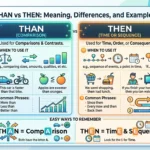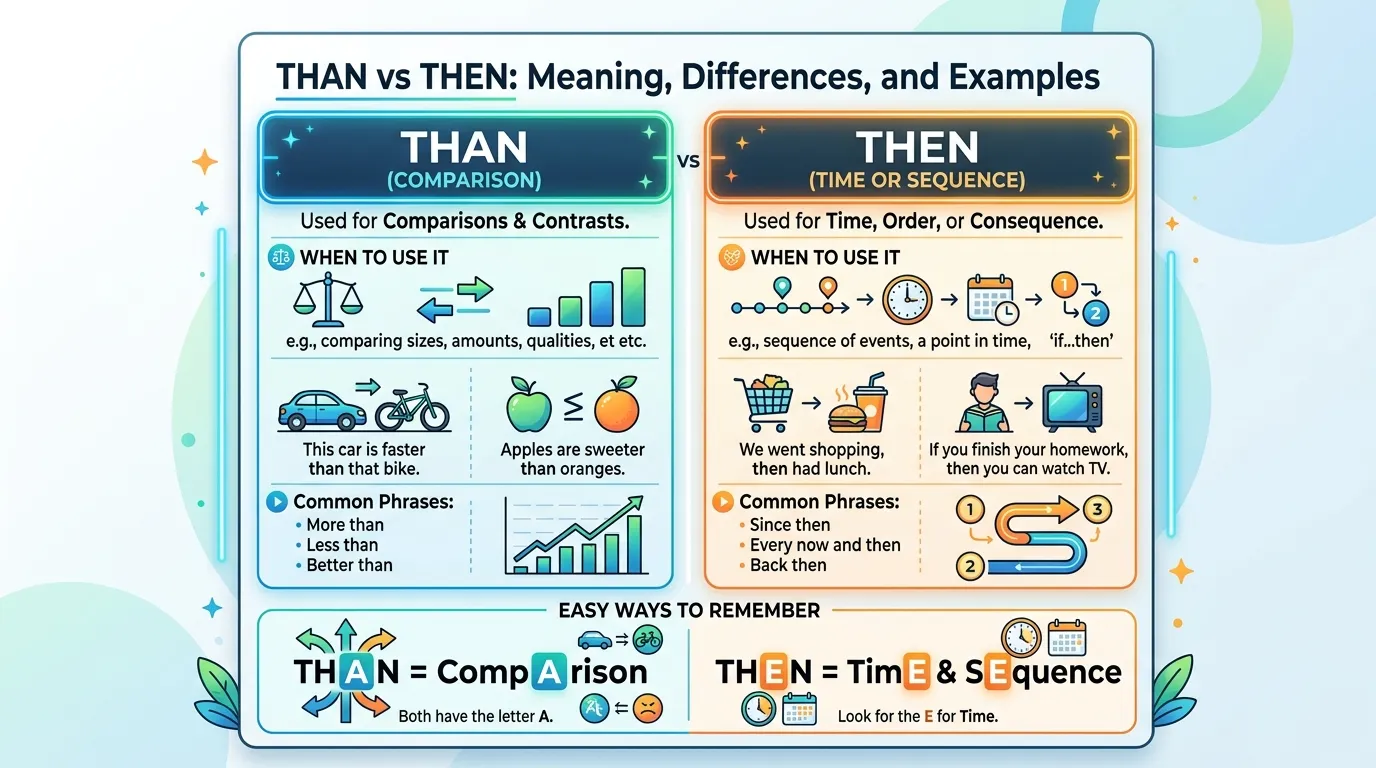
If you often pause when writing than vs then, you are not alone. These two words look and sound similar, but they have completely different jobs in a sentence. Than is mainly used when you compare two or more things. Then usually tells us about time, order, or what happens next. For example, you might say, “My car is faster than yours,” but “I finished work, then I went home.”
The confusion is common because the words differ by only one letter and can sound similar in fast speech. Both American and British English use than and then in the same basic ways. There is no major UK vs US English grammar difference in their meanings or correct usage.
Understanding the than vs then grammar difference is useful in school, business writing, emails, social media, and everyday conversation. Once you learn the simple rule, choosing the right word becomes much easier.
Quick Answer
Here is the easiest way to remember the difference:
| Word | Correct use | Example |
|---|---|---|
| Than ✓ | Used for comparisons | Sarah is taller than Mia. |
| Then ✓ | Used for time, order, or results | We ate dinner, then watched a movie. |
| Than ✗ | Wrong when you mean “next” or “after that” | I went home than I slept. |
| Then ✗ | Wrong when making a comparison | She is older then me. |
Simple rule:
Than = comparison
Then = time or sequence
A useful memory sentence is:
Better than something, and then something happens.
What Does Than Mean?
Than is a conjunction or preposition used mainly to compare people, things, amounts, or qualities.
It often appears after comparative words such as:
- better
- bigger
- smaller
- faster
- slower
- older
- younger
- more
- less
- fewer
- easier
- harder
Than in American English
Here are common American English examples:
- My house is bigger than yours.
- This test was easier than the last one.
- James runs faster than I do.
- She has more experience than her brother.
- Today is warmer than yesterday.
Than in British English
British English uses than in the same way:
- London is larger than many British cities.
- This book is better than the first one.
- Your new office is closer than mine.
- The train was later than expected.
- He is younger than his sister.
There is no meaningful difference here between American and British English.
What Does Then Mean?
Then is mainly an adverb. It can describe a time, an order of events, or a result.
It can mean:
- at that time
- next
- afterward
- in that case
- as a result
For example:
- I was living in Chicago then.
- First, wash the vegetables. Then cut them.
- We had dinner and then went home.
- If you are tired, then you should rest.
- Finish your homework, then you can play.
Then in American English
- I finished my report and then sent it.
- Back then, I lived with my parents.
- First, call the bank. Then check your account.
- We can talk then.
- If that is true, then we need another plan.
Then in British English
- We had tea and then went for a walk.
- I lived in Manchester then.
- First, take the train. Then change at Leeds.
- We can discuss it then.
- If you agree, then we can continue.
Again, the basic correct usage is the same in both varieties of English.
Than vs Then: The Main Grammar Difference
The easiest way to understand the than vs then difference is to look at what the word does.
| Feature | Than | Then |
|---|---|---|
| Main meaning | Comparison | Time, order, or result |
| Common part of speech | Conjunction or preposition | Adverb |
| Main question answered | How do two things compare? | When or what happens next? |
| Common words nearby | better, bigger, more, less | first, next, after, later |
| Example | This is cheaper than that. | Buy this, then go home. |
| UK usage | Same | Same |
| US usage | Same | Same |
Think of than as a comparison word and then as a timeline word.
Than vs Then in a Sentence
Seeing the words in complete sentences makes the difference clearer.
Examples with Than
- My new phone is faster than my old phone.
- This lesson is more useful than the previous one.
- She is better at math than I am.
- The rent is higher than last year.
- This invoice is larger than expected.
Examples with Then
- I checked the invoice and then called the customer.
- We went to the bank and then returned to the office.
- First, pay the bill. Then keep the receipt.
- I was younger then.
- If you agree, then sign the form.
Why Do People Confuse Than and Then?
There are several reasons.
First, the words look almost identical. The only difference is the letter a and e.
Second, their pronunciation can become less distinct in quick conversation.
Third, autocorrect and casual texting can make mistakes easy to miss.
Fourth, many learners memorize the words without learning their grammatical roles.
The best solution is not to memorize spelling alone. Learn what each word does.
If you are comparing, choose than.
If you are talking about time, order, or a result, choose then.
Pronunciation Guide
The standard pronunciations are:
| Word | IPA | Simple pronunciation |
|---|---|---|
| than | /ðæn/ | th-an |
| then | /ðen/ | th-en |
Both begin with the voiced th sound /ð/, as in this and that.
The vowel is different:
- than has the /æ/ sound, similar to the vowel in cat
- then has the /e/ sound, similar to the vowel in bed
In natural speech, especially in fast conversation, these sounds can become less noticeable. This is one reason the words are frequently confused in writing.
Word Origins and Etymology
Although than and then look closely related, their histories are different.
Than comes from Old English forms such as þanne and þan, which were connected with comparison. Over time, the word developed into the modern English than.
Then also comes from Old English. It developed from forms such as þanne and þonne, which referred to time or a particular point in sequence.
Their historical forms were similar, which helps explain why modern learners may find them confusing. However, their modern meanings have become clearly separated.
Than vs Then Synonyms
The words do not have exact synonyms in every sentence. However, some alternatives can help you understand their meanings.
| Word | Possible alternative | Example |
|---|---|---|
| Than | compared with | She is taller than me. |
| Than | in comparison with | It is cheaper than the other one. |
| Then | next | We ate, then left. |
| Then | afterward | We left afterward. |
| Then | later | I will call you later. |
| Then | at that time | I lived there then. |
In both American and British English, than is normally preferred for direct comparisons. Then is normally preferred for sequence and time.
Seven Common Than vs Then Mistakes
Mistake 1: Using Then for a Comparison
Incorrect:
My car is faster then yours.
Correct:
My car is faster than yours.
The sentence compares two cars, so use than.
Mistake 2: Using Than for Sequence
Incorrect:
I finished work than went home.
Correct:
I finished work, then went home.
The sentence describes what happened next, so use then.
Mistake 3: More Then
Incorrect:
She has more money then I do.
Correct:
She has more money than I do.
The word more signals a comparison.
Mistake 4: First Than
Incorrect:
First finish the form, than submit it.
Correct:
First finish the form, then submit it.
The sentence describes two steps in order.
Mistake 5: Better Then
Incorrect:
This option is better then the other one.
Correct:
This option is better than the other one.
Better than is a comparison.
Mistake 6: Back Than
Incorrect:
Back than, people used paper checks more often.
Correct:
Back then, people used paper checks more often.
Back then refers to an earlier time.
Mistake 7: If Then Confusion
Incorrect:
If you are ready, than we can begin.
Correct:
If you are ready, then we can begin.
Here then introduces a result or consequence.
Real Life Examples
Emails
Correct:
Please review the document and then send your comments.
Comparison:
This version is clearer than the previous one.
Offices
I will speak with the manager and then update you.
The new system is faster than the old system.
Banking
Check your balance and then confirm the transfer.
The transfer fee is lower than last month.
Invoices
Please review the invoice and then contact our accounts team.
Invoice 204 is larger than invoice 203.
Schools
Finish the exercise and then turn the page.
This lesson is easier than yesterday’s lesson.
Social Media
I thought the new version was better than the old one.
I posted the photo and then checked the comments.
Rent Payments
Pay the rent first, then save the receipt.
This month’s rent is higher than last month’s rent.
Everyday Conversation
Let’s have coffee and then go shopping.
Your new phone looks better than mine.
Ten American English Examples
- My brother is taller than me.
- This restaurant is cheaper than the other one.
- I finished my work and then went home.
- She arrived earlier than expected.
- First, open the app, then enter your password.
- This road is longer than the highway.
- I lived there then.
- He earns more than his coworker.
- We can talk then.
- The weather is better than yesterday.
Ten British English Examples
- This train is faster than the old one.
- I had breakfast and then went to work.
- Your garden is larger than ours.
- First, take the lift and then turn left.
- She is more experienced than her colleague.
- I was living in London then.
- This option is cheaper than the other one.
- We can discuss it then.
- The new office is closer than the old one.
- He finished the meeting and then went home.
Related Words and Expressions
Some expressions make the difference especially easy to spot.
Expressions with Than
- rather than
- more than
- less than
- better than
- worse than
- greater than
- smaller than
- other than
Examples:
I would walk rather than drive.
She has more than enough time.
Expressions with Then
- back then
- until then
- since then
- now and then
- first, then
- and then
Examples:
I knew him back then.
We have not spoken since then.
I visit my hometown now and then.
Five Easy Memory Tricks
Trick 1: A Means Against
Think of the A in than as standing for against. When you compare two things, they are being measured against each other.
Trick 2: E Means Events
The E in then can remind you of events happening in order.
Trick 3: Than Has Comparison Partners
Words like more, less, better, worse, bigger, and smaller often take than.
Trick 4: Then Has a Timeline
Imagine a timeline:
First → Then → Next → Later
Trick 5: Ask One Simple Question
Ask yourself:
Am I comparing?
Yes → than
Am I talking about when or what happens next?
Yes → then
Formal vs Informal Usage
Both than and then are standard words used in formal and informal English.
You can use them in:
- academic essays
- business emails
- reports
- contracts
- school assignments
- text messages
- social media
- everyday speech
The important point is not formality. It is correct usage.
A spelling mistake such as “better then” instead of “better than” can look careless in professional writing, so it is worth checking carefully.
FAQs
Is than or then correct?
Both are correct words, but they are used differently. Than is mainly for comparisons. Then is mainly for time, sequence, or results.
What is the difference between than and then?
The main grammar difference is meaning. Than compares things, while then describes time, order, or a result.
What is the than vs then meaning?
The than vs then meaning depends on the word’s role. Than means that two things are being compared. Then refers to a time, sequence, or consequence.
What is the pronunciation of than and then?
Than is commonly pronounced /ðæn/, while then is commonly pronounced /ðen/. Their similar sounds contribute to confusion.
Is than different in British and American English?
No major difference exists. Both American and British English use than for comparisons.
Is then different in British and American English?
No. The basic meaning and grammar of then are the same in both varieties.
What is a synonym for than?
There is no perfect synonym in every context. Expressions such as compared with and in comparison with can sometimes replace a comparison using than.
What is a synonym for then?
Depending on the sentence, possible alternatives include next, afterward, later, and at that time.
Is than formal or informal?
Than is standard in both formal and informal English. It is appropriate for professional writing, academic work, and everyday conversation.
Is then a conjunction?
Usually, then functions as an adverb. It can show time, sequence, or a result. Its exact role can depend on the sentence structure.
People Also Ask
When should I use than?
Use than when comparing two or more people, objects, amounts, or qualities.
This book is better than that one.
When should I use then?
Use then when talking about time, sequence, or a consequence.
Finish your work, then take a break.
Is it better than or better then?
The correct expression is better than because it compares two things.
Is it first then or first than?
The correct phrase is first, then because it describes the order of events.
Is it more than or more then?
The correct expression is more than because more introduces a comparison.
Is it back then or back than?
The correct expression is back then because it refers to an earlier time.
How can I remember than vs then?
Remember this simple rule: than compares, then continues the timeline.
Final Conclusion
The difference between than vs then is simple once you focus on meaning rather than spelling. Use than when you compare people, things, amounts, or qualities. Use then when you talk about time, order, what happens next, or a result.
For example, “This phone is cheaper than mine” uses than because it makes a comparison. “I bought the phone and then went home” uses then because it shows the next event.
The same basic rule applies in American and British English, so learners do not need to memorize separate UK and US rules. When checking your writing, ask one question: Am I comparing, or am I talking about time or sequence? If you are comparing, choose than. If you are describing what happens next or when something happened, choose then. With this simple habit, one of the most common English mistakes becomes much easier to avoid.