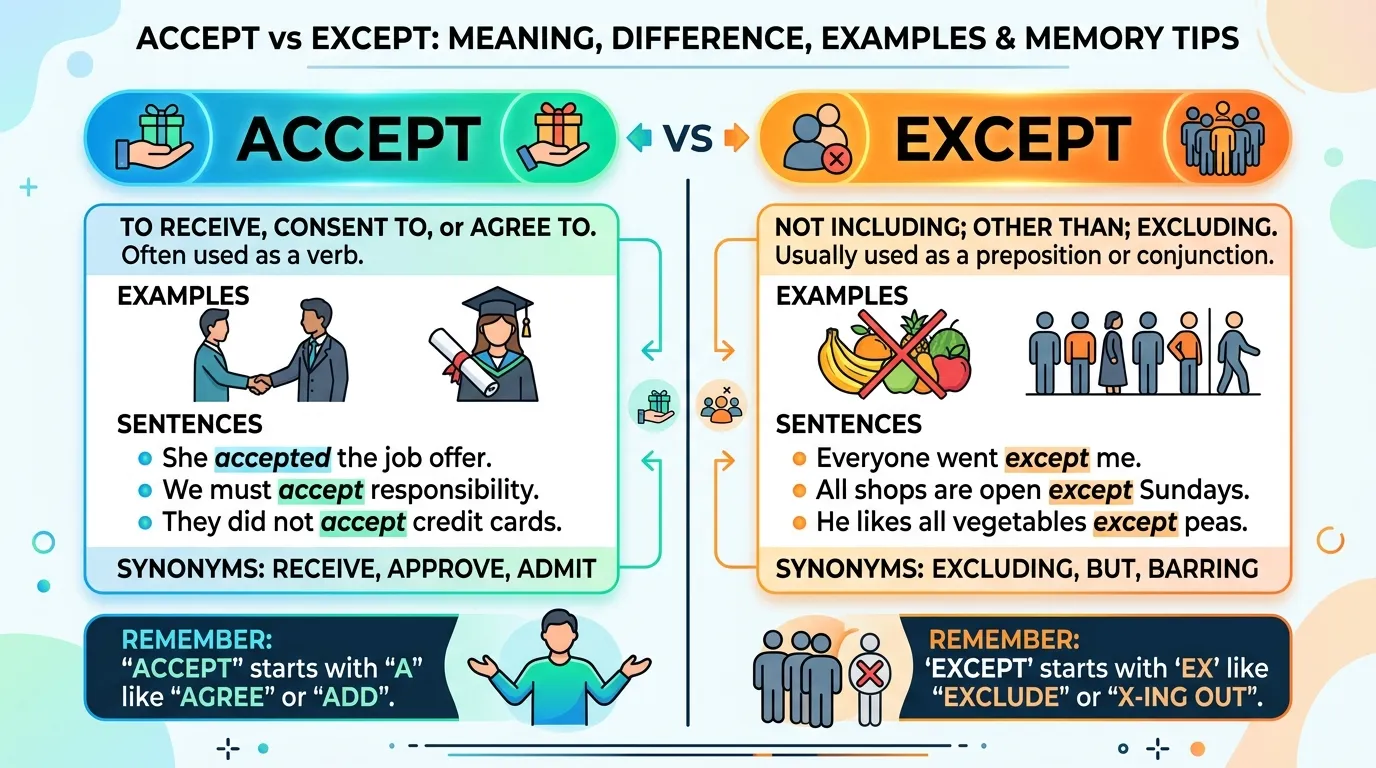
Accept vs except is one of the most common English word pairs that confuse students, ESL learners, and even native speakers. The two words look and sound very similar, but they have completely different meanings and grammatical roles. Knowing the difference between accept vs except can help you write clearer emails, school assignments, business messages, and everyday conversations.
The easiest way to remember the difference is this: accept means to receive, agree to, or say yes to something, while except means to leave something or someone out. For example, you can accept an invitation, but you can invite everyone except Tom.
There is no major UK vs US English difference in the spelling or basic meaning of these words. Both American and British English use accept and except in the same ways. The main challenge is pronunciation and remembering which word fits the sentence.
In this guide, you will learn the accept vs except meaning, grammar difference, pronunciation, origins, synonyms, common mistakes, real-life examples, and simple memory tricks. By the end, choosing the correct word should feel easy.
Quick Answer: Accept vs Except
| Word | Correct? | Basic meaning | Part of speech |
|---|---|---|---|
| Accept | ✅ Correct | To receive, agree to, or approve | Verb |
| Except | ✅ Correct | To leave out or exclude | Preposition, conjunction, sometimes verb |
Both words are correct English words. The question is which one fits your meaning.
The simple rule
- Accept = say yes, receive, or approve
- Except = leave out or exclude
Examples
- I accept your apology. ✅
- Everyone came except James. ✅
- She accepted the job offer. ✅
- The store is open every day except Sunday. ✅
These words cannot normally be swapped.
Accept Meaning and Correct Usage
Accept is a verb. It means to receive something willingly, agree to something, approve something, or recognize something as true or valid.
The exact meaning depends on the situation.
For example:
- You can accept a gift.
- You can accept an invitation.
- You can accept an offer.
- You can accept responsibility.
- You can accept an explanation.
- You can accept a decision.
Accept as a verb
Common forms of the verb include:
| Form | Example |
|---|---|
| Base form | accept |
| Third-person singular | accepts |
| Past tense | accepted |
| Past participle | accepted |
| -ing form | accepting |
For example:
She accepted the position yesterday.
We are accepting applications until Friday.
Accept in a sentence
The word usually involves receiving, agreeing, or saying yes.
- I accept your offer.
- He accepted the invitation.
- The bank accepted my payment.
- She finally accepted the truth.
- We accept credit cards.
Accept Examples in American English
Here are natural accept examples commonly used in American English:
- I accept your apology.
- The company accepted my application.
- She accepted the job offer.
- Please accept this small gift.
- He refused to accept the blame.
- The restaurant accepts credit cards.
- I happily accepted their invitation.
- The bank did not accept the check.
- She is learning to accept criticism.
- They accepted the new terms.
American English does not use a different spelling such as aksept. The correct spelling is always accept.
Accept Examples in British English
British English uses accept in the same basic way:
- I accept your apology.
- She accepted the university offer.
- The shop accepts card payments.
- He refused to accept responsibility.
- Please accept my thanks.
- They accepted the invitation.
- We cannot accept this payment.
- She finally accepted the decision.
- He was willing to accept the criticism.
- The company accepted her application.
So, there is no important UK vs US spelling difference here.
Except Meaning and Correct Usage
Except usually means excluding, leaving out, or with the exception of.
It can work as a preposition or conjunction.
Except as a preposition
A preposition connects a noun or pronoun with another part of the sentence.
- Everyone came except John.
- The office is open every day except Sunday.
- I like all vegetables except broccoli.
- Nobody knows the answer except Maria.
Here, except means that one person or thing is not included.
Except as a conjunction
Except can also introduce a clause.
- I would go, except I have to work.
- She would have called, except her phone was dead.
- We could leave now, except it is raining.
In these examples, except introduces an exception to what was just stated.
Except as a verb
The verb except exists, but it is uncommon in everyday modern English. It means to exclude or leave out.
For example:
The rule excepts no one.
In normal conversation, however, speakers are much more likely to use exclude instead.
Except Examples in American English
- Everyone passed except Mike.
- The store is closed every day except Monday.
- I eat almost everything except seafood.
- All employees attended except Sarah.
- The price includes everything except tax.
- We could meet tonight, except I have plans.
- Nobody knew about the change except me.
- The gym is open every day except Christmas Day.
- She likes every color except orange.
- All rooms were clean except the kitchen.
Except Examples in British English
- Everyone arrived except James.
- The office is open every day except Sunday.
- I like all fruit except grapefruit.
- The ticket includes everything except lunch.
- Nobody was invited except the neighbours.
- We would come, except we are away this weekend.
- All the shops were open except one.
- The school is closed on bank holidays except in special circumstances.
- He eats everything except mushrooms.
- Everyone agreed except Sarah.
Again, the grammar is essentially the same in American and British English.
Accept vs Except: The Main Grammar Difference
The biggest grammar difference is simple:
Accept is normally a verb.
Except is usually a preposition or conjunction.
Compare these sentences:
I accept your invitation.
Here, accept describes an action.
Everyone came except John.
Here, except identifies someone who is not included.
A useful test is to ask:
Does the sentence mean receive, approve, or say yes?
Use accept.
Does the sentence mean leave out, exclude, or with the exception of?
Use except.
Accept vs Except Comparison Table
| Feature | Accept | Except |
|---|---|---|
| Main meaning | Receive, approve, agree | Exclude or leave out |
| Main part of speech | Verb | Preposition/conjunction |
| Common use | Accept an offer | Everyone except Alex |
| Action involved | Yes | Usually no |
| Example | She accepted the gift. | Everyone came except Tom. |
| Past form | Accepted | Excepted, but rare |
| Common phrase | Accept responsibility | Except for |
| US English | Same | Same |
| UK English | Same | Same |
| Common confusion | Sounds like except | Sounds like accept |
Accept vs Except Pronunciation
The two words are close in pronunciation, which explains much of the confusion.
| Word | IPA | Approximate sound |
|---|---|---|
| accept | /əkˈsɛpt/ | uhk-SEPT |
| except | /ɪkˈsɛpt/ | ik-SEPT |
The main difference is the first vowel sound.
Both words have stress on the second syllable:
ac-CEPT
ex-CEPT
In fast speech, the difference between the first syllables can become less noticeable. That is one reason people sometimes confuse the words when speaking or writing.
Why Are Accept and Except So Commonly Confused?
There are several reasons.
They look almost identical
Both words contain the letters cept.
They sound similar
Both have a strong -sept sound at the end.
They are often used in everyday sentences
You may hear both words frequently in school, work, banking, and conversation.
Their meanings are opposite in a useful way
Accept often means saying yes or including something.
Except often means leaving something out.
That contrast can make them easier to mix up when writing quickly.
Accept vs Except Word Origins and Etymology
Understanding word origins can make vocabulary easier to remember.
Origin of accept
Accept comes from Latin accipere, meaning to receive or take.
It developed through Old French and Middle English before becoming the modern English accept.
Its historical sense of receiving explains today’s meanings:
- receive something
- agree to something
- approve something
- recognize something as valid
Origin of except
Except comes from Latin excipere, meaning to take out, withdraw, or exclude.
The prefix ex- can carry the idea of out or away.
That connection is useful because except often means taking someone or something out of a group.
So you can remember:
Accept → receive
Except → take out
Accept Synonyms and Except Synonyms
The best accept vs except synonym depends on the sentence.
| Word | Possible synonym | Best use |
|---|---|---|
| Accept | receive | Getting something |
| Accept | approve | Agreeing with something |
| Accept | agree to | Saying yes to a proposal |
| Accept | acknowledge | Recognizing something |
| Accept | embrace | Welcoming an idea or situation |
| Except | exclude | Leaving something out |
| Except | omit | Not including something |
| Except | excluding | Identifying what is left out |
| Except | apart from | Showing an exception |
| Except | other than | Identifying an exception |
These synonyms are generally used in both American and British English. However, apart from is especially common in British English, while other than is very common in American English as well.
Common Mistakes With Accept and Except
Mistake 1: I except your apology.
❌ I except your apology.
✅ I accept your apology.
An apology is something you receive or acknowledge, so use accept.
Mistake 2: Everyone accept John came.
❌ Everyone accept John came.
✅ Everyone came except John.
John is excluded from the group.
Mistake 3: She will except the offer.
❌ She will except the offer.
✅ She will accept the offer.
An offer is something you can agree to or receive.
Mistake 4: I accept everyone except Sarah.
This sentence is grammatically possible, but the meaning may not be what you intend.
If you mean that you approve of everyone except Sarah, accept and except are both needed.
Mistake 5: The price accepts tax.
❌ The price accepts tax.
✅ The price includes everything except tax.
A price cannot normally accept tax. Except identifies something not included.
Mistake 6: The bank excepted my payment.
❌ The bank excepted my payment.
✅ The bank accepted my payment.
The bank received or approved the payment.
Mistake 7: Everyone was invited accept Tom.
❌ Everyone was invited accept Tom.
✅ Everyone was invited except Tom.
Tom is the exception.
Real-Life Accept vs Except Examples
These words appear in many practical situations.
Emails
Thank you for the offer. I am pleased to accept it.
All team members will attend the meeting except David.
Offices
We accept applications until Friday.
Everyone is available except the manager.
Banking
The bank accepted my deposit.
The fee applies to all accounts except student accounts.
Invoices
We accept payment by credit card.
The invoice includes all charges except delivery.
Schools
The teacher accepted my assignment.
All students passed except two.
Social media
I accept your friend request.
Everyone liked the post except one person.
Rent payments
The landlord accepted my rent payment.
The rent covers all utilities except electricity.
Everyday conversation
I accept your explanation.
I like every pizza topping except anchovies.
Ten Accept vs Except Sentences in American English
- I accept your invitation.
- She accepted the new job.
- We accept cash and cards.
- He finally accepted the truth.
- The school accepted her application.
- Everyone came except Mark.
- I eat almost everything except shellfish.
- The store is closed except on Saturdays.
- The fee covers everything except delivery.
- Nobody knew the answer except Lisa.
Ten Accept vs Except Sentences in British English
- I accept your apology.
- She accepted the university place.
- The shop accepts card payments.
- He accepted responsibility.
- We accept your proposal.
- Everyone arrived except James.
- I like all vegetables except peas.
- The office is closed except on bank holidays.
- The price includes everything except postage.
- Nobody complained except one customer.
Related Words and Expressions
Several words can appear in sentences that use accept or except.
Accept vs agree
Accept and agree can be similar, but they are not always interchangeable.
I accepted the offer.
I agreed to the terms.
Accept often focuses on receiving or approving something. Agree focuses more directly on having the same opinion or giving consent.
Except vs exclude
Except and exclude are closely related.
Everyone came except John.
The rule excludes John.
Except is often used to show an exception inside a sentence. Exclude is a verb that describes the act of leaving something out.
Except for
Except for is a very common expression.
The room was perfect except for the noise.
It means apart from or with the exception of.
Five Easy Memory Tricks
Think: Accept = Add
Both accept and add can remind you of receiving or including something.
Accept = say yes.
Think: Except = Exit
The first letters can help:
EXcept → EXit
Something is left outside.
Remember the A
Accept = Agree.
If you agree to something, you may accept it.
Remember the X
EXcept contains EX, which can remind you of something being excluded.
Use the yes/no test
Ask yourself:
Am I saying yes or receiving something?
→ Accept
Am I leaving something out?
→ Except
This is one of the fastest ways to choose the right word.
Grammar Rule for Beginners
The easiest beginner rule is:
Accept is a verb. Except usually introduces an exception.
Look at the structure:
Subject + accept + object
She accepted the invitation.
Group + except + excluded person/thing
Everyone came except John.
Do not choose the word based only on how it sounds. Look at the meaning and grammar of the sentence.
If an action means receiving, approving, or agreeing, choose accept.
If the sentence identifies someone or something that is not included, choose except.
FAQs
What is the difference between accept and except?
Accept means to receive, approve, or agree to something. Except means to leave something or someone out.
Is accept a verb?
Yes. Accept is primarily a verb.
She accepted the invitation.
Is except a verb?
Except can be a verb, but that use is uncommon. It is much more commonly used as a preposition or conjunction.
What is an easy accept vs except example?
I accept your offer.
Everyone came except John.
The first means saying yes. The second means John was not included.
What is the synonym of accept?
Depending on context, synonyms include receive, approve, agree to, acknowledge, and embrace.
What is the synonym of except?
Common alternatives include exclude, omit, apart from, other than, and excluding.
How do you pronounce accept and except?
Accept is commonly pronounced /əkˈsɛpt/, while except is commonly pronounced /ɪkˈsɛpt/. Both stress the second syllable.
Is accept American or British English?
Both. Accept is standard in both American and British English.
Is except American or British English?
Both. Except is standard in both varieties.
Are accept and except formal or informal?
Both words are standard and suitable for formal and informal English. They are common in academic writing, business communication, conversation, and everyday speech.
People Also Ask
Should I accept or except an invitation?
Use accept.
I accept the invitation.
An invitation is something you agree to receive or attend.
Is it everyone accept or everyone except?
Usually, the correct phrase is everyone except when you mean one or more people are not included.
Everyone came except Maria.
Is it accept or except my apology?
Use accept.
Please accept my apology.
You receive or acknowledge an apology.
Is it accept or except the rule?
Usually, use accept if you mean agree to or acknowledge the rule.
We accept the new rule.
Is except the opposite of accept?
Not exactly. The words have different meanings, and in many contexts they can feel opposite: accept can involve receiving or including, while except involves excluding. However, reject is a more direct opposite of accept.
Does UK English use accept differently?
No major difference exists. British and American English use accept with essentially the same meanings and grammar.
Does UK English use except differently?
No major difference exists. Both varieties use except to introduce exceptions or exclusions.
Which dictionary form is correct: accept or except?
Both are correct dictionary words. Neither is a misspelling of the other. The correct choice depends on your intended meaning.
Conclusion
Understanding accept vs except becomes much easier when you focus on meaning instead of spelling. Accept is mainly a verb meaning to receive, approve, recognize, or agree to something. Except usually means excluding someone or something from a group or situation.
There is no important difference between American and British English in the basic spelling, meaning, or grammar of these words. The main source of confusion is their similar appearance and pronunciation.
Remember the simple rule: accept means say yes or receive; except means leave out. You can accept an offer, accept an apology, or accept a payment. You can also say that everyone attended except John, or that a price includes everything except tax.
With these examples, grammar rules, pronunciation tips, and memory tricks, you can avoid the most common mistakes and use both words confidently in school, work, emails, and everyday English.


