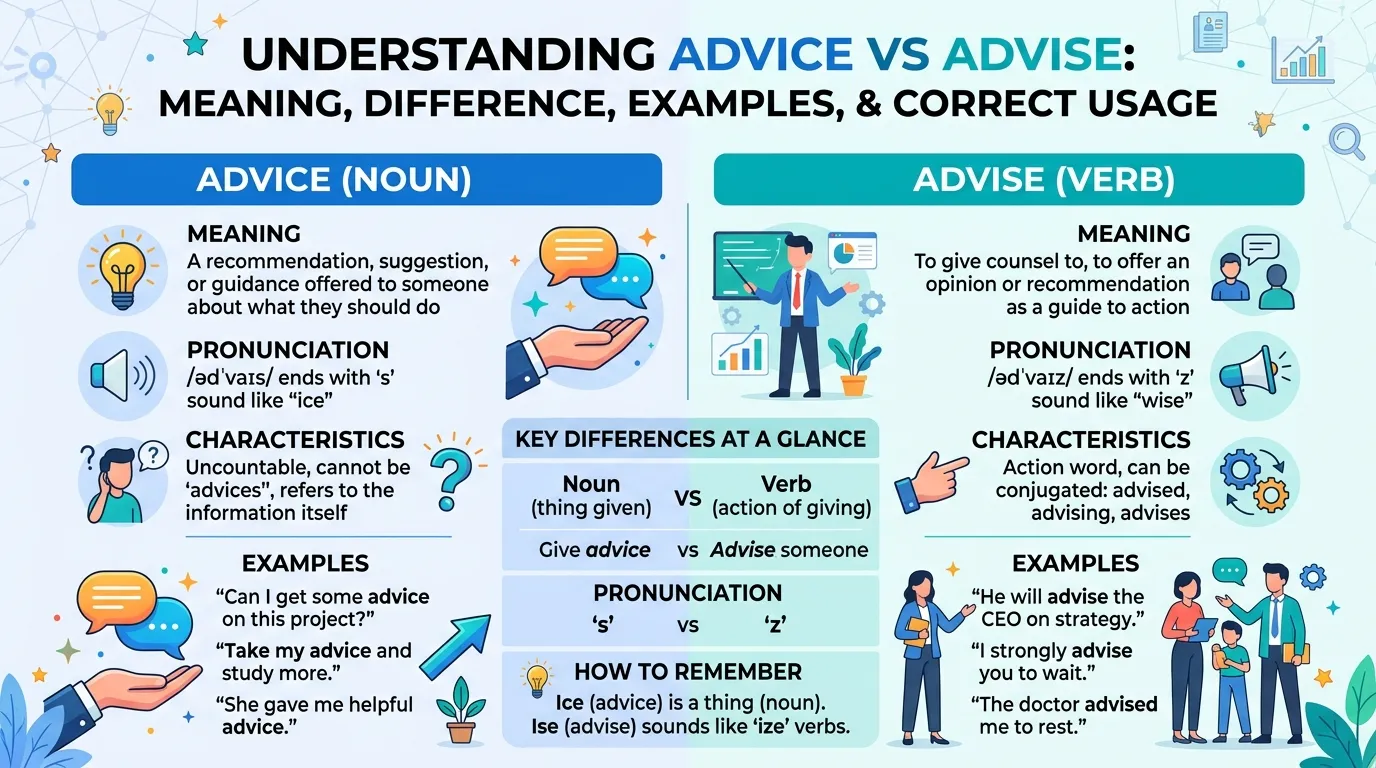
Have you ever wondered whether you should write advice or advise? You are not alone. These two words look almost identical, sound very similar, and are closely related in meaning. Yet, they have an important grammar difference: advice is a noun, while advise is a verb. Once you learn this simple rule, the choice becomes much easier.
The main difference is simple: you give advice, but you advise someone. For example, “My teacher gave me good advice” is correct, while “My teacher advised me to study” is also correct.
The advice vs advise question can be especially confusing for ESL learners because the words are pronounced differently in standard English. There is also a small spelling trap: advice ends with an /s/ sound, while advise ends with a /z/ sound.
This guide explains advice vs advise meaning, pronunciation, grammar, examples, common mistakes, synonyms, and real-life usage. It also explains UK vs US English, where the basic rule is the same in both varieties.
Quick Answer: Advice vs Advise
| Word | Correct? | Part of speech | Meaning |
|---|---|---|---|
| Advice | ✅ | Noun | An opinion or suggestion about what someone should do |
| Advise | ✅ | Verb | To give someone advice or recommend an action |
| Advize | ❌ | — | Incorrect spelling in standard English |
The easiest rule
Advice = a thing you give.
Advise = an action you do.
- ✅ She gave me some advice.
- ✅ She advised me to wait.
- ❌ She gave me some advise.
- ❌ She adviced me to wait.
Remember: give advice, but advise someone.
What Does Advice Mean?
Advice is a noun. It means an opinion, recommendation, or helpful suggestion about what someone should do.
For example:
My father gave me good advice about saving money.
Here, “advice” is the thing the father gave.
Another example:
I need your advice before I make a decision.
The speaker wants a suggestion or opinion.
Is advice countable?
In standard English, advice is normally an uncountable noun.
That means we usually do not say:
- ❌ an advice
- ❌ two advices
- ❌ many advices
Instead, use:
- ✅ some advice
- ✅ a piece of advice
- ✅ two pieces of advice
- ✅ some useful advice
- ✅ a bit of advice
For example:
She gave me a piece of advice.
This is an important grammar rule for ESL learners.
What Does Advise Mean?
Advise is a verb. It means to give advice, make a recommendation, or tell someone what you think they should do.
For example:
My doctor advised me to get more rest.
The verb is advised because it describes an action.
The basic structure is often:
advise + person + to + verb
Examples:
- The teacher advised us to study.
- My manager advised me to wait.
- The bank advised customers to update their information.
- She advised him to save money.
You can also use:
advise + -ing
I advise checking the information first.
Advice vs Advise: The Main Grammar Difference
The biggest difference is their part of speech.
| Feature | Advice | Advise |
|---|---|---|
| Part of speech | Noun | Verb |
| Meaning | A suggestion or recommendation | To give a suggestion |
| Pronunciation | /ədˈvaɪs/ | /ədˈvaɪz/ |
| Final sound | /s/ | /z/ |
| Example | I need your advice. | I advise you to wait. |
| Common pattern | give/receive advice | advise someone |
| Plural | Usually not “advices” | Verb forms change |
| UK usage | Same basic rule | Same basic rule |
| US usage | Same basic rule | Same basic rule |
A simple test
Ask yourself:
Is it a thing or an action?
If it is a thing or suggestion → advice
If it is the action of giving a suggestion → advise
Advice Examples in American English
Here are common advice examples in American English:
- My mom gave me great advice.
- I need some advice about my career.
- Can you give me a piece of advice?
- His advice helped me make the right choice.
- She asked her lawyer for advice.
- Thanks for your advice.
- I ignored his advice and regretted it.
- Your advice was very helpful.
- He gives good advice to new employees.
- I appreciate your advice.
Advise Examples in American English
- I advise you to read the contract.
- My teacher advised me to practice every day.
- The bank advised customers to update their passwords.
- I would advise waiting until tomorrow.
- She advised him to save more money.
- We advise clients to keep their receipts.
- The manager advised us to arrive early.
- I advise checking the invoice carefully.
- My friend advised me to apply for the job.
- The school advised parents to attend the meeting.
Advice Examples in British English
The grammar is the same in British English.
- I need your advice.
- She gave me some useful advice.
- He asked for my advice.
- That was excellent advice.
- My teacher gave me some advice.
- I followed your advice.
- His advice was very helpful.
- She received professional advice.
- Can I ask your advice?
- Thank you for the advice.
Advise Examples in British English
- I advise you to check the letter.
- The doctor advised him to rest.
- We advise passengers to arrive early.
- She advised me to contact the office.
- I would advise against making a quick decision.
- The bank advised customers to keep their details safe.
- My teacher advised me to revise more.
- They advised us to book early.
- The solicitor advised her to read the agreement.
- I advise checking the details before payment.
Why Is Advise Not Advice?
Advise is not an incorrect form. It is a different word.
The mistake happens when writers use the verb where the noun is needed.
For example:
❌ Thank you for your advise.
This is incorrect because “your” is followed by a noun here.
Correct:
✅ Thank you for your advice.
Likewise:
❌ My teacher adviced me to study.
The correct past tense is:
✅ My teacher advised me to study.
So there are two common mistakes:
- advise instead of advice
- adviced instead of advised
Advice vs Advise Pronunciation
Pronunciation is one reason these words are easy to confuse.
Advice
IPA: /ədˈvaɪs/
The final sound is /s/, like the sound at the end of “ice.”
Advise
IPA: /ədˈvaɪz/
The final sound is /z/, like the sound in “eyes.”
A useful comparison is:
- advice → /s/
- advise → /z/
The spelling differs by only one letter, but the final sound changes.
Why do people confuse them?
There are several reasons:
- They look almost identical.
- They have the same first syllable.
- Their meanings are closely connected.
- Both are used when talking about recommendations.
- Fast speech can make the final sounds hard to notice.
- ESL learners may not hear the /s/ and /z/ difference clearly.
Advice vs Advise: UK vs US English
The good news is that there is no major grammar difference between British and American English here.
Both use:
- advice as a noun
- advise as a verb
For example:
US English:
My manager gave me some advice.
UK English:
My manager gave me some advice.
Both are correct.
Likewise:
US:
I advise you to wait.
UK:
I advise you to wait.
The main difference is not the word itself. Other vocabulary, spelling, pronunciation, and style differences may exist between British and American English, but the correct usage of advice and advise is essentially the same.
Advice vs Advise: Word Origins and Etymology
Both words come from the same historical family.
They developed from Old French forms related to avis, meaning an opinion, view, or judgment. The word entered English through French and developed into forms associated with giving an opinion or recommendation.
Over time, English developed two related forms:
- advice became the noun
- advise became the verb
This explains why they look so similar today.
Their shared history also explains why their meanings are closely connected. One word describes the recommendation, while the other describes the act of giving that recommendation.
Advice Synonyms and Advise Synonyms
The best advice synonym depends on the sentence.
| Word | Related to | Example |
|---|---|---|
| Suggestion | Advice | Her suggestion was useful. |
| Recommendation | Advice | I followed his recommendation. |
| Guidance | Advice | I need some guidance. |
| Counsel | Advice | She sought legal counsel. |
| Tip | Advice | He gave me a helpful tip. |
| Recommend | Advise | I recommend waiting. |
| Suggest | Advise | I suggest checking again. |
| Guide | Advise | She guided me through the process. |
| Counsel | Advise | The lawyer counselled him carefully. |
In everyday American English, suggestion, recommendation, guidance, and tip are very common.
In British English, these words are also common. Advice, guidance, and recommendation are especially useful in formal writing.
Seven Common Advice vs Advise Mistakes
Mistake 1: “Thank you for your advise.”
❌ Thank you for your advise.
✅ Thank you for your advice.
Why? “Your” is describing a noun.
Mistake 2: “She adviced me.”
❌ She adviced me to wait.
✅ She advised me to wait.
The past tense of advise is advised.
Mistake 3: “He gave me an advice.”
❌ He gave me an advice.
✅ He gave me some advice.
✅ He gave me a piece of advice.
Mistake 4: “I need your advise.”
❌ I need your advise.
✅ I need your advice.
You need the noun.
Mistake 5: “I advice you to wait.”
❌ I advice you to wait.
✅ I advise you to wait.
You need the verb.
Mistake 6: “She gave me two advices.”
❌ She gave me two advices.
✅ She gave me two pieces of advice.
Mistake 7: “My teacher advice me.”
❌ My teacher advice me to study.
✅ My teacher advised me to study.
The sentence needs a verb, so use advised.
Advice vs Advise in Real-Life Situations
Emails
Thank you for your advice regarding the project.
Or:
I would advise you to review the attached document.
Office
My manager gave me useful advice.
The manager advised us to finish the report today.
Banking
I need some advice about opening a savings account.
The bank advised me to update my information.
Invoices
Could you give me some advice about this invoice?
We advise customers to check invoice numbers before payment.
School
My teacher gave me good advice.
My teacher advised me to study vocabulary every day.
Social Media
Thanks for the advice!
I would advise everyone to check the source before sharing the post.
Rent Payments
I need some advice about my rent payment.
The landlord advised me to keep proof of payment.
Everyday Conversation
Can I ask your advice?
Sure. I advise you to take your time.
Advice vs Advise in a Sentence: A Simple Pattern
Try these patterns:
Noun pattern:
give + advice
receive + advice
ask for + advice
Verb pattern:
advise + someone
advise + someone + to do something
Examples:
She gave me advice.
She advised me to wait.
This side-by-side pattern is one of the easiest ways to understand the correct usage.
Five Memory Tricks for Advice vs Advise
1. Advice has an “S” sound
Think:
Advice = suggestion
Both are connected with the idea of a helpful suggestion.
2. Advise has a “Z” sound
Advise = the action
The verb tells you what someone does.
3. Give advice, not advise
Memorize this phrase:
Give advice.
4. Advise someone
Memorize:
Advise someone to do something.
5. Think Noun vs Verb
Ask:
What is it? → advice
What do you do? → advise
That simple question can solve most problems.
Grammar Rule for Beginners
Here is the core grammar rule:
Advice is a noun. Advise is a verb.
A noun names something. Advice names a recommendation or suggestion.
A verb describes an action. Advise describes the action of giving a recommendation.
Verb forms of advise
- advise
- advises
- advised
- advising
Examples:
I advise you to wait.
She advises customers regularly.
He advised me yesterday.
They are advising us to leave early.
There is no adjective formed simply by changing advice to advise. Related adjectives include advisory, as in:
The bank issued an advisory notice.
Related Expressions
Advice vs recommendation
A recommendation is often a stronger or more specific suggestion.
The doctor gave me advice.
The doctor gave me a recommendation for a specialist.
Advice vs suggestion
A suggestion can be more casual.
I have a suggestion for you.
Advice vs guidance
Guidance often suggests longer-term help or direction.
The counselor provided career guidance.
Advice vs opinion
An opinion is what someone thinks. Advice usually goes further by suggesting what someone should do.
In my opinion, the job is difficult.
My advice is to prepare carefully.
FAQs About Advice vs Advise
Is “advice” a noun or a verb?
Advice is a noun. It refers to a suggestion, recommendation, or guidance.
Is “advise” a noun or a verb?
Advise is a verb. It means to give someone advice or recommend an action.
What is the difference between advice and advise?
The main grammar difference is their part of speech. Advice is a noun; advise is a verb.
What is the pronunciation of advice?
Advice is pronounced /ədˈvaɪs/, with an /s/ sound at the end.
What is the pronunciation of advise?
Advise is pronounced /ədˈvaɪz/, with a /z/ sound at the end.
Is “advices” correct?
Usually, no. Advice is normally uncountable. Say “some advice” or “two pieces of advice.”
Is “adviced” correct?
No. The past tense of advise is advised.
Do British people use advice differently from Americans?
Not in the basic grammar. UK vs US English uses advice as a noun and advise as a verb.
Is advice formal or informal?
Advice can be used in both formal and informal English. It is common in everyday conversation, school writing, business communication, and professional settings.
What is a synonym for advice?
Common synonyms include suggestion, recommendation, guidance, counsel, and tip. The best choice depends on the context.
People Also Ask
Which is correct: advice or advise?
Both are correct words, but they have different jobs. Use advice as a noun and advise as a verb.
Do you give advice or advise?
You give advice. You can also advise someone.
Can I say “an advice”?
Usually, no. Say some advice or a piece of advice.
Can I say “I advise you”?
Yes. For example:
I advise you to wait.
What is the easiest way to remember advice vs advise?
Remember:
Advice is something you give. Advise is something you do.
Is advice American or British?
It is used in both American and British English. The basic meaning and grammar are the same.
Is “advise” more formal than “advice”?
Not exactly. The words have different grammatical roles. Both can appear in formal and informal contexts.
Final Takeaway
The advice vs advise difference is much easier once you focus on grammar rather than spelling. Advice is a noun. It means a suggestion, recommendation, or helpful opinion. Advise is a verb. It means to give someone a recommendation or tell them what you think they should do.
The easiest rule is:
Give advice. Advise someone.
Remember that advice is normally uncountable, so say “some advice” or “a piece of advice,” not “an advice.” The past tense of advise is advised, not “adviced.”
The same basic rules apply in American and British English, so you do not need separate grammar rules for this pair. Once you learn the noun-versus-verb difference and hear the /s/ versus /z/ pronunciation, choosing the correct word becomes much easier. Whether you are writing an email, completing schoolwork, talking at work, or posting online, you can now use advice and advise with confidence.


