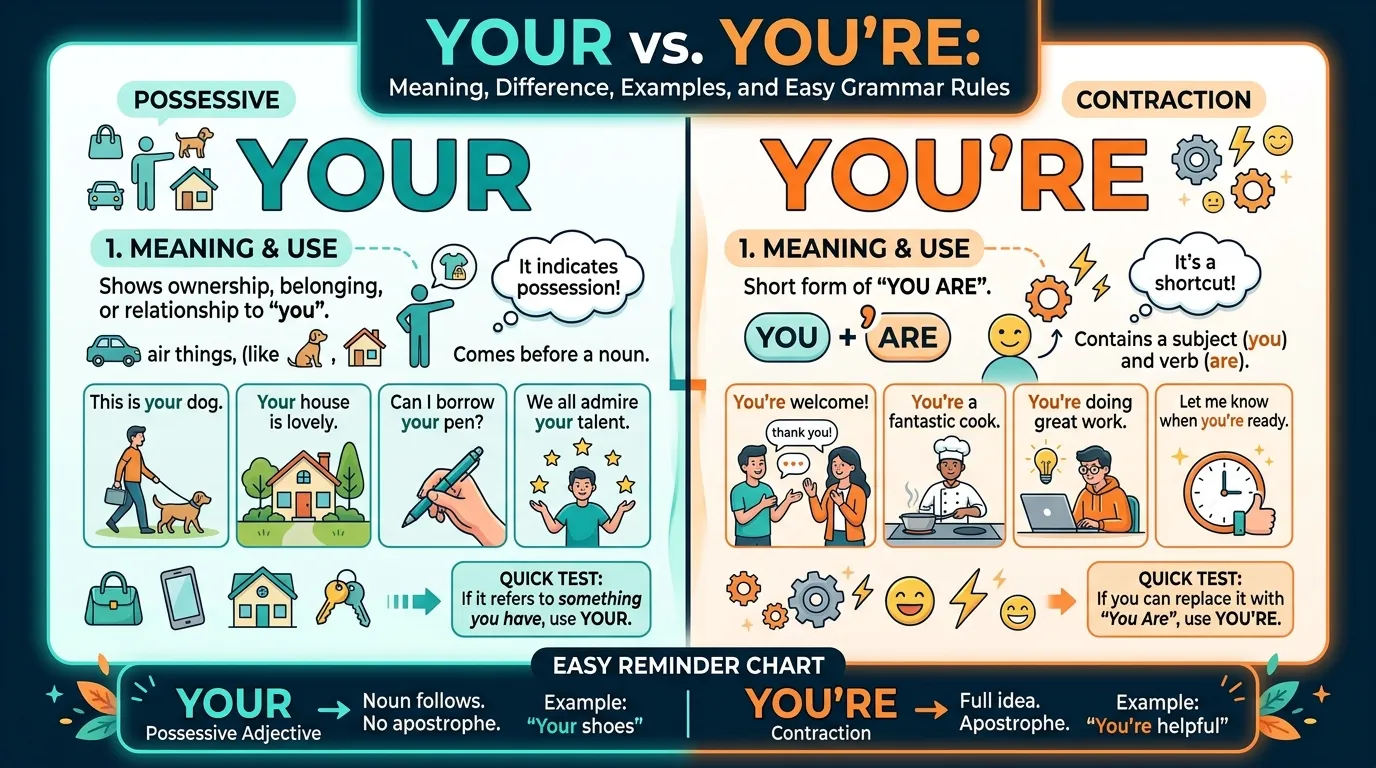
Your vs you’re is one of the most common grammar questions in English. The two words sound almost identical in everyday speech, but they have completely different meanings and grammar roles. If you are unsure whether to write your or you’re, there is a simple rule: your shows possession, while you’re means “you are.”
For example, “Is this your phone?” asks who owns the phone. “You’re using my phone” means “You are using my phone.” This small grammar difference can change the meaning of an entire sentence.
The confusion is especially common for beginners, students, ESL learners, and people writing quickly online. Speech does not always make the difference clear because your and you’re are often pronounced the same or nearly the same.
The good news is that the your vs you’re rule is easy to learn. It works in both American and British English. There is no major UK vs US English difference in the correct usage. In both varieties, your shows possession and you’re is short for you are.
Quick Answer: Your vs You’re
Here is the easiest way to remember the grammar difference:
- ✅ Your = belongs to you / connected with you
- ✅ You’re = you are
- ❌ Your = do not use it to mean “you are”
- ❌ You’re = do not use it to show possession
Quick test
Replace you’re with you are.
- “You’re very kind.” → “You are very kind.” ✅
- “You’re late.” → “You are late.” ✅
If “you are” does not work, use your.
- “Where is your bag?” → “Where is you are bag?” ❌
- Therefore, your is correct. ✅
What Does “Your” Mean?
Your is a possessive determiner. It tells us that something belongs to, relates to, or is associated with the person or people being addressed.
Examples include:
- your car
- your idea
- your name
- your parents
- your office
The word normally comes before a noun.
Your in American English: Examples
- Is this your laptop?
- Please check your email.
- I like your new shoes.
- Did you bring your passport?
- What is your phone number?
Your in British English: Examples
- Have you finished your homework?
- Where did you leave your umbrella?
- Please send your invoice today.
- Is that your flat?
- I really like your idea.
Notice that the grammar is the same in both varieties of English.
What Does “You’re” Mean?
You’re is a contraction of you are.
A contraction combines two words and uses an apostrophe to show that letters have been removed.
- you + are = you’re
For example:
- You’re happy. = You are happy.
- You’re working. = You are working.
- You’re my friend. = You are my friend.
The word you’re contains a verb because are is a form of the verb be.
You’re in American English: Examples
- You’re doing a great job.
- You’re ready for the meeting.
- I think you’re right.
- You’re welcome to join us.
- You’re going to love this movie.
You’re in British English: Examples
- You’re looking well today.
- I hope you’re enjoying your holiday.
- You’re right about the train.
- You’re welcome to stay here.
- I think you’re making the right choice.
Your vs You’re: Detailed Comparison
| Feature | Your | You’re |
|---|---|---|
| Meaning | Belonging to or connected with you | You are |
| Grammar role | Possessive determiner | Contraction |
| Related word | Possessive form of “you” | “You” + “are” |
| Usually followed by | A noun | An adjective, noun, verb phrase, or other complement |
| Example | Your book is here. | You’re reading a book. |
| Can replace with “you are”? | No | Yes |
| Shows possession? | Yes | No |
| Used in US English? | Yes | Yes |
| Used in UK English? | Yes | Yes |
| Formal writing | Standard | Standard, though “you are” may sound more formal |
The key correct usage rule
Remember:
Your = possession. You’re = you are.
That one rule solves most your vs you’re questions.
Why Are Your and You’re So Commonly Confused?
The main reason is pronunciation.
In many accents, your and you’re are pronounced the same or very similarly. This makes the difference easy to hear incorrectly but easy to confuse when writing.
For example:
“I think you’re ready.”
When spoken quickly, you’re may sound very similar to your.
There is also a visual reason. Both words begin with you, and the only difference is the apostrophe and the final letters.
This is why people often make the mistake in texts, emails, comments, and social media posts.
Pronunciation Guide
The pronunciation can vary by accent.
| Word | Common IPA | Simple pronunciation |
|---|---|---|
| your | /jʊr/, /jɔːr/ | “yur” or “yor” |
| you’re | /jʊr/, /jɔːr/ | “yur” or “yor” |
In many American and British accents, your and you’re are homophones or near-homophones.
That means context, rather than sound, often tells listeners which word is intended.
Your vs You’re: Word Origins and Etymology
The two words have different histories.
Origin of “your”
Your developed from older forms of English related to the possessive form of you. Its history can be traced through Old English forms such as ēower, which was connected with the plural form of “you.”
Over centuries, English spelling and pronunciation changed. The modern form your eventually became the standard possessive determiner.
Origin of “you’re”
You’re is much easier to explain. It is simply a contraction of:
you + are = you’re
The apostrophe shows that part of are has been removed.
So although the two words sound similar today, they do not come from the same grammatical construction.
Your vs You’re Synonyms and Alternatives
There is an important point about your vs you’re synonym: neither word has a perfect one-word synonym in every situation.
Alternatives for “your”
| Alternative | Meaning | Example |
|---|---|---|
| belonging to you | Shows ownership | The book belonging to you |
| associated with you | Connected with you | A decision associated with you |
| of yours | Possessive phrase | A friend of yours |
| owned by you | Direct ownership | A car owned by you |
Your is normally the shortest and most natural choice.
Alternatives for “you’re”
| Alternative | Meaning | Example |
|---|---|---|
| you are | Full form | You are correct. |
| you happen to be | More specific | You happen to be correct. |
| you remain | Different meaning | You remain responsible. |
| you seem | Different meaning | You seem tired. |
The most direct synonym for you’re is you are.
There is no major US-versus-UK preference for these forms. Both American and British speakers use your and you’re in the same basic way.
Seven Common Your vs You’re Mistakes
1. “Your going to love it.”
❌ Your going to love it.
✅ You’re going to love it.
Why? “You’re” means “you are.”
2. “I like you’re car.”
❌ I like you’re car.
✅ I like your car.
Why? The sentence refers to a car belonging to you.
3. “Your welcome.”
❌ Your welcome.
✅ You’re welcome.
The meaning is “You are welcome.”
4. “Is this you’re seat?”
❌ Is this you’re seat?
✅ Is this your seat?
The seat is associated with you, so your is required.
5. “I know your tired.”
❌ I know your tired.
✅ I know you’re tired.
The sentence means “I know you are tired.”
6. “Please bring you’re documents.”
❌ Please bring you’re documents.
✅ Please bring your documents.
The documents belong to or are connected with you.
7. “Your the best!”
❌ Your the best!
✅ You’re the best!
“You’re” = “you are.”
Real-Life Your vs You’re Examples
Emails
- Please check your email before the meeting.
- I hope you’re available tomorrow.
- Is this your final report?
- I think you’re ready to present.
Offices
- Please update your employee details.
- You’re responsible for this project.
- Have you submitted your invoice?
- You’re joining the meeting at 10, right?
Banking
- Please verify your bank details.
- You’re required to provide identification.
- Check your account balance.
- You’re receiving a payment today.
Invoices
- Please pay your outstanding invoice.
- You’re responsible for confirming the amount.
- Is this your invoice number?
- You’re receiving an updated invoice.
Schools
- Bring your textbook tomorrow.
- You’re doing very well in class.
- Have you completed your homework?
- You’re ready for the exam.
Rent Payments
- Please make your rent payment by Friday.
- You’re responsible for the monthly payment.
- Has your rent been paid?
- You’re late with this month’s payment.
Social Media
- I love your new profile picture!
- You’re absolutely hilarious.
- What happened to your account?
- You’re trending today.
Everyday Conversations
- Where is your phone?
- You’re kidding!
- I like your jacket.
- You’re very kind.
Ten Your vs You’re Examples in American English
- Your package arrived today.
- You’re almost finished.
- Where is your sister?
- You’re better than you think.
- Please bring your ID.
- I know you’re busy.
- Is that your seat?
- You’re making good progress.
- What is your favorite restaurant?
- I hope you’re feeling ready.
Ten Your vs You’re Examples in British English
- Where is your mobile?
- You’re quite early today.
- Have you got your keys?
- I think you’re right.
- Please check your bank statement.
- You’re welcome to come along.
- Is that your flat?
- Don’t forget your umbrella.
- You’re doing brilliantly.
- Have you paid your rent?
The grammar remains the same. Differences between American and British English usually involve vocabulary, spelling, pronunciation, or style—not the basic rule for your and you’re.
Grammar Rule: Parts of Speech Explained Simply
Understanding the parts of speech makes the difference much easier.
Your: possessive determiner
Your tells us who something belongs to or relates to.
Your book is on the desk.
Here, your describes the noun book.
You’re: contraction
You’re contains:
- you — pronoun
- are — verb
Together:
You’re happy.
This means:
You are happy.
The verb are is a form of be. It can be followed by adjectives, nouns, or other structures.
Examples:
- You’re happy.
- You’re a student.
- You’re working.
- You’re at home.
Five Easy Memory Tricks
1. The “are” test
If you can replace the word with you are, use you’re.
2. Possession test
If something belongs to you, use your.
3. Apostrophe clue
The apostrophe in you’re helps remind you that letters were removed from you are.
4. Expand it
Whenever you see you’re, mentally expand it:
you’re → you are
If the sentence still makes sense, you have the right word.
5. Remember this sentence
Your dog is happy because you’re taking it outside.
The first word shows possession. The second means “you are.”
Your vs You’re in a Sentence: Side-by-Side Examples
Compare these pairs:
- Your phone is ringing. / You’re calling me.
- Your answer is correct. / You’re correct.
- Your friend is here. / You’re my friend.
- Your shoes are wet. / You’re getting wet.
- Your work looks great. / You’re working hard.
This is one of the fastest ways to learn the correct usage.
Related Words: Yours, You, and You Are
Your vs yours
Your usually comes before a noun:
Is this your bag?
Yours can stand alone:
Is this bag yours?
Your vs you
You is a pronoun.
You are late.
Your shows possession.
Your train is late.
You’re vs you are
These have the same basic meaning:
You’re right.
You are right.
The contraction is shorter and common in everyday English.
Formal vs Informal Usage
You’re is not grammatically incorrect or inherently informal. It is a standard English contraction and appears in both everyday and professional writing.
Still, some very formal writing may prefer you are.
For example:
- Everyday: You’re invited to the meeting.
- More formal: You are invited to the meeting.
Your does not have a formal replacement. It is the standard possessive form in both casual and formal English.
UK vs US English: Is There a Difference?
There is no major grammar difference between American and British English when using your and you’re.
Both use:
- your for possession
- you’re for “you are”
The words can sound slightly different depending on regional accent, but the spelling and grammar rule remain the same.
For example, an American might say:
You’re using your phone.
A British speaker can say exactly the same sentence.
FAQs
1. What is the difference between your and you’re?
Your shows possession or connection. You’re is short for you are.
2. Is “your” a possessive word?
Yes. Your is a possessive determiner used before a noun.
3. What does you’re mean?
You’re means you are.
4. What is the easiest way to remember your vs you’re?
Replace you’re with you are. If the sentence works, use you’re. If something belongs to you, use your.
5. Are your and you’re pronounced the same?
Often, yes. In many accents, they are homophones or nearly identical in pronunciation.
6. Is your vs you’re different in British English?
No. The basic grammar rule is the same in British and American English.
7. What is the synonym of you’re?
The direct equivalent is you are.
8. What is the synonym of your?
There is no perfect one-word synonym. Phrases such as belonging to you or of yours can sometimes express a similar meaning.
9. Is “you’re” acceptable in formal writing?
Yes. It is grammatically standard. However, you are may sound slightly more formal or deliberate.
10. Which form do dictionaries prefer?
Both your and you’re are standard dictionary words. Neither is a “preferred” spelling of the other because they have different meanings and grammatical roles.
People Also Ask
Is it “your welcome” or “you’re welcome”?
The correct expression is “you’re welcome” because it means “you are welcome.”
Is it “your right” or “you’re right”?
Use “you’re right” when you mean “you are right.” Use “your right” when referring to something belonging or relating to you, such as “your right hand.”
Is it “your going” or “you’re going”?
The correct form is “you’re going” because it means “you are going.”
Can “your” mean “you are”?
No. Your is a possessive determiner. It does not mean “you are.”
Can “you’re” show ownership?
No. Use your for possession.
Why do people confuse your and you’re?
They often sound the same, especially in fast speech. Their similar spelling also makes the mistake easy to make.
Conclusion
Learning the difference between your vs you’re is much easier once you focus on meaning instead of pronunciation. Your is a possessive determiner. It tells us that something belongs to or is connected with you. You’re is a contraction of you are.
Use your before nouns, as in “your car,” “your idea,” or “your account.” Use you’re when you can replace it with you are, as in “you’re happy,” “you’re working,” or “you’re correct.”
The same rule applies in American and British English, so there is no difficult UK vs US English difference to remember. When in doubt, use the you are test. If it works, choose you’re. If you are talking about possession or connection, choose your.
With this simple rule, you can avoid the most common mistakes in emails, schoolwork, business writing, social media, and everyday communication.


