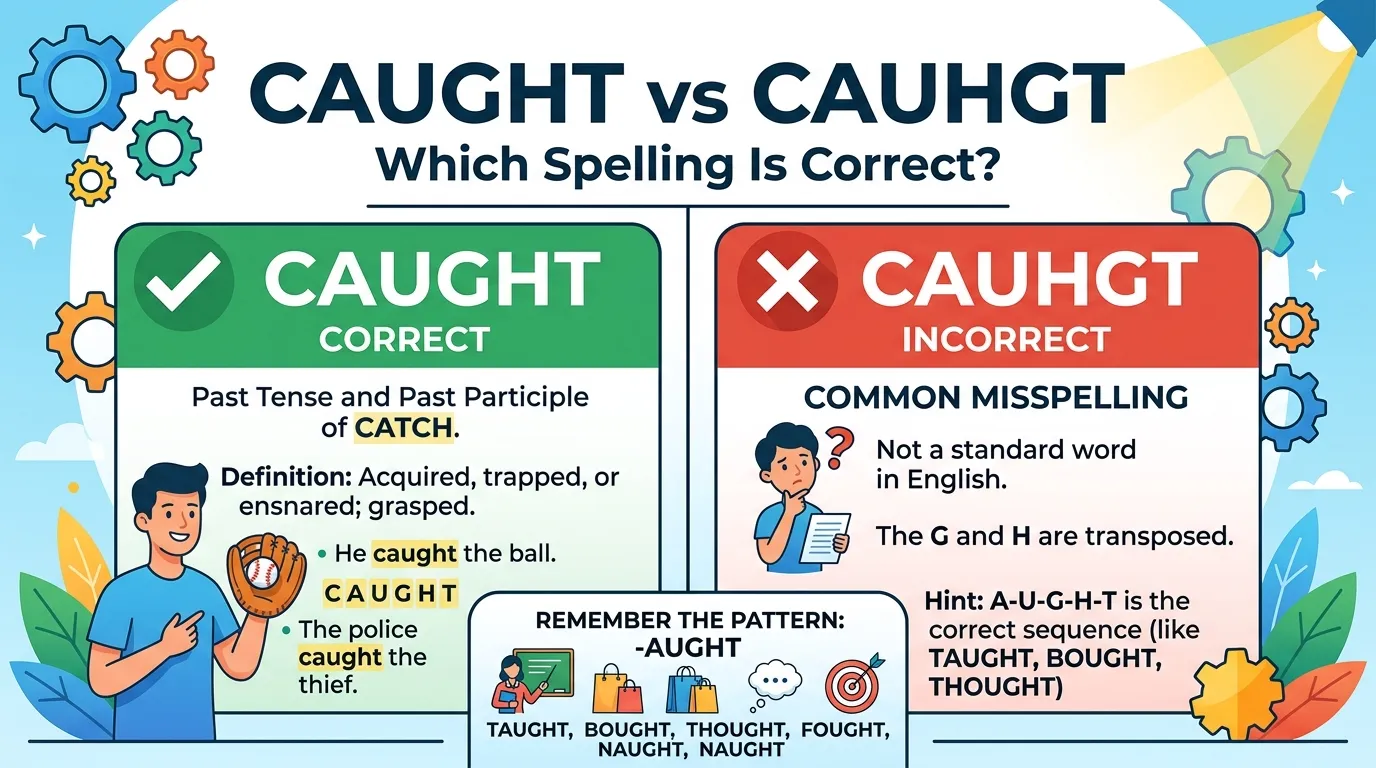
If you are wondering about caught vs cauhgt, the answer is simple: caught is the correct English spelling, while cauhgt is a misspelling. You may see cauhgt when someone accidentally switches the order of letters while typing, but it is not a standard English word.
The confusion is understandable because caught has an unusual spelling and pronunciation. It is also the past tense and past participle of catch, so it appears frequently in everyday English: I caught the ball, She caught the train, and He was caught in the rain.
This guide explains the difference between caught and cauhgt, including pronunciation, meaning, grammar, word history, common expressions, spelling mistakes, examples, and practical ways to remember the correct form.
Quick Answer: Caught vs Cauhgt
Caught is the correct spelling.
Cauhgt is incorrect and should not be used in standard English.
| Spelling | Correct? | Meaning |
|---|---|---|
| caught | ✅ Yes | Past tense and past participle of catch |
| cauhgt | ❌ No | Common spelling mistake of caught |
Examples
- Correct: I caught the bus this morning.
- Correct: She caught the ball.
- Correct: He was caught cheating.
- Incorrect: I cauhgt the bus.
- Incorrect: She cauhgt the ball.
If you are writing an email, essay, article, report, text, or professional document, always use caught.
What Does Caught Mean?
Caught is the past tense and past participle of the verb catch.
The basic forms are:
catch → caught → caught
Unlike many regular English verbs, catch does not form its past tense by simply adding -ed. You do not say catched in standard English. The correct past form is caught.
Dictionary-style definition of caught
Caught means having successfully taken, stopped, grabbed, noticed, reached, or encountered something or someone.
Its exact meaning depends on the context.
For example:
- I caught the ball.
I successfully grabbed the ball. - She caught the train.
She reached the train in time and traveled on it. - The police caught the thief.
The police captured or arrested the thief. - I caught a cold.
I became ill with a cold. - He caught me looking at him.
He noticed me looking at him.
The word can therefore have both literal and figurative meanings.
What Does Cauhgt Mean?
Cauhgt has no standard English meaning.
It is simply a misspelling of caught.
The error usually occurs because the letters u, g, and h can be accidentally rearranged when someone is typing quickly.
The correct spelling is:
C-A-U-G-H-T
The incorrect version is:
C-A-U-H-G-T
Notice that h and g have switched positions.
Why cauhgt looks believable
English spelling contains many unusual letter combinations. Words such as:
- caught
- taught
- daughter
- thought
- brought
- fought
already contain combinations that are not pronounced exactly as they appear.
Because caught is visually unusual, it is easy to make a typo and produce cauhgt.
However, dictionaries do not recognize cauhgt as the standard spelling of the verb.
Caught vs Cauhgt: The Key Difference
The main difference is correctness.
Caught is an established English word.
Cauhgt is a spelling error.
| Feature | Caught | Cauhgt |
|---|---|---|
| Standard English word | Yes | No |
| Correct spelling | Yes | No |
| Pronunciation | /kɔːt/ in many varieties | No standard pronunciation |
| Past tense of catch | Yes | No |
| Past participle of catch | Yes | No |
| Appropriate in formal writing | Yes | No |
| Appropriate in academic writing | Yes | No |
| Common typo | No | Yes |
There is no meaningful difference in definition because cauhgt does not have an independent standard definition.
Why Do People Confuse Caught and Cauhgt?
Several factors can make caught difficult to spell.
The letter sequence is unusual
The spelling -aught is not common in everyday English.
Compare:
- caught
- taught
- bought
- brought
- thought
These words have similar historical spelling patterns but can be difficult for learners to memorize.
Typing makes the mistake easier
When typing quickly, people may accidentally reverse adjacent letters.
For example:
caught → cauhgt
This is a typical transposition error.
Pronunciation does not clearly reveal the spelling
In many English accents, caught sounds approximately like court or has a similar vowel sound, depending on the speaker’s pronunciation.
You cannot reliably spell the word just by listening to it.
How Do You Pronounce Caught?
The pronunciation of caught varies somewhat by English dialect.
In many American accents, it is pronounced approximately:
/kɔːt/
However, the exact vowel can vary.
Caught vs cot in American English
One interesting feature is the cot–caught merger.
Some American speakers pronounce cot and caught with the same vowel. Others maintain a distinction between them.
As a result, the pronunciation of caught is not identical across all American English varieties.
Caught vs court
For many speakers, caught and court are pronounced similarly or identically.
For others, there may be a slight difference.
This is another reason spelling the word from pronunciation alone can be difficult.
Is Caught a Verb?
Yes. Caught is a verb form.
More specifically, it is both the:
- simple past tense of catch
- past participle of catch
Simple past
Use caught to describe something that happened in the past.
- I caught the ball.
- She caught the bus.
- They caught the mistake.
- We caught the last train.
Past participle
The past participle appears in constructions such as the present perfect, past perfect, and passive voice.
- I have caught the mistake.
- She had caught the earlier train.
- He was caught by the police.
- They have caught several fish.
Caught in Different Contexts
One reason caught is such an important word is that it has many meanings.
Caught a ball
This is the literal sense of catch.
Maya caught the ball with one hand.
Caught a bus
Here, caught means successfully reached or boarded transportation.
I caught the 8:15 bus.
Caught a person
It can mean captured or stopped someone.
The police caught the suspect.
Caught someone’s attention
This is figurative.
The bright sign caught my attention.
Caught someone’s eye
This means attracted someone’s notice or interest.
A beautiful painting caught my eye.
Caught a cold
This means became infected with a cold.
I caught a cold last week.
Caught someone lying
This means discovered someone in the act of lying or discovered evidence of dishonesty.
She caught him lying about where he had been.
Caught in the rain
This means unexpectedly being outside when it starts raining.
We got caught in the rain on the way home.
Common Phrases and Expressions With Caught
Caught appears in many fixed expressions and collocations.
Caught red-handed
This means discovered while committing a wrongdoing.
The employee was caught red-handed taking money.
Caught off guard
This means surprised or unprepared.
The unexpected question caught me off guard.
Caught by surprise
This means unexpectedly surprised.
The sudden announcement caught everyone by surprise.
Caught in the act
This means discovered while doing something, usually something wrong.
The burglar was caught in the act.
Caught between two choices
This describes being forced to choose between alternatives.
She was caught between two difficult choices.
Caught in a trap
This can be literal or figurative.
The animal was caught in a trap.
Caught up in something
This means becoming deeply involved in an activity or situation.
He became caught up in the excitement.
Caught short
This expression can mean being unexpectedly without something needed.
I was caught short without enough cash.
Caught vs Catch: What’s the Difference?
Catch is the base form, while caught is its past form.
| Form | Example |
|---|---|
| catch | I usually catch the bus. |
| caught | I caught the bus yesterday. |
| caught | I have caught the bus many times. |
Present tense
I catch the train at 7 a.m.
Past tense
I caught the train yesterday.
Present perfect
I have caught that train before.
A common mistake is using catched instead of caught.
❌ I catched the ball.
✅ I caught the ball.
Is Caught Formal or Informal?
Caught is completely standard in both formal and informal English.
You can use it in:
- casual conversations
- text messages
- school assignments
- academic writing
- business communication
- journalism
- technical writing
- sports reporting
- fiction
- legal or official writing
For example:
The athlete caught the ball before it crossed the boundary.
This works in sports writing.
The error was caught during the quality-control review.
This works in professional or technical writing.
There is no need to replace caught with a more formal word simply because you are writing professionally.
Caught in American English vs British English
Caught is standard in both American and British English.
The spelling does not change between the two major varieties.
However, pronunciation may differ because vowel systems vary between regions.
American English
Many Americans pronounce caught with a vowel represented approximately by /ɔː/, although speakers with the cot–caught merger may pronounce it like cot.
British English
British pronunciation also varies by region. In many standard British varieties, caught has a rounded vowel sound.
The important point for spelling is this:
Both American and British English spell the word caught.
There is no standard regional spelling cauhgt.
Caught in Sports
Caught is especially common in sports vocabulary.
Baseball
The center fielder caught the ball.
Cricket
The batsman was caught behind.
In cricket, caught is an important method of dismissal.
Football
In American football:
The receiver caught the pass.
Basketball
He caught the rebound.
General sports writing
She caught the ball just before it hit the ground.
Sports writers frequently use caught, and cauhgt would simply be an error.
Caught in Professional and Business English
The word is also common in professional contexts.
Quality control
The inspection team caught the defect before shipment.
Customer service
The representative caught the billing error.
Project management
We caught the issue during testing.
Workplace communication
Thanks for catching that mistake.
Here, catch has a figurative meaning: notice or identify something.
Caught in Academic Writing
Caught is perfectly acceptable in academic writing when the context calls for it.
For example:
The researchers caught an unexpected pattern in the data.
However, academic writers may sometimes choose more precise alternatives depending on meaning.
Instead of:
The study caught a problem.
You might write:
The study identified a problem.
The choice depends on the intended meaning and level of formality, not on the spelling of caught.
Caught in Journalism
Journalists commonly use caught in headlines and reports.
Examples include:
- Driver caught speeding
- Suspect caught after investigation
- Team caught off guard
- Player caught the winning pass
- Company caught in controversy
The word is concise and versatile, making it useful for news writing.
Caught in Casual Texting
In texting, people frequently use caught.
Examples:
I caught the bus 👍
You caught me 😂
Got caught in traffic.
I almost caught it!
Someone might type cauhgt accidentally, but that does not make it an accepted alternative spelling.
If the mistake appears in a casual text, the meaning is usually obvious from context.
Common Mistakes With Caught
Mistake: cauhgt
❌ I cauhgt the ball.
✅ I caught the ball.
Mistake: catched
❌ She catched the train.
✅ She caught the train.
Mistake: cot
❌ I cot the ball.
✅ I caught the ball.
Cot is a different word. In American English, a cot is a small bed.
Mistake: cought
❌ He cought the thief.
✅ He caught the thief.
Cought is another common misspelling.
Awkward vs Natural Examples
Example 1
❌ Awkward: I cauhgt the bus at seven.
✅ Natural: I caught the bus at seven.
Example 2
❌ Incorrect: She catched the ball.
✅ Natural: She caught the ball.
Example 3
❌ Incorrect: The police cauhgt the suspect.
✅ Natural: The police caught the suspect.
Example 4
❌ Incorrect: I was cauhgt in traffic.
✅ Natural: I was caught in traffic.
Example 5
❌ Incorrect: He has cauhgt a cold.
✅ Natural: He has caught a cold.
How to Remember the Spelling of Caught
A simple memory trick is to remember:
CATCH changes to CAUGHT.
Do not try to spell the past tense by rearranging the letters.
You can also group it with similar words:
- catch → caught
- teach → taught
- buy → bought
- bring → brought
- think → thought
- fight → fought
These words are not identical in spelling, but seeing them together can help you become more familiar with common English -ought and -aught patterns.
A useful visual trick
Remember the middle of the word as:
CAU + GHT
So:
C-A-U-G-H-T
Not:
C-A-U-H-G-T
The G comes before H.
Caught Synonyms
The best synonym depends on the context.
When caught means grabbed
- grabbed
- seized
- captured
- took hold of
She caught the ball.
She grabbed the ball.
When caught means discovered
- discovered
- detected
- exposed
- found out
- noticed
He was caught cheating.
He was discovered cheating.
When caught means captured
- arrested
- captured
- apprehended
- detained
The police caught the suspect.
The police arrested the suspect.
When caught means reached transportation
- boarded
- got
- reached
I caught the train.
I boarded the train.
These alternatives are not always interchangeable, so context matters.
Antonyms of Caught
Depending on the meaning, possible opposites include:
- missed
- escaped
- avoided
- released
- lost
- overlooked
For example:
I caught the bus.
The opposite is:
I missed the bus.
Similarly:
The police caught the thief.
The opposite could be:
The thief escaped.
Common Collocations With Caught
A collocation is a group of words that commonly appear together.
Some common combinations with caught include:
- caught a ball
- caught a bus
- caught a train
- caught a cold
- caught fire
- caught attention
- caught someone’s eye
- caught a mistake
- caught a thief
- caught a criminal
- caught in traffic
- caught in the rain
- caught off guard
- caught by surprise
- caught red-handed
- caught in the act
- caught up in
- caught between
- caught on camera
- caught on video
Learning these phrases can make your English sound more natural.
Literal and Figurative Uses of Caught
Caught has both literal and figurative applications.
Literal
She caught the ball.
Here, someone physically stops or holds an object.
Figurative
His story caught my attention.
Nobody physically grabs attention. The expression means the story attracted interest.
Another example:
The announcement caught me off guard.
This means the announcement surprised me.
Understanding these figurative meanings is important because caught appears frequently in idiomatic English.
Is Cauhgt Ever Correct?
In standard English, no.
If you encounter cauhgt, it is almost certainly a typographical or spelling error.
It may appear in:
- social media posts
- comments
- informal messages
- user-generated content
- drafts
- search queries
- online discussions
Search engines can often understand what someone means when they type cauhgt, but that does not make the spelling correct.
For polished writing, replace it with caught.
Caught vs Cought vs Cauhgt
These three spellings are often confused.
| Word | Standard spelling? | Explanation |
|---|---|---|
| caught | ✅ | Correct past tense of catch |
| cought | ❌ | Misspelling |
| cauhgt | ❌ | Misspelling |
The correct form is always:
caught
This is especially important because both cought and cauhgt may look plausible to someone who has only heard the word spoken.
Word History and Etymology of Caught
The unusual spelling of caught has historical roots.
The verb catch entered English through Anglo-French and Middle English forms related to taking or capturing something. Over time, English spelling and pronunciation developed into the modern forms catch and caught.
The past form reflects historical changes in English rather than a simple modern spelling rule.
This is why caught cannot be predicted simply by applying the regular -ed ending.
English contains many irregular verbs whose past forms developed through older Germanic, French, and Middle English patterns.
Other familiar irregular forms include:
- go → went
- see → saw
- take → took
- teach → taught
- buy → bought
- think → thought
- catch → caught
Learning these as complete verb pairs is often easier than trying to create a general spelling rule.
Practical Recommendations for Different Types of Writing
American English
Use caught.
I caught the train.
British English
Use caught.
I caught the train.
International English
Use caught.
Academic writing
Use caught when it accurately expresses the intended meaning.
Business writing
Use caught.
The team caught the error during review.
Technical writing
Use caught when describing detection, interception, or capture.
Journalism
Use caught for concise reporting.
Sports writing
Use caught for receiving or intercepting a ball or pass.
Blogging
Use caught and correct common typos before publishing.
Casual writing
Caught remains the correct spelling, although readers will generally understand a typo such as cauhgt.
Caught vs Cauhgt: Final Comparison
| Question | Caught | Cauhgt |
|---|---|---|
| Is it a word? | Yes | No |
| Is it correctly spelled? | Yes | No |
| Is it the past tense of catch? | Yes | No |
| Is it the past participle of catch? | Yes | No |
| Can it be used professionally? | Yes | No |
| Can it be used academically? | Yes | No |
| Can it be used in texting? | Yes | Only as an accidental typo |
| Does it have a dictionary definition? | Yes | No |
| Should you use it in published content? | Yes | No |
Frequently Asked Questions
Is caught the correct spelling?
Yes. Caught is the correct spelling. It is the past tense and past participle of catch.
Is cauhgt a word?
No. Cauhgt is not a standard English word. It is a common misspelling of caught.
How do you spell caught correctly?
The correct spelling is:
C-A-U-G-H-T
A useful reminder is that G comes before H.
What is the past tense of catch?
The past tense of catch is caught.
Present: I catch the ball.
Past: I caught the ball.
Is it caught or catched?
The correct form is caught. Catched is not the standard past tense of catch.
Is it caught or cought?
Caught is correct. Cought is a misspelling.
Is caught the same in American and British English?
Yes. The spelling caught is standard in both American and British English, although pronunciation may vary by region.
Why is caught spelled so strangely?
The spelling comes from the historical development of English. It is an irregular past form of catch, so it cannot be formed by simply adding -ed.
What does caught mean in a sentence?
Its meaning depends on context. It can mean grabbed, captured, noticed, reached, encountered, or became affected by something.
For example:
I caught the ball.
means I grabbed the ball, while:
I caught a cold.
means I became sick with a cold.
Conclusion
When choosing between caught vs cauhgt, there is no real contest: caught is the correct spelling, and cauhgt is a spelling mistake.
Caught is the past tense and past participle of catch. It can mean grabbed, captured, noticed, reached, encountered, or became affected by something, depending on the context.
The word is used naturally in American, British, and international English. It is appropriate for casual conversation, texting, academic writing, journalism, business communication, technical documents, and professional content.
If you frequently confuse the spelling, remember the sequence:
C-A-U-G-H-T
The key is keeping G before H.