The CompTIA Security+ certification is one of the most important entry-level cybersecurity certifications. It focuses on protecting networks, systems, and data from cyber threats. Because cybersecurity is highly technical, professionals use many CompTIA Security acronyms to simplify communication.
These acronyms are widely used in security operations centers (SOC), IT security jobs, penetration testing, and exam preparation.
What Are CompTIA Security Acronyms?
CompTIA Security acronyms are shortened forms of cybersecurity terms used to describe threats, tools, protocols, and security processes.
They are commonly used in:
- Cybersecurity jobs
- Security operations centers (SOC)
- Ethical hacking and penetration testing
- Network security management
- CompTIA Security+ exams
For example:
- CIA = Confidentiality, Integrity, Availability
- VPN = Virtual Private Network
- MFA = Multi-Factor Authentication
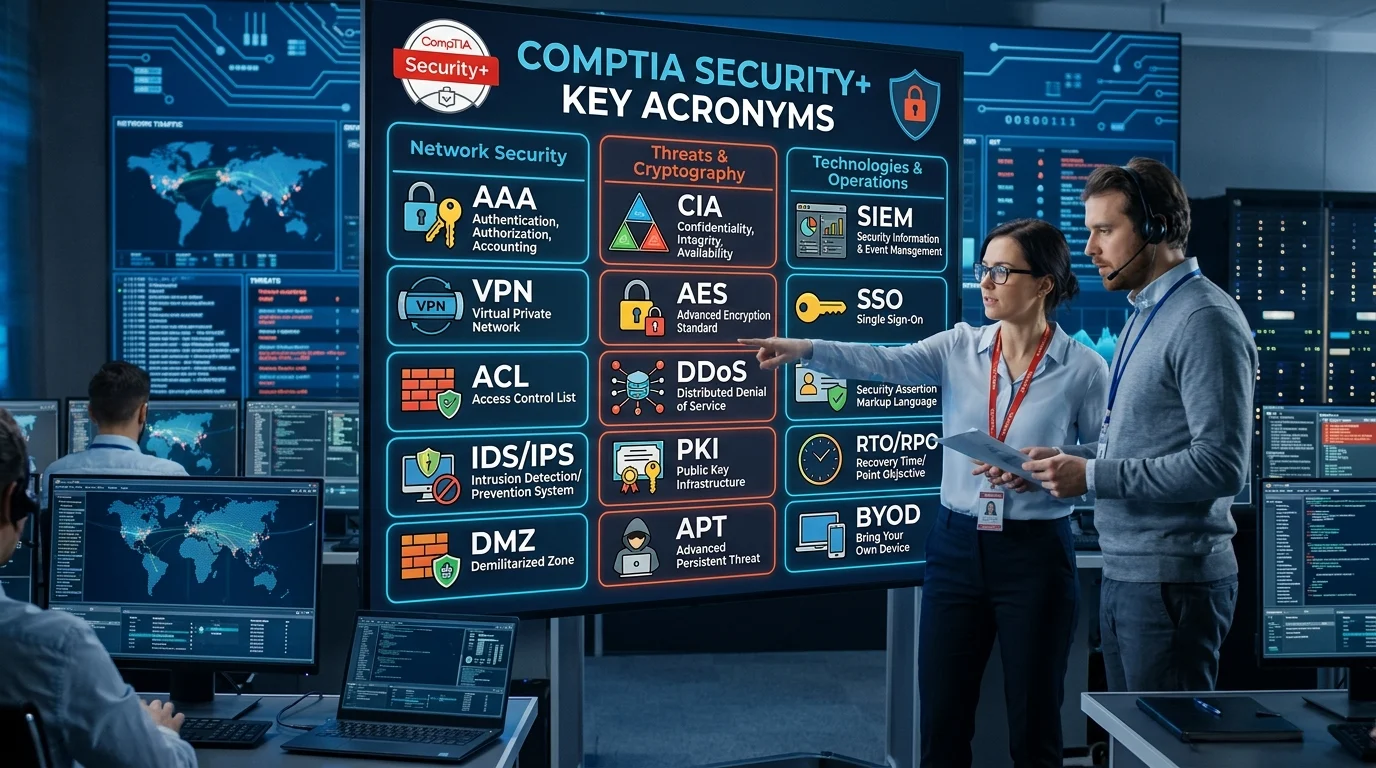
Common CompTIA Security Acronyms and Meanings
| Acronym | Full Form | Meaning | Usage Context |
|---|---|---|---|
| CIA | Confidentiality, Integrity, Availability | Core security principles | Cybersecurity |
| MFA | Multi-Factor Authentication | Multiple login verification methods | Access security |
| VPN | Virtual Private Network | Secure encrypted connection | Network security |
| IDS | Intrusion Detection System | Detects malicious activity | Monitoring |
| IPS | Intrusion Prevention System | Blocks threats automatically | Security systems |
| SIEM | Security Information and Event Management | Security log analysis system | Monitoring |
| DLP | Data Loss Prevention | Prevents data leakage | Data security |
| AAA | Authentication, Authorization, Accounting | Access control framework | Security management |
| IAM | Identity and Access Management | Manages user access | Enterprise security |
| PKI | Public Key Infrastructure | Digital certificate system | Encryption |
| SSL | Secure Sockets Layer | Secure web communication | Web security |
| TLS | Transport Layer Security | Modern encryption protocol | Web security |
| DDoS | Distributed Denial of Service | Overloading system attack | Cyber threats |
| XSS | Cross-Site Scripting | Web injection attack | Application security |
| SQLi | SQL Injection | Database attack method | Application security |
| SOC | Security Operations Center | Cybersecurity monitoring center | Security teams |
| EDR | Endpoint Detection and Response | Endpoint threat detection tool | Device security |
| AV | Antivirus | Malware protection software | System security |
| BYOD | Bring Your Own Device | Personal device in workplace | Policy |
| RBAC | Role-Based Access Control | Access based on user roles | Permissions |
Cybersecurity Principles Acronyms
CIA Triad
The foundation of cybersecurity:
- Confidentiality = Data is protected from unauthorized access
- Integrity = Data is accurate and unaltered
- Availability = Data is accessible when needed
AAA Framework
Controls system access:
- Authentication = Verify identity
- Authorization = Grant permissions
- Accounting = Track user activity
Security Tools Acronyms
SIEM
Security Information and Event Management system that collects and analyzes security logs.
IDS / IPS
- IDS = Detects threats
- IPS = Prevents threats
EDR
Monitors endpoints like laptops and servers for suspicious activity.
Encryption and Web Security Acronyms
PKI
Public Key Infrastructure used for digital certificates and secure communication.
SSL / TLS
- SSL = Older encryption standard
- TLS = Modern secure version used today
Cyber Threat Acronyms
DDoS
Attack that overloads a system with traffic to make it unavailable.
XSS
Injects malicious scripts into websites.
SQLi
Attacks databases using malicious SQL commands.
Why CompTIA Security Acronyms Are Important
These acronyms are important because they:
- Simplify complex cybersecurity concepts
- Standardize communication in IT security
- Help detect and prevent cyber threats
- Are required for Security+ certification exams
- Improve incident response speed
Common Mistakes in Security Acronyms
1. Confusing IDS and IPS
- IDS only detects threats
- IPS actively blocks threats
2. Mixing encryption protocols
SSL is outdated, TLS is current standard.
3. Misunderstanding CIA Triad
It refers to security principles, not government agencies.
Real-Life Cybersecurity Examples
Network Monitoring
“SIEM detected suspicious activity and IDS triggered alert.”
Secure Login
“MFA and VPN required for remote access.”
Web Security
“TLS encryption protects online transactions.”
Simple Memory Guide
- CIA = Core security principles
- MFA = Extra login protection
- VPN = Secure connection
- IDS = Detect threats
- IPS = Block threats
- SIEM = Security monitoring system
Final Summary
CompTIA Security acronyms are essential for understanding cybersecurity concepts, tools, and threats. From CIA Triad and MFA to SIEM, IDS, IPS, and TLS, these terms are widely used in security operations, IT environments, and certification exams.
Learning these acronyms helps professionals protect systems, detect threats faster, and build strong cybersecurity skills.