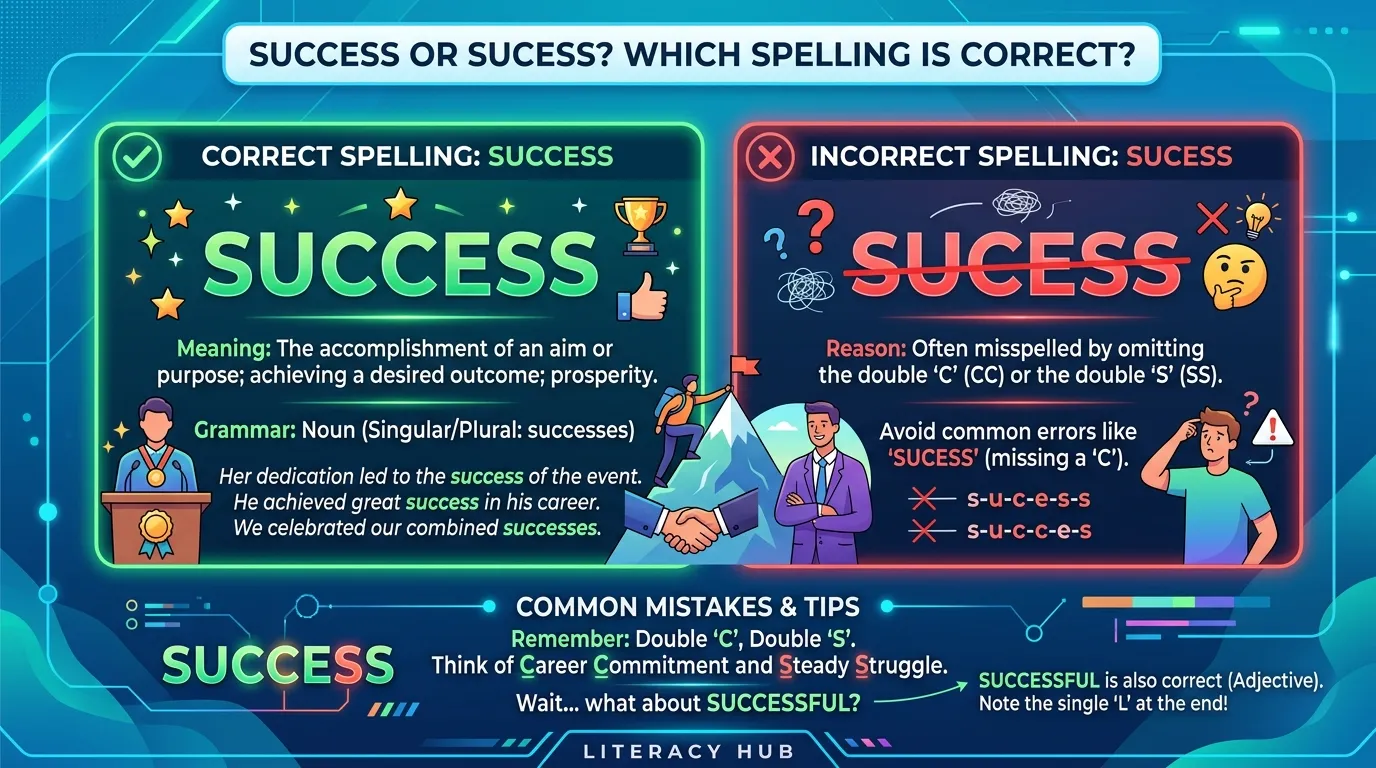
English has many words that people misspell, especially when typing quickly on a phone, computer, or tablet. One of the most common spelling questions is “Success or Sucess?” Thousands of students, professionals, job seekers, bloggers, and English learners search for this topic because they want to write confidently in emails, school assignments, business reports, social media posts, and everyday conversations.
In today’s world of digital communication, even a small spelling mistake can affect how professional your writing appears. Whether you’re writing a LinkedIn post, sending a work email, preparing an academic paper, or posting on social media, using the correct spelling helps build credibility, clarity, and confidence.
Unlike terms such as CEO, MBA, or FBI, success is not an acronym or abbreviation. Instead, it is a commonly used English noun that is often confused because people accidentally omit one of its letters and write sucess.
This guide explains the correct spelling, meaning, pronunciation, grammar rules, examples, and common mistakes so you’ll never confuse success and sucess again.
Success or Sucess: Quick Answer
| Word | Correct? | Meaning |
|---|---|---|
| Success | ✅ Yes | The achievement of a goal or desired result. |
| Sucess | ❌ No | Incorrect spelling of success. |
Correct spelling: Success
Incorrect spelling: Sucess
Always use success with double “c” and double “s.”
Is “Success” an Acronym?
No.
Success is not an acronym, abbreviation, or initialism.
It is simply an English noun that means:
- achieving a goal
- accomplishing something important
- obtaining favorable results
Examples:
- She achieved great success in business.
- Hard work often leads to success.
- The project was a huge success.
What Does Success Mean?
Success means achieving something that you wanted to accomplish.
It can refer to:
- personal achievement
- business growth
- academic excellence
- career advancement
- financial accomplishment
- reaching goals
Simple Definition
Success = accomplishing a desired goal or obtaining positive results.
Pronunciation
Success
IPA (American English): /səkˈsɛs/
Pronounced like:
suh-KSESS
Notice the word contains:
- double c
- double s
Remember:
Suc + cess
Not
Su + cess
Why Do People Write “Sucess”?
The mistake happens because English spelling is not always phonetic.
When speaking quickly, both spellings sound nearly identical, causing people to accidentally remove one c while typing.
Common reasons include:
- typing too fast
- autocorrect failures
- forgetting the second “c”
- lack of familiarity with the word
- pronunciation doesn’t clearly reveal both letters
Memory Trick to Remember the Correct Spelling
Think of this pattern:
Success = Double C + Double S
Visual reminder:
Suc + cess
Both parts contain double letters.
Another easy memory trick:
Successful people need double confidence (CC) and double strength (SS).
Success vs Sucess Comparison Table
| Feature | Success | Sucess |
|---|---|---|
| Correct spelling | ✅ Yes | ❌ No |
| Dictionary word | Yes | No |
| Used in academic writing | Yes | No |
| Accepted in business writing | Yes | No |
| Appears in dictionaries | Yes | No |
| Recommended for professional communication | Yes | No |
Word Origin
The word success comes from the Latin word successus, meaning:
outcome, advance, favorable result
It entered English hundreds of years ago and has always referred to achieving positive results.
Different Forms of Success
| Word | Part of Speech | Example |
|---|---|---|
| Success | Noun | Her success inspired everyone. |
| Successful | Adjective | She is a successful entrepreneur. |
| Successfully | Adverb | They successfully completed the project. |
| Succeed | Verb | I hope you succeed in life. |
Common Examples
Workplace
- The campaign was a success.
- Your presentation was a great success.
- Our company achieved remarkable success.
School
- His academic success impressed the teachers.
- Success requires consistent study habits.
- Every student’s success matters.
Business
- Customer satisfaction leads to long-term success.
- The startup became an overnight success.
Sports
- Teamwork contributed to their success.
- Hard training brings success.
Social Media
- Wishing you continued success.
- Celebrate every small success.
Acronyms, Abbreviations, and Initialisms
Although success itself is not an acronym, many people searching for language topics also want to understand these related terms.
What Is an Acronym?
An acronym is formed from the first letters of several words and is pronounced as a normal word.
Examples:
| Acronym | Full Form |
|---|---|
| NASA | National Aeronautics and Space Administration |
| NATO | North Atlantic Treaty Organization |
| UNESCO | United Nations Educational, Scientific and Cultural Organization |
What Is an Initialism?
An initialism uses the first letters of words, but each letter is spoken separately.
Examples:
- FBI
- BBC
- CEO
- MBA
- USA
What Is an Abbreviation?
An abbreviation is any shortened form of a word or phrase.
Examples:
- Dr.
- Ave.
- Dept.
- Prof.
- etc.
Difference Between Acronyms, Initialisms, and Abbreviations
| Type | Pronounced As | Example |
|---|---|---|
| Acronym | One word | NASA |
| Initialism | Letter by letter | FBI |
| Abbreviation | Shortened word | Dr. |
Using “A” or “An” Before Acronyms
The choice depends on pronunciation, not spelling.
Use an before vowel sounds.
Examples:
- an MBA
- an FBI agent
- an NGO
- an MRI
- an SMS notification
Although these begin with consonant letters, they start with vowel sounds when spoken:
- M → em
- F → ef
- N → en
Use a before consonant sounds.
Examples:
- a CEO
- a NASA engineer
- a URL
- a university
- a European company
Even though some begin with vowel letters, their pronunciation starts with a consonant sound.
Common Grammar Mistakes
❌ a MBA
✅ an MBA
❌ an CEO
✅ a CEO
❌ an NASA scientist
✅ a NASA scientist
Remember:
Listen to the first sound—not the first letter.
Usage Reference Table
Although Success is not an acronym, here is a comparison with common communication terms.
| Term | Full Form | Meaning | Tone | Common Usage |
|---|---|---|---|---|
| Success | Not an acronym | Achievement | Neutral | General English |
| CEO | Chief Executive Officer | Company leader | Formal | Business |
| MBA | Master of Business Administration | Graduate degree | Formal | Education |
| FBI | Federal Bureau of Investigation | Government agency | Formal | News |
| ASAP | As Soon As Possible | Quickly | Casual/Professional | Email, texting |
| DIY | Do It Yourself | Home projects | Casual | Social media |
Real-World Usage Examples
Texting
- Wishing you lots of success!
- Your exam was a success!
Workplace
- Congratulations on your professional success.
- The launch was a complete success.
- Success depends on teamwork.
Academic Writing
- Student success is our priority.
- Academic success requires dedication.
Social Media
- Success begins with small daily habits.
- Celebrate every success, no matter how small.
Common Mistakes
1. Writing “Sucess”
Incorrect:
Sucess
Correct:
Success
2. Forgetting the Double “C”
Many writers remember the double S but forget the second C.
3. Mixing Up Related Words
Incorrect:
She was success.
Correct:
She was successful.
4. Confusing Parts of Speech
Success = noun
Successful = adjective
Successfully = adverb
Succeed = verb
When Should You Use “Success”?
Use success when referring to:
- achievements
- accomplishments
- positive outcomes
- reaching goals
- favorable results
Examples:
- Business success
- Career success
- Academic success
- Financial success
- Personal success
Professional Writing Guide
Use “Success”
✔ Business reports
✔ Academic papers
✔ Emails
✔ News articles
✔ Resumes
✔ Cover letters
✔ Presentations
Avoid
❌ Sucess
❌ Informal misspellings
❌ Typing without proofreading
Spell-check before publishing important documents.
Practice Exercises
Fill in the Blank
- Hard work often leads to ________.
Answer: success
- The product launch was a huge ________.
Answer: success
- Academic ________ requires consistent effort.
Answer: success
Multiple Choice
Which spelling is correct?
A) Sucess
B) Success
✅ Answer: B
Which sentence is correct?
A) She achieved sucess.
B) She achieved success.
✅ Answer: B
Which word is a noun?
A) Successful
B) Success
C) Successfully
✅ Answer: B
Rewrite the Sentence
Incorrect
Our sucess depends on teamwork.
Correct:
Our success depends on teamwork.
Incorrect
She become success.
Correct:
She became successful.
Incorrect
The company sucess was impressive.
Correct:
The company’s success was impressive.
Frequently Asked Questions
Is success the correct spelling?
Yes. Success is the only correct spelling.
Is sucess a real English word?
No.
It is simply a misspelling of success.
Why is success spelled with two C’s?
The spelling comes from its Latin origin and has remained unchanged in modern English.
Is success an acronym?
No.
It is a regular English noun.
Can I use success in formal writing?
Yes.
It is appropriate for:
- business writing
- academic writing
- professional emails
- research papers
- resumes
- official documents
How do I remember the spelling?
Remember:
Success = Double C + Double S
Which article should I use before acronym-based terms?
Choose a or an based on pronunciation, not the first letter.
Examples:
- an MBA
- an FBI agent
- a CEO
- a NASA scientist
Why is correct spelling important?
Correct spelling improves readability, professionalism, credibility, and searchability. It also helps avoid confusion in academic, workplace, and online communication.
Conclusion
The answer is simple: Success is the correct spelling, while sucess is always incorrect. Although many people search for “Success or Sucess” because of a common typing mistake, remembering the double “c” and double “s” will help you avoid the error. Success is a standard English noun—not an acronym, abbreviation, or initialism—and it is suitable for every type of writing, from text messages to professional reports.
By understanding the correct spelling, pronunciation, grammar, and usage, you’ll communicate more clearly and confidently in both personal and professional settings.


