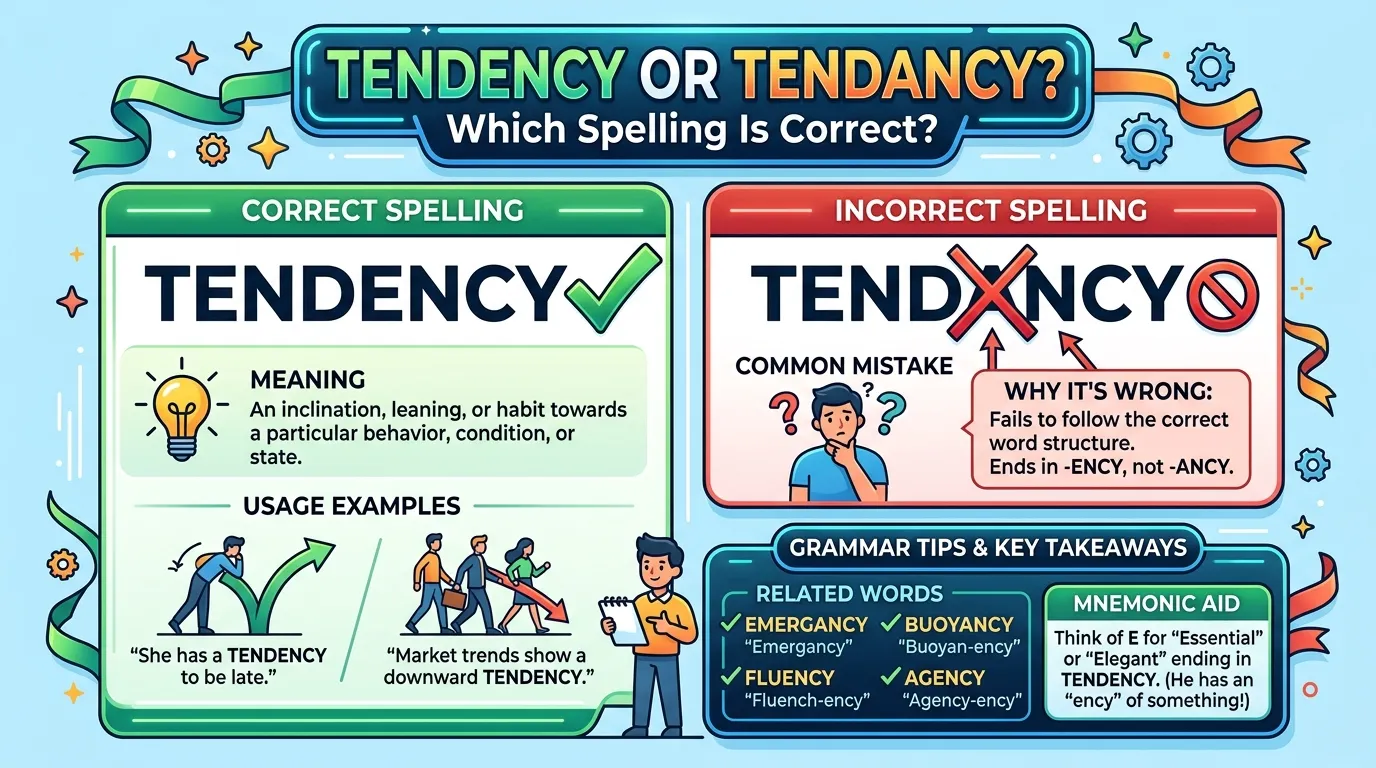
Have you ever typed “tendancy” and wondered if it was correct? You’re not alone. Many English learners, students, professionals, and even native speakers search for “Tendency or Tendancy” because the two words sound very similar.
In today’s world of texting, business communication, social media, emails, and academic writing, using the correct spelling is more important than ever. A simple spelling mistake can make your writing appear less professional or even confuse your reader.
If you’re searching for the correct spelling, pronunciation, grammar rules, or examples, this guide has everything you need.
Quick Answer: ✅ Tendency is the correct English spelling. ❌ Tendancy is incorrect and is considered a spelling mistake.
Quick Comparison Table
| Word | Correct? | Meaning |
|---|---|---|
| Tendency | ✅ Yes | A natural habit, inclination, or likelihood to do something |
| Tendancy | ❌ No | Incorrect spelling of tendency |
What Does “Tendency” Mean?
Tendency is a noun that describes someone’s natural habit, usual behavior, or likelihood to do something.
Simple Definition
Tendency means a natural inclination or habit of acting, thinking, or behaving in a certain way.
Examples
- She has a tendency to wake up early.
- Children have a tendency to imitate adults.
- The market shows a tendency to grow during summer.
- He has a tendency to forget names.
Why Do People Write “Tendancy”?
The incorrect spelling tendancy usually happens because English pronunciation can be misleading.
People often hear the ending as:
ten-den-see
and mistakenly replace -ency with -ancy.
However, the standard English spelling has always been:
✅ Tendency
Never:
❌ Tendancy
Spell checkers, dictionaries, and grammar tools all recognize tendency as the correct form.
Pronunciation
Tendency
IPA (American English):
/ˈtɛn.dən.si/
Easy Pronunciation
TEN-duhn-see
Notice that although the pronunciation sounds similar to “-ancy,” the correct spelling remains -ency.
Word Origin
The word tendency comes from the Latin word tendere, meaning to stretch or lean toward.
Over time it entered Middle English through French and eventually became the modern English noun tendency, meaning an inclination or natural direction.
Grammar Category
| Property | Information |
|---|---|
| Part of Speech | Noun |
| Countable | Yes |
| Plural | Tendencies |
| Adjective | Tendentious (different meaning), Tendential (rare) |
| Verb | Tend (related but different meaning) |
Is “Tendancy” Ever Correct?
No.
There are no major English dictionaries that recognize tendancy as a correct spelling.
This includes:
- Merriam-Webster
- Cambridge Dictionary
- Oxford English Dictionary
- Collins Dictionary
- Dictionary.com
Whenever you write tendancy, it should be corrected to tendency.
Why Is “Tendency” the Correct Spelling?
Many English nouns end in -ency, including:
- frequency
- consistency
- urgency
- dependency
- transparency
- efficiency
- tendency
These words follow common English spelling patterns.
Examples of “Tendency” in Everyday Life
Daily Conversation
- I have a tendency to drink too much coffee.
- Dogs have a tendency to bark at strangers.
- Teenagers have a tendency to stay up late.
Workplace
- The company has a tendency to hire experienced candidates.
- Our customers show a tendency to shop online.
Academic Writing
- Researchers observed a tendency toward healthier eating habits.
- The data revealed a tendency for temperatures to rise.
Healthcare
- Some people have a tendency to develop allergies.
- Genetics may increase the tendency for certain diseases.
Business
- Consumer spending shows a tendency to increase during holidays.
- Investors noticed a tendency toward safer investments.
Common Collocations
Native speakers often use tendency with certain verbs and adjectives.
Examples include:
- strong tendency
- natural tendency
- growing tendency
- clear tendency
- general tendency
- tendency to
- tendency toward
- tendency for
Example Sentences
- She has a strong tendency to overthink.
- There is a growing tendency toward remote work.
- Humans have a natural tendency to seek comfort.
Tendency vs Trend
These two words are similar but not identical.
| Tendency | Trend |
|---|---|
| Habit or inclination | General direction of change |
| Often about behavior | Often about statistics or fashion |
| Personal or general | Usually large-scale |
Examples
Tendency
- He has a tendency to interrupt.
Trend
- Remote work is a growing trend.
Tendency vs Habit
| Tendency | Habit |
|---|---|
| Natural inclination | Repeated learned behavior |
| May not happen every time | Happens regularly |
Example:
- She has a tendency to worry.
- She has a habit of checking her phone every five minutes.
Common Spelling Mistakes Similar to “Tendency”
Many learners confuse similar words.
| Incorrect | Correct |
|---|---|
| Tendancy | Tendency |
| Dependancy | Dependency |
| Urgancy | Urgency |
| Frequancy | Frequency |
| Consistancy | Consistency |
Learning these patterns helps improve spelling accuracy.
Memory Trick
A simple way to remember the correct spelling:
Think of the word:
Tend + ency
Notice the E.
Many similar nouns also end in -ency.
Examples:
- emergency
- efficiency
- frequency
- consistency
- tendency
Remember:
If in doubt, choose “-ency,” not “-ancy,” for this word.
Common Mistakes
❌ Writing “tendancy”
Incorrect:
She has a tendancy to worry.
Correct:
She has a tendency to worry.
❌ Confusing “tendency” with “trend”
Incorrect:
My tendency is becoming popular.
Correct:
This trend is becoming popular.
❌ Using “tendency” as a verb
Incorrect:
He tendency to forget.
Correct:
He has a tendency to forget.
or
He tends to forget.
Synonyms of Tendency
Depending on the context, you can use:
- inclination
- habit
- likelihood
- leaning
- preference
- disposition
- propensity
- pattern
- bias
- characteristic
Antonyms
Some opposite words include:
- resistance
- avoidance
- unwillingness
- dislike
- reluctance
- opposition
Examples in Different Contexts
Personal Life
- I have a tendency to smile when I’m nervous.
- She has a tendency to forget birthdays.
School
- Students have a tendency to procrastinate before exams.
- Young learners show a tendency to ask many questions.
Sports
- The team has a tendency to play better at home.
- He has a tendency to score late in games.
Technology
- Smartphones have a tendency to slow down when storage is full.
- AI models sometimes show a tendency toward repetitive responses.
Social Media
- Viral posts have a tendency to spread quickly.
- Users have a tendency to engage with short videos.
Practice Exercises
Fill in the Blank
Choose the correct spelling.
- She has a ________ to laugh loudly.
- A. Tendancy
- B. Tendency ✅
- The data showed a ________ toward improvement.
- A. Tendency ✅
- B. Tendancy
- He has a ________ to arrive early.
- A. Tendancy
- B. Tendency ✅
Correct the Mistake
Incorrect:
- I have a tendancy to forget passwords.
- Her tendancy is improving.
- The tendancy continues every year.
Correct:
- I have a tendency to forget passwords.
- Her tendency is improving.
- The tendency continues every year.
Choose the Correct Word
- Children have a ________ to copy adults.
- tendency ✅
- tendancy
- Scientists noticed a ________ toward warmer weather.
- tendency ✅
- tendancy
Frequently Asked Questions
Is “tendancy” a real word?
No. It is an incorrect spelling. The correct word is tendency.
Which spelling is correct: tendency or tendancy?
Tendency is the only correct spelling in English.
Why do people misspell tendency?
Because the pronunciation can make the ending sound like “-ancy,” leading many writers to spell it incorrectly.
Is “tendency” a noun?
Yes. It is a countable noun.
Example:
- He has a tendency to worry.
What is the plural of tendency?
The plural is:
Tendencies
Example:
- Human tendencies differ from person to person.
Can I use “tendency” in formal writing?
Yes.
It is commonly used in:
- academic papers
- business reports
- journalism
- scientific research
- professional emails
Is “tendency” common in everyday English?
Yes.
It is frequently used in daily conversations as well as professional writing.
What is another word for tendency?
Some common synonyms include:
- inclination
- habit
- preference
- propensity
- disposition
- likelihood
Final Thoughts
Although “tendency” and “tendancy” may sound alike, only tendency is correct in standard English. Understanding this difference will help you write with greater confidence in school, at work, and in everyday communication.
Whenever you want to describe a natural habit, inclination, or likelihood, remember to use tendency. Avoid the incorrect spelling tendancy, proofread your writing, and rely on trusted dictionaries or grammar tools when you’re unsure. Mastering small spelling distinctions like this can make your communication clearer, more professional, and more effective.


