In today’s digital world, people communicate faster than ever through text messages, emails, social media, business documents, and online learning platforms. While acronyms and abbreviations make communication quicker, correct spelling is just as important. A single misplaced letter can change how professional or trustworthy your writing appears.
One of the most commonly searched spelling questions is “Strength or Strenght?” Many people accidentally type “strenght” instead of “strength” because the last two consonants (th) are easy to reverse when typing quickly.
Whether you’re writing an email, completing school assignments, updating your resume, posting on social media, or creating business content, knowing the correct spelling helps you communicate clearly and confidently.
In this guide, you’ll learn:
- Which spelling is correct
- Why people confuse strength and strenght
- The meaning of strength
- Grammar rules and pronunciation
- The difference between acronyms, abbreviations, and initialisms
- How to use a or an before acronyms
- Real-life examples
- Common mistakes to avoid
- Practice exercises
- Frequently asked questions
Let’s clear up the confusion once and for all.
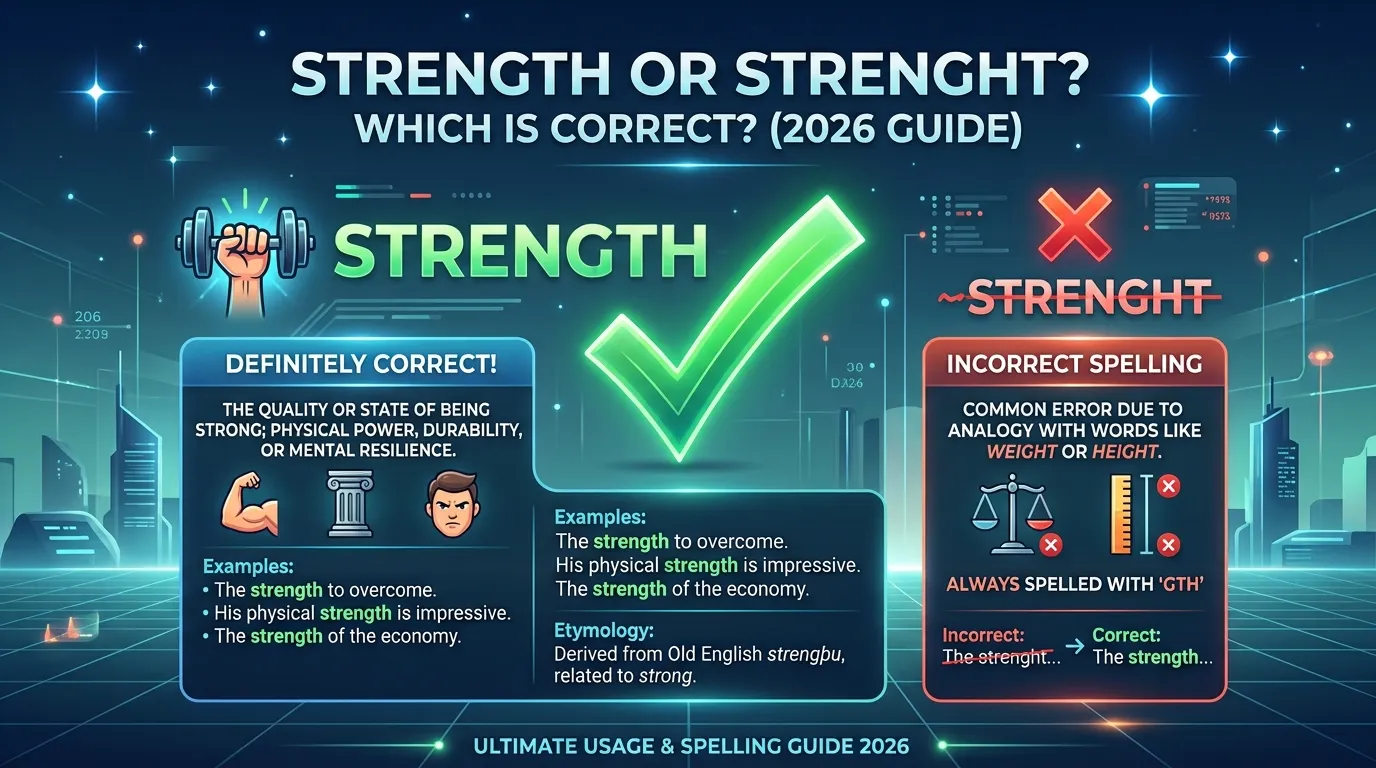
Strength or Strenght: Which Is Correct?
✅ Correct: Strength
❌ Incorrect: Strenght
The correct English spelling is always strength.
| Word | Correct? | Meaning |
|---|---|---|
| Strength | ✅ Yes | Power, ability, force, or resilience |
| Strenght | ❌ No | Misspelling of strength |
Strength is an English noun that describes physical power, mental resilience, emotional courage, or the durability of something.
Example:
- She showed great strength during difficult times.
- Exercise helps build muscle strength.
- Honesty is one of his greatest strengths.
Meaning of Strength
The word strength means:
- Physical power
- Mental toughness
- Emotional resilience
- Moral courage
- The quality of being strong
- An advantage or positive characteristic
Examples
- Her greatest strength is patience.
- Teamwork is the company’s biggest strength.
- Yoga improves balance and core strength.
- His emotional strength inspired everyone.
Why Do People Misspell “Strength” as “Strenght”?
The mistake happens because of letter transposition.
Many writers accidentally reverse the final letters.
Correct order:
S-T-R-E-N-G-T-H
Incorrect order:
S-T-R-E-N-G-H-T
Since both th and ht are common letter combinations in English typing, the fingers sometimes switch them unconsciously.
Other reasons include:
- Fast typing
- Autocorrect errors
- Learning English as a second language
- Weak spelling memory
- Pronunciation not matching spelling exactly
Pronunciation
Strength
IPA (American English):
/streŋθ/
Pronounced approximately as:
STRENGTH
Notice that the final sound is θ (th), just like in:
- think
- thank
- thick
Is “Strength” an Acronym?
No.
Strength is not an acronym.
It is a regular English noun.
Many people searching for this topic also want to understand abbreviations and acronyms, so let’s explain them clearly.
What Is an Acronym?
An acronym is a word formed from the first letters of several words and pronounced as one word.
Examples:
| Acronym | Full Form |
|---|---|
| NASA | National Aeronautics and Space Administration |
| UNESCO | United Nations Educational, Scientific and Cultural Organization |
| SCUBA | Self-Contained Underwater Breathing Apparatus |
| LASER | Light Amplification by Stimulated Emission of Radiation |
People use acronyms because they save time and make communication more efficient.
Acronyms vs Abbreviations vs Initialisms
Many people confuse these three terms.
| Type | Definition | Example | Pronunciation |
|---|---|---|---|
| Acronym | First letters pronounced as a word | NASA | “nah-sa” |
| Initialism | First letters pronounced individually | FBI | “F-B-I” |
| Abbreviation | Shortened form of a word | Dr. | Doctor |
Examples
Acronym
- NASA
- UNESCO
- SCUBA
Initialism
- CEO
- FBI
- BBC
- ATM
Abbreviation
- Ave.
- Inc.
- Prof.
- Mr.
Why Are Acronyms Widely Used Today?
Modern communication values speed and clarity.
Acronyms help people communicate faster in:
- Business emails
- Corporate reports
- Universities
- Government documents
- Healthcare
- Technology
- Social media
- Text messaging
Instead of writing:
Artificial Intelligence
people simply write:
AI
Instead of:
Frequently Asked Questions
people use:
FAQ
Using “A” or “An” Before Acronyms
One of the biggest grammar mistakes involves articles.
The rule depends on pronunciation, not spelling.
Use “An”
Use an before acronyms that begin with a vowel sound.
Examples:
- an MBA
- an FBI agent
- an LCD screen
- an MRI scan
Although M, F, L, and M are consonant letters, they start with vowel sounds when spoken:
- em
- ef
- el
- em
Therefore:
✅ an MBA
✅ an FBI officer
Use “A”
Use a before acronyms that begin with a consonant sound.
Examples:
- a CEO
- a NASA engineer
- a URL (American pronunciation: “yoo-are-el”)
- a USB cable
Common Grammar Mistakes
❌ a MBA
✅ an MBA
❌ an CEO
✅ a CEO
❌ an NASA employee
✅ a NASA employee
Remember:
Always listen to the pronunciation—not the first letter.
Acronym Usage Table
| Acronym | Full Form | Meaning | Tone | Common Usage |
|---|---|---|---|---|
| CEO | Chief Executive Officer | Company leader | Formal | Business |
| MBA | Master of Business Administration | Graduate degree | Formal | Education |
| FBI | Federal Bureau of Investigation | U.S. law enforcement | Formal | Government |
| AI | Artificial Intelligence | Computer intelligence | Neutral | Technology |
| FAQ | Frequently Asked Questions | Common questions | Neutral | Websites |
| DIY | Do It Yourself | Self-made projects | Casual | Social media |
| LOL | Laugh Out Loud | Funny response | Casual | Texting |
| BTW | By The Way | Additional information | Casual | Messaging |
| ETA | Estimated Time of Arrival | Expected arrival time | Neutral | Business & travel |
| HR | Human Resources | Employee department | Formal | Workplace |
Real-World Usage Examples
Text Messaging
- LOL, that was hilarious.
- BTW, I’ll be late.
- ETA is 10 minutes.
Workplace Communication
- The CEO announced a new policy.
- HR scheduled the interviews.
- AI is improving customer support.
Academic Writing
- She completed an MBA last year.
- The report included several FAQs.
- Students studied NASA missions.
Social Media
- DIY room makeover ideas.
- AI art is becoming popular.
- FAQ in bio.
Common Mistakes with Acronyms
1. Overusing Acronyms
Too many acronyms confuse readers.
Poor example:
The CEO asked HR to review KPI and ROI before the ESG meeting.
Better:
Introduce each acronym before using it repeatedly.
2. Assuming Everyone Knows Them
Not every reader understands every acronym.
Write:
Artificial Intelligence (AI)
Then continue using AI.
3. Cultural Differences
Some acronyms mean different things in different countries.
For example:
CV
United Kingdom:
Curriculum Vitae
United States:
Resume is more common.
4. Tone Confusion
LOL may sound appropriate in texting but unprofessional in a formal report.
Choose acronyms that fit your audience.
When Should You Use Acronyms?
Professional Writing
Use acronyms when:
- The audience knows them.
- The term appears many times.
- You define it on first use.
Example:
Artificial Intelligence (AI) is transforming healthcare. AI also improves medical imaging.
Academic Writing
Spell out the full term first.
Example:
World Health Organization (WHO)
Later:
WHO
Business Communication
Widely recognized acronyms are acceptable.
Examples:
- CEO
- CFO
- HR
- KPI
Texting and Social Media
Casual acronyms are common.
Examples:
- LOL
- BRB
- IMO
- BTW
Avoid them in formal emails unless appropriate.
Interactive Practice
Fill in the Blanks
- The correct spelling is ________.
- She showed great ________ during the competition.
- I earned ______ MBA from Harvard.
- The ______ announced the quarterly results.
- NASA is an example of an ________.
Answers
- strength
- strength
- an
- CEO
- acronym
Multiple Choice
1. Which spelling is correct?
A. Strenght
B. Strength ✅
C. Strenth
D. Strengh
2. Which is an acronym?
A. FBI
B. NASA ✅
C. Dr.
D. Mr.
3. Which sentence is correct?
A. a MBA
B. an MBA ✅
C. an CEO
D. a FBI agent
4. Which is an abbreviation?
A. NASA
B. CEO
C. Dr. ✅
D. UNESCO
Rewrite These Sentences
Correct the mistakes.
- He has great strenght.
Answer:
He has great strength.
- She earned a MBA.
Answer:
She earned an MBA.
- An CEO visited our office.
Answer:
A CEO visited our office.
- Strenght is important.
Answer:
Strength is important.
Frequently Asked Questions
Is “strength” or “strenght” correct?
Strength is the correct spelling. Strenght is a common misspelling.
What does “strength” mean?
It means power, resilience, ability, or a positive quality.
Is “strength” an acronym?
No. Strength is a regular English noun, not an acronym or abbreviation.
Why do people spell it as “strenght”?
The letters t and h are often accidentally reversed during typing.
Is “strenght” ever acceptable?
No. It is always considered a spelling error in standard English.
Should I write “a MBA” or “an MBA”?
The correct form is an MBA because the letter M is pronounced “em,” which begins with a vowel sound.
Should I use acronyms in formal writing?
Yes, but define the full term the first time you mention it unless the acronym is universally recognized (such as NASA or CEO).
Why are acronyms popular today?
They make communication faster, shorter, and easier, especially in business, education, technology, texting, and social media.
Conclusion
The correct spelling is strength, while strenght is simply a common typo caused by reversing the final letters. Using the correct spelling improves your credibility and ensures clear communication in school, work, and everyday writing. Although strength is not an acronym, understanding how acronyms, abbreviations, and initialisms work can help you communicate more effectively in modern contexts.
Finally, remember that grammar rules such as choosing a or an before acronyms depend on how the acronym is pronounced, not how it is spelled. Mastering these small details will make your English writing more accurate, professional, and confident.


