The HVAC industry uses many technical abbreviations called HVAC acronyms. These terms are essential for technicians, engineers, contractors, and building managers to understand heating, cooling, ventilation, and air quality systems.
Learning HVAC acronyms helps improve communication, system maintenance, installation work, and energy efficiency planning.
What Are HVAC Acronyms?
HVAC acronyms are shortened terms used in heating, ventilation, and air conditioning systems to describe equipment, processes, measurements, and controls.
They are commonly used in:
- Building construction
- HVAC installation and repair
- Engineering design
- Energy management
- Industrial systems
- Smart building automation
For example:
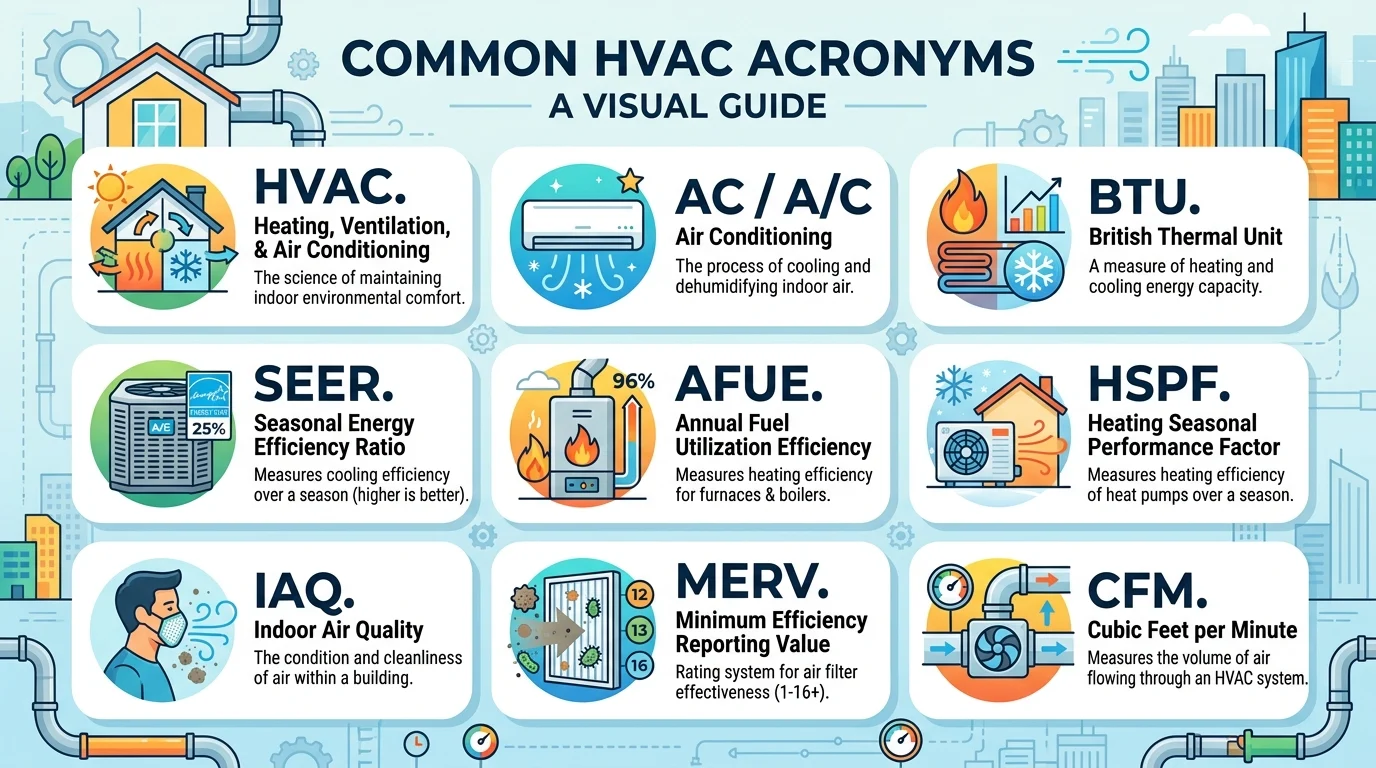
- HVAC = Heating, Ventilation, and Air Conditioning
- BTU = British Thermal Unit
- CFM = Cubic Feet per Minute
Common HVAC Acronyms List
| Acronym | Full Form | Meaning | Usage Context |
|---|---|---|---|
| HVAC | Heating, Ventilation, and Air Conditioning | Climate control system | Buildings |
| BTU | British Thermal Unit | Heat energy measurement | Cooling/heating |
| CFM | Cubic Feet per Minute | Airflow rate | Ventilation |
| SEER | Seasonal Energy Efficiency Ratio | Cooling efficiency rating | Air conditioners |
| EER | Energy Efficiency Ratio | Cooling performance measure | HVAC systems |
| COP | Coefficient of Performance | Efficiency of heating/cooling | Engineering |
| AHU | Air Handling Unit | Central air system component | Commercial HVAC |
| FCU | Fan Coil Unit | Small heating/cooling unit | Buildings |
| RTU | Rooftop Unit | HVAC unit on rooftops | Commercial systems |
| VAV | Variable Air Volume | Airflow control system | Ventilation |
| HVACR | Heating, Ventilation, Air Conditioning & Refrigeration | Full system category | Industry |
| IAQ | Indoor Air Quality | Air cleanliness measurement | Health & safety |
| DUCT | Air distribution channel | Airflow passage system | Ventilation |
| HVACR | Heating, Ventilation, Air Conditioning, Refrigeration | Extended system term | Industry |
Heating & Cooling Acronyms
BTU (British Thermal Unit)
Measures the amount of heat energy needed to raise temperature.
SEER
Measures how efficiently an air conditioner operates over a season.
EER
Measures cooling efficiency at a fixed temperature.
Airflow & Ventilation Acronyms
CFM
Measures how much air moves through a system per minute.
VAV
Adjusts airflow based on temperature needs in different zones.
IAQ
Refers to the quality and cleanliness of indoor air.
HVAC Equipment Acronyms
AHU (Air Handling Unit)
Central system that regulates and circulates air.
FCU (Fan Coil Unit)
Small device used for heating or cooling individual rooms.
RTU (Rooftop Unit)
HVAC system installed on top of commercial buildings.
Efficiency & Performance Acronyms
COP
Measures how efficiently a system converts energy into heating or cooling.
SEER & EER
Used to compare energy efficiency of air conditioning units.
Why HVAC Acronyms Are Important
HVAC acronyms are important because they:
- Simplify technical communication
- Improve installation accuracy
- Help with system design and maintenance
- Support energy efficiency planning
- Standardize industry terminology
Common Mistakes with HVAC Acronyms
1. Confusing SEER and EER
SEER is seasonal, EER is fixed condition efficiency.
2. Misreading airflow units
CFM must match system design requirements.
3. Ignoring IAQ importance
Indoor air quality affects health and comfort.
Real-Life Examples
Air Conditioning Installation
“Unit rated at 18 SEER and 12,000 BTU.”
Commercial Building
“AHU controls airflow using VAV system.”
Maintenance Report
“CFM levels indicate reduced airflow efficiency.”
Simple Memory Guide
- HVAC = Climate system
- BTU = Heat energy
- CFM = Airflow speed
- SEER = Cooling efficiency
- AHU = Air system unit
- IAQ = Air quality
Final Summary
HVAC acronyms are essential in heating, cooling, and ventilation systems. Terms like HVAC, BTU, CFM, SEER, AHU, and IAQ help professionals understand system performance, energy efficiency, and air quality.
Learning these acronyms improves communication and technical understanding in the HVAC industry.