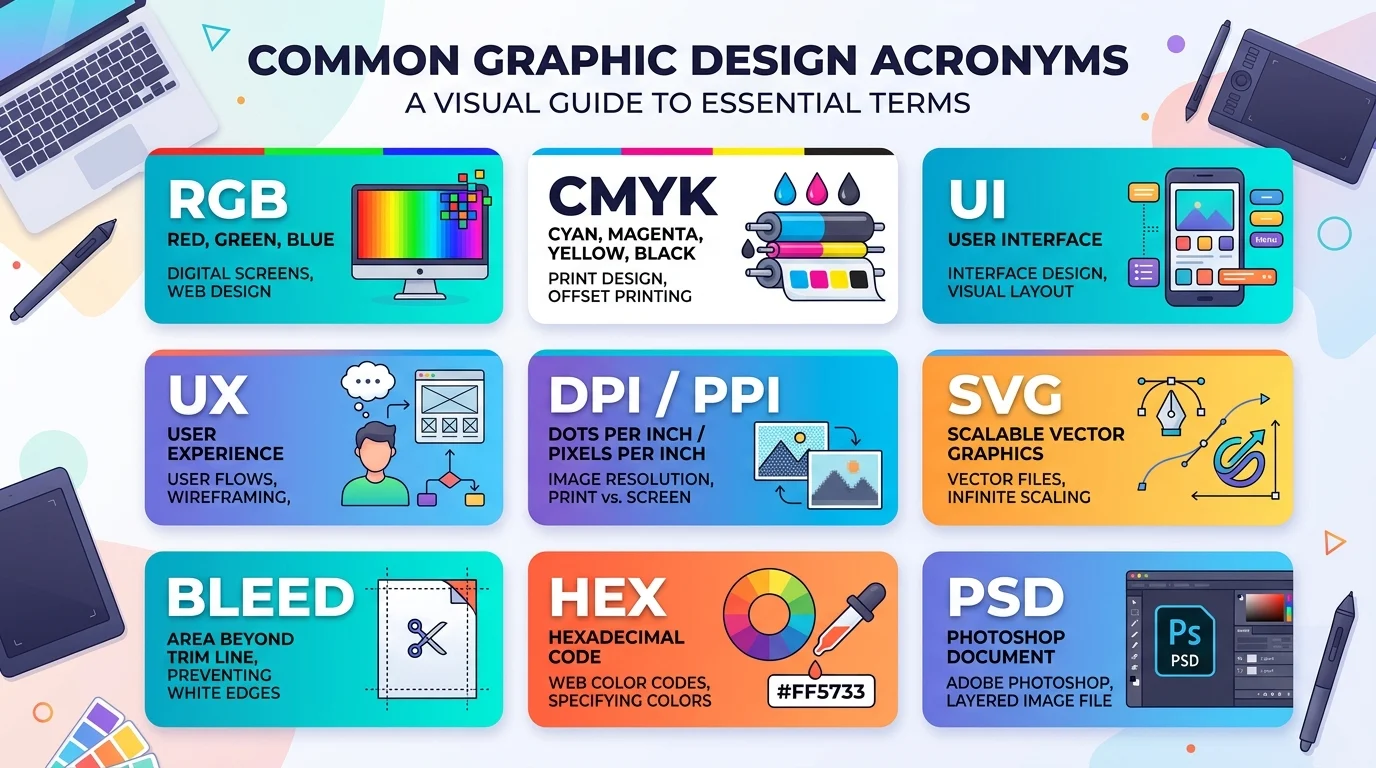
Graphic designers use many graphic design acronyms to communicate efficiently about design projects, printing, branding, digital media, and user experience. These abbreviations help designers, marketers, printers, and clients understand technical concepts quickly.
Whether you’re a beginner or a professional designer, learning these acronyms can improve your workflow and communication.
What Are Graphic Design Acronyms?
Graphic design acronyms are shortened terms used in design, printing, digital media, branding, web design, and marketing.
They are commonly used in:
- Logo design
- Print design
- Web design
- UI/UX design
- Digital marketing
- Publishing and advertising
For example:
- RGB = Red, Green, Blue
- CMYK = Cyan, Magenta, Yellow, Key (Black)
- DPI = Dots Per Inch
Common Graphic Design Acronyms List
| Acronym | Full Form | Meaning | Usage Context |
|---|---|---|---|
| RGB | Red, Green, Blue | Digital color model | Web & screens |
| CMYK | Cyan, Magenta, Yellow, Key (Black) | Print color model | Printing |
| DPI | Dots Per Inch | Print resolution measurement | Print design |
| PPI | Pixels Per Inch | Screen resolution measurement | Digital design |
| SVG | Scalable Vector Graphics | Vector image format | Web graphics |
| JPG | Joint Photographic Experts Group | Compressed image format | Photography |
| PNG | Portable Network Graphics | Transparent image format | Web design |
| Portable Document Format | Universal document format | Printing & sharing | |
| UI | User Interface | Visual interaction design | Apps & websites |
| UX | User Experience | User interaction and usability | Product design |
| PSD | Photoshop Document | Adobe Photoshop file | Graphic design |
| AI | Adobe Illustrator File | Vector artwork format | Illustration |
| EPS | Encapsulated PostScript | Professional vector format | Printing |
| CTA | Call to Action | Marketing prompt | Advertising |
| SEO | Search Engine Optimization | Website visibility improvement | Digital marketing |
Color and Printing Acronyms
RGB
Used for digital screens such as:
- Websites
- Smartphones
- Computers
- TVs
CMYK
Used for professional printing because printers use ink rather than light.
DPI
Measures print quality and image sharpness.
Image Format Acronyms
JPG
Popular format for photos due to smaller file sizes.
PNG
Supports transparency and high-quality web graphics.
SVG
Vector-based format that can scale without losing quality.
Widely used for sharing and printing design files.
Design Software Acronyms
PSD
Native file format of Adobe Photoshop.
AI
Native file format of Adobe Illustrator used for vector graphics.
EPS
Professional vector format used in commercial printing.
Web and User Experience Acronyms
UI (User Interface)
Focuses on how websites and applications look.
UX (User Experience)
Focuses on how users interact with products and services.
SEO
Helps websites rank better in search engines.
Marketing and Branding Acronyms
CTA
A phrase encouraging users to take action.
Examples:
- Buy Now
- Sign Up
- Learn More
Why Graphic Design Acronyms Are Important
These acronyms are important because they:
- Simplify technical communication
- Improve project collaboration
- Reduce misunderstandings
- Help designers work efficiently
- Standardize industry terminology
Common Mistakes with Graphic Design Acronyms
1. Confusing RGB and CMYK
RGB is for screens, while CMYK is for print.
2. Mixing DPI and PPI
DPI relates to printing; PPI relates to screens.
3. Using the wrong file format
Different projects require different formats.
Real-Life Examples
Website Design
“Use RGB colors and SVG graphics.”
Print Brochure
“Convert artwork to CMYK and export as PDF.”
Marketing Campaign
“Add a strong CTA and optimize for SEO.”
Simple Memory Guide
- RGB = Screen colors
- CMYK = Print colors
- DPI = Print resolution
- SVG = Scalable vector graphic
- UI = Interface design
- UX = User experience
Final Summary
Graphic design acronyms are essential for designers, marketers, and print professionals. Terms like RGB, CMYK, DPI, SVG, UI, UX, and PDF help streamline communication and ensure high-quality design work.
Understanding these acronyms improves design skills, project management, and collaboration across the creative industry.


