In today’s fast-moving world, acronyms are everywhere. Whether you’re reading a business report, sending a text message, browsing social media, or studying for an exam, you’re likely to encounter abbreviations and acronyms daily. These shortened forms help people communicate faster while saving time and space.
One acronym that people frequently search for is WHO. Some users want to know its official meaning, while others are curious about how it is used in professional, educational, and global communication.
Understanding the WHO acronym, along with the broader concept of acronyms, can improve your communication skills, enhance your writing, and help you avoid common grammar mistakes. This guide explains everything you need to know in simple, easy-to-understand language.
What Does WHO Stand For?
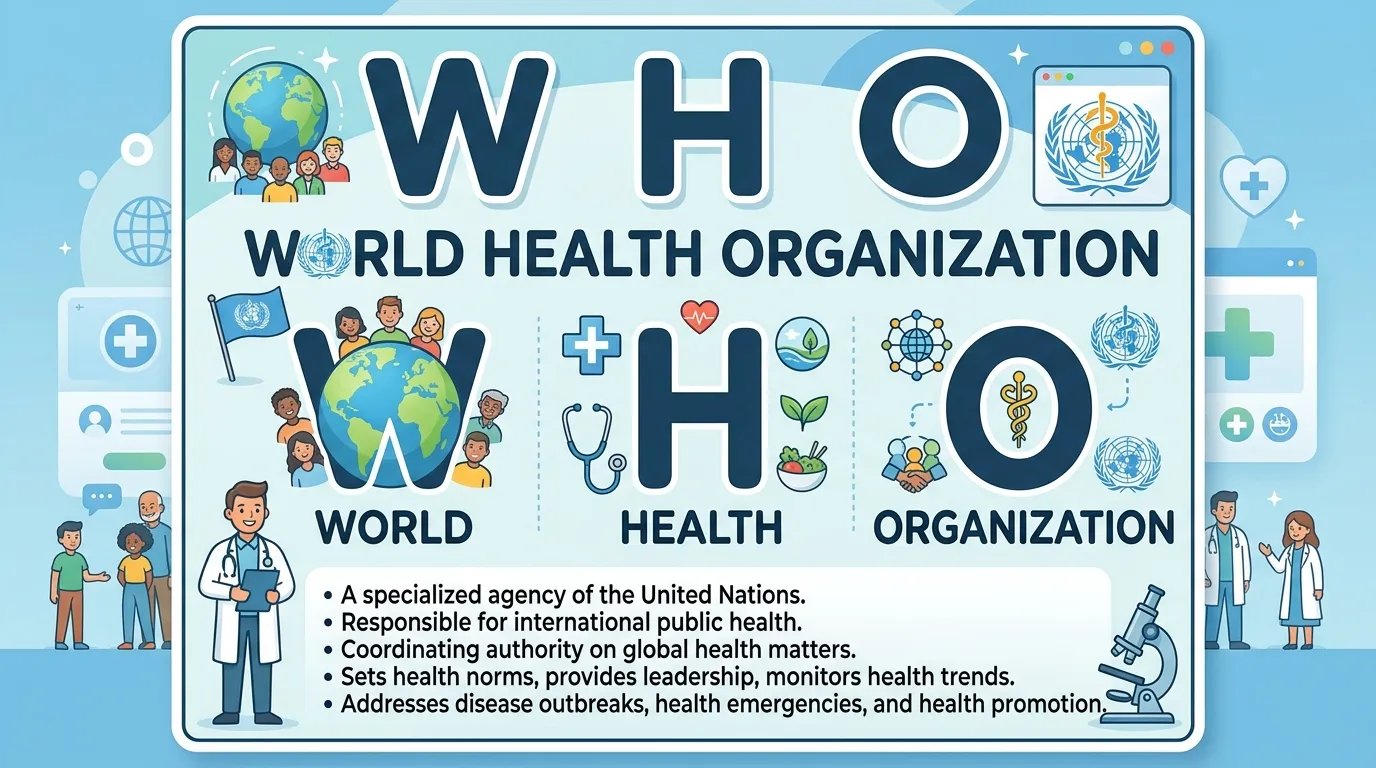
WHO stands for World Health Organization.
The World Health Organization is a specialized agency of the United Nations responsible for promoting global public health, coordinating responses to health emergencies, and supporting countries in improving healthcare systems.
Simple Meaning
- W = World
- H = Health
- O = Organization
The acronym WHO is widely recognized around the world and is commonly used in news reports, academic research, healthcare discussions, and government communications.
Example
✅ The WHO released new health guidelines.
✅ Researchers followed recommendations published by the WHO.
What Is an Acronym?
An acronym is a word formed from the first letters of a group of words and pronounced as a word itself.
Examples
| Acronym | Full Form | Pronunciation |
|---|---|---|
| NASA | National Aeronautics and Space Administration | NASS-uh |
| UNESCO | United Nations Educational, Scientific and Cultural Organization | You-NESS-co |
| WHO | World Health Organization | Double-U H O (commonly spoken as individual letters) |
Acronyms make communication faster and more efficient.
Acronyms vs Abbreviations vs Initialisms
Many people use these terms interchangeably, but they are different.
Acronym
An acronym forms a new pronounceable word.
Examples:
- NASA
- UNESCO
- NATO
- SCUBA
Initialism
An initialism uses the first letters of words, but each letter is pronounced separately.
Examples:
- FBI
- CEO
- BBC
- WHO
Technically, WHO is often considered an initialism because people usually say each letter individually.
Abbreviation
An abbreviation is any shortened form of a word or phrase.
Examples:
- Dr. = Doctor
- Ave. = Avenue
- Prof. = Professor
Quick Comparison
| Type | Example | Pronounced As |
|---|---|---|
| Acronym | NASA | As a word |
| Initialism | FBI | Letter by letter |
| Abbreviation | Dr. | Shortened word |
Why Are Acronyms So Popular Today?
Modern communication values speed and efficiency.
Benefits of Acronyms
- Save typing time
- Reduce long phrases
- Improve readability
- Make communication quicker
- Create standardized terminology
Common Areas of Use
- Business
- Healthcare
- Education
- Technology
- Government
- Text messaging
- Social media
For example, saying “WHO” is much faster than repeatedly saying “World Health Organization.”
WHO Acronym Reference Table
| Acronym | Full Form | Meaning | Tone | Usage Context |
|---|---|---|---|---|
| WHO | World Health Organization | International public health agency | Formal | Healthcare, academics, government |
| CEO | Chief Executive Officer | Top company leader | Formal | Business |
| MBA | Master of Business Administration | Graduate degree | Formal | Education |
| FBI | Federal Bureau of Investigation | U.S. law enforcement agency | Formal | Government |
| LOL | Laughing Out Loud | Expression of amusement | Casual | Texting |
| ASAP | As Soon As Possible | Urgent request | Neutral | Business, texting |
| FAQ | Frequently Asked Questions | Common inquiries | Neutral | Websites, education |
Grammar Rule: Should You Use “A” or “An” Before Acronyms?
This is one of the most common grammar questions.
The Rule
Use a or an based on the sound you hear, not the first letter you see.
Use “An” Before Vowel Sounds
✅ an MBA
Why?
MBA is pronounced:
“em-bee-ay”
The first sound is “em,” which begins with a vowel sound.
Other examples:
✅ an FBI agent
✅ an HR manager
✅ an LCD screen
Use “A” Before Consonant Sounds
✅ a CEO
CEO is pronounced:
“see-ee-oh”
The first sound is “s,” which is a consonant sound.
Other examples:
✅ a WHO report
✅ a NATO official
✅ a UNICEF program
Common Grammar Mistakes
Incorrect
❌ a MBA degree
Correct
✅ an MBA degree
Incorrect
❌ an CEO
Correct
✅ a CEO
Incorrect
❌ an WHO report
Correct
✅ a WHO report
The pronunciation begins with the “W” sound (“double-u”), which starts with a consonant sound.
Real-World Examples of WHO Usage
In Academic Writing
“The WHO published updated recommendations for disease prevention.”
“The WHO report was cited in the research paper.”
In Workplace Communication
“Our health policy follows WHO guidelines.”
“The presentation includes WHO statistics.”
In News Reporting
“WHO experts met to discuss global health concerns.”
“The WHO issued a public statement.”
In Social Media Discussions
“According to WHO data, vaccination rates have improved.”
“The WHO’s latest findings are being widely shared online.”
In Healthcare Settings
“Doctors often reference WHO recommendations.”
“The hospital adopted standards based on WHO guidance.”
Using Acronyms in Text Messages
Texting often relies heavily on acronyms.
Common Texting Acronyms
| Acronym | Meaning |
|---|---|
| LOL | Laughing Out Loud |
| BRB | Be Right Back |
| BTW | By The Way |
| IMO | In My Opinion |
| IDK | I Don’t Know |
| TBH | To Be Honest |
Example Conversation
Person A: “Are you coming?”
Person B: “BRB, finishing work.”
Person A: “OK, BTW don’t forget the meeting.”
These acronyms help keep messages short and efficient.
Common Mistakes When Using Acronyms
1. Overusing Acronyms
Too many acronyms can confuse readers.
❌ The CEO told the CFO that the KPI and ROI should improve before the QBR.
While professionals may understand this, many readers may not.
Better
Introduce the full term first before using the acronym.
2. Assuming Everyone Knows the Meaning
Different audiences understand different acronyms.
For example:
“WHO” is widely known, but many specialized industry acronyms are not.
Always consider your audience.
3. Cultural Differences
Some acronyms have different meanings in different countries or industries.
An acronym familiar in one region may be unfamiliar elsewhere.
4. Tone Confusion
Using casual acronyms in formal writing can appear unprofessional.
Example:
❌ The research findings were surprising LOL.
Better:
✅ The research findings were surprising.
When Should You Use Acronyms?
Professional Writing
Use acronyms after introducing the full term.
Example:
“The World Health Organization (WHO) released a report.”
After that, simply use:
“WHO”
throughout the document.
Academic Writing
Most style guides recommend:
- Write the full name first.
- Place the acronym in parentheses.
- Use the acronym afterward.
Example:
“The World Health Organization (WHO) published the study.”
Corporate Communication
Use common industry acronyms when your audience understands them.
Avoid excessive shorthand with clients or external readers.
Digital Communication
Texting and social media allow more acronyms.
Examples:
- LOL
- BTW
- IMO
- TBH
However, professional social media posts should still prioritize clarity.
Acronym Practice Section
Fill in the Blank
- WHO stands for __________ Health Organization.
Answer: World
- An MBA begins with a vowel sound, so we write _____ MBA.
Answer: an
- The FBI is an example of an __________.
Answer: initialism
Multiple Choice Questions
1. What does WHO stand for?
A. World Human Office
B. World Health Organization
C. World Hospital Organization
D. World Health Office
Answer: B
2. Which is an acronym?
A. FBI
B. CEO
C. NASA
D. BBC
Answer: C
3. Which phrase is correct?
A. a MBA graduate
B. an MBA graduate
C. a FBI agent
D. an CEO
Answer: B
Rewrite the Sentence
Original
The World Health Organization released new recommendations.
Rewrite
The WHO released new recommendations.
Original
The Federal Bureau of Investigation started an investigation.
Rewrite
The FBI started an investigation.
Frequently Asked Questions
What is the full form of WHO?
WHO stands for World Health Organization.
Is WHO an acronym or an initialism?
Technically, WHO is usually considered an initialism because its letters are pronounced individually.
How is WHO used in writing?
Writers typically introduce the full name first and then use WHO for the rest of the document.
Is WHO formal or informal?
WHO is considered a formal abbreviation commonly used in healthcare, government, research, and education.
Should I write “a WHO report” or “an WHO report”?
The correct form is a WHO report because the pronunciation begins with a consonant sound (“double-u”).
Why are acronyms important?
Acronyms save time, improve efficiency, reduce repetition, and make communication easier across professional and digital environments.
Can acronyms be used in academic writing?
Yes. Most academic style guides encourage introducing the full term first and then using the acronym afterward.
Are texting acronyms appropriate in professional emails?
Usually not. Professional communication should prioritize clarity and formality unless the acronym is widely accepted in the industry.
Conclusion
The WHO acronym stands for World Health Organization, one of the most recognized international health organizations in the world. More broadly, understanding acronyms, abbreviations, and initialisms is an essential communication skill in 2026. They help people write faster, reduce repetition, and communicate efficiently across business, education, healthcare, and digital platforms.
Remember the key grammar rule: choose a or an based on pronunciation, not spelling. For example, write an MBA, an FBI agent, but a CEO and a WHO report. By using acronyms thoughtfully and clearly, you can improve readability, avoid confusion, and communicate more effectively in both professional and everyday situations.


