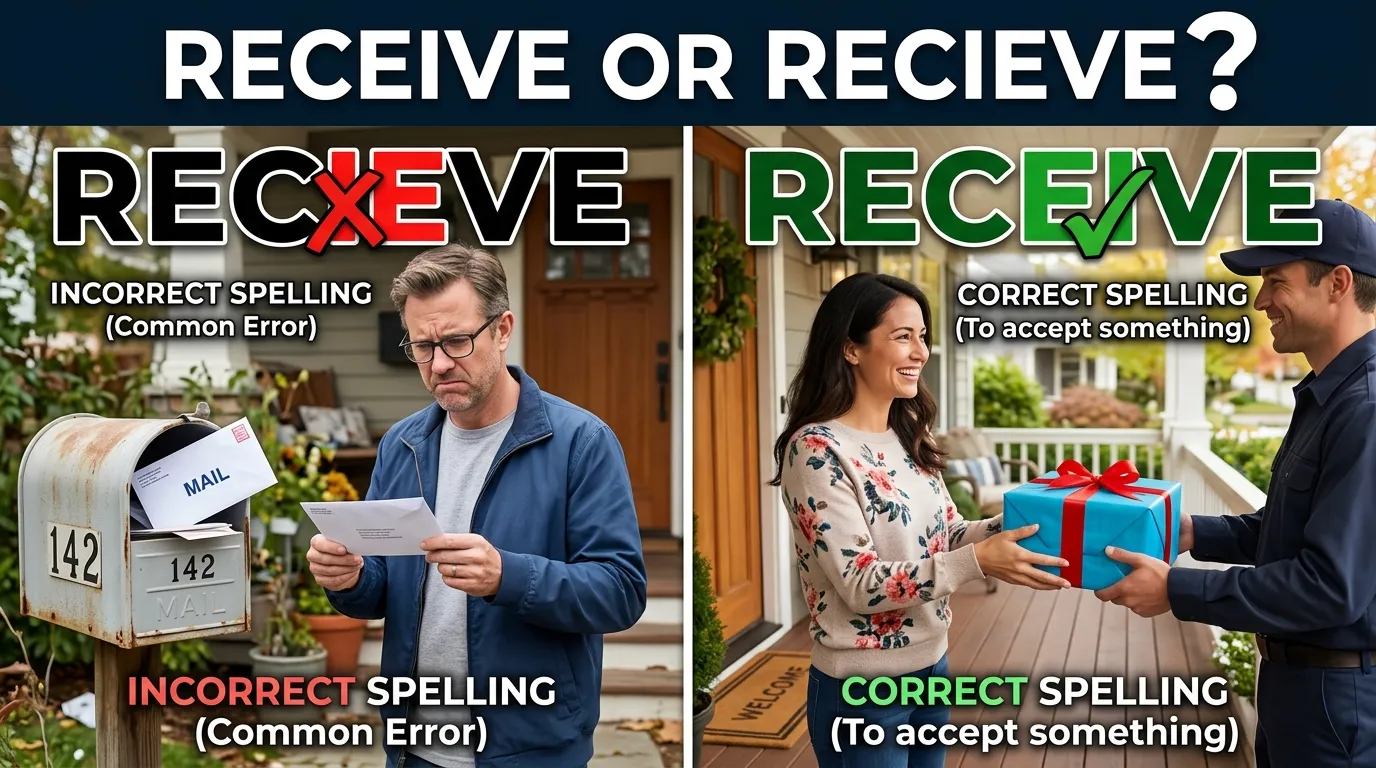
Many English learners, students, professionals, and even native speakers often get confused between receive or recieve because both words look almost the same. A single change in the position of the letters “i” and “e” creates confusion, but only one spelling is correct in standard English. The correct word is receive, while recieve is a common spelling mistake.
The word receive is used every day in American English and British English. You can see it in emails, business communication, banking, education, online messages, and everyday conversations. Understanding the correct usage of receive helps writers avoid mistakes and communicate more professionally.
Many people remember the spelling rule “i before e except after c,” but they forget that receive follows the special pattern where e comes before i after the letter c. This article explains the meaning, pronunciation, grammar difference, examples, common mistakes, and memory tricks to help you always choose the correct spelling.
Quick Answer
✅ Correct Spelling: Receive
❌ Incorrect Spelling: Recieve
Receive means to get, accept, obtain, or be given something.
Examples:
- I received your email.
- She received a gift.
Recieve is not accepted as a correct English word.
Receive Meaning
The word receive is a verb that means getting something from another person, organization, or source.
It can mean:
- To get something
- To accept something
- To obtain information
- To experience something
- To welcome someone
Receive in a sentence:
- I received a message from my friend.
- The company received your application.
- She received an award.
Grammar Role of Receive
Receive is a verb.
Verb Forms:
| Form | Example |
|---|---|
| Base | receive |
| Past | received |
| Past participle | received |
| -ing form | receiving |
Examples:
- I receive emails daily.
- He received a letter yesterday.
- They have received the payment.
- We are receiving new orders.
Receive in American English
In American English, receive is commonly used in formal and casual communication.
Examples:
- I received your message.
- We received the documents today.
- She received a promotion.
- The bank received your payment.
- He received a birthday gift.
Receive in British English
British English uses the same spelling and meaning.
Examples:
- I received your letter.
- Have you received my email?
- She received excellent results.
- They received a warm welcome.
- The office received the report.
There is no UK vs US English spelling difference for receive.
Receive vs Recieve Comparison Table
| Difference | Receive | Recieve |
|---|---|---|
| Correct spelling | ✅ Yes | ❌ No |
| Meaning | To get something | No standard meaning |
| Grammar | Verb | Incorrect form |
| Usage | Professional and daily English | Avoid |
| UK English | Correct | Wrong |
| US English | Correct | Wrong |
Pronunciation of Receive
The pronunciation of receive is:
IPA: /rɪˈsiːv/
Pronounced:
ri-SEEV
The incorrect spelling recieve is often pronounced the same, which makes the spelling mistake common.
Why Do People Confuse Receive and Recieve?
The confusion happens because many learners remember:
“i before e except after c.”
Examples:
- believe ✅
- receive ✅
- deceive ✅
But:
- recieve ❌
The letter c changes the order, making receive the correct spelling.
Word Origin and Etymology of Receive
The word receive comes from the Latin word recipere, meaning “to take back” or “to accept.”
It developed through Old French before becoming part of English vocabulary.
The spelling remained with the cei pattern, which is why receive is correct today.
Receive Synonyms
| Synonym | Meaning |
|---|---|
| Get | Obtain something |
| Accept | Agree to take something |
| Obtain | Gain something |
| Acquire | Gain possession |
| Collect | Take something |
| Gain | Receive a benefit |
Examples:
- I received a gift.
- I got a gift.
- I accepted the gift.
Common Mistakes and Corrections
1. Writing Recieve Instead of Receive
❌ I recieved your email.
✅ I received your email.
2. Confusing Receive and Receipt
❌ I need to receive.
✅ I need the receipt.
Receive = verb
Receipt = noun
3. Wrong Email Writing
❌ We have recieved your request.
✅ We have received your request.
4. Incorrect Business Documents
❌ The company recieved the invoice.
✅ The company received the invoice.
5. Technology Mistakes
❌ My phone recieved a signal.
✅ My phone received a signal.
6. Mixing Give and Receive
Receive means get.
Give means provide.
Example:
- I received a gift.
- I gave a gift.
7. Using Incorrect Past Form
❌ She recieve the package yesterday.
✅ She received the package yesterday.
Real-Life Examples of Receive
Emails
- I received your email this morning.
- We received your message.
Office
- The manager received the report.
- Employees received new instructions.
Banking
- The bank received your payment.
- I received a transaction notification.
Invoices
- We received the invoice.
- The company received the bill.
School
- Students received certificates.
- She received good marks.
Social Media
- I received your comment.
- He received many likes.
Rent Payments
- The landlord received the rent.
- We received your payment confirmation.
More American English Examples
- I received your invitation yesterday.
- Did you receive my call?
- She received a scholarship.
- The customer received the package.
- We received positive feedback.
- He received important news.
- The company received applications.
- I received your update.
- They received permission.
- The student received an award.
More British English Examples
- I received your letter.
- Have you received the parcel?
- She received a certificate.
- The hotel received complaints.
- We received your order.
- He received support.
- They received information.
- The school received funding.
- I received a notification.
- She received praise.
Memory Tricks to Remember Receive
1. Remember “C + EI”
Receive has:
cei
Not:
cie
2. Think About Receipt
Receive and receipt both use:
cei
3. Break the Word
Re + ceive
The middle is ceive.
4. Remember the Exception
After C:
E comes before I.
5. Practice Writing
Write:
Receive
Receive
Receive
Repeated practice builds memory.
FAQs
Is receive or recieve correct?
Receive is correct. Recieve is incorrect.
What does receive mean?
Receive means to get, accept, or obtain something.
How do you spell receive?
R-E-C-E-I-V-E
Is recieve a real word?
No. It is a spelling mistake.
Is receive used in UK and US English?
Yes. Both use receive.
What is the pronunciation of receive?
It is pronounced “ri-SEEV.”
What are synonyms of receive?
Get, accept, obtain, collect, and acquire.
Is receive formal?
Yes. It can be used in both formal and informal writing.
People Also Ask
Why is recieve wrong?
Because standard English spelling uses ei after c in words like receive.
How can I remember receive spelling?
Remember the phrase: After C, use EI.
Can receive be used for feelings?
Yes.
Examples:
- He received support.
- She received praise.
What is the difference between receive and receipt?
Receive is an action. Receipt is a record.
Example:
I received the receipt.
Conclusion
The difference between receive or recieve is simple once you understand the correct spelling rule. The correct form is always receive, while recieve is a common spelling mistake that should be avoided. Receive is an important English verb used in both American and British English to describe getting, accepting, or obtaining something.
Although many people confuse these words because of the “i before e” rule, the correct pattern is “cei” after the letter c. Learning examples, pronunciation, grammar rules, and memory tricks can help you avoid this mistake.
Whether you are writing emails, school assignments, professional documents, invoices, or everyday messages, choosing receive improves your English accuracy. Always remember: receive is correct, recieve is wrong.


