In today’s fast-moving digital world, acronyms are everywhere. We see them in text messages, workplaces, schools, government documents, emails, and even social media posts. They save time, improve communication, and help people understand complex terms quickly.
One area where acronyms are especially common is Social Security. Whether you’re reading retirement documents, disability forms, Medicare information, tax papers, or government letters, you’ll likely come across terms like SSA, SSI, SSDI, COLA, and Medicare abbreviations.
Many people search for Social Security acronyms because these short forms can feel confusing—especially when dealing with important financial or retirement decisions. This guide breaks everything down in simple English.
By the end of this article, you’ll understand:
- What social security acronyms mean
- How to use them correctly
- Grammar rules for acronyms
- Common mistakes people make
- Real-world examples
- Practice exercises to test your knowledge
What Does “Social Security Acronyms” Mean?
Social Security acronyms are shortened forms of terms used in government benefits, retirement planning, disability support, and healthcare systems.
These acronyms make communication faster and easier when discussing official programs.
For example:
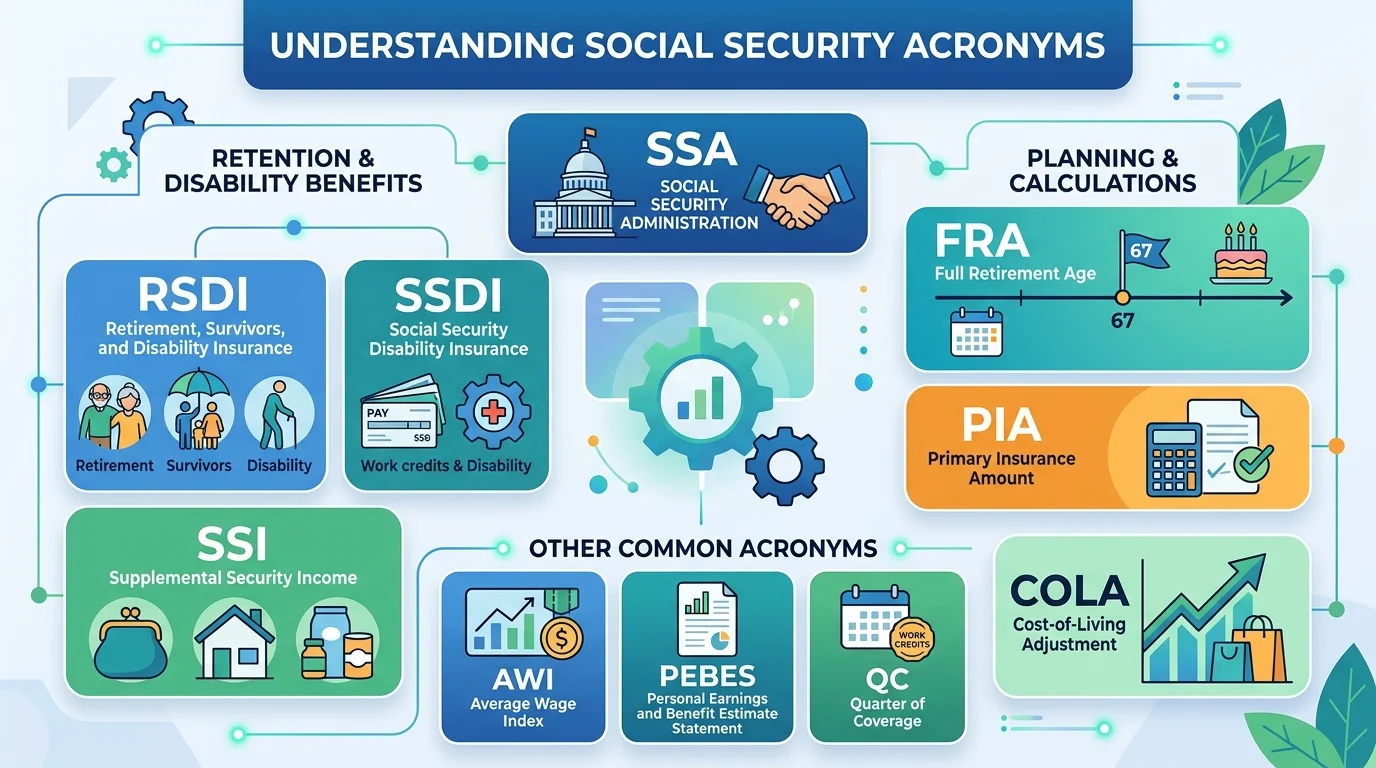
- SSA = Social Security Administration
- SSI = Supplemental Security Income
- SSDI = Social Security Disability Insurance
Instead of writing long government titles repeatedly, people use these shorter forms.
Full Forms of Common Social Security Acronyms
Here are some of the most commonly used social security acronyms:
| Acronym | Full Form | Meaning | Tone | Usage Context |
|---|---|---|---|---|
| SSA | Social Security Administration | U.S. government agency managing benefits | Formal | Government, Business |
| SSI | Supplemental Security Income | Financial support for low-income individuals | Formal | Government, Healthcare |
| SSDI | Social Security Disability Insurance | Disability income program | Formal | Medical, Government |
| COLA | Cost of Living Adjustment | Annual benefit increase | Neutral | Finance, Retirement |
| FICA | Federal Insurance Contributions Act | Payroll tax for Social Security | Formal | Payroll, Accounting |
| Medicare | Medical Insurance Program | Health coverage program | Formal | Healthcare |
| PIA | Primary Insurance Amount | Base benefit calculation | Formal | Retirement Planning |
| FRA | Full Retirement Age | Age for full benefits | Neutral | Retirement |
| OASDI | Old-Age, Survivors, and Disability Insurance | Official Social Security program | Formal | Government |
| EIN | Employer Identification Number | Business tax identifier | Formal | Payroll, Business |
Acronyms vs Abbreviations vs Initialisms
Many people think these terms mean the same thing—but they’re different.
Acronyms
An acronym is pronounced like a word.
Examples:
- NASA
- NATO
- COLA
You say them as complete words.
Initialisms
An initialism is pronounced letter by letter.
Examples:
- SSA
- SSI
- FBI
- CEO
You say each letter separately.
Abbreviations
An abbreviation is any shortened version of a word.
Examples:
- Dr. = Doctor
- Ave. = Avenue
- Dept. = Department
Important: Every acronym is an abbreviation, but not every abbreviation is an acronym.
Grammar Rule: “A” or “An” Before Acronyms?
One of the biggest grammar mistakes involves articles before acronyms.
The rule is simple:
Choose “a” or “an” based on pronunciation—not spelling.
Use “An” Before a Vowel Sound
Examples:
- an SSA representative
- an FBI agent
- an MBA graduate
Why?
Because “S” sounds like ess, “F” sounds like ef, and “M” sounds like em.
These begin with vowel sounds.
Use “A” Before a Consonant Sound
Examples:
- a CEO
- a COLA increase
- a Medicare consultant
Why?
Because “C” sounds like see, but “CEO” starts with a “y” consonant sound when spoken.
Common Grammar Mistakes
❌ a FBI agent
✅ an FBI agent
❌ an CEO
✅ a CEO
❌ an SSDI application
✅ an SSDI application (“ess-ess-dee-eye” starts with vowel sound)
Why Social Security Acronyms Are Widely Used
Social Security acronyms are used because they:
- Save time
- Reduce repetition
- Simplify complex documents
- Improve workplace communication
- Make government communication more efficient
Professionals in healthcare, accounting, HR, and retirement planning use these acronyms every day.
Real-World Usage Examples
1. Workplace Communication
“Please submit the employee’s FICA records before payroll closes.”
“HR needs updated SSA documentation.”
2. Government Communication
“Your SSI benefits have been approved.”
“Your COLA increase begins in January.”
3. Financial Planning
“She plans to claim benefits at her FRA.”
“The advisor calculated her PIA.”
4. Academic Discussion
“Students studied how OASDI impacts public policy.”
5. Social Media
“2026 COLA update just announced!”
Common Mistakes With Social Security Acronyms
1. Overusing Acronyms
Too many acronyms can confuse readers.
Poor example:
“SSA said SSDI under OASDI impacts FRA via PIA.”
Better:
“The Social Security Administration said disability benefits may affect retirement calculations.”
2. Assuming Everyone Understands Them
Not everyone knows government acronyms.
Always define the term first.
Example:
✅ “Social Security Administration (SSA)”
Then use SSA afterward.
3. Tone Confusion
Acronyms may sound too technical in casual conversations.
Example:
Formal:
“Your SSDI eligibility has changed.”
Casual:
“Your disability benefit status has changed.”
4. Cultural Misinterpretation
Some acronyms mean different things in different countries or industries.
Always consider your audience.
When to Use Social Security Acronyms
Use Them In:
✅ Government forms
✅ Professional emails
✅ Payroll reports
✅ Retirement planning
✅ Academic writing
Avoid Them In:
❌ First conversations with clients
❌ General public content without explanation
❌ International communication without definitions
Usage Guide by Context
Academic Writing
Define first, then shorten.
Example:
“Social Security Administration (SSA) manages federal benefits.”
Corporate Communication
Use acronyms if employees already know them.
Example:
“Review FICA deductions.”
Digital Communication
Use short forms for speed, but clarity matters.
Example:
“2026 COLA update is live.”
Interactive Practice Section
Fill in the Blanks
- The ______ manages retirement benefits.
(SSA / FBI) - ______ provides disability income support.
(SSDI / CEO) - Annual benefit increases are called ______.
(COLA / MBA)
Multiple Choice
Which one is correct?
A. a FBI officer
B. an FBI officer
✅ Answer: B
Which acronym refers to payroll tax?
A. FICA
B. FRA
C. SSI
✅ Answer: A
Rewrite the Sentence
Original:
“I spoke with a SSA officer.”
Correct it:
✅ “I spoke with an SSA officer.”
Frequently Asked Questions (FAQ)
What does SSA mean?
SSA stands for Social Security Administration, the government agency that manages benefits.
What does SSI mean?
SSI means Supplemental Security Income, a program for individuals with limited income.
What does SSDI mean?
SSDI stands for Social Security Disability Insurance.
Is SSA an acronym or an initialism?
It is an initialism because each letter is pronounced separately.
Do I say “a SSA” or “an SSA”?
Use an SSA because “S” begins with an “ess” sound.
Should I use social security acronyms in formal writing?
Yes—but define them the first time.
Example:
“Social Security Administration (SSA)”
Conclusion
Social Security acronyms play an important role in modern communication, especially in government, finance, healthcare, and retirement planning. Understanding terms like SSA, SSI, SSDI, COLA, and FICA helps you read official documents with confidence and communicate more clearly.
Remember these key rules:
- Define acronyms the first time
- Use “a” or “an” based on pronunciation
- Match your acronym usage to your audience
- Avoid overusing technical shorthand
When used correctly, acronyms make communication faster, smarter, and clearer in 2026 and beyond.