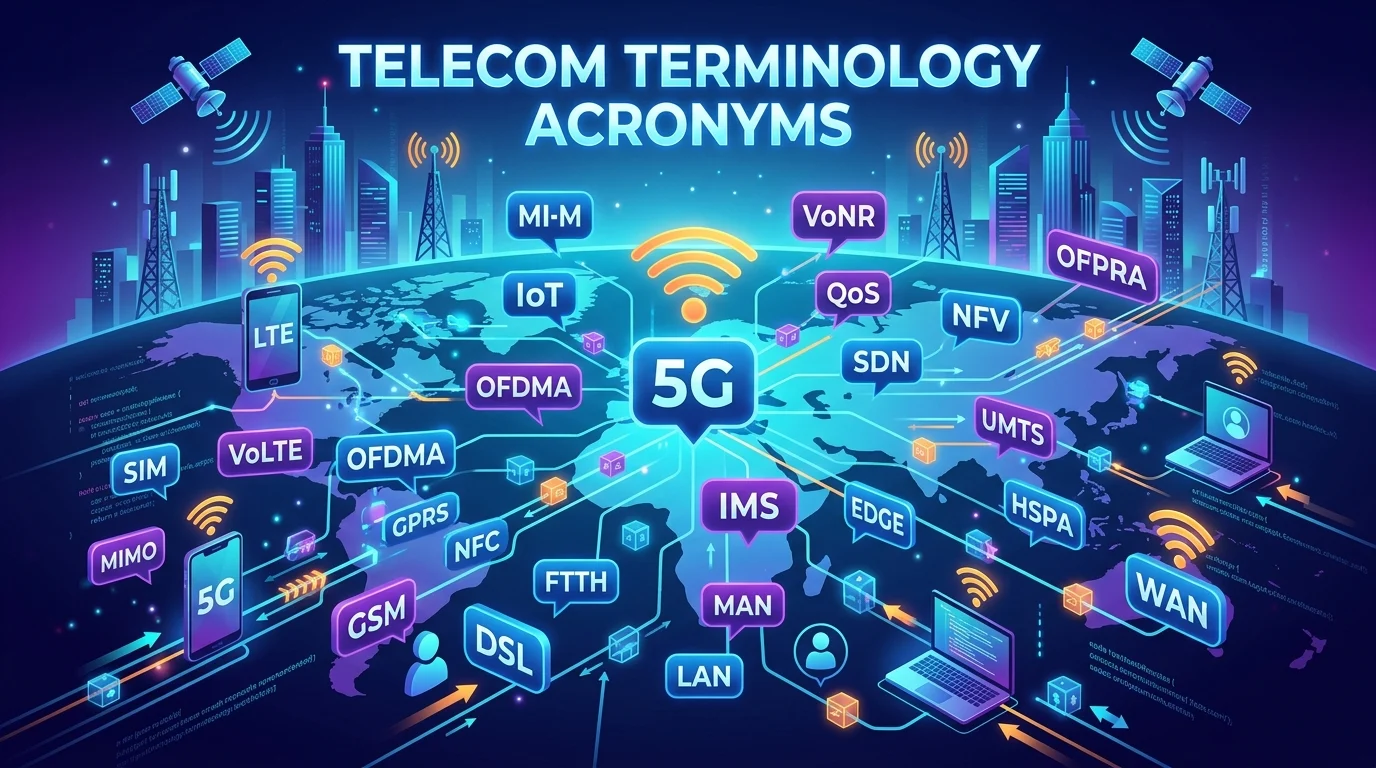
The telecommunications industry is built on fast, complex, and highly technical systems. To make communication easier between engineers, providers, and customers, the industry uses a large number of telecom terminology acronyms.
These acronyms appear in mobile networks, internet services, satellite systems, broadband infrastructure, and telecom engineering reports. Understanding them helps you interpret technical documents, service plans, and network discussions more easily.
What Are Telecom Acronyms?
Telecom acronyms are shortened forms of technical terms used in the telecommunications industry to simplify communication and documentation.
They are commonly used in:
- Mobile networks
- Internet service providers
- Network engineering
- Satellite communication
- Broadband systems
- Telecom billing and services
For example:
- LTE = Long Term Evolution
- VoIP = Voice over Internet Protocol
- ISP = Internet Service Provider
Common Telecom Acronyms and Their Meanings
| Acronym | Full Form | Meaning | Usage Context |
|---|---|---|---|
| ISP | Internet Service Provider | Company that provides internet | Internet services |
| LTE | Long Term Evolution | 4G mobile network technology | Mobile communication |
| 5G | Fifth Generation | Latest mobile network standard | Wireless networks |
| VoIP | Voice over Internet Protocol | Internet-based calling system | Communication |
| SMS | Short Message Service | Text messaging service | Mobile messaging |
| MMS | Multimedia Messaging Service | Sending images/videos via mobile | Messaging |
| VoLTE | Voice over LTE | High-quality voice calls on 4G | Mobile networks |
| SIM | Subscriber Identity Module | Mobile user identity card | Mobile devices |
| IMSI | International Mobile Subscriber Identity | Unique SIM identification number | Network systems |
| IMEI | International Mobile Equipment Identity | Device identification number | Device tracking |
| BTS | Base Transceiver Station | Mobile network tower equipment | Cellular networks |
| HLR | Home Location Register | Subscriber database system | Telecom backend |
| VLR | Visitor Location Register | Temporary subscriber database | Roaming services |
| APN | Access Point Name | Internet gateway for mobile data | Mobile internet |
| QoS | Quality of Service | Network performance measure | Data services |
| VPN | Virtual Private Network | Secure internet connection | Cybersecurity |
| DNS | Domain Name System | Converts domain names to IP addresses | Internet routing |
| IP | Internet Protocol | Address system for devices | Networking |
| CDN | Content Delivery Network | Distributed server system | Web performance |
Telecom Acronyms in Mobile Networks
Mobile communication relies heavily on standardized acronyms.
LTE
A 4G mobile technology that provides fast internet speeds.
5G
The latest generation of mobile networks with ultra-fast speed and low latency.
SIM
A small card that identifies a mobile user on the network.
BTS
A cell tower component that connects mobile devices to the network.
Telecom Acronyms in Internet Services
ISP (Internet Service Provider)
Companies that provide internet access to homes and businesses.
DNS (Domain Name System)
Translates website names into IP addresses.
VPN (Virtual Private Network)
Provides secure and private internet browsing.
CDN (Content Delivery Network)
Speeds up websites by using multiple servers globally.
Telecom Acronyms in Communication Services
VoIP
Allows voice calls using the internet instead of traditional phone lines.
SMS
Basic text messaging service.
MMS
Allows sending multimedia like images and videos.
VoLTE
High-quality voice calling over 4G LTE networks.
Telecom Acronyms in Network Engineering
IP (Internet Protocol)
System used to identify and route devices on a network.
QoS (Quality of Service)
Measures performance such as speed, latency, and reliability.
APN (Access Point Name)
Connects mobile devices to the internet.
HLR and VLR
Databases that manage mobile user location and authentication.
Why Telecom Acronyms Are Important
Telecom acronyms are used because they:
- Simplify complex technical communication
- Improve speed and efficiency in engineering work
- Standardize global telecom systems
- Reduce errors in documentation
- Help professionals collaborate internationally
Common Mistakes in Telecom Acronyms
1. Confusing similar terms
LTE vs 5G are different generations of technology.
2. Misunderstanding network functions
HLR and VLR serve different roles in mobile systems.
3. Using acronyms without context
Not all users understand technical abbreviations like QoS or IMSI.
Real-Life Examples
Mobile Network Usage
“Your SIM is connected to a 5G LTE network.”
Internet Setup
“Configure APN settings for mobile data access.”
Communication Service
“VoIP calling reduces international call costs.”
Cybersecurity
“A VPN ensures secure browsing on public Wi-Fi.”
Simple Memory Guide
- ISP = Internet provider
- LTE = 4G network
- 5G = latest mobile technology
- VoIP = internet calling
- SIM = mobile identity card
- DNS = website address system
Final Summary
Telecom terminology acronyms are essential in modern communication systems. From LTE and 5G mobile networks to ISP, VoIP, and DNS internet services, these abbreviations help professionals and users understand complex technologies more easily.
Learning these terms makes it easier to understand mobile networks, internet services, and communication systems in today’s digital world.