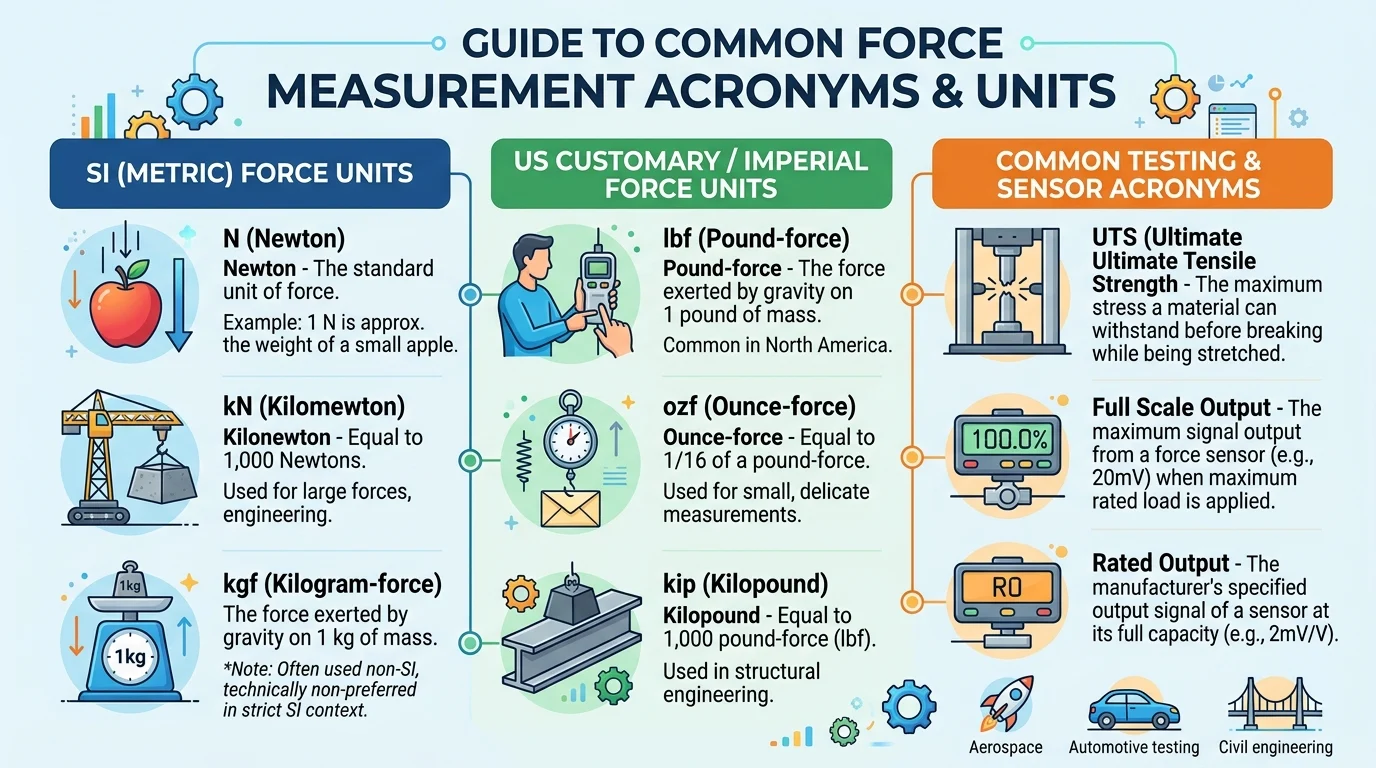
Force measurement is an important part of physics, engineering, manufacturing, and material testing. It is used to calculate how much push or pull is applied to an object. To simplify technical communication, professionals use force measurement acronyms and abbreviations in reports, instruments, and scientific documentation.
These acronyms help engineers, scientists, and technicians communicate quickly and accurately when dealing with force, pressure, and load measurements.
What Are Force Measurement Acronyms?
Force measurement acronyms are shortened forms of technical terms used to describe force, load, pressure, and related physical quantities.
They are commonly used in:
- Mechanical engineering
- Physics experiments
- Material testing labs
- Industrial manufacturing
- Structural analysis
- Calibration systems
For example:
- N = Newton
- kN = Kilonewton
- lbf = Pound-force
Common Force Measurement Acronyms and Meanings
| Acronym | Full Form | Meaning | Usage Context |
|---|---|---|---|
| N | Newton | SI unit of force | Physics, engineering |
| kN | Kilonewton | 1000 Newtons | Structural engineering |
| MN | Meganewton | 1 million Newtons | Large-scale engineering |
| lbf | Pound-force | Imperial unit of force | Mechanical systems |
| kgf | Kilogram-force | Force of 1 kg under gravity | Engineering |
| dyne | Dyne | CGS unit of force | Physics |
| tf | Ton-force | Force of one ton weight | Heavy engineering |
| PSI | Pounds per Square Inch | Pressure measurement | Hydraulics |
| Pa | Pascal | SI unit of pressure | Physics |
| kPa | Kilopascal | 1000 Pascals | Engineering |
| MPa | Megapascal | 1 million Pascals | Material strength |
| G | Gravity force | Acceleration due to gravity | Physics |
| F | Force | General force symbol | Equations |
Force Measurement Units Explained Simply
Newton (N)
The standard SI unit of force. It measures how much force is needed to move an object.
Kilonewton (kN)
Used in construction and civil engineering for large forces.
Pound-force (lbf)
Common in the United States for mechanical and engineering applications.
Kilogram-force (kgf)
Represents force exerted by gravity on a 1 kg mass.
Force Measurement in Engineering Applications
Force measurement acronyms are widely used in engineering fields:
Structural Engineering
- kN is used to measure building load capacity
- MPa is used for material strength
Mechanical Engineering
- lbf and N are used in machine design
- Torque and force calculations rely on standardized units
Material Testing
- Tensile strength is measured in MPa
- Load testing uses kN and N
Force vs Pressure Acronyms
It is important to understand the difference:
- Force = push or pull (N, kN, lbf)
- Pressure = force per area (Pa, kPa, PSI)
Example:
- Force applied on a surface = 500 N
- Pressure on surface = 200 kPa
Why Force Measurement Acronyms Are Important
They are used because they:
- Standardize scientific communication
- Simplify engineering calculations
- Reduce errors in technical documentation
- Improve efficiency in design and testing
- Allow global consistency in physics and engineering
Common Mistakes in Force Measurement Terms
1. Confusing force and pressure
N (force) vs Pa (pressure) are often mixed up.
2. Using wrong unit conversions
kN and N differences are sometimes misunderstood.
3. Ignoring system differences
Imperial (lbf, PSI) vs SI units (N, Pa) can cause errors.
Real-Life Examples
Engineering Design
“The beam can withstand a load of 50 kN.”
Physics Experiment
“The applied force was measured as 200 N.”
Material Testing
“The steel has a tensile strength of 450 MPa.”
Hydraulic System
“The pressure inside the system reached 3000 PSI.”
Simple Memory Guide
- N = basic force unit
- kN = large force
- lbf = imperial force unit
- Pa = pressure
- MPa = material strength
- PSI = hydraulic pressure
Final Summary
Force measurement acronyms are essential in physics, engineering, and industrial applications. From Newton (N) and kilonewton (kN) to Pascal (Pa) and pound-force (lbf), these abbreviations help professionals measure, analyze, and communicate force-related data accurately.
Understanding these terms makes it easier to work with engineering systems, scientific data, and technical documentation in a clear and standardized way.