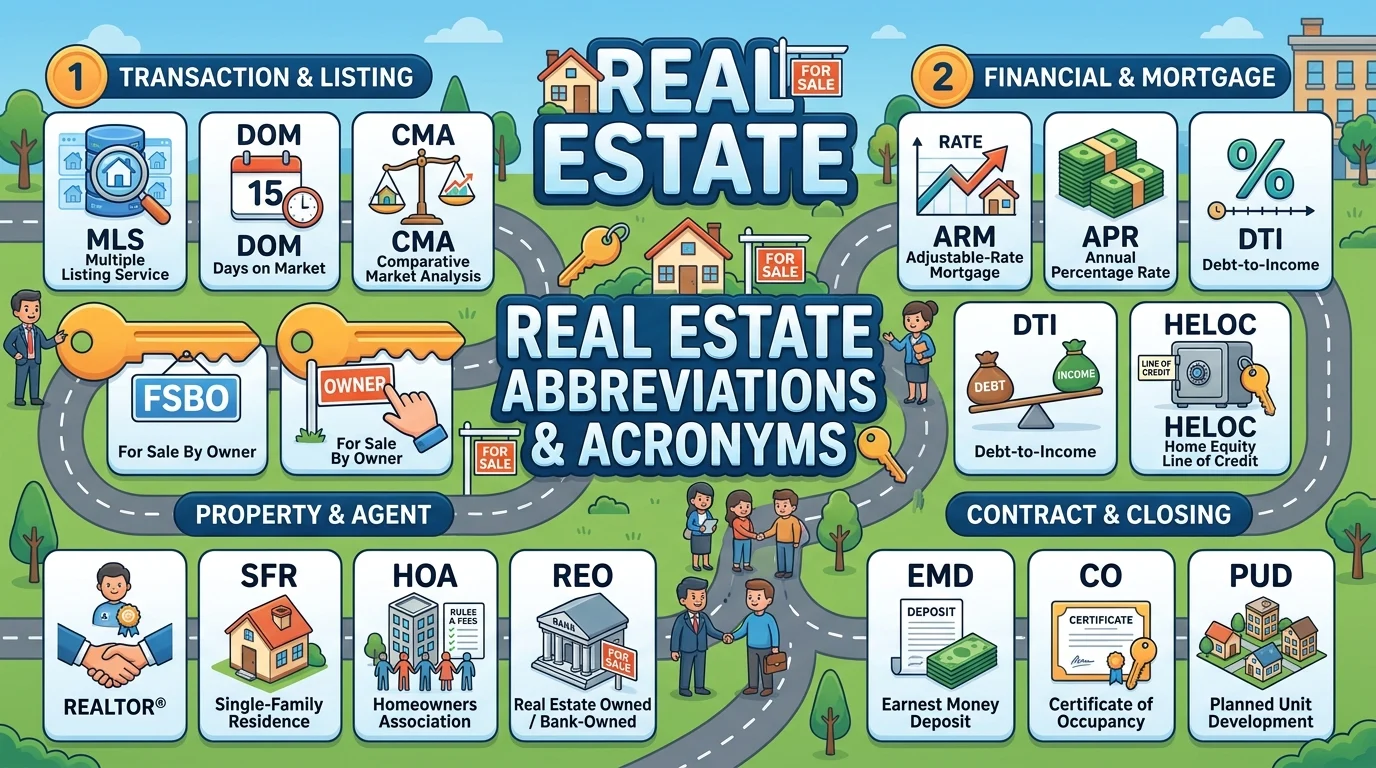
Real estate is one of the most terminology-heavy industries in the world. Whether you are buying a home, working with an agent, reading property listings, or investing in real estate, you will constantly encounter abbreviations and acronyms that can be confusing at first.
These short forms are not random. They are widely used in contracts, listings, mortgage documents, and investment reports to make communication faster, clearer, and more standardized across the industry.
This guide explains the most important real estate abbreviations and acronyms in a professional, easy-to-understand way so you can confidently interpret property-related information.
Understanding Real Estate Acronyms
Real estate acronyms are shortened forms of industry terms used to simplify communication between buyers, sellers, agents, lenders, and investors.
For example, instead of writing “Multiple Listing Service” every time, professionals use MLS. Instead of writing “Return on Investment,” they use ROI.
These abbreviations help streamline communication in a fast-moving market where clarity and speed are essential.
Most Common Real Estate Abbreviations and Their Meanings
Below is a structured list of frequently used real estate acronyms with their meanings and usage context.
| Acronym | Full Form | Meaning | Context |
|---|---|---|---|
| RE | Real Estate | Property and land business sector | General use |
| MLS | Multiple Listing Service | Central database for property listings | Property listings |
| ROI | Return on Investment | Profitability of a property | Investment analysis |
| HOA | Homeowners Association | Organization managing community rules | Residential housing |
| FSBO | For Sale By Owner | Property sold without an agent | Selling process |
| LTV | Loan-to-Value | Ratio of loan amount to property value | Mortgage lending |
| APR | Annual Percentage Rate | Yearly cost of borrowing | Mortgage and loans |
| PITI | Principal, Interest, Taxes, Insurance | Total monthly mortgage cost | Loan calculation |
| CMA | Comparative Market Analysis | Property valuation method | Pricing strategy |
| REO | Real Estate Owned | Bank-owned property after foreclosure | Foreclosure market |
| DTI | Debt-to-Income Ratio | Measure of borrower’s financial stability | Loan approval |
| SQFT | Square Feet | Measurement of property size | Property listing |
| BR | Bedroom(s) | Number of bedrooms in a property | Listings |
| BA | Bathroom(s) | Number of bathrooms in a property | Listings |
| ARM | Adjustable Rate Mortgage | Loan with changing interest rate | Mortgage type |
| CAP RATE | Capitalization Rate | Investment return rate | Real estate investing |
| CASH FLOW | Cash Flow | Net income from property | Investment performance |
Real Estate Acronyms in Property Listings
Property listings use abbreviations to present key details quickly.
For example, a listing might read:
“4BR/3BA home, 2200 SQFT, located in HOA community, strong ROI potential.”
This means:
- 4 bedrooms
- 3 bathrooms
- 2200 square feet
- Community managed by a homeowners association
- Good investment return expected
These abbreviations allow agents to describe properties efficiently without writing long descriptions.
Real Estate Acronyms in Mortgages and Financing
Mortgage and lending terms are heavily abbreviated because they involve complex financial calculations.
LTV (Loan-to-Value Ratio)
This shows how much of the property value is financed by a loan.
APR (Annual Percentage Rate)
This represents the yearly cost of borrowing money, including interest and fees.
PITI (Principal, Interest, Taxes, Insurance)
This is the total monthly mortgage payment.
DTI (Debt-to-Income Ratio)
This measures a borrower’s monthly debt compared to income and is used to assess loan eligibility.
These acronyms are essential for understanding mortgage offers and financial responsibilities.
Investment-Focused Real Estate Acronyms
Real estate investors rely heavily on specific terms to evaluate property performance.
ROI (Return on Investment)
ROI measures how much profit a property generates compared to its cost.
CAP RATE (Capitalization Rate)
This indicates the expected return on an investment property based on income.
CASH FLOW
Cash flow represents the remaining income after all property expenses are paid.
REO (Real Estate Owned)
This refers to properties owned by banks after foreclosure proceedings.
These terms help investors compare properties and make informed financial decisions.
Real Estate Acronyms in Everyday Communication
These abbreviations are also commonly used in conversations between agents and clients.
Examples include:
“Your LTV is within acceptable range for loan approval.”
“This property has strong ROI potential due to high rental demand.”
“The HOA fees are included in monthly expenses.”
Such terms help professionals communicate complex ideas quickly and efficiently.
Why Real Estate Uses So Many Acronyms
The real estate industry relies on acronyms for several important reasons:
They save time in communication
They simplify complex legal and financial terms
They standardize property descriptions across platforms
They improve efficiency in contracts and negotiations
They allow faster communication between professionals
Because real estate transactions involve multiple parties and large amounts of data, standardized language is essential.
Common Mistakes When Using Real Estate Acronyms
Misunderstanding financial terms
Many beginners confuse ROI with cash flow, although they measure different things.
Misreading property listings
New buyers often struggle with abbreviations like BR, BA, and SQFT.
Overlooking loan details
Terms like APR, LTV, and DTI are often misunderstood, which can lead to poor financial decisions.
Assuming universal meaning
Some acronyms may vary slightly between countries or markets.
Professional Usage Guidelines
In professional real estate communication:
Always define acronyms when first introduced in documents
Use abbreviations only when the audience understands them
Avoid overusing acronyms in client-facing communication
Maintain clarity in contracts and reports
For example:
Correct usage
Social Security Administration (SSA) policies were reviewed
Incorrect usage
SSA policies were reviewed (without prior definition in formal documents)
Practical Examples in Real Estate Context
Property Listing Example
“Modern 3BR/2BA home, 1800 SQFT, low HOA fees, strong ROI potential.”
Mortgage Example
“Borrower approved with 80 percent LTV and 6.5 percent APR.”
Investment Example
“This property generates positive cash flow with a 9 percent CAP RATE.”
Final Summary
Real estate abbreviations and acronyms are essential tools used throughout the industry to simplify communication and improve efficiency. From MLS listings to mortgage terms like LTV and APR, understanding these abbreviations helps buyers, sellers, and investors make informed decisions.
By learning these key terms, you can confidently navigate property listings, understand financial documents, and communicate effectively in real estate environments.