DIBELS is widely used in schools to measure early reading skills in children. It helps teachers understand how well students are developing important literacy abilities like phonics, fluency, and comprehension.
To make assessment easier, educators use DIBELS acronyms to quickly refer to different tests and reading skills. These acronyms are commonly used in classrooms, progress reports, and educational evaluations.
What Is DIBELS?
DIBELS stands for Dynamic Indicators of Basic Early Literacy Skills.
It is a set of short assessments designed to measure early reading and literacy development in students from kindergarten through middle school.
DIBELS helps identify:
- Reading fluency
- Phonics skills
- Word recognition
- Reading comprehension readiness
Common DIBELS Acronyms and Meanings
| Acronym | Full Form | Meaning | Skill Measured |
|---|---|---|---|
| DIBELS | Dynamic Indicators of Basic Early Literacy Skills | Literacy assessment system | Overall reading ability |
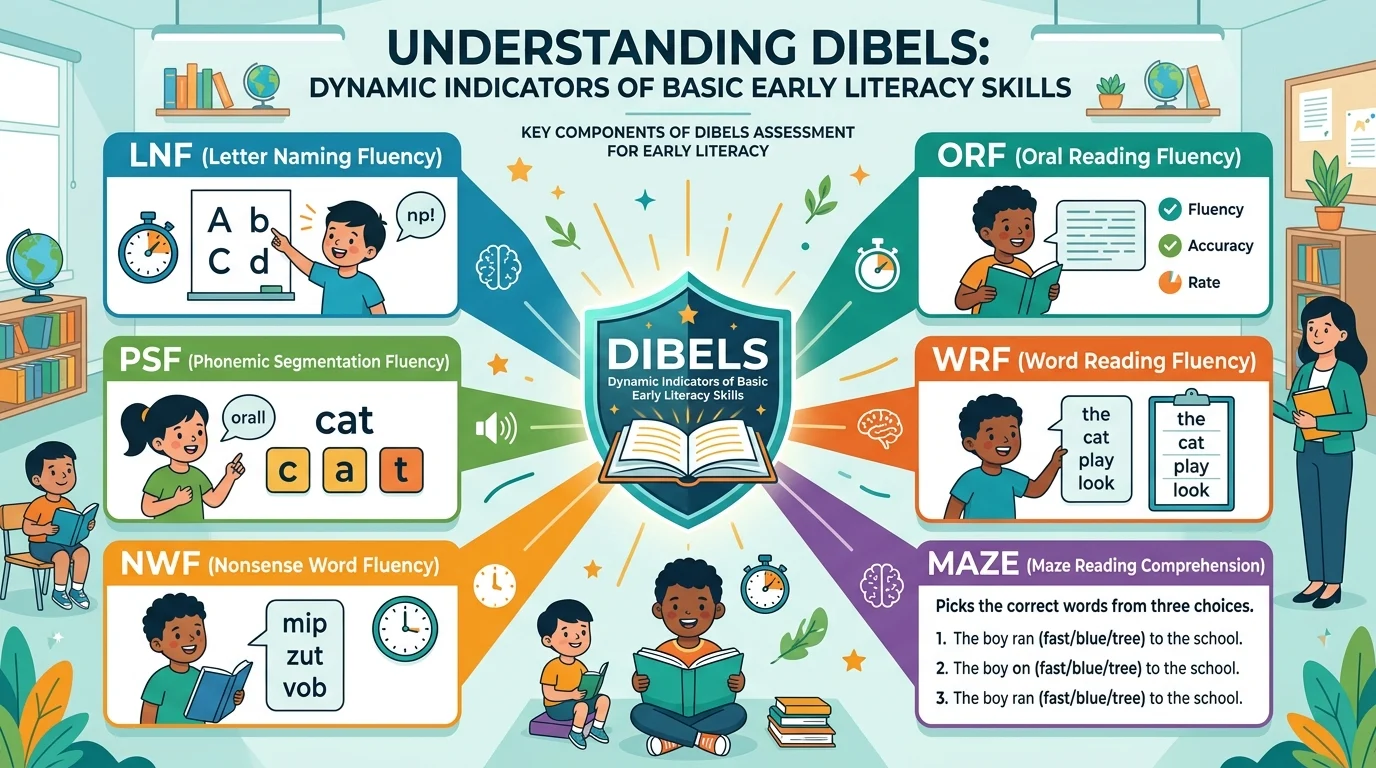
| PSF | Phoneme Segmentation Fluency | Ability to break words into sounds | Phonics |
| NWF | Nonsense Word Fluency | Reading made-up words | Decoding skills |
| ORF | Oral Reading Fluency | Reading aloud accurately and quickly | Reading fluency |
| WRF | Word Reading Fluency | Reading real words | Word recognition |
| LNF | Letter Naming Fluency | Naming letters quickly | Early literacy |
| MAZE | Maze Comprehension | Reading comprehension test | Understanding text |
| ISF | Initial Sound Fluency | Identifying beginning sounds | Phonemic awareness |
Key DIBELS Assessments Explained
PSF (Phoneme Segmentation Fluency)
Measures how well students can break words into individual sounds.
Example:
“cat” = /c/ /a/ /t/
NWF (Nonsense Word Fluency)
Students read made-up words to test decoding skills.
Example:
“lat”, “mip”, “vog”
ORF (Oral Reading Fluency)
Students read passages aloud to measure speed, accuracy, and expression.
MAZE (Reading Comprehension)
Students choose correct words to complete sentences in a passage.
Why DIBELS Acronyms Are Important
DIBELS acronyms are used because they:
- Simplify educational testing terms
- Help teachers track student progress quickly
- Standardize reading assessments across schools
- Make reporting easier and more efficient
- Support early intervention for struggling readers
DIBELS Acronyms in Classroom Use
Teacher Reporting
“The student scored high in ORF but needs improvement in PSF.”
Progress Monitoring
“NWF results show strong decoding skills this term.”
Parent Communication
“Your child is improving in letter naming fluency (LNF).”
Common Mistakes in Understanding DIBELS Acronyms
1. Confusing skills
PSF and ISF both relate to sounds but measure different abilities.
2. Ignoring assessment purpose
Nonsense words are used intentionally for decoding tests.
3. Misinterpreting fluency scores
Fluency includes speed and accuracy, not just reading ability.
Simple Memory Guide
- PSF = Sound breakdown
- NWF = Fake word reading
- ORF = Reading aloud
- MAZE = Comprehension test
- LNF = Letter naming
- ISF = Beginning sounds
Real-Life Example
Classroom Assessment
“Student demonstrated strong ORF but needs support in PSF and NWF.”
Progress Report
“Improved LNF scores indicate stronger early literacy development.”
Final Summary
DIBELS acronyms are essential tools in early education that help teachers measure and track reading development. From PSF and NWF to ORF and MAZE, these assessments provide a clear picture of a student’s literacy skills.
Understanding these acronyms helps educators, parents, and students work together to improve reading fluency, comprehension, and overall academic success.