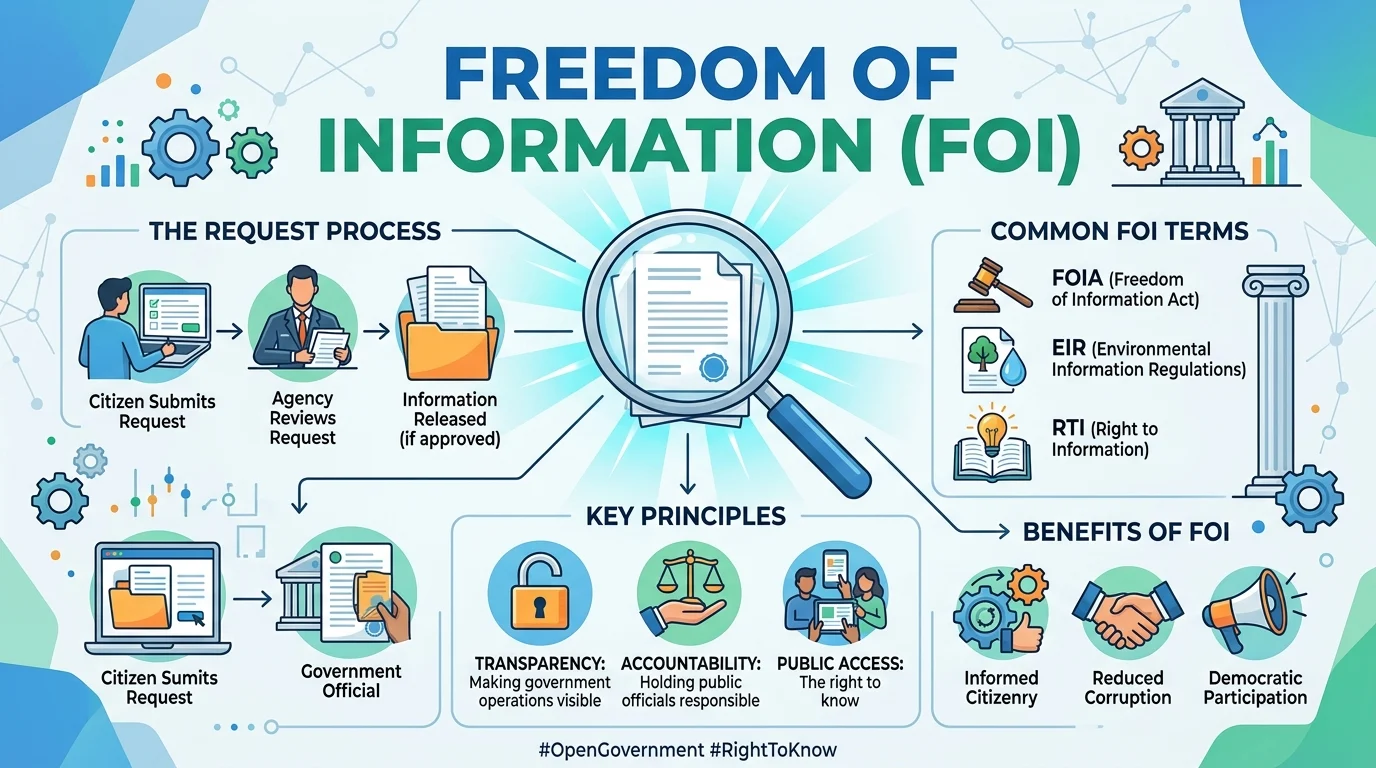
FOI acronyms are widely used in government, legal systems, journalism, research, and public records management. FOI usually stands for Freedom of Information, a principle that allows citizens to request access to public records held by government agencies and public institutions.
Understanding FOI acronyms helps journalists, researchers, students, lawyers, and everyday citizens navigate public information systems more effectively.
What Does FOI Mean?
FOI stands for Freedom of Information.
It refers to laws, policies, and procedures that give the public the right to access government-held information, official documents, and public records.
FOI systems are commonly used for:
- Government transparency
- Investigative journalism
- Legal research
- Academic studies
- Public accountability
- Policy analysis
Common FOI Acronyms and Meanings
| Acronym | Full Form | Meaning | Usage Context |
|---|---|---|---|
| FOI | Freedom of Information | Public access to government records | Public records |
| FOIA | Freedom of Information Act | Law governing information access | Legal requests |
| RTI | Right to Information | Public information access law | Government transparency |
| SAR | Subject Access Request | Request for personal data | Privacy law |
| PII | Personally Identifiable Information | Sensitive personal information | Data protection |
| GDPR | General Data Protection Regulation | Data privacy law | Information management |
| PA | Public Authority | Government body holding records | FOI requests |
| RFI | Request for Information | Formal information request | Procurement/legal |
| DPA | Data Protection Act | Privacy legislation | Records management |
| ICO | Information Commissioner’s Office | Data and information regulator | Compliance |
| SOP | Standard Operating Procedure | Official internal procedures | Public records |
| NDA | Non-Disclosure Agreement | Confidentiality agreement | Legal documentation |
Legal FOI Acronyms Explained
FOIA (Freedom of Information Act)
A law that gives citizens the right to request access to government documents.
In the United States, the Freedom of Information Act established this public access framework.
RTI (Right to Information)
Similar to FOI, used in many countries to promote government transparency.
SAR (Subject Access Request)
Allows individuals to request personal data held by organizations.
Privacy and Data Protection Acronyms
PII
Personally Identifiable Information includes:
- Names
- Addresses
- Phone numbers
- Identification numbers
GDPR
A major privacy regulation in the European Union that protects personal data.
DPA
National laws that govern personal information handling.
Government and Compliance Acronyms
PA (Public Authority)
Government departments or public institutions that hold records.
ICO
The Information Commissioner’s Office oversees information rights and privacy compliance in the UK.
Why FOI Acronyms Are Important
FOI acronyms are used because they:
- Simplify legal and administrative communication
- Improve public transparency
- Help citizens access public records
- Support investigative journalism
- Promote accountability in government
Common Mistakes in FOI Acronyms
1. Confusing FOI and FOIA
FOI is the general concept; FOIA is a specific law.
2. Mixing privacy and transparency laws
FOI gives access to public records, while GDPR and DPA protect personal data.
3. Submitting incomplete requests
Clear wording is essential in FOI applications.
Real-Life Examples
Journalism
“A reporter submitted an FOIA request for public spending records.”
Personal Data
“A customer filed a SAR to access personal records.”
Government Research
“Documents were released under FOI regulations.”
Simple Memory Guide
- FOI = Freedom of information
- FOIA = Information law
- RTI = Right to know
- SAR = Personal data request
- PII = Personal information
- GDPR = Privacy protection
Final Summary
FOI acronyms are essential in government transparency, public accountability, and data access. From FOI and FOIA to RTI, SAR, GDPR, and PII, these terms help citizens, journalists, and organizations understand how public information systems work.
Learning these acronyms makes it easier to request records, protect privacy, and navigate legal information systems with confidence.