The piano is one of the most popular and versatile musical instruments in the world. Whether you are a beginner, music student, teacher, performer, or composer, you will often encounter piano acronyms in sheet music, digital keyboards, music theory, recording software, and piano lessons.
These acronyms help musicians communicate quickly and understand technical instructions more efficiently.
What Are Piano Acronyms?
Piano acronyms are shortened musical or technical terms used in piano playing, music education, digital keyboards, recording, and performance.
They are commonly used in:
- Piano lessons
- Sheet music
- Music production
- Keyboard settings
- Recording studios
- Music theory classes
For example:
- BPM = Beats Per Minute
- MIDI = Musical Instrument Digital Interface
- DAW = Digital Audio Workstation
Common Piano Acronyms and Meanings
| Acronym | Full Form | Meaning | Usage Context |
|---|---|---|---|
| BPM | Beats Per Minute | Speed of music tempo | Rhythm and timing |
| MIDI | Musical Instrument Digital Interface | Digital communication between instruments | Digital keyboards |
| DAW | Digital Audio Workstation | Music recording software | Music production |
| LCD | Liquid Crystal Display | Screen on digital pianos | Hardware |
| USB | Universal Serial Bus | Device connection | Recording and transfer |
| AUX | Auxiliary Input | External audio connection | Sound systems |
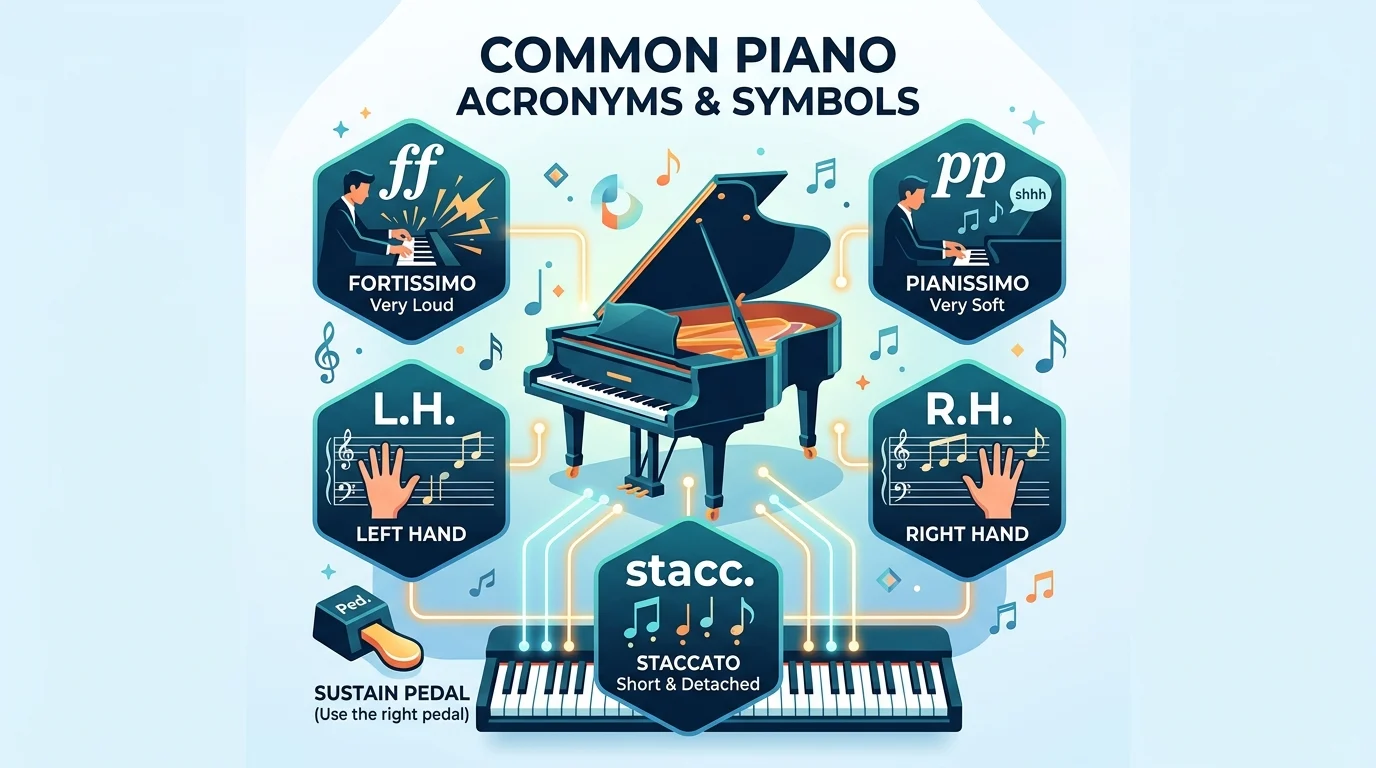
| LH | Left Hand | Notes played by left hand | Piano lessons |
| RH | Right Hand | Notes played by right hand | Piano lessons |
| SMF | Standard MIDI File | Saved MIDI music format | Digital music |
| DSP | Digital Signal Processing | Sound enhancement technology | Digital keyboards |
| AC | Alternating Current | Power source | Piano hardware |
| FX | Effects | Added sound processing | Music production |
| EQ | Equalization | Tone adjustment | Audio control |
| CV | Control Voltage | Signal control in electronic music | Synthesizers |
Music Theory Acronyms
BPM (Beats Per Minute)
BPM measures the speed or tempo of music.
Examples:
- 60 BPM = Slow tempo
- 120 BPM = Moderate tempo
- 180 BPM = Fast tempo
Digital Piano Acronyms
MIDI (Musical Instrument Digital Interface)
Allows a piano to communicate with computers, software, and other instruments.
USB
Connects digital pianos to computers for recording and file transfer.
LCD
The display screen found on many modern keyboards.
Music Production Acronyms
DAW (Digital Audio Workstation)
Software used to record, edit, and produce music.
Popular DAWs include:
- Ableton Live
- FL Studio
- Logic Pro
FX (Effects)
Sound effects like reverb, chorus, and delay.
EQ (Equalization)
Adjusts bass, midrange, and treble frequencies.
Piano Lesson Acronyms
LH (Left Hand)
Indicates notes or chords played by the left hand.
RH (Right Hand)
Indicates notes played by the right hand.
These appear frequently in beginner sheet music.
Electronic Keyboard Acronyms
DSP
Digital processing that improves piano sound quality.
AUX
Allows connection to speakers or headphones.
AC
Power connection for electronic pianos.
Why Piano Acronyms Are Important
Piano acronyms are used because they:
- Simplify music instructions
- Improve communication between teachers and students
- Make digital piano setup easier
- Help musicians use recording software
- Standardize music technology worldwide
Common Mistakes in Piano Acronyms
1. Confusing MIDI with audio
MIDI contains note data, not actual sound.
2. Ignoring tempo markings
BPM affects how music feels and sounds.
3. Misunderstanding LH and RH
Hand instructions are essential for correct technique.
Real-Life Examples
Piano Lesson
“Practice RH melody at 80 BPM.”
Home Recording
“Connect your keyboard via USB to your DAW.”
Performance Setup
“Use EQ and FX to improve piano tone.”
Simple Memory Guide
- BPM = Tempo
- MIDI = Digital note data
- DAW = Recording software
- LH = Left hand
- RH = Right hand
- USB = Computer connection
- EQ = Tone control
Final Summary
Piano acronyms are essential for music learning, digital performance, and recording. From BPM and MIDI to DAW, LH, RH, and EQ, these terms help musicians understand tempo, technology, and technique more effectively.
Learning these acronyms makes piano study easier, improves communication, and helps musicians succeed in both traditional and digital music environments.