Cell phones are an essential part of modern life, powering communication, internet access, social media, and digital services. Behind every smartphone lies a complex system of technologies, and to simplify this complexity, the mobile industry uses cell phone acronyms.
These acronyms appear in phone settings, network signals, SIM cards, messaging apps, and technical specifications. Understanding them helps users better navigate smartphones, mobile networks, and communication services.
What Are Cell Phone Acronyms?
Cell phone acronyms are shortened forms of technical terms used in mobile communication and smartphone technology.
They are commonly used in:
- Mobile network systems
- Smartphone settings
- Messaging services
- Telecom engineering
- Device specifications
- Internet connectivity
For example:
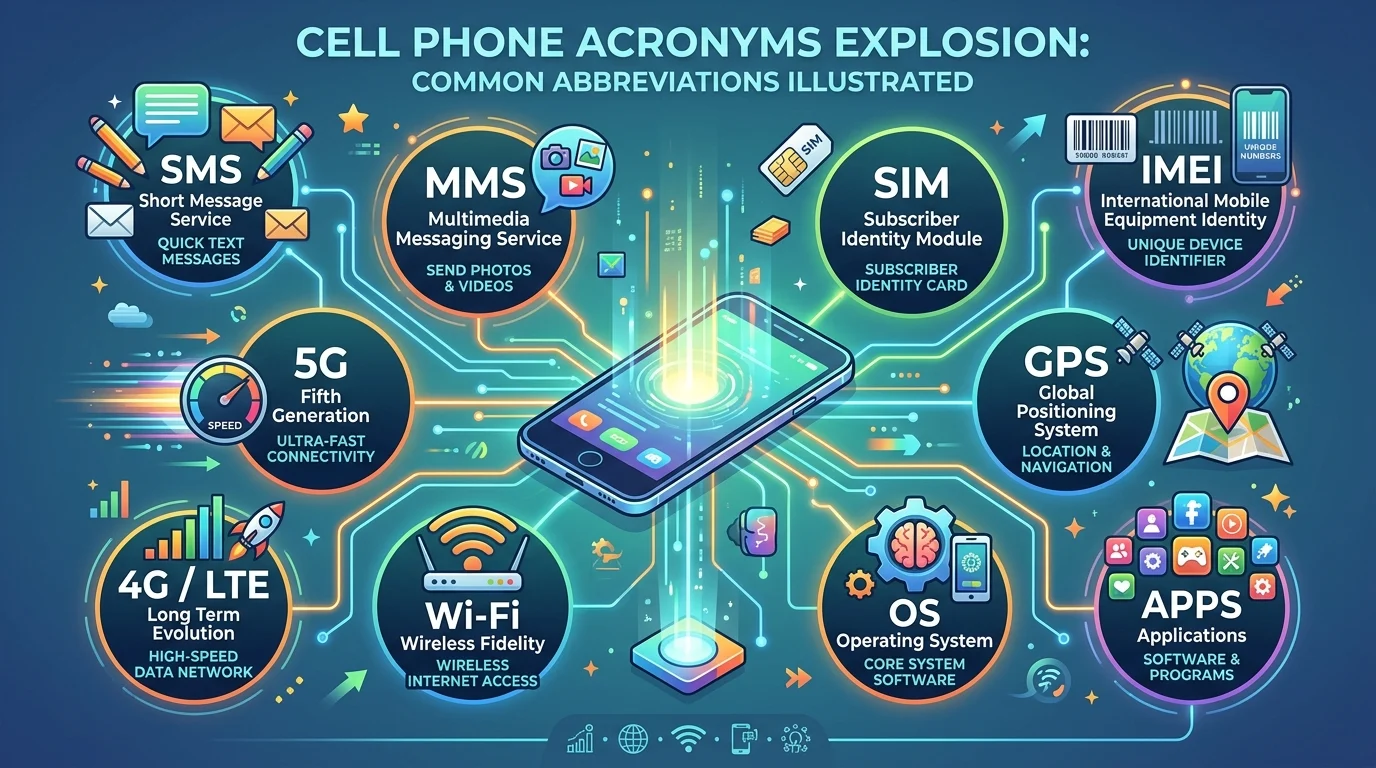
- SIM = Subscriber Identity Module
- SMS = Short Message Service
- LTE = Long Term Evolution
Common Cell Phone Acronyms and Meanings
| Acronym | Full Form | Meaning | Usage Context |
|---|---|---|---|
| SIM | Subscriber Identity Module | Chip that identifies mobile user | Mobile devices |
| SMS | Short Message Service | Text messaging service | Messaging |
| MMS | Multimedia Messaging Service | Sending images/videos via text | Messaging |
| IMEI | International Mobile Equipment Identity | Unique device ID number | Device tracking |
| IMSI | International Mobile Subscriber Identity | Unique SIM identification | Network systems |
| LTE | Long Term Evolution | 4G mobile network technology | Internet connection |
| 5G | Fifth Generation | Latest mobile network technology | High-speed data |
| 4G | Fourth Generation | Mobile broadband standard | Mobile internet |
| VoLTE | Voice over LTE | High-quality voice calls on 4G | Calling services |
| APN | Access Point Name | Mobile internet gateway settings | Data connection |
| PIN | Personal Identification Number | SIM security code | Device security |
| PUK | Personal Unblocking Key | Unlocks blocked SIM | SIM recovery |
| Wi-Fi | Wireless Fidelity | Wireless internet connection | Connectivity |
| GPS | Global Positioning System | Location tracking system | Navigation |
| NFC | Near Field Communication | Short-range data transfer | Payments & sharing |
Mobile Network Acronyms Explained
LTE (Long Term Evolution)
A 4G mobile technology that provides fast internet browsing and streaming.
5G (Fifth Generation)
The latest mobile network offering ultra-fast speed and low latency.
VoLTE (Voice over LTE)
Allows high-quality voice calls over 4G networks instead of traditional systems.
APN (Access Point Name)
Settings that connect your phone to mobile internet services.
Messaging and Communication Acronyms
SMS (Short Message Service)
Basic text messaging service used worldwide.
MMS (Multimedia Messaging Service)
Allows sending pictures, videos, and audio through messages.
IM (Instant Messaging)
Real-time chat services like WhatsApp or Messenger.
Device Identification Acronyms
SIM (Subscriber Identity Module)
A small chip that stores your mobile identity and connects you to a network.
IMEI (International Mobile Equipment Identity)
A unique number used to identify your smartphone globally.
IMSI (International Mobile Subscriber Identity)
A number that identifies the user within the mobile network.
Internet and Connectivity Acronyms
Wi-Fi
A wireless technology that connects devices to the internet.
GPS
A system used for tracking location and navigation.
NFC
Allows short-range communication for payments and file sharing.
Security and Access Acronyms
PIN
A security code used to unlock SIM cards or phones.
PUK
Used to unlock SIM cards if the PIN is entered incorrectly multiple times.
Why Cell Phone Acronyms Are Important
Cell phone acronyms are used because they:
- Simplify technical communication
- Improve understanding of mobile technology
- Standardize global telecom systems
- Help users troubleshoot devices
- Make smartphone settings easier to navigate
Common Mistakes with Cell Phone Acronyms
1. Confusing similar terms
SMS vs MMS vs IM are often mixed up.
2. Not understanding network types
LTE, 4G, and 5G are different generations.
3. Ignoring device identifiers
IMEI and IMSI serve different purposes.
Real-Life Examples
Mobile Settings
“Enable LTE for faster internet speed.”
Messaging App
“Send an SMS if internet is unavailable.”
Device Security
“Enter PIN to unlock SIM card.”
Navigation
“Turn on GPS for location tracking.”
Simple Memory Guide
- SIM = Your phone identity
- SMS = Text message
- LTE = 4G internet
- 5G = fastest network
- IMEI = phone ID number
- GPS = location tracking
- Wi-Fi = wireless internet
Final Summary
Cell phone acronyms are essential for understanding modern mobile technology. From SIM, SMS, and MMS to LTE, 5G, and IMEI, these abbreviations simplify complex systems and make smartphones easier to use.
Learning these terms helps users better understand mobile networks, improve device usage, and navigate digital communication more effectively in today’s connected world.