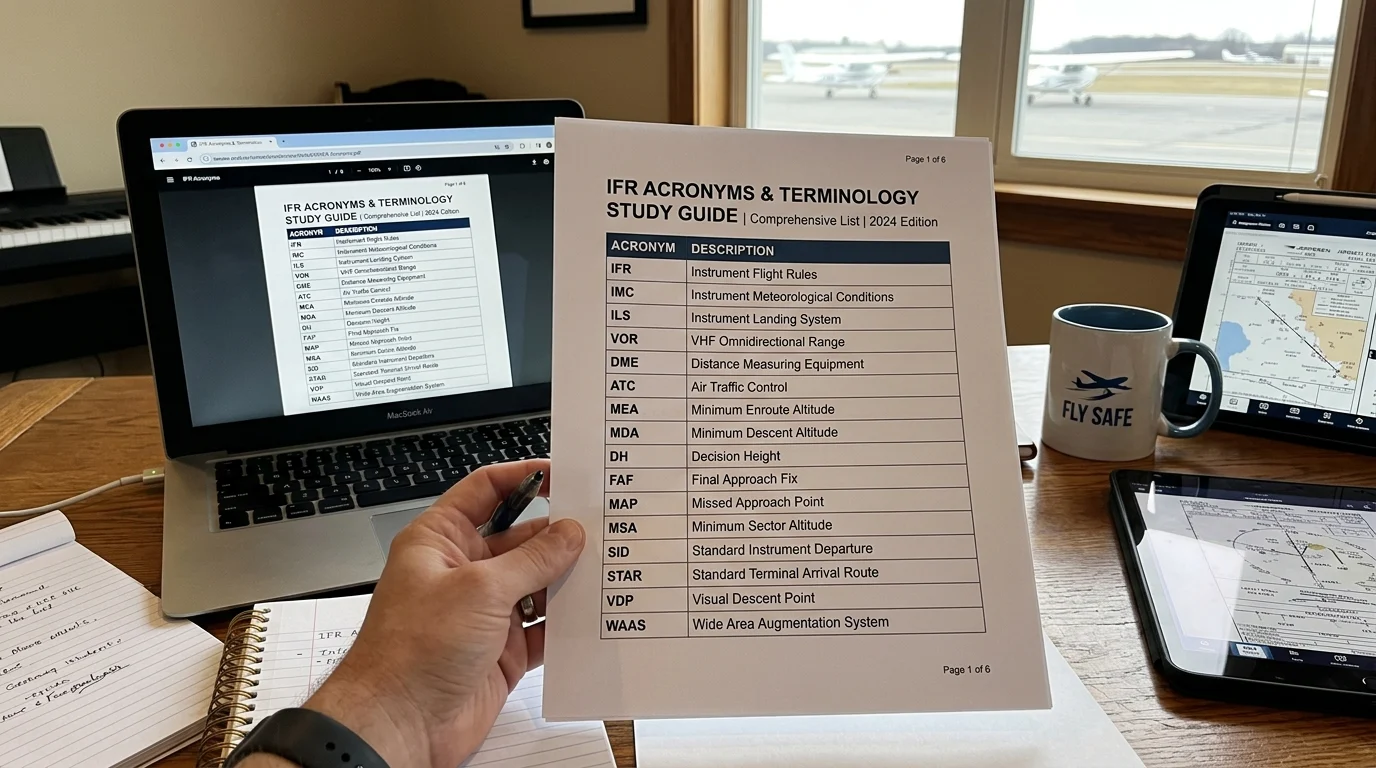
IFR acronyms are essential aviation abbreviations used by pilots, air traffic controllers, flight instructors, and aviation students. IFR stands for Instrument Flight Rules, a system that allows aircraft to operate primarily by reference to instruments rather than visual landmarks.
An IFR Acronyms PDF typically contains a collection of aviation terms related to navigation, weather, communications, flight planning, and air traffic control.
What Does IFR Mean?
IFR = Instrument Flight Rules
These rules govern flying when weather conditions limit visibility or when pilots choose to navigate using cockpit instruments and air traffic control guidance.
IFR operations are commonly used in:
- Commercial aviation
- Airline operations
- Instrument training
- Poor weather conditions
- Cross-country flights
Common IFR Acronyms List
| Acronym | Full Form | Meaning |
|---|---|---|
| IFR | Instrument Flight Rules | Flying by reference to instruments |
| VFR | Visual Flight Rules | Flying using outside visual references |
| ATC | Air Traffic Control | Aircraft traffic management |
| ILS | Instrument Landing System | Precision landing aid |
| VOR | VHF Omnidirectional Range | Radio navigation system |
| GPS | Global Positioning System | Satellite navigation |
| NDB | Non-Directional Beacon | Radio navigation aid |
| DME | Distance Measuring Equipment | Measures aircraft distance |
| FAF | Final Approach Fix | Approach navigation point |
| METAR | Meteorological Aerodrome Report | Current airport weather |
| TAF | Terminal Aerodrome Forecast | Airport weather forecast |
| NOTAM | Notice to Air Missions | Aviation notices and alerts |
| SID | Standard Instrument Departure | Published departure route |
| STAR | Standard Terminal Arrival Route | Published arrival route |
| RNAV | Area Navigation | Modern navigation method |
| FMS | Flight Management System | Aircraft navigation computer |
| FMC | Flight Management Computer | Flight planning computer |
| MSL | Mean Sea Level | Altitude reference |
| AGL | Above Ground Level | Height above terrain |
| PIC | Pilot in Command | Responsible pilot |
Navigation Acronyms
VOR
A radio navigation system that helps pilots determine position and direction.
GPS
Satellite-based navigation used in modern aircraft.
DME
Provides distance information from a navigation station.
RNAV
Allows aircraft to fly flexible routes without relying solely on ground-based navigation aids.
Approach and Landing Acronyms
ILS (Instrument Landing System)
Provides precise guidance during landing, especially in low visibility.
FAF (Final Approach Fix)
The point where the final descent begins during an instrument approach.
Weather Acronyms
METAR
A real-time aviation weather report.
TAF
A forecast of expected weather conditions at an airport.
NOTAM
Important notices affecting flight operations, airports, or airspace.
Flight Procedure Acronyms
SID
Standard routes used after takeoff.
STAR
Standard routes used when approaching an airport.
These procedures improve safety and efficiency in busy airspace.
Flight Management Acronyms
FMS
An onboard computer that manages navigation and flight planning.
FMC
Part of the flight management system that stores route and performance data.
Altitude Acronyms
MSL (Mean Sea Level)
Altitude measured from sea level.
AGL (Above Ground Level)
Altitude measured from the terrain directly below the aircraft.
Why IFR Acronyms Are Important
IFR acronyms help:
- Improve aviation safety
- Standardize pilot communication
- Simplify flight planning
- Support navigation accuracy
- Enhance weather interpretation
- Reduce operational errors
Common Mistakes with IFR Acronyms
Confusing IFR and VFR
IFR relies on instruments, while VFR relies mainly on visual references.
Misunderstanding Weather Reports
METAR provides current weather; TAF provides forecasts.
Mixing Altitude References
MSL and AGL measure altitude differently.
Real-Life Examples
Pilot Communication
“Cleared IFR to destination via SID route.”
Flight Planning
“RNAV approach available with GPS guidance.”
Weather Briefing
“METAR indicates reduced visibility; check TAF for forecast conditions.”
Quick Memory Guide
- IFR = Instrument Flight Rules
- ILS = Landing guidance system
- VOR = Radio navigation aid
- GPS = Satellite navigation
- METAR = Current weather report
- TAF = Weather forecast
- SID = Departure route
- STAR = Arrival route
Final Summary
An IFR Acronyms PDF is a valuable resource for pilots, aviation students, and flight instructors. Acronyms such as IFR, ILS, VOR, GPS, METAR, TAF, SID, and STAR are used daily in flight operations and air traffic control.
Learning these terms improves aviation knowledge, communication skills, navigation understanding, and overall flight safety.


