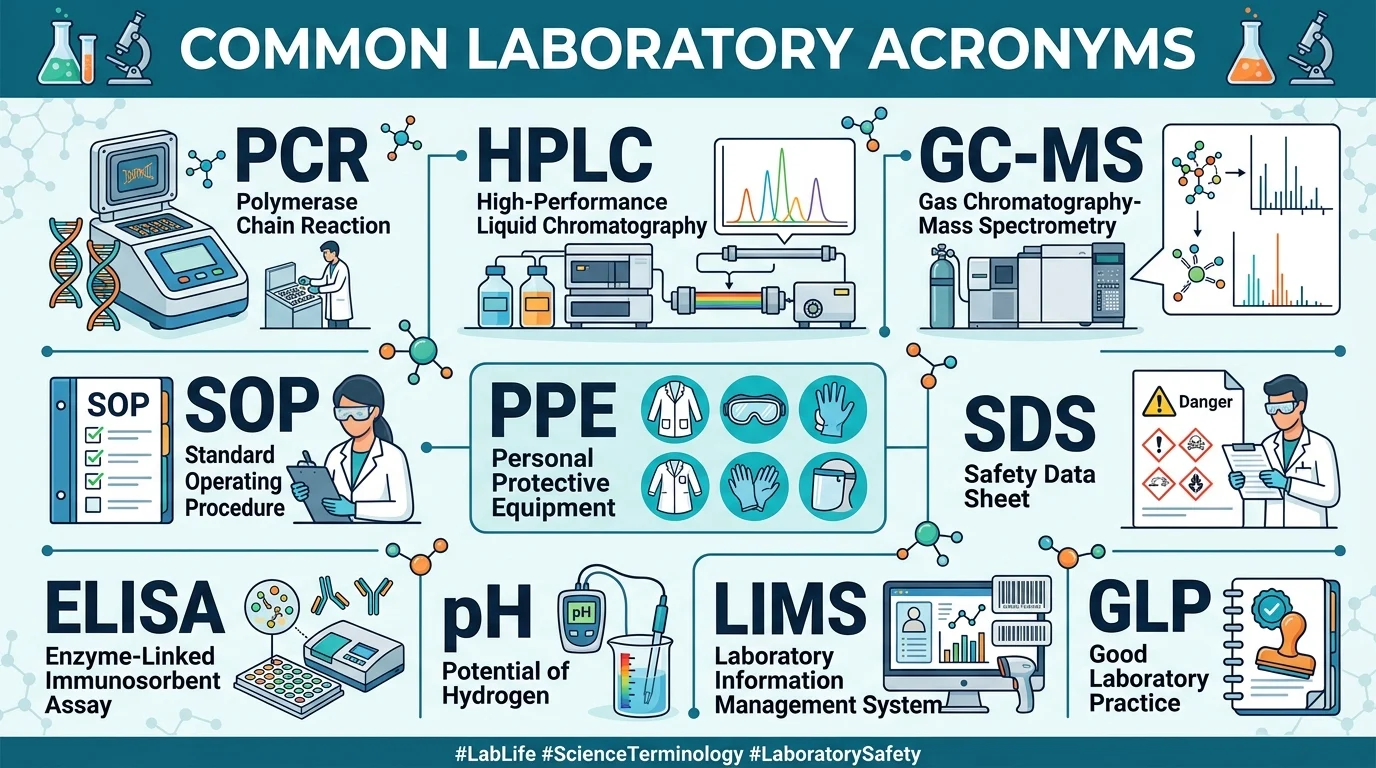
Laboratories use many lab acronyms to make scientific communication faster, clearer, and more standardized. These abbreviations are widely used in medical labs, chemistry labs, biology research, hospital testing, and academic science.
Understanding lab acronyms is important for students, lab technicians, doctors, researchers, and healthcare professionals.
What Are Lab Acronyms?
Lab acronyms are shortened terms used in laboratory science to represent tests, equipment, safety procedures, and medical or research processes.
They are commonly used in:
- Medical laboratories
- Research labs
- Hospitals and clinics
- Universities and schools
- Biotechnology and pharmaceutical industries
For example:
- CBC = Complete Blood Count
- PCR = Polymerase Chain Reaction
- DNA = Deoxyribonucleic Acid
Common Lab Acronyms List
| Acronym | Full Form | Meaning | Usage Context |
|---|---|---|---|
| CBC | Complete Blood Count | Blood test measuring cells | Medical labs |
| CMP | Comprehensive Metabolic Panel | Blood chemistry test | Healthcare |
| PCR | Polymerase Chain Reaction | DNA amplification method | Genetics |
| DNA | Deoxyribonucleic Acid | Genetic material | Biology |
| RNA | Ribonucleic Acid | Protein synthesis material | Molecular biology |
| WBC | White Blood Cells | Infection-fighting cells | Medical testing |
| RBC | Red Blood Cells | Oxygen-carrying cells | Blood tests |
| ELISA | Enzyme-Linked Immunosorbent Assay | Disease detection test | Immunology |
| HPLC | High-Performance Liquid Chromatography | Chemical separation method | Chemistry |
| QC | Quality Control | Testing accuracy checks | Lab standards |
| QA | Quality Assurance | Process monitoring | Lab management |
| PPE | Personal Protective Equipment | Safety gear | Lab safety |
| BSL | Biosafety Level | Lab safety classification | Research labs |
| RPM | Revolutions Per Minute | Centrifuge speed | Lab equipment |
Medical Lab Acronyms
CBC (Complete Blood Count)
A common test that measures:
- Red blood cells
- White blood cells
- Platelets
CMP (Comprehensive Metabolic Panel)
Checks organ function and chemical balance in the body.
Molecular Biology Acronyms
DNA
The genetic blueprint of living organisms.
PCR
A method used to copy DNA for research and testing.
RNA
Helps in protein production and gene expression.
Laboratory Safety Acronyms
PPE
Includes gloves, masks, lab coats, and goggles.
BSL (Biosafety Level)
Defines safety levels in laboratories handling biological materials.
Equipment and Testing Acronyms
HPLC
Used to separate and analyze chemical compounds.
RPM
Measures speed of centrifuge machines in labs.
Quality Control Acronyms
QC
Ensures test results are accurate and reliable.
QA
Focuses on improving lab processes and standards.
Why Lab Acronyms Are Important
Lab acronyms are important because they:
- Save time in scientific communication
- Reduce errors in documentation
- Standardize medical and research reporting
- Improve lab efficiency
- Support global scientific collaboration
Common Mistakes with Lab Acronyms
1. Confusing similar tests
CBC and CMP are different blood tests.
2. Misinterpreting abbreviations
PCR is not a blood test but a DNA method.
3. Ignoring safety terms
PPE and BSL levels are critical in labs.
Real-Life Examples
Hospital Lab Report
“Patient CBC results are normal.”
Research Study
“DNA extracted using PCR method.”
Laboratory Safety
“Wear PPE before entering BSL-2 lab.”
Simple Memory Guide
- CBC = Blood test
- PCR = DNA copying method
- DNA = Genetic code
- PPE = Safety gear
- QC = Accuracy check
- HPLC = Chemical analysis
Final Summary
Lab acronyms are essential in medical, scientific, and research environments. Terms like CBC, PCR, DNA, PPE, HPLC, and QC help scientists and healthcare professionals communicate quickly and accurately.
Understanding these acronyms improves lab efficiency, safety, and scientific knowledge across all laboratory fields.