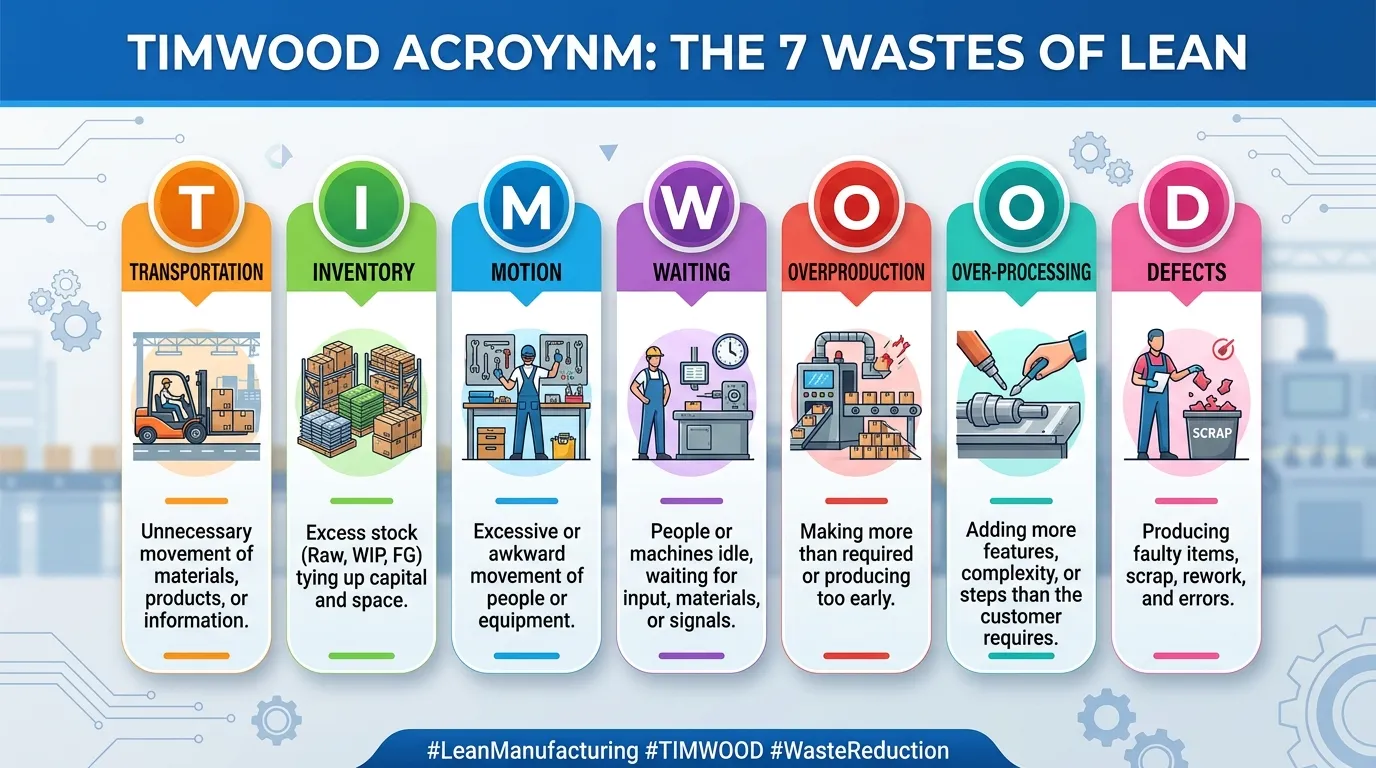
The TIMWOOD acronym is a popular tool used in Lean Manufacturing and process improvement to identify waste in business operations. Companies use TIMWOOD to improve efficiency, reduce costs, increase productivity, and deliver better value to customers.
People search for the TIMWOOD acronym because it helps organizations recognize activities that consume time, money, or resources without adding value. Understanding TIMWOOD is essential for professionals working in manufacturing, logistics, healthcare, project management, and continuous improvement programs.
What Does TIMWOOD Stand For?
TIMWOOD represents the seven types of waste identified in Lean methodology:
| Letter | Waste Type | Meaning |
|---|---|---|
| T | Transportation | Unnecessary movement of products or materials |
| I | Inventory | Excess stock or materials not immediately needed |
| M | Motion | Unnecessary movement of people or equipment |
| W | Waiting | Delays between process steps |
| O | Overproduction | Producing more than needed |
| O | Overprocessing | Doing more work than required |
| D | Defects | Errors that require rework or replacement |
Understanding Each TIMWOOD Waste
1. Transportation
Unnecessary movement of materials between locations.
Example: Moving products across multiple warehouses before shipping.
2. Inventory
Holding more inventory than required.
Example: Storing excess raw materials that remain unused for months.
3. Motion
Extra movement by employees that does not add value.
Example: Workers walking long distances to retrieve tools.
4. Waiting
Idle time caused by delays.
Example: Machines sitting unused while waiting for materials.
5. Overproduction
Producing items before they are needed.
Example: Manufacturing products without confirmed customer demand.
6. Overprocessing
Performing unnecessary steps in a process.
Example: Adding features customers do not need or want.
7. Defects
Products or services that fail to meet quality standards.
Example: Faulty products requiring repairs or replacement.
Why Is TIMWOOD Important?
Businesses use TIMWOOD because it helps:
- Reduce operational costs
- Improve productivity
- Increase customer satisfaction
- Eliminate inefficiencies
- Streamline workflows
- Support continuous improvement initiatives
TIMWOOD in Different Industries
Manufacturing
Identifies waste on production lines and improves efficiency.
Healthcare
Reduces patient waiting times and unnecessary procedures.
Logistics
Improves transportation routes and inventory management.
Office Environments
Eliminates paperwork delays and repetitive administrative tasks.
TIMWOOD vs Lean Waste
TIMWOOD is often used as a memory aid for the seven wastes of Lean Manufacturing developed by Taiichi Ohno at Toyota Motor Corporation.
Many organizations also include an eighth waste:
Skills (or Talent) – underutilizing employee knowledge and abilities.
This expanded version is sometimes called TIMWOODS.
Acronyms, Initialisms, and TIMWOOD
TIMWOOD is generally pronounced as a word:
TIM-wood
Because it can be spoken as a single word, it functions similarly to an acronym rather than an initialism.
Common Mistakes When Using TIMWOOD
Focusing Only on One Waste
Organizations should evaluate all seven waste categories.
Ignoring Small Inefficiencies
Minor waste can become a major cost over time.
Treating TIMWOOD as a One-Time Exercise
Waste reduction should be an ongoing process.
Overlooking Employee Feedback
Workers often identify waste more effectively than management.
Practical Example of TIMWOOD
Imagine a manufacturing company:
- Materials travel unnecessarily between buildings (Transportation)
- Excess products fill warehouses (Inventory)
- Employees walk long distances for tools (Motion)
- Machines sit idle awaiting parts (Waiting)
- Extra products are produced (Overproduction)
- Unnecessary inspections occur (Overprocessing)
- Faulty items require rework (Defects)
TIMWOOD helps identify and eliminate each of these problems.
FAQ About TIMWOOD
What does TIMWOOD stand for?
TIMWOOD stands for Transportation, Inventory, Motion, Waiting, Overproduction, Overprocessing, and Defects.
What is TIMWOOD used for?
It is used to identify waste and improve efficiency in Lean processes.
Is TIMWOOD only for manufacturing?
No. It can be applied in healthcare, logistics, offices, retail, and many other industries.
What is the eighth waste in Lean?
Many organizations add Skills or Talent, creating the acronym TIMWOODS.
Why is TIMWOOD important?
It helps businesses reduce waste, save money, and improve customer value.
Conclusion
The TIMWOOD acronym is a powerful Lean Manufacturing tool that helps organizations identify and eliminate seven common types of waste. By focusing on Transportation, Inventory, Motion, Waiting, Overproduction, Overprocessing, and Defects, businesses can improve efficiency, lower costs, and create better outcomes for customers. Understanding TIMWOOD is an important step toward continuous improvement and operational excellence.