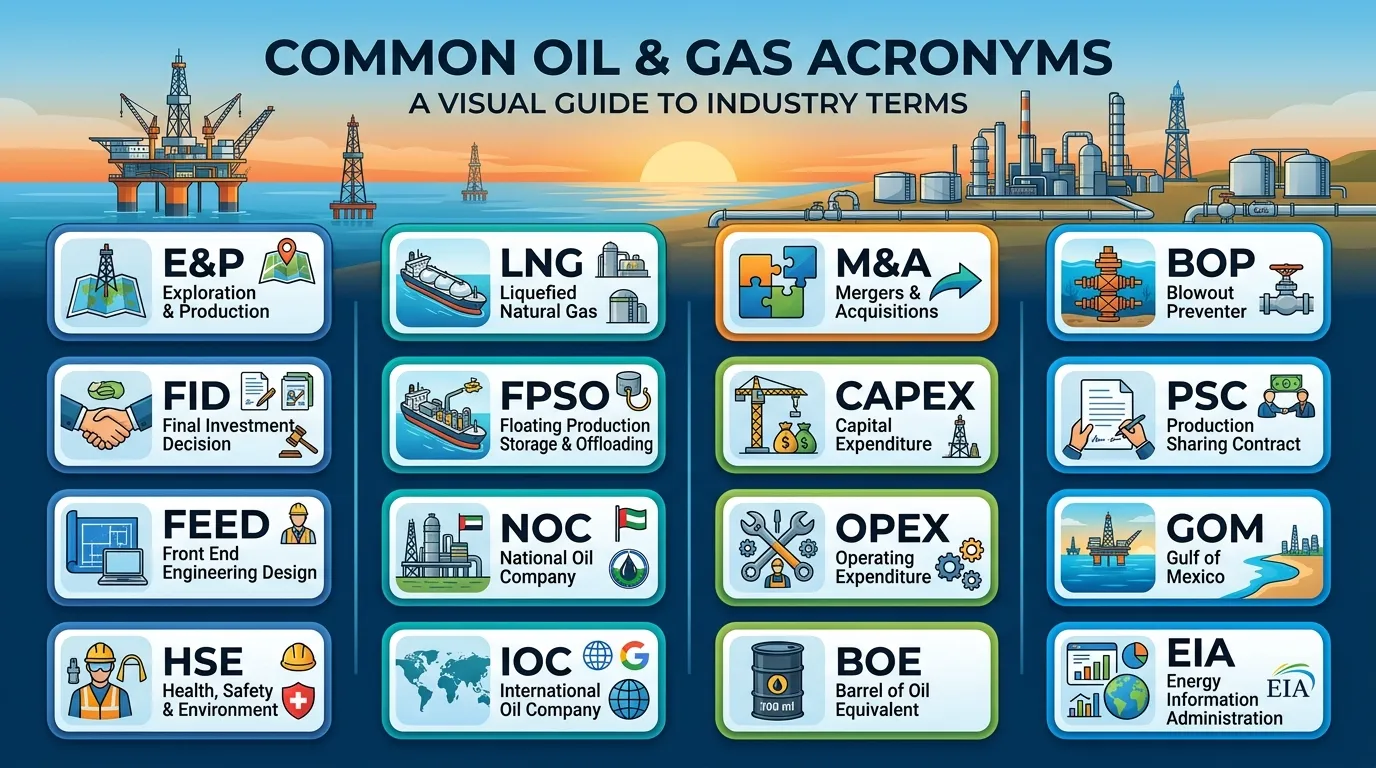
The oil and gas industry uses hundreds of acronyms and abbreviations to simplify complex technical, engineering, and business communication. From drilling operations to refinery processes, these short forms help professionals communicate faster and more efficiently in a high-pressure global industry.
People search for oil and gas acronyms to understand reports, job descriptions, safety manuals, and technical documents where these abbreviations are frequently used.
What Are Oil and Gas Acronyms?
Oil and gas acronyms are shortened forms of industry-specific terms used in exploration, drilling, production, refining, and distribution of petroleum and natural gas.
Example:
- LNG = Liquefied Natural Gas
- FPSO = Floating Production Storage and Offloading
- BOP = Blowout Preventer
Why Are Acronyms Important in Oil and Gas?
Acronyms are essential because they:
- Save time in technical communication
- Reduce long and complex terminology
- Improve safety reporting clarity
- Standardize global industry language
- Help engineers and workers communicate quickly on-site
Common Oil and Gas Acronyms (Table)
| Acronym | Full Form | Meaning | Usage Context |
|---|---|---|---|
| LNG | Liquefied Natural Gas | Natural gas cooled into liquid form | Transport & Export |
| LPG | Liquefied Petroleum Gas | Propane/butane gas mixture | Domestic & Industry |
| FPSO | Floating Production Storage and Offloading | Offshore production vessel | Offshore drilling |
| BOP | Blowout Preventer | Safety device to control pressure | Drilling safety |
| OPEC | Organization of the Petroleum Exporting Countries | Oil-producing nations group | Global oil market |
| API | American Petroleum Institute | Industry standards body | Quality & standards |
| EOR | Enhanced Oil Recovery | Methods to increase oil extraction | Production |
| NGL | Natural Gas Liquids | Liquids extracted from gas | Processing |
Real-World Usage Examples
1. Drilling Site Example
- “Check the BOP before starting drilling operations.”
2. Engineering Report
- “The facility processes LNG for export to Asia.”
3. Business Communication
- “OPEC decisions are affecting global oil prices.”
4. Offshore Operations
- “The FPSO is scheduled for maintenance next month.”
Types of Oil and Gas Acronyms
1. Exploration & Production (E&P)
Used in drilling and oil extraction:
- BOP, EOR, ESP (Electric Submersible Pump)
2. Transportation & Storage
Used in shipping and logistics:
- LNG, LPG, FPSO
3. Regulatory & Organizations
Industry bodies and standards:
- OPEC, API, IEA (International Energy Agency)
4. Refining & Processing
Used in refineries:
- NGL, FCC (Fluid Catalytic Cracking), H2S (Hydrogen Sulfide)
Common Mistakes with Oil & Gas Acronyms
- Confusing similar acronyms (LNG vs LPG)
- Using acronyms without explanation in reports
- Misinterpreting safety-related terms
- Assuming all regions use the same abbreviations
When to Use Oil and Gas Acronyms
Use them when:
- Writing technical reports
- Communicating on job sites
- Reading engineering documents
- Working in industry operations
Avoid them when:
- Writing for general audiences
- Training beginners
- Explaining safety instructions clearly
FAQ: Oil and Gas Acronyms
1. What are oil and gas acronyms?
They are shortened terms used in petroleum exploration, drilling, production, and refining.
2. Why does the oil industry use acronyms?
To simplify complex technical communication and improve efficiency.
3. What is the most common oil and gas acronym?
LNG, LPG, and BOP are among the most widely used.
4. Are oil and gas acronyms the same worldwide?
Most are standardized, but some regional differences exist.
5. What does FPSO mean?
It stands for Floating Production Storage and Offloading vessel used in offshore oil production.
Conclusion
Oil and gas acronyms play a vital role in simplifying communication across one of the world’s most technical industries. Understanding these terms helps professionals read reports, follow safety procedures, and communicate effectively in global operations.
Using acronyms correctly ensures clarity, safety, and efficiency in every stage of oil and gas work.


