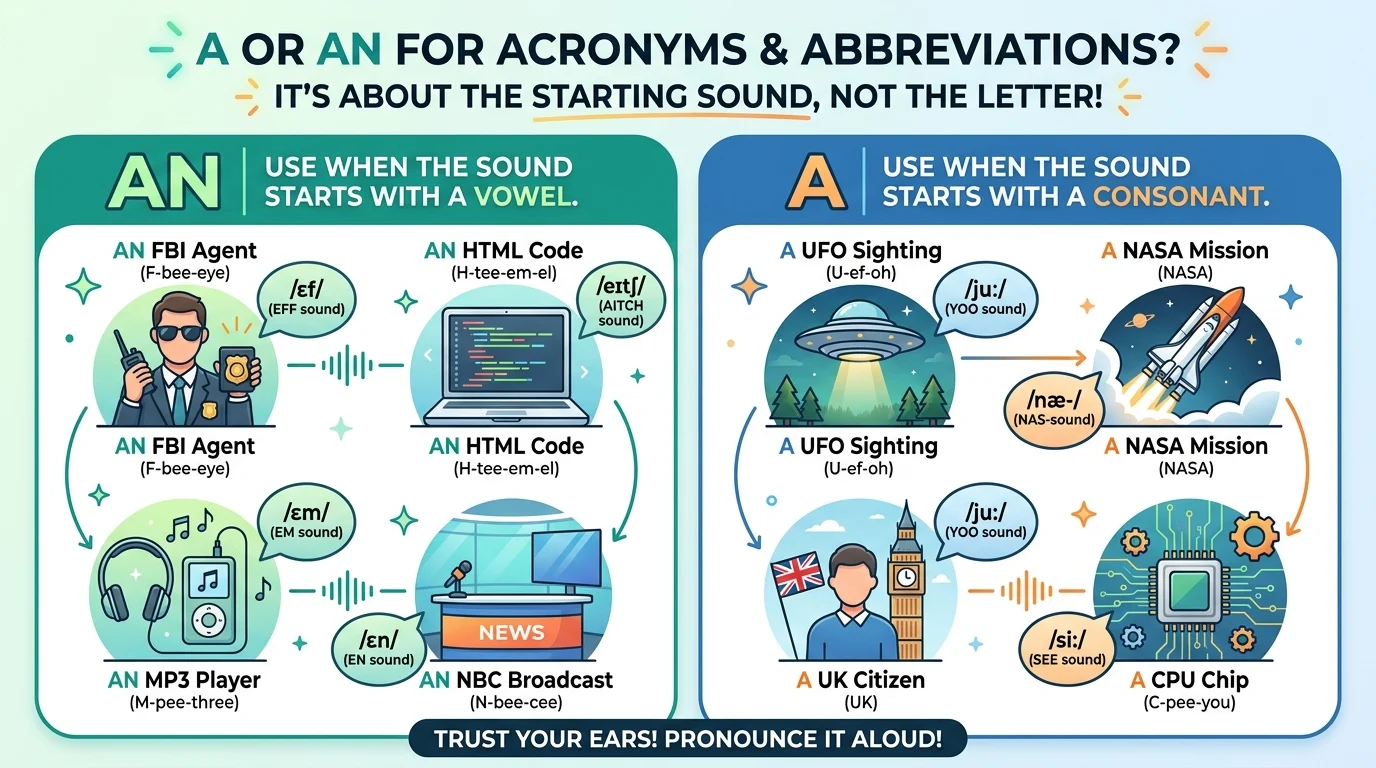
In English, acronyms like FBI, MBA, CEO, NASA, and HR are used in everyday communication. They appear in business, education, texting, and social media. However, many learners often get confused about one important grammar rule: whether to use “a” or “an” before acronyms.
People usually ask this because incorrect usage can make English sound unnatural or unprofessional. The main rule is simple, but it depends on pronunciation, not spelling.
This article explains the correct rule, examples, and common mistakes so you can use acronyms correctly in speaking and writing.
Meaning of “A or An for Acronyms”
The use of “a” or “an” depends on the sound of the first letter of the acronym when spoken, not the written letter.
Use “a” before consonant sounds
Use “an” before vowel sounds
Examples:
- a CEO (sounds like “see-ee-oh”)
- an MBA (sounds like “em-bee-ay”)
- an FBI agent (sounds like “eff-bee-eye”)
Acronyms, Abbreviations, and Initialisms
Acronym: A word formed from initials and pronounced as a word
Example: NASA, UNESCO
Initialism: Letters are pronounced separately
Example: FBI, HR, BBC
Abbreviation: Shortened form of a word or phrase
Example: Dr., etc.
The rule of “a” and “an” mainly applies based on pronunciation, especially with acronyms and initialisms.
Grammar Rule: A vs An
Use “a” before consonant sounds:
- a CEO
- a university
- a UFO
- a NASA scientist
Use “an” before vowel sounds:
- an FBI agent
- an MBA student
- an HR manager
- an ATM machine
Quick Table
| Acronym | Full Form | Meaning | Article |
|---|---|---|---|
| MBA | Master of Business Administration | Degree | an MBA |
| FBI | Federal Bureau of Investigation | Agency | an FBI agent |
| CEO | Chief Executive Officer | Company head | a CEO |
| HR | Human Resources | Department | an HR officer |
| NASA | Space agency | Research organization | a NASA scientist |
Real-Life Examples
Texting:
- I want to become an MBA graduate.
- He is a CEO now.
Workplace:
- She works as an HR manager.
- We hired a CFO last month.
Social Media:
- Dream job: an FBI agent.
- He became a CEO at 30.
Academic:
- He completed an MBA degree.
- NASA launched a new mission.
Common Mistakes
- Using spelling instead of sound (a MBA ❌ / an MBA ✔️)
- Overusing acronyms in formal writing
- Ignoring pronunciation differences
When to Use Acronyms
Use acronyms:
- In business communication
- In texting and social media
- With well-known terms
Avoid acronyms:
- In formal academic writing (without explanation)
- When clarity is important for beginners
Practice
Fill in the blanks:
- She is ___ MBA student.
- He works for ___ FBI.
- I met ___ CEO yesterday.
Choose correct answer:
- a FBI agent / an FBI agent
- a university / an university
Rewrite:
- a MBA student is here → _________
- an CEO visited us → _________
FAQs
Why do we say “an FBI” but “a CEO”?
Because it depends on pronunciation, not spelling.
Is it based on vowels?
No, it is based on sound.
Can acronyms be used in formal writing?
Yes, but only when they are well-known or defined.
Conclusion
The rule for using “a” or “an” before acronyms is simple: always follow pronunciation, not spelling. Use “a” before consonant sounds and “an” before vowel sounds. This improves your grammar, speaking, and professional writing in English.


