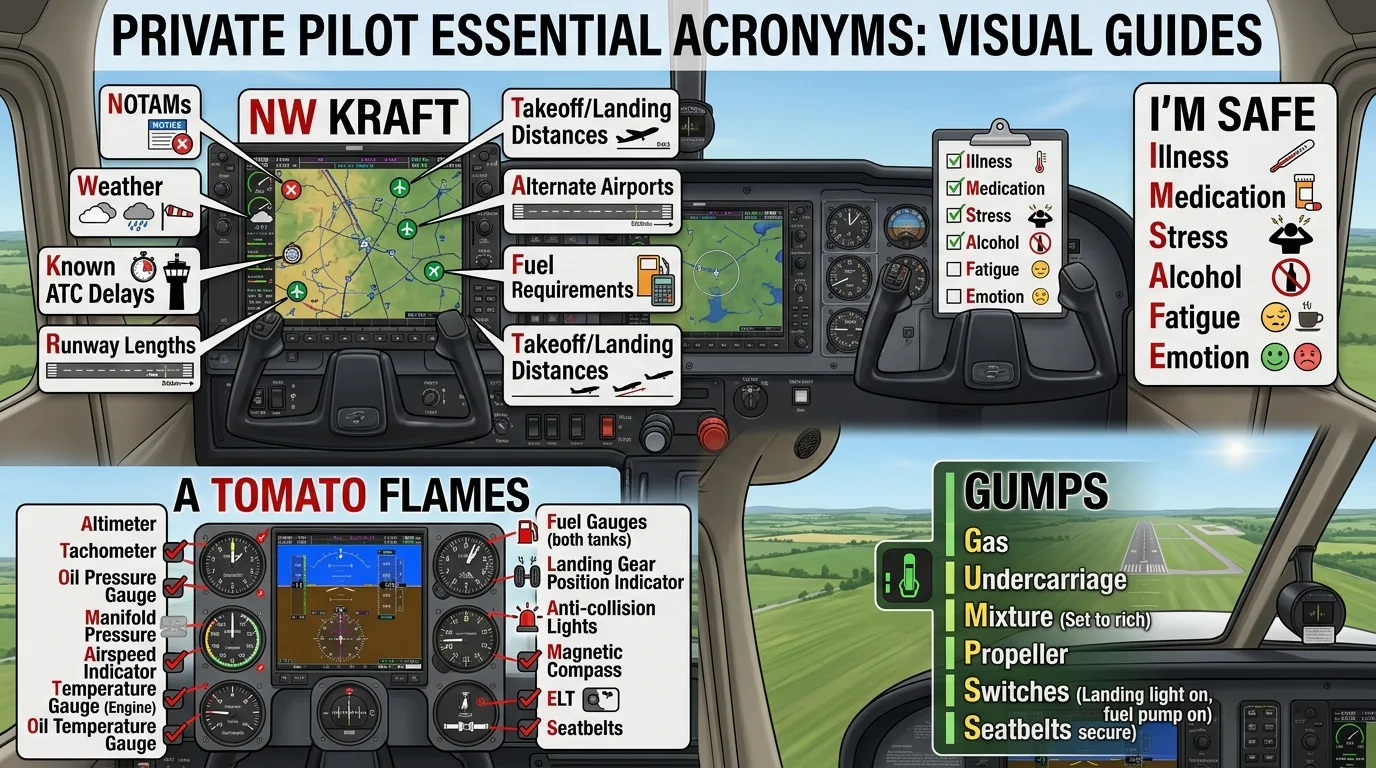
Becoming a private pilot requires understanding many aviation rules, instruments, procedures, and safety systems. To make communication faster and clearer, pilots use private pilot acronyms in training, radio communication, flight planning, and aviation exams.
These acronyms are widely used in flight schools, aviation charts, cockpit communication, and FAA-based training programs.
What Are Private Pilot Acronyms?
Private pilot acronyms are shortened aviation terms used to describe flight rules, weather systems, navigation tools, aircraft instruments, and safety procedures.
They are commonly used in:
- Flight training (PPL courses)
- Cockpit communication
- Air traffic control (ATC)
- Aviation weather reports
- FAA exams
For example:
- ATC = Air Traffic Control
- VFR = Visual Flight Rules
- IFR = Instrument Flight Rules
Common Private Pilot Acronyms and Meanings
| Acronym | Full Form | Meaning | Usage Context |
|---|---|---|---|
| PPL | Private Pilot License | Certification to fly private aircraft | Pilot licensing |
| ATC | Air Traffic Control | System controlling air traffic | Aviation communication |
| VFR | Visual Flight Rules | Flying using visual references | Flight rules |
| IFR | Instrument Flight Rules | Flying using instruments only | Poor weather flying |
| METAR | Meteorological Aerodrome Report | Weather report for airports | Aviation weather |
| TAF | Terminal Aerodrome Forecast | Weather forecast for airports | Flight planning |
| FAA | Federal Aviation Administration | US aviation authority | Regulation |
| AGL | Above Ground Level | Height above ground | Altitude measurement |
| MSL | Mean Sea Level | Altitude above sea level | Navigation |
| RPM | Revolutions Per Minute | Engine speed measurement | Aircraft engines |
| VOR | VHF Omnidirectional Range | Radio navigation system | Navigation aid |
| GPS | Global Positioning System | Satellite navigation system | Flight navigation |
| TCAS | Traffic Collision Avoidance System | Prevents aircraft collisions | Safety system |
| FAR | Federal Aviation Regulations | Aviation rules | Compliance |
| NOTAM | Notice to Airmen | Important flight notices | Flight safety |
| EGT | Exhaust Gas Temperature | Engine temperature monitoring | Engine health |
Flight Rules Acronyms Explained
VFR (Visual Flight Rules)
Flying using visual references like the horizon and landmarks.
IFR (Instrument Flight Rules)
Flying using cockpit instruments when visibility is poor.
Weather Acronyms for Pilots
METAR
Real-time weather report for airports including wind, visibility, and temperature.
TAF
Forecast weather conditions for airports over a specific time period.
Navigation Acronyms
VOR
Ground-based radio navigation system used to guide aircraft.
GPS
Satellite-based navigation system used for precise location tracking.
Safety and Control Acronyms
ATC
Air Traffic Control manages aircraft movement to prevent collisions.
TCAS
System that warns pilots of nearby aircraft and possible collision risks.
Pilot Licensing Acronyms
PPL (Private Pilot License)
Allows individuals to fly aircraft for personal use, not commercial purposes.
FAA
The regulatory authority responsible for aviation rules in the United States.
Aircraft Performance Acronyms
RPM
Measures engine speed and performance.
EGT
Monitors engine temperature for safe operation.
AGL vs MSL
- AGL = Height above ground
- MSL = Height above sea level
Why Private Pilot Acronyms Are Important
These acronyms are important because they:
- Improve communication between pilots and ATC
- Simplify complex aviation terms
- Increase flight safety
- Help with navigation and weather interpretation
- Are required for pilot certification exams
Common Mistakes in Aviation Acronyms
1. Confusing IFR and VFR
They represent completely different flying conditions.
2. Misreading weather reports
METAR and TAF serve different purposes.
3. Ignoring altitude references
AGL and MSL are often mixed up.
Real-Life Pilot Communication Examples
Pre-Flight Check
“Review METAR and TAF before IFR departure.”
In-Flight Navigation
“Maintain 5,000 ft MSL using VOR guidance.”
Safety Alert
“TCAS warning received—adjust altitude immediately.”
Simple Memory Guide
- VFR = Visual flying
- IFR = Instrument flying
- ATC = Air traffic control
- METAR = Current weather
- TAF = Weather forecast
- VOR = Radio navigation
- GPS = Satellite navigation
Final Summary
Private pilot acronyms are essential for safe and efficient aviation operations. From VFR and IFR to METAR, TAF, ATC, and GPS, these terms help pilots understand weather, navigation, aircraft systems, and air traffic control instructions.
Learning these acronyms is a key part of becoming a skilled and safe private pilot, ensuring clear communication and safe flight operations in all conditions.