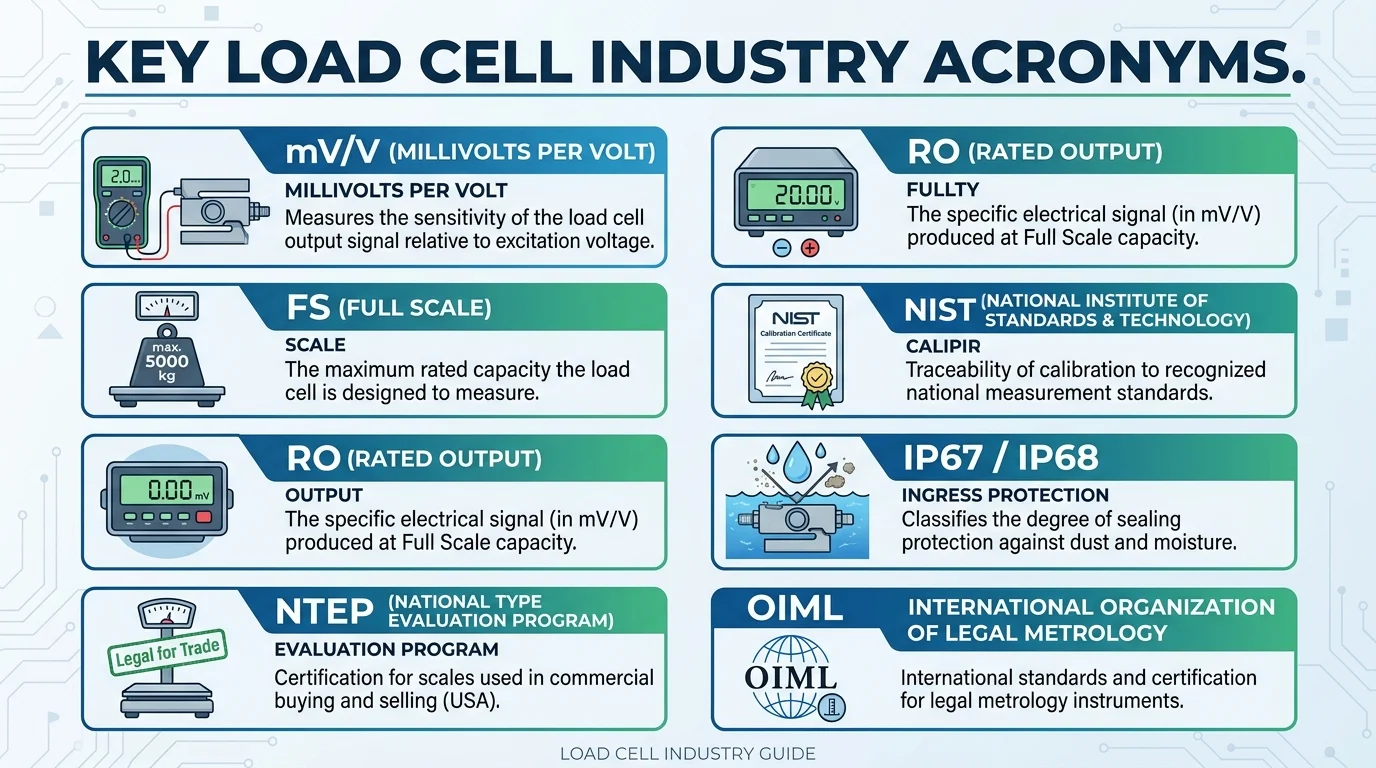
The load cell industry plays a critical role in modern engineering, manufacturing, construction, and industrial weighing systems. Load cells are sensors used to measure force, weight, and pressure with high precision. Because this field is highly technical, professionals use many load cell industry acronyms to simplify communication, calibration reports, and system documentation.
These acronyms are commonly found in industrial scales, testing machines, automation systems, and engineering specifications.
What Are Load Cell Industry Acronyms?
Load cell industry acronyms are shortened technical terms used in force measurement, weighing systems, calibration processes, and sensor specifications.
They are widely used in:
- Industrial weighing systems
- Material testing machines
- Calibration laboratories
- Construction and engineering
- Automation and robotics
- Quality control systems
For example:
- mV/V = Millivolt per Volt (sensor output sensitivity)
- kN = Kilonewton (force measurement unit)
- OIML = International organization for measurement standards
Common Load Cell Industry Acronyms and Meanings
| Acronym | Full Form | Meaning | Usage Context |
|---|---|---|---|
| mV/V | Millivolt per Volt | Load cell output sensitivity | Sensor calibration |
| N | Newton | SI unit of force | Force measurement |
| kN | Kilonewton | 1000 Newtons | Heavy load systems |
| kgf | Kilogram-force | Force due to gravity on 1 kg | Mechanical testing |
| lb | Pound | Imperial weight unit | Industrial weighing |
| PSI | Pounds per Square Inch | Pressure measurement | Hydraulic systems |
| OIML | International Organization of Legal Metrology | Global measurement standards body | Certification |
| ISO | International Organization for Standardization | Global standards organization | Quality control |
| FS | Full Scale | Maximum rated capacity | Load cell specs |
| RL | Rated Load | Maximum safe load capacity | Engineering limits |
| EMax | Maximum Capacity | Highest measurable load | Sensor specification |
| ZO | Zero Output | Output when no load is applied | Calibration |
| IP | Ingress Protection | Protection rating against dust/water | Device durability |
| EMC | Electromagnetic Compatibility | Resistance to electrical interference | Sensor reliability |
| TEDS | Transducer Electronic Data Sheet | Digital sensor identification system | Smart sensors |
Load Cell Measurement Acronyms Explained
mV/V (Millivolt per Volt)
This is one of the most important load cell specifications. It represents how much electrical signal the load cell produces per unit of excitation voltage.
👉 Higher mV/V = higher sensitivity
N and kN (Force Units)
- N (Newton) = basic force unit
- kN (Kilonewton) = 1000 Newtons, used for heavy loads
kgf and lb
These are traditional force and weight units used in mechanical industries.
Standards and Certification Acronyms
OIML
The International Organization of Legal Metrology sets international standards for measuring instruments including load cells and weighing systems.
ISO
The International Organization for Standardization defines global quality and manufacturing standards used in load cell production.
Load Cell Technical Specification Acronyms
FS (Full Scale)
Represents the maximum capacity a load cell can measure safely.
RL (Rated Load)
The recommended safe operating load limit.
ZO (Zero Output)
Electrical signal output when no weight is applied.
Protection and Quality Acronyms
IP Rating
Shows protection against dust and water (e.g., IP67, IP68).
EMC
Ensures load cells are not affected by electromagnetic interference.
Smart Load Cell Technology Acronyms
TEDS
Transducer Electronic Data Sheet stores calibration and identification data inside smart sensors.
Why Load Cell Acronyms Are Important
These acronyms are used because they:
- Standardize global measurement systems
- Improve communication in engineering documentation
- Ensure accurate calibration and testing
- Reduce errors in industrial systems
- Help technicians and engineers work efficiently
Common Mistakes in Load Cell Acronyms
1. Confusing force and weight units
N, kN, and kgf are often mixed up.
2. Misreading sensor sensitivity
mV/V is misunderstood by beginners.
3. Ignoring standards
OIML and ISO certifications are often overlooked.
Real-Life Examples
Industrial Weighing System
“Load cell rated at 10 kN with 2 mV/V output.”
Calibration Report
“Device complies with OIML and ISO standards.”
Factory Automation
“System protected with IP67-rated load sensors.”
Simple Memory Guide
- mV/V = Sensor output
- N / kN = Force units
- kgf / lb = Weight units
- OIML / ISO = Standards
- IP = Protection level
- FS / RL = Load capacity
Final Summary
Load cell industry acronyms are essential in force measurement, weighing systems, and industrial engineering. From mV/V sensitivity and kN force units to ISO and OIML standards, these terms ensure accuracy, safety, and consistency in measurement systems worldwide.
Understanding these acronyms helps engineers, technicians, and manufacturers work more effectively with load cells and precision weighing technologies.