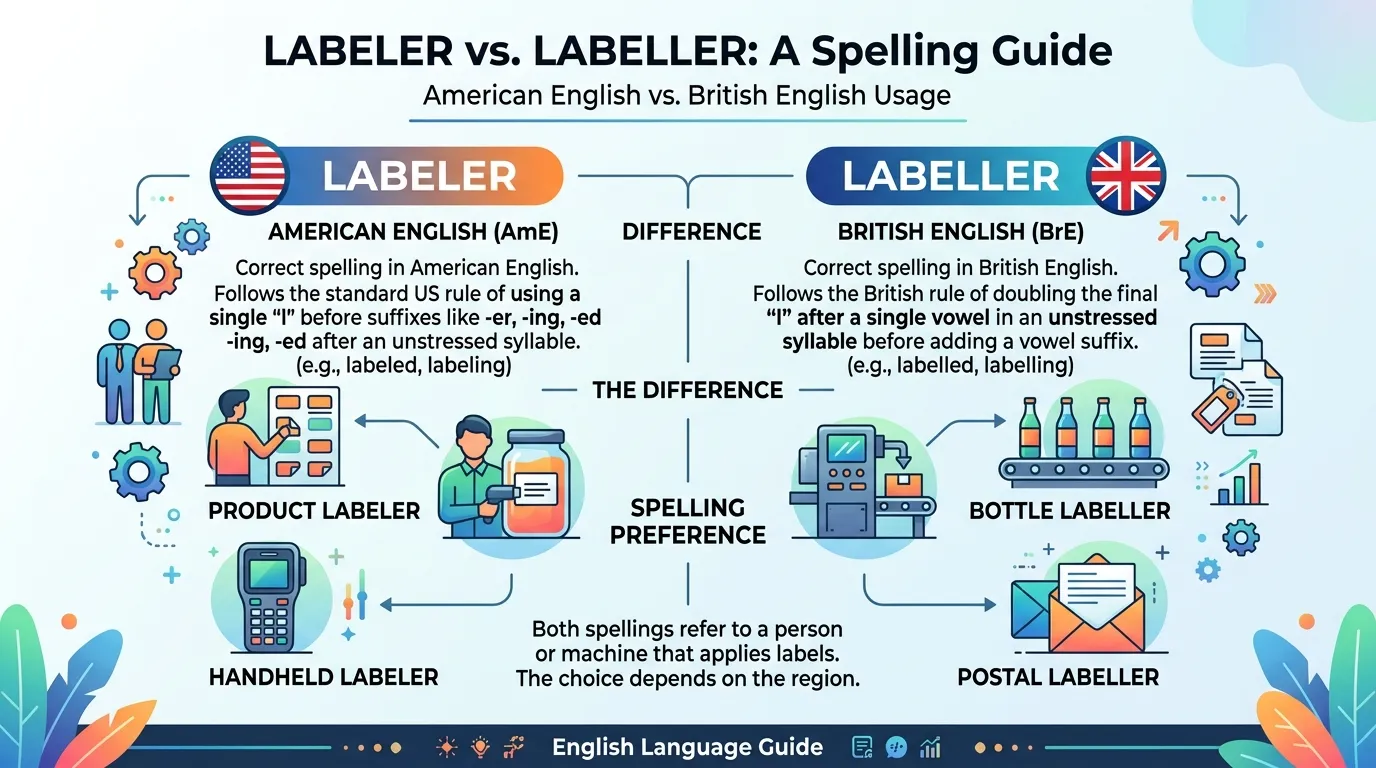
Have you ever wondered whether labeler or labeller is the correct spelling? The answer depends mainly on the variety of English you use. Labeler is the standard spelling in American English, while labeller is the preferred spelling in British English and several other varieties, including Canadian and Australian English. Both forms refer to a person or thing that labels something.
The confusion comes from a common spelling pattern. British English often doubles a final consonant before adding a suffix, while American English often keeps the single consonant in words such as labeling and labeled. As a result, learners may see both labeler and labeller and assume that one must be incorrect.
In this guide, we will explain the labeler vs labeller difference, meaning, pronunciation, grammar, etymology, examples, synonyms, and everyday usage. We will also look closely at UK vs US English so you can choose the right spelling with confidence.
Quick Answer
- ✅ Labeler = standard American English spelling
- ✅ Labeller = standard British English spelling
- ❌ Labeller is not wrong in British English.
- ❌ Labeler is not wrong in American English.
Simple rule
US English: labeler
UK English: labeller
Both words have the same basic meaning: a person, machine, or system that puts labels on things.
Labeler vs Labeller Meaning
A labeler or labeller is someone or something that labels products, objects, documents, packages, or other items.
For example:
The labeler puts shipping labels on every package.
The word can describe a person who performs the action or, depending on context, a machine that performs it.
Labeler meaning
In American English, labeler means a person or device that labels something.
Examples:
- The labeler checked every package before shipment.
- We hired a new labeler for the warehouse.
- The machine works as an automatic labeler.
- The product labeler must follow company rules.
- She is responsible for operating the bottle labeler.
Labeller meaning
In British English, labeller has exactly the same basic meaning.
Examples:
- The labeller checked every package before shipment.
- We hired a new labeller for the warehouse.
- The machine works as an automatic labeller.
- The product labeller must follow company rules.
- She operates the bottle labeller every morning.
The meaning does not change because of the extra l.
Labeler vs Labeller Grammar Difference
The words labeler and labeller are both nouns.
They come from the verb label.
The basic word family looks like this:
| Word | Part of speech | Meaning |
|---|---|---|
| label | Verb | To put a label on something |
| label | Noun | A tag or description |
| labeled | Past tense/adjective | Given a label |
| labeling | Present participle/gerund | Putting a label on something |
| labeler | Noun | A person or device that labels |
| labeller | Noun | A person or device that labels |
The spelling difference follows regional spelling rules.
American English usually writes:
- labeler
- labeled
- labeling
British English commonly writes:
- labeller
- labelled
- labelling
This is why the labeler vs labeller grammar difference is really a spelling difference between varieties of English, not a difference in meaning or grammatical function.
Why Is Labeller Spelled With Two Ls?
The answer is connected to British spelling conventions.
The verb is label. When British English adds a suffix beginning with a vowel, the final l is commonly doubled:
label + er = labeller
American English generally does not double the final l in this word:
label + er = labeler
The same pattern appears in other forms.
| American English | British English |
|---|---|
| labeler | labeller |
| labeled | labelled |
| labeling | labelling |
However, spelling rules can be more complex than this simple table suggests. English has many historical exceptions, so it is better to learn the common forms rather than assume that every word follows exactly the same rule.
Labeler vs Labeller Pronunciation
Both words are normally pronounced the same way.
American English
Labeler: /ˈleɪbələr/
It sounds roughly like:
LAY-buh-lər
British English
Labeller: /ˈleɪbələ/
It sounds roughly like:
LAY-buh-luh
The main difference may come from the speaker’s accent rather than from the spelling itself.
The extra l in labeller does not create a completely different pronunciation. This is another reason people confuse the two spellings.
Why Are Labeler and Labeller Commonly Confused?
There are several reasons.
First, the two words have identical meanings.
Second, they come from the same verb, label.
Third, they are usually pronounced almost identically.
Finally, English spelling varies between countries.
An American writer may see labeller in a British document and think it is a spelling mistake. A British writer may see labeler in an American document and have the same reaction.
Neither conclusion is correct.
The best choice depends on your intended variety of English.
Labeler vs Labeller: Detailed Comparison
| Feature | Labeler | Labeller |
|---|---|---|
| Main variety | American English | British English |
| Part of speech | Noun | Noun |
| Meaning | Person or machine that labels | Person or machine that labels |
| Verb | Label | Label |
| Pronunciation | Similar | Similar |
| Correct spelling | Yes | Yes |
| Formal usage | Yes | Yes |
| Informal usage | Yes | Yes |
| Common related form | labeled | labelled |
| Present participle | labeling | labelling |
| Best choice for US writing | Yes | No |
| Best choice for UK writing | No | Yes |
Labeler Examples in American English
Here are natural labeler examples in US English:
- The warehouse uses an automatic labeler for shipping boxes.
- The new employee works as a labeler in the production area.
- The machine is a fast and reliable bottle labeler.
- The labeler must check each package carefully.
- We replaced the old labeler last month.
- The company bought a high-speed product labeler.
- The labeler prints the customer information automatically.
- A trained labeler inspected the finished products.
- The factory needs another labeler during the holiday season.
- The package moves directly from the printer to the labeler.
Labeller Examples in British English
Here are natural labeller examples in UK English:
- The warehouse uses an automatic labeller for shipping boxes.
- The new employee works as a labeller in the production area.
- The machine is a fast and reliable bottle labeller.
- The labeller must check each package carefully.
- We replaced the old labeller last month.
- The company bought a high-speed product labeller.
- The labeller prints the customer information automatically.
- A trained labeller inspected the finished products.
- The factory needs another labeller during the holiday season.
- The package moves directly from the printer to the labeller.
Notice that the meaning stays the same. Only the spelling changes.
Labeler in a Sentence
Here are some additional American English examples showing the correct usage:
- Our labeler stopped working this morning.
- The labeler applies stickers to each container.
- Please ask the labeler to check the boxes.
- The company purchased a new electronic labeler.
- The labeler produces thousands of labels every day.
- We need a replacement labeler for the warehouse.
- The labeler is easy to operate.
- The shipping team uses the labeler every afternoon.
- The labeler needs regular maintenance.
- This labeler can handle different package sizes.
Labeller in a Sentence
Here are additional British English examples:
- Our labeller stopped working this morning.
- The labeller applies stickers to each container.
- Please ask the labeller to check the boxes.
- The company purchased a new electronic labeller.
- The labeller produces thousands of labels every day.
- We need a replacement labeller for the warehouse.
- The labeller is easy to operate.
- The shipping team uses the labeller every afternoon.
- The labeller needs regular maintenance.
- This labeller can handle different package sizes.
Common Mistakes With Labeler and Labeller
Using labeller in American English
Incorrect for standard US usage:
The company bought a new labeller.
Better American English:
The company bought a new labeler.
Using labeler in British English
Less suitable for standard UK usage:
The factory needs a new labeler.
Better British English:
The factory needs a new labeller.
Assuming labeller is always wrong
This is a common mistake.
Labeller is correct in British English.
Assuming labeler is always wrong
This is also incorrect.
Labeler is the normal American English spelling.
Mixing spelling systems
A document can look inconsistent if it uses:
- labeled
- labelling
- labeler
Choose one regional style and stay consistent.
Confusing the noun with the verb
Labeler is a noun.
The verb is label.
Correct:
The worker will label the boxes.
Correct:
The labeler checked the boxes.
Thinking the extra L changes the meaning
It does not. Labeler and labeller mean the same thing.
Real-Life Usage
The word can appear in many practical situations.
Emails
US:
Please ask the labeler to finish the shipment before 4 p.m.
UK:
Please ask the labeller to finish the shipment before 4 p.m.
Offices
The office labeler needs a new cartridge.
In Britain, this would normally be:
The office labeller needs a new cartridge.
Banking
Banks may use labels on documents, envelopes, files, or cards. A machine or employee responsible for this task can be called a labeler in US English or a labeller in UK English.
Invoices
The labeler printed the shipping information for the invoices.
Schools
A teacher might say:
Please use the labeler to print name tags.
A British teacher would more commonly write labeller.
Social Media
People may use the word casually when discussing products:
This little labeler is perfect for organizing my desk.
Rent Payments
A property manager might label files for rent payments:
The office labeler helps organize tenant documents.
Everyday Conversations
Where is the labeler? I need to label these boxes.
In British English:
Where is the labeller? I need to label these boxes.
Word Origins and Etymology
The word label has a long history.
English borrowed label through Old French, with earlier roots connected to words referring to a strip, ribbon, or piece attached to something. Over time, its meaning developed toward a tag, mark, or written identification attached to an object.
The verb developed from the noun. To label something came to mean putting a label on it or identifying it with a particular description.
The noun labeler was then formed by adding -er to the verb:
label + er = labeler
British spelling developed the form:
label + ler = labeller
The extra l reflects a broader British spelling pattern involving consonant doubling.
Labeler vs Labeller Synonyms
There are several alternatives, although the best choice depends on context.
| Synonym or alternative | Meaning | Common use |
|---|---|---|
| labeling machine | Machine that applies labels | Very common |
| labeling device | Device used for labeling | Technical |
| tagging machine | Machine that attaches tags | Product/retail |
| label printer | Printer that creates labels | Office/home |
| marker | Person or thing that marks something | General |
| identifier | Something that identifies | Technical/formal |
| tagging device | Device used to attach tags | Industrial |
In American English, labeler and labeling machine are natural choices.
In British English, labeller and labelling machine are common.
For technical writing, labeling machine or labelling machine may be clearer than labeler/labeller because it immediately tells the reader that the subject is a machine.
Labeler vs Related Words
Do not confuse labeler with label or labeling.
- Label = the tag itself or the act of putting a tag on something.
- Labeler = a person or device that labels something.
- Labeling = the process of putting labels on things.
- Label printer = a machine that prints labels.
- Labeling machine = a machine designed to apply labels.
For example:
The label is on the box.
The worker is labeling the box.
The labeler is applying the label.
Each word has a different grammatical role.
Five Memory Tricks for Labeler vs Labeller
Remember the US rule
Think:
US = one L
So:
labeler
Remember the UK double L
Think:
UK = extra L
So:
labeller
Learn the word family
US:
labeled → labeling → labeler
UK:
labelled → labelling → labeller
Think of the map
If your document is for an American audience, use labeler.
If it is for a British audience, use labeller.
Remember that both are correct
Do not memorize one as right and the other as wrong.
Instead remember:
American English = labeler
British English = labeller
Formal vs Informal Usage
Both labeler and labeller can be used in formal writing.
They are not slang.
You can use them in:
- Business reports
- Technical manuals
- Emails
- School assignments
- Product descriptions
- Workplace documents
- Manufacturing instructions
However, labeling machine or labelling machine may be more precise when you are talking specifically about equipment.
FAQs
Is labeler or labeller correct?
Both are correct. Labeler is the standard American English spelling, while labeller is the standard British English spelling.
What does labeler mean?
A labeler is a person or machine that labels something. The word is mainly used in American English.
What does labeller mean?
Labeller has the same meaning as labeler. It is the preferred British English spelling.
Is labeller a British spelling?
Yes. Labeller is commonly used in British English and follows the British tendency to double the final l in this word family.
Is labeler American English?
Yes. Labeler is the usual spelling in standard American English.
How do you pronounce labeler?
Labeler is commonly pronounced /ˈleɪbələr/, roughly like LAY-buh-lər.
How do you pronounce labeller?
Labeller is commonly pronounced /ˈleɪbələ/ in British English, roughly like LAY-buh-luh.
What is a synonym for labeler?
Depending on context, alternatives include labeling machine, label printer, tagging machine, and labeling device.
Which spelling should I use in formal writing?
Use the spelling that matches your audience. Choose labeler for American English and labeller for British English.
Do American dictionaries prefer labeler?
Major American English dictionaries generally use labeler as the expected American spelling, while British dictionaries commonly reflect labeller as the British form.
People Also Ask
Is labeler spelled with one L or two?
It depends on the English variety. American English uses labeler with one l before the suffix, while British English commonly uses labeller with two.
Is labeller a misspelling?
No. Labeller is not a misspelling when British English is being used.
What is the American spelling of labeller?
The American spelling is labeler.
What is the British spelling of labeler?
The British spelling is labeller.
Is labeling or labelling correct?
Both are correct regionally. American English uses labeling, while British English generally uses labelling.
Is labeled or labelled correct?
American English normally uses labeled. British English normally uses labelled.
Does labeler mean a person or a machine?
It can mean either, depending on context. A labeler may be a person who labels items or a machine that performs the labeling task.
Final Verdict
The labeler vs labeller question is really a question of regional spelling. Neither word is universally wrong. Labeler is the preferred form in American English, while labeller is the preferred form in British English. Both words have the same meaning, grammatical role, and pronunciation pattern.
If you are writing for readers in the United States, choose labeler. If you are writing for readers in the United Kingdom, choose labeller. The same regional difference appears in related words: Americans generally write labeled and labeling, while British writers commonly use labelled and labelling.
The easiest way to remember the correct usage is simple: US English uses labeler; UK English uses labeller. Once you know this rule, you can avoid one of the most common spelling mix-ups and write with confidence in either variety of English.


