Have you ever paused while writing and wondered whether “onto” or “on to” is correct? You are not alone. The difference between onto vs on to can be confusing because both forms are pronounced almost the same, and both can appear in very similar sentences. However, they do not always have the same grammar or meaning.
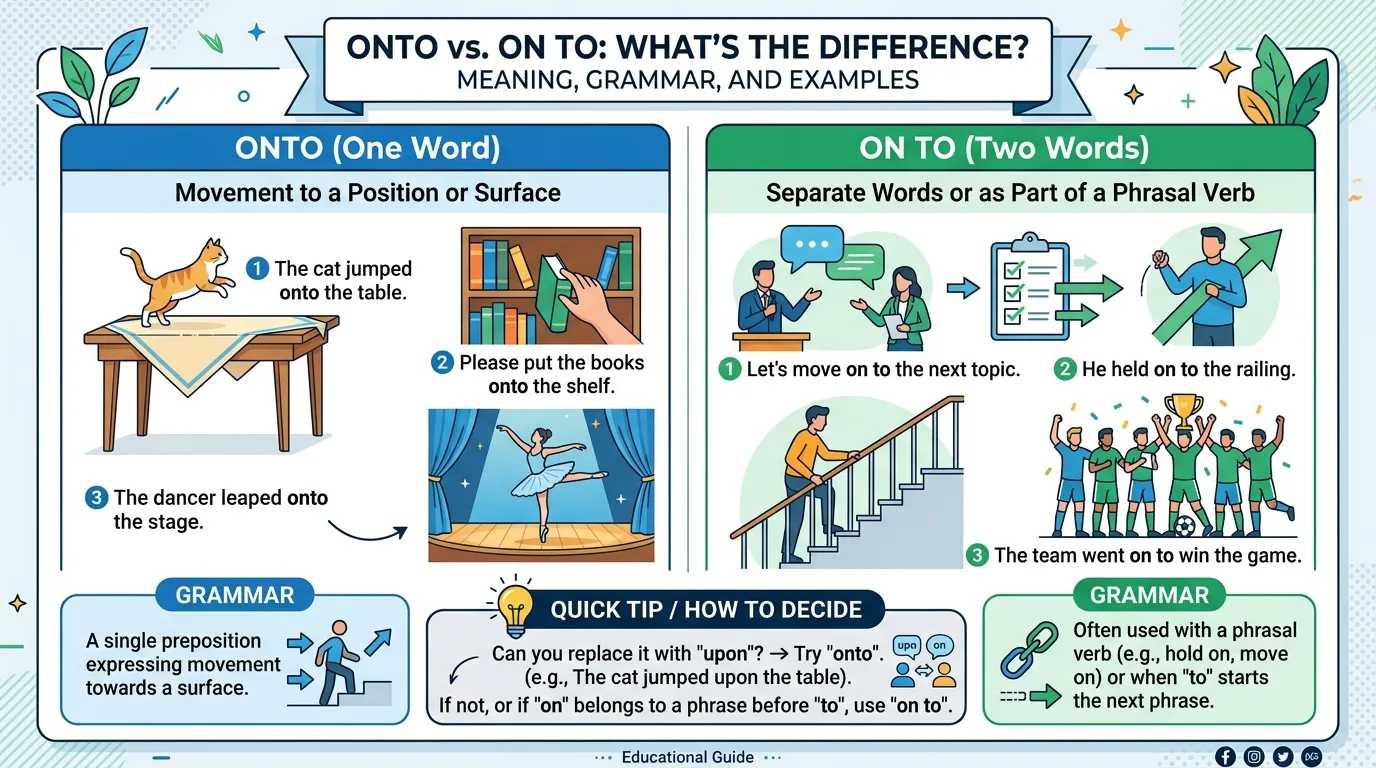
The simple rule is this: use onto when you mean movement to a position or place on a surface, such as “She climbed onto the roof.” Use on to when on belongs to the verb or previous phrase and to begins the next phrase, as in “She went on to become a doctor.”
This onto vs on to difference is the same in both American and British English in most cases. The main variation is style and dictionary preference, not a major difference in meaning. Once you understand what each word is doing in a sentence, the choice becomes much easier.
Quick Answer: Onto vs On To
Here is the easiest way to remember the basic correct usage:
- ✅ Onto = movement toward or into a position on something.
- ✅ On to = on + to, when the two words have separate grammatical jobs.
- ❌ Do not use onto simply because the sentence contains movement.
- ❌ Do not combine on to when onto is clearly acting as one preposition.
Examples:
- ✅ The cat jumped onto the table.
- ❌ The cat jumped on to the table. (Usually less preferred when the meaning is clearly movement to the surface.)
- ✅ She went on to explain the problem.
- ❌ She went onto explain the problem.
The key is not the spelling alone. Look at the meaning and grammar.
What Does “Onto” Mean?
Onto is mainly a preposition. It shows movement toward a position on, or sometimes attachment to, something.
For example:
The child climbed onto the bed.
The child moved from another place and ended up on the bed.
The basic pattern is:
movement + onto + surface/place
Common verbs used with onto include:
- climb onto
- jump onto
- step onto
- move onto
- get onto
- fall onto
- crawl onto
- place something onto
Onto Examples in American English
- The dog jumped onto the couch.
- She stepped onto the bus.
- He climbed onto the roof.
- Put the documents onto my desk.
- The child crawled onto the floor.
Onto Examples in British English
- The boy climbed onto the train.
- She stepped onto the pavement.
- The cat jumped onto the sofa.
- He moved onto the next platform.
- The cyclist fell onto the road.
These examples show that the basic meaning of onto is broadly the same in UK vs US English.
What Does “On To” Mean?
On to is not usually one word. It is a combination of on and to, and each word has its own grammatical role.
A common example is:
After finishing college, Maya went on to work in London.
Here, on is part of the expression go on, while to introduces what happens next.
Another example:
Let’s move on to the next question.
The phrase means move forward to the next thing.
This is why writing onto can change the grammar:
She went onto explain the issue. ❌
The correct sentence is:
She went on to explain the issue. ✅
Here, to explain is an infinitive phrase.
Onto vs On To: The Grammar Difference
The most useful test is to ask:
Does “to” show a destination on a surface, or does “to” introduce another action or destination?
Compare these sentences:
| Sentence | Correct form | Why? |
|---|---|---|
| The cat jumped ___ the bed. | onto | Movement to a surface |
| She went ___ discuss the plan. | on to | “go on” + infinitive |
| He climbed ___ the stage. | onto | Movement to a position |
| We moved ___ the next topic. | on to | Moving forward to another topic |
| Put it ___ the shelf. | onto | Movement to a surface |
| She went ___ become famous. | on to | “go on” + infinitive |
A Simple Test
Try replacing onto with to a position on.
The bird flew onto the roof.
The bird flew to a position on the roof.
That works, so onto is appropriate.
Now try:
He went on to become a manager.
You cannot replace it naturally with “to a position on.” Instead, on belongs with went, and to become introduces the next action.
Therefore, use on to.
Onto vs On To Comparison Table
| Feature | Onto | On to |
|---|---|---|
| Grammar | Usually a preposition | Two separate words |
| Main meaning | Movement to a position on something | Continuation, progression, or separate “to” phrase |
| Example | Jump onto the bed | Go on to explain |
| Can show a surface? | Yes | Sometimes, depending on sentence structure |
| Used before an infinitive? | Usually no | Yes |
| American English | Common | Common |
| British English | Common | Common |
| Pronunciation | Usually /ˈɒntuː/ or /ˈɑːntuː/ | Often similar in connected speech |
| Main test | “to a position on” | “on” + separate “to” phrase |
Pronunciation Guide
The pronunciation of onto and on to can be almost identical in normal speech. That is one reason people confuse them.
Onto
British English: /ˈɒn.tuː/
American English: /ˈɑːn.tuː/
It sounds roughly like “ON-too.”
On to
The pronunciation is usually similar in connected speech:
/ɒn tuː/ in British English
/ɑːn tuː/ in American English
Because there is little or no noticeable pause between the words, listeners may not know which spelling a speaker intends.
That is why the grammar difference, rather than pronunciation, is the best way to choose the correct form.
Why Are “Onto” and “On To” So Commonly Confused?
There are several reasons.
First, they often sound the same.
Second, both can follow verbs of movement:
She jumped onto the chair.
She moved on to the next room.
Third, the meaning can sometimes be close enough to create uncertainty.
Finally, English has many combinations where a preposition can be written either as a single word or as separate words depending on its grammatical function.
The best solution is to examine the sentence rather than rely on sound.
Onto and On To: Word Origins and Etymology
The word on is very old. It comes from early forms of English and Germanic languages that expressed position, contact, or location.
To is also an ancient English word. It developed from Old English forms used to express direction, movement, purpose, and relationships between words.
The combined form onto developed from the idea of movement to + on a surface or position. Over time, it became established as a single preposition.
However, English still uses the separate words on to when on and to perform different grammatical functions.
This explains an important point: onto is not simply a shorter spelling of every instance of “on to.” The forms developed overlapping but distinct grammatical uses.
Onto Synonyms and Alternatives
There is no perfect synonym for onto, because the best replacement depends on the sentence.
| Expression | Meaning | Example |
|---|---|---|
| to | Direction | Move to the platform |
| upon | Formal/literary version | He stepped upon the stage |
| on | Position/contact | The book is on the table |
| toward | Direction toward something | Walk toward the door |
| over | Movement across/above | Jump over the fence |
| up onto | Movement upward to a surface | Climb up onto the roof |
For everyday American English, onto is usually the most natural choice when movement ends on a surface.
In British English, onto is also widely used. Upon sounds more formal or literary in both varieties.
Seven Common Mistakes With Onto vs On To
Mistake 1: Using “onto” before an infinitive
❌ She went onto explain the issue.
✅ She went on to explain the issue.
Why? To explain is an infinitive.
Mistake 2: Always writing “on to” for movement
❌ The cat jumped on to the table.
While this can occur, onto is normally clearer when the meaning is direct movement to a surface.
✅ The cat jumped onto the table.
Mistake 3: Assuming the pronunciation decides the spelling
The two forms can sound nearly identical.
Correction: Look at the sentence structure.
Mistake 4: Confusing location with movement
Compare:
The phone is on the desk.
She put the phone onto the desk.
The first describes position. The second describes movement.
Mistake 5: Writing “onto” for every “go on to” expression
❌ He went onto become a successful writer.
✅ He went on to become a successful writer.
Mistake 6: Ignoring the verb
Certain expressions naturally use on to:
- go on to
- move on to
- carry on to
- pass on to
Check what the verb means before combining the words.
Mistake 7: Thinking UK and US English use completely different rules
They do not.
Both varieties use onto and on to in broadly the same way. Differences are more likely to come from individual style guides or editorial preferences.
Onto vs On To in Real-Life Situations
Emails
Please upload the document onto the shared system.
I would now like to move on to the final point.
Offices
She placed the report onto the manager’s desk.
Let’s move on to the next item on the agenda.
Banking
The payment was transferred onto the customer’s account.
The bank went on to review the transaction.
Invoices
Please enter the invoice details onto the online form.
The company went on to issue a corrected invoice.
Schools
The student stepped onto the stage.
The teacher went on to explain the answer.
Social Media
The video was uploaded onto the platform.
The creator went on to discuss the trend.
Rent Payments
The tenant transferred the rent onto the payment account.
After paying rent, she went on to pay the utility bill.
Everyday Conversations
Get onto the bus before the doors close.
After dinner, we went on to watch a movie.
Ten “Onto” Examples in American English
- The baby climbed onto the sofa.
- Please put the box onto the table.
- The bird landed onto the branch.
- He stepped onto the elevator.
- The dog jumped onto my bed.
- She moved the files onto her computer.
- The child climbed onto the playground equipment.
- He threw the towel onto the floor.
- The actor walked onto the stage.
- The kitten jumped onto the chair.
Ten “On To” Examples in American English
- She went on to study law.
- Let’s move on to the next question.
- He went on to become a successful engineer.
- The teacher went on to explain the final step.
- After college, she went on to start a business.
- We can move on to another subject.
- He went on to win the competition.
- The report went on to discuss future risks.
- She carried on to the next stage of the project.
- The speaker went on to answer questions.
Ten “Onto” Examples in British English
- The child climbed onto the sofa.
- She stepped onto the pavement.
- The dog jumped onto the bed.
- He walked onto the platform.
- The book fell onto the floor.
- The driver moved onto the main road.
- She placed the parcel onto the table.
- The actor walked onto the stage.
- The cat jumped onto the windowsill.
- He climbed onto the bus.
Ten “On To” Examples in British English
- She went on to study medicine.
- He went on to become a teacher.
- Let’s move on to the next subject.
- The lecturer went on to explain the theory.
- We then moved on to the final question.
- She went on to win the award.
- He went on to lead the organisation.
- The report went on to describe the results.
- After school, he went on to university.
- The discussion moved on to transport costs.
Five Memory Tricks for Remembering the Difference
1. Think “surface”
If something moves to a surface, think onto.
Jump + onto + table.
2. Think “next”
If someone moves on to the next thing, keep the words separate.
Move on to the next question.
3. Use the replacement test
If you can say “to a position on,” choose onto.
4. Watch for “go on to”
This is one of the most common on to patterns.
She went on to become a doctor.
5. Remember: one word, one job
Onto acts as one preposition.
On to contains two separate grammatical pieces.
Related Expressions
The focus keyword onto vs on to is closely related to several other English expressions:
- on — describes position or contact.
- to — often shows direction, destination, or introduces an infinitive.
- upon — a more formal alternative to “on” or “onto” in some contexts.
- into — movement from outside to inside.
- toward/towards — movement in the direction of something.
- up to — movement toward a higher point or another limit.
- go on — continue.
- move on — progress or change to something else.
Notice the contrast:
He climbed onto the roof.
He climbed into the attic.
He moved on to another project.
Each expression has a different grammatical function.
Formal vs Informal Usage
Both onto and on to are normal in formal and informal English when used correctly.
You can use them in:
- academic writing
- business emails
- reports
- school assignments
- text messages
- social media
- everyday speech
The important issue is correct usage, not formality.
For example:
The study then went on to examine the second group.
This is perfectly suitable for academic writing.
Likewise:
The child climbed onto the chair.
This is natural in everyday English.
FAQs
Is “onto” one word or two?
Onto is normally one word when it functions as a preposition showing movement to a position on something.
What is the difference between onto and on to?
Onto usually shows movement to a position or surface. On to consists of two separate words, often appearing when on belongs to the preceding verb or expression and to introduces another phrase.
Is “onto” correct in American English?
Yes. Onto is standard and widely used in American English.
Is “onto” correct in British English?
Yes. Onto is also standard in British English. British and American usage are broadly similar.
What is an “onto” synonym?
Depending on context, possible alternatives include upon, to, or phrases such as to a position on. However, onto is often the clearest everyday choice.
How do you pronounce “onto”?
It is commonly pronounced /ˈɑːntuː/ in American English and /ˈɒntuː/ in British English.
Is “on to” grammatically correct?
Yes. It is correct when on and to have separate functions.
She went on to explain the answer.
Can “onto” be used before a verb?
Usually not when you mean go on to + verb.
❌ He went onto explain it.
✅ He went on to explain it.
Which is more formal: onto or on to?
Neither is automatically more formal. The correct choice depends on the grammar and meaning of the sentence.
People Also Ask
Should I write “move onto” or “move on to”?
Both can be correct, depending on meaning. Move onto commonly means move to a surface or position. Move on to often means progress to another subject, task, or stage.
Is “onto” always a preposition?
It is mainly used as a preposition, although dictionaries and grammar references may describe some uses as adverbial or prepositional depending on the sentence.
Is “on to” a mistake?
No. On to is completely correct when the words perform separate grammatical roles.
Is “onto” more common in the US or UK?
Both American and British English use onto regularly. The main differences come from style preferences rather than a strict national grammar rule.
Can I use “upon” instead of “onto”?
Sometimes, but not always naturally. Upon is more formal and may change the tone. In ordinary conversation, onto is usually more natural for movement to a surface.
Conclusion
Understanding onto vs on to becomes much easier when you focus on grammar rather than pronunciation. Onto is normally used as one preposition when something moves to a position on a surface or object: “The cat jumped onto the table.” On to, however, keeps the words separate when on belongs to the preceding expression and to has its own role: “She went on to become a teacher.”
The basic rule works in both American and British English. So, when you are unsure, ask yourself what the sentence means. Is something moving to a position on something? Choose onto. Does the sentence mean continuing or progressing on to another action, subject, or stage? Keep the words separate.
With these simple tests, the correct form should become much easier to spot in emails, essays, conversations, business writing, and everyday English.


