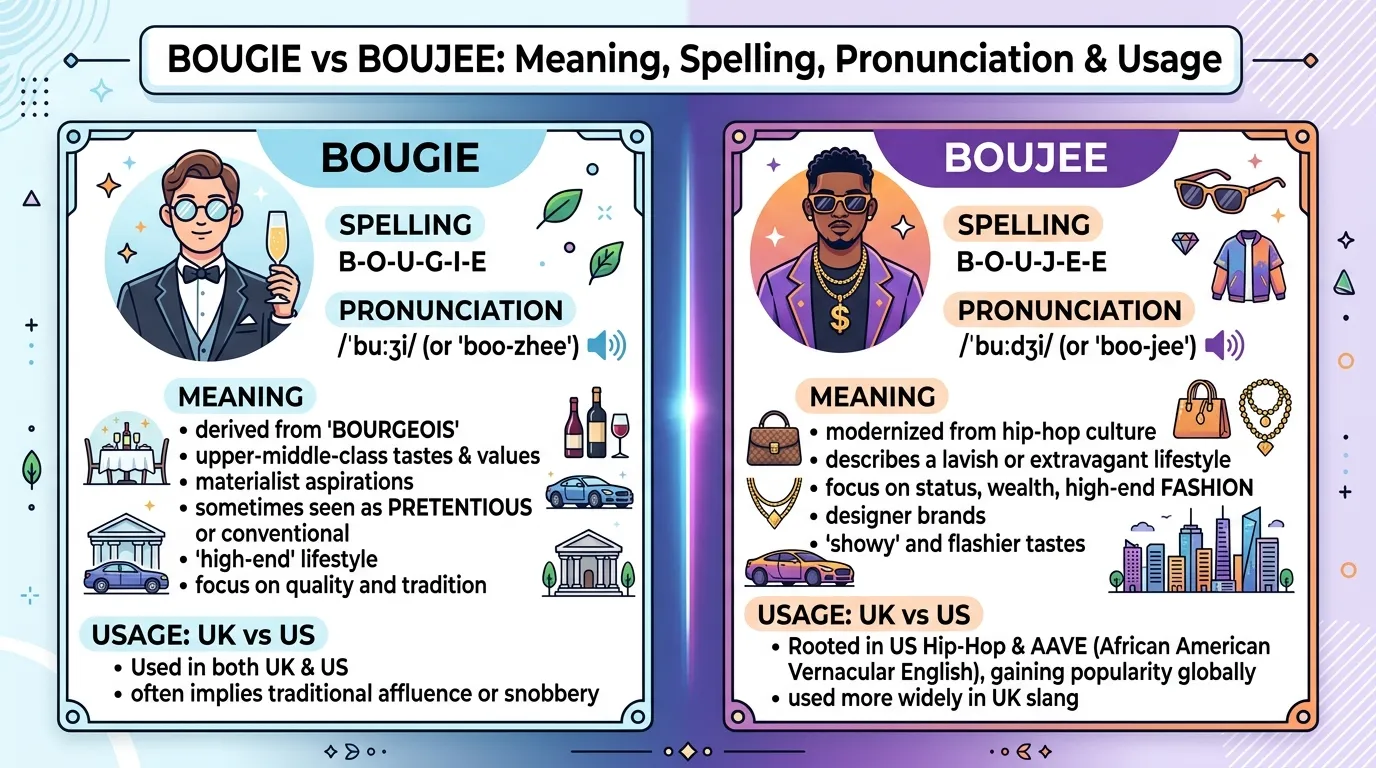
If you have seen bougie and boujee online, you may wonder which spelling is correct. The short answer is that both bougie and boujee are used, but bougie is the more established dictionary spelling, while boujee is a popular informal variant, especially in social media, music, and modern slang.
The bougie vs boujee difference is therefore not as simple as right versus wrong. Both words usually describe someone or something that seems fancy, upscale, luxurious, or concerned with appearing wealthy or sophisticated. However, the spelling can affect how the word feels.
In US English, bougie and boujee are common in casual speech and online writing. In UK English, bougie is also understood, although words such as posh, fancy, high-end, or luxurious may sound more natural in many situations.
Understanding the bougie vs boujee distinction can help you choose the right word for a text, social media post, conversation, or professional setting.
Quick Answer: Bougie or Boujee?
- ✅ Bougie — established and widely recognized spelling
- ✅ Boujee — accepted informal variant, especially in slang and pop culture
- ❌ Bougie is not the only possible spelling
- ❌ Boujee is not simply a spelling mistake
- ⚠️ In formal writing, it is usually better to use luxurious, upscale, pretentious, elegant, or sophisticated, depending on the meaning.
So, which one should you use?
For general slang writing, bougie is the safer choice.
Use boujee when you want a more playful, modern, internet-friendly, or pop-culture style.
What Does Bougie Mean?
Bougie is an informal adjective or noun used to describe someone or something associated with luxury, wealth, expensive tastes, or an upscale lifestyle.
Depending on context, the word can be positive, neutral, or slightly mocking.
For example:
- She loves bougie restaurants.
- That hotel is so bougie.
- He has become a little bougie since moving to the city.
- I want a bougie coffee before work.
The bougie meaning often depends on the speaker’s attitude.
Calling a restaurant bougie might mean that it is beautifully designed and expensive. It might also suggest that the restaurant is overly fancy or pretentious.
Bougie as an adjective
As an adjective, bougie describes a person, place, thing, or experience.
Examples:
- a bougie apartment
- a bougie restaurant
- a bougie neighborhood
- a bougie vacation
- a bougie hotel
Bougie as a noun
Less commonly, bougie can refer to a person who behaves in a sophisticated, wealthy, or status-conscious way.
For example:
- She is such a bougie.
- He acts like a bougie now.
However, this noun use is less natural for many speakers than using bougie as an adjective.
What Does Boujee Mean?
Boujee is a popular informal spelling of bougie.
It has essentially the same core meaning: fancy, luxurious, upscale, stylish, or concerned with wealth and status.
The spelling boujee became especially visible through hip-hop and popular culture, including the 2016 song Bad and Boujee by Migos.
Examples include:
- Her new apartment is so boujee.
- We went to a boujee brunch place.
- He bought a boujee car.
- This hotel looks really boujee.
The extra e gives the word a more deliberately slangy and playful appearance.
Bougie vs Boujee: Grammar Difference
There is little grammatical difference between bougie and boujee because they normally perform the same role.
Both are mainly used as adjectives.
| Feature | Bougie | Boujee |
|---|---|---|
| Main part of speech | Adjective | Adjective |
| Meaning | Fancy, upscale, luxurious, sometimes pretentious | Same basic meaning |
| Style | Informal slang | Very informal slang |
| Standard spelling | More established | Informal variant |
| Common online | Yes | Yes |
| Social media | Yes | Very common |
| Formal writing | Usually avoid | Usually avoid |
| UK English | Understood | Understood, but less traditional |
| US English | Very common | Very common |
| Tone | Casual, sometimes ironic | Casual, playful, slangy |
Neither spelling changes the basic grammar of the sentence.
You can say:
That restaurant is bougie.
or:
That restaurant is boujee.
The meaning is nearly identical.
Bougie vs Boujee Pronunciation
Both spellings are generally pronounced the same way.
Bougie
IPA: /ˈbuːʒi/
It sounds roughly like:
BOO-zhee
Boujee
IPA: /ˈbuːʒi/
It is also commonly pronounced:
BOO-zhee
The j sound is like the sound in vision or the middle sound of measure, rather than the hard J in jump.
Why are they so confusing?
English spelling is one reason.
The pronunciation does not clearly tell you whether the word should end in -gie or -jee. Because boujee looks more phonetic to many English speakers, it became an attractive slang spelling.
Music and social media also helped spread boujee as a separate-looking form.
Bougie vs Boujee: Word Origins and Etymology
The history of bougie goes back to the French word bourgeois, meaning a member of the middle class or a person associated with the middle class.
Over time, bourgeois developed social and cultural meanings connected with material comfort, conventional respectability, wealth, and status.
English speakers later shortened and reshaped the word into bougie as slang.
So the modern slang meaning is connected to the idea of someone enjoying expensive or sophisticated things.
Where did boujee come from?
Boujee is best understood as a stylized slang spelling of bougie rather than a completely separate word with a separate basic meaning.
Its popularity grew through African American English, hip-hop culture, music, and internet culture.
The Migos song Bad and Boujee, released in 2016, played a major role in making boujee widely recognizable.
The spelling does not necessarily mean something different from bougie. Instead, it can signal a more playful or pop-culture tone.
Bougie vs Boujee Examples in American English
Here are natural bougie examples in US English:
- That new restaurant is really bougie.
- She loves bougie coffee shops.
- We stayed at a bougie hotel downtown.
- His apartment looks pretty bougie.
- They had a bougie wedding with a huge floral display.
- I bought some candles because I wanted my apartment to feel more bougie.
- That brunch place is expensive but very bougie.
- She has a bougie taste in furniture.
- Their vacation looked incredibly bougie.
- I am feeling bougie today, so let’s order dessert.
The word is especially common in casual conversations, texts, memes, captions, and social media.
Bougie vs Boujee Examples in British English
British speakers can understand and use bougie, especially because American slang spreads quickly through music and social media.
However, posh is often a more natural British alternative.
Examples:
- That restaurant is a bit bougie.
- She likes bougie cafés in London.
- Their hotel was incredibly bougie.
- He has quite a bougie taste in clothes.
- We found a bougie little restaurant near the station.
- That neighborhood has a very bougie feel.
- The wedding looked rather bougie.
- Their new flat is surprisingly bougie.
- She loves expensive, bougie skincare products.
- That place is too bougie for me.
A British speaker might instead say:
- That restaurant is very posh.
- They stayed in a luxurious hotel.
- That’s a rather fancy café.
Ten Bougie Examples in a Sentence: American English
Here are additional examples showing the correct usage naturally:
- My sister wants a bougie birthday dinner.
- This grocery store feels surprisingly bougie.
- That coffee machine looks bougie.
- Their new house has a very bougie kitchen.
- I cannot afford that bougie gym membership.
- He ordered the most bougie item on the menu.
- This neighborhood has become pretty bougie.
- She gave us a bougie gift basket.
- We found a bougie rooftop bar downtown.
- My friend loves anything that looks expensive and bougie.
Ten Bougie Examples in a Sentence: British English
In UK English, the word can be used in much the same way:
- That hotel looks rather bougie.
- We found a lovely but slightly bougie café.
- Her new flat is very bougie.
- He has a fairly bougie taste in clothing.
- That restaurant feels too bougie for me.
- They booked a bougie weekend away.
- She bought some bougie candles for the sitting room.
- The new development looks quite bougie.
- Their wedding was beautiful but a little bougie.
- He enjoys going to bougie restaurants in central London.
Again, posh, fancy, and upmarket may sound more traditionally British.
When Should You Use Bougie?
Use bougie when you want an informal word for something that feels:
- luxurious
- expensive
- upscale
- stylish
- sophisticated
- status-conscious
- slightly pretentious
The word can be complimentary:
This hotel is so bougie!
It can also be teasing:
You are getting bougie now!
Or critical:
That restaurant is too bougie for me.
Context matters.
When Should You Use Boujee?
Use boujee when you want the same basic meaning but a more playful, trendy, or slang-heavy tone.
It works well in:
- TikTok captions
- Instagram posts
- text messages
- memes
- casual conversations
- humorous comments
- music-related language
For example:
Feeling boujee tonight ✨
In a formal business report, however, neither bougie nor boujee would usually be the best choice.
Why Is Boujee Sometimes Called Incorrect?
You may see people claim that boujee is wrong.
That is too simple.
Boujee is widely used as an informal variant, so calling it an ordinary spelling error is misleading. At the same time, bougie has stronger dictionary and historical grounding as the established form.
Therefore, if your goal is standard-looking English, bougie is usually the better choice.
If your goal is modern slang, boujee can be perfectly appropriate.
Incorrect assumption
❌ Boujee is always a spelling mistake.
Better explanation
✅ Boujee is a slang variant of bougie and is common in popular culture.
Common Mistakes With Bougie and Boujee
Mistake 1: Treating boujee as a completely different word
❌ Bougie means expensive, but boujee means stylish.
✅ Both can describe something fancy, upscale, or luxurious.
The difference is mainly spelling and tone.
Mistake 2: Using bougie in formal academic writing
❌ The university has a bougie educational environment.
✅ The university has a sophisticated educational environment.
Bougie is slang, so a formal synonym is often better.
Mistake 3: Assuming boujee is always misspelled
❌ She spelled boujee incorrectly.
✅ She used the informal variant boujee.
Mistake 4: Confusing bougie with beautiful
Bougie does not simply mean beautiful.
A thing can be beautiful without being bougie.
Mistake 5: Thinking bougie always means rich
The word often suggests wealth or expensive tastes, but it can also describe someone who acts as though they enjoy luxury.
Mistake 6: Using bougie as a verb
❌ I bougied my apartment.
There is no standard verb bougie in this slang sense.
Instead, say:
✅ I made my apartment look more luxurious.
Mistake 7: Assuming the word is always positive
Calling someone bougie can be praise, teasing, or criticism.
Your new kitchen is bougie!
may be positive.
But:
You’re too bougie for this place.
may be critical.
Bougie Synonyms
The best bougie synonym depends on what you mean.
| Synonym | Meaning | US English | UK English |
|---|---|---|---|
| Fancy | Attractive or expensive | Very common | Very common |
| Upscale | High quality and expensive | Very common | Common |
| Luxurious | Very comfortable and expensive | Common | Common |
| Posh | Stylish and expensive | Understood | Very common |
| High-end | Expensive and premium | Very common | Common |
| Sophisticated | Refined or cultured | Common | Common |
| Pretentious | Trying too hard to appear important | Common | Common |
| Upmarket | Expensive or premium | Less common | Very common |
| Swanky | Stylish and impressive | Common | Common |
Notice that bougie does not always equal pretentious. Pretentious has a stronger negative meaning.
UK vs US English: Is Bougie Different?
There is no major difference in the core slang meaning between UK and US English.
However, frequency and alternatives can differ.
In American English, you are likely to encounter:
That place is so bougie.
In British English, you may hear:
That place is so posh.
or:
That’s a bit upmarket.
Social media has made bougie familiar to many British speakers, but posh remains a very natural British choice.
So the main UK vs US English difference is not grammar. It is often a matter of preference and frequency.
Bougie in Real-Life Situations
Emails
Informal:
The new office café is pretty bougie, but the coffee is excellent.
Formal:
The new office café has a more upscale design.
Offices
The new meeting room looks so bougie.
This works among coworkers in a casual setting.
Banking
That bank’s new branch looks really bougie.
For formal financial writing, use modern, premium, or upscale instead.
Invoices
You normally would not write:
❌ Bougie office furniture — $4,000
A professional invoice should use a precise description such as:
✅ Premium office furniture — $4,000
Schools
Students may say:
Our school cafeteria looks bougie now.
In an academic essay, modern or high-end would usually be better.
Social media
My little bougie breakfast ✨☕🥐
This is a very natural informal use.
Rent payments
My new apartment is kind of bougie, but the rent is expensive.
This sounds natural in casual conversation.
Everyday conversation
Let’s go somewhere less bougie.
This means the speaker wants a place that feels less fancy or expensive.
Bougie vs Related Expressions
These words overlap, but they are not identical.
Bougie vs Posh
Posh strongly suggests expensive, stylish, or upper-class surroundings. It is especially common in British English.
Bougie is more slangy and can be humorous or critical.
Bougie vs Fancy
Fancy is broader.
A fancy dress, for example, does not have to be expensive. Bougie more often suggests luxury, money, or status.
Bougie vs Luxurious
Luxurious is more formal and strongly positive.
Bougie can be positive, neutral, or mocking.
Bougie vs Pretentious
Pretentious is usually negative. It suggests someone is trying too hard to seem sophisticated or important.
Bougie can imply pretentiousness, but it does not always do so.
The Grammar Rule Behind Bougie
The simplest grammar rule is this:
Bougie and boujee are mainly adjectives.
An adjective describes a noun.
Examples:
- bougie restaurant
- bougie hotel
- bougie apartment
- bougie lifestyle
They can also appear after a linking verb:
The restaurant is bougie.
Her new apartment looks bougie.
There are no normal verb forms such as bougied, bougieing, or boujeed in standard English.
Because this is slang, usage can vary online. However, beginners should treat bougie and boujee as adjectives.
Five Memory Tricks for Bougie vs Boujee
Remember the French connection
Think:
bourgeois → bougie
This helps you remember the established spelling.
Think of boujee as the playful version
The extra e can remind you that boujee is the more playful slang spelling.
Use bougie for safer general writing
When unsure, choose bougie.
Think BOO-zhee
Both are commonly pronounced BOO-zhee, so do not try to pronounce boujee like boo-jee with a hard J.
Remember the tone
Bougie = established slang
Boujee = playful slang variant
That simple contrast works well for everyday writing.
Is Bougie Appropriate in Formal Writing?
Usually, no.
Although bougie is established slang, it is still informal.
In a formal report, academic essay, business document, or professional presentation, consider:
- luxurious
- upscale
- premium
- sophisticated
- high-end
- expensive
- elegant
- refined
Choose the word that matches your exact meaning.
For example:
Informal:
The hotel is really bougie.
Formal:
The hotel offers a luxurious and upscale experience.
Frequently Asked Questions
Is bougie or boujee correct?
Both are used. Bougie is the more established spelling, while boujee is a popular informal variant.
What does bougie mean in slang?
It usually means fancy, luxurious, upscale, expensive, or concerned with appearing sophisticated or wealthy.
What does boujee mean?
Boujee generally means the same thing as bougie. It is a popular slang spelling associated strongly with modern pop culture.
Is boujee in the dictionary?
Dictionary treatment varies by source and edition. Some dictionaries recognize bougie, while boujee may be treated as a variant or slang form. Dictionary coverage can change as slang becomes established.
How do you pronounce bougie?
It is commonly pronounced /ˈbuːʒi/, roughly BOO-zhee.
How do you pronounce boujee?
It is generally pronounced the same way: /ˈbuːʒi/.
Is bougie British or American?
The slang is widely used in American English and is also understood in British English. British speakers often have alternatives such as posh and upmarket.
Is bougie a bad word?
No. It is not inherently offensive. However, it can sound mocking or judgmental depending on how it is used.
Is bougie formal English?
No. It is best treated as informal slang.
What is the best bougie synonym?
Depending on context, good alternatives include fancy, upscale, luxurious, high-end, sophisticated, posh, and upmarket.
People Also Ask
Is bougie the same as boujee?
Yes, in most modern slang contexts. Both describe something fancy, upscale, luxurious, or associated with wealth and status.
Which spelling is more correct, bougie or boujee?
Bougie is generally the safer and more established spelling. Boujee is a widely used informal variant.
Why do people spell bougie as boujee?
The spelling boujee developed as a playful, phonetic-looking slang form and became especially popular through music and internet culture.
Does bougie mean rich?
Not exactly. It can suggest wealth, expensive tastes, or an interest in luxury, but a person does not need to be rich to be called bougie.
What is the opposite of bougie?
Depending on context, possible opposites include simple, modest, casual, basic, inexpensive, or low-key.
Can you use bougie in a professional email?
You can use it in a very casual workplace if you know your audience. In formal professional writing, upscale, premium, luxurious, or high-end is usually better.
Is bougie a compliment?
It can be. Someone may use bougie to praise an elegant lifestyle or tease someone for enjoying expensive things.
Is boujee slang?
Yes. Boujee is strongly associated with informal slang and popular culture.
Final Thoughts
The bougie vs boujee debate is mostly about spelling, style, and tone rather than two completely different meanings. Bougie is the more established form and is usually the safest choice when you want recognized slang. Boujee is a popular, playful variant that became especially prominent through hip-hop, music, and social media.
Both can describe something fancy, upscale, luxurious, expensive, or status-conscious. Neither should normally be treated as formal vocabulary.
For everyday American English, bougie works well in casual conversations, texts, captions, and social media. In British English, it is understood, but posh, fancy, and upmarket may sound more natural in many contexts.
If you are writing formally, skip both and choose a precise word such as luxurious, sophisticated, premium, upscale, or high-end.
So, when in doubt, remember: bougie is the established spelling; boujee is the playful slang variant. Both are useful when the tone is casual and the context calls for it.


