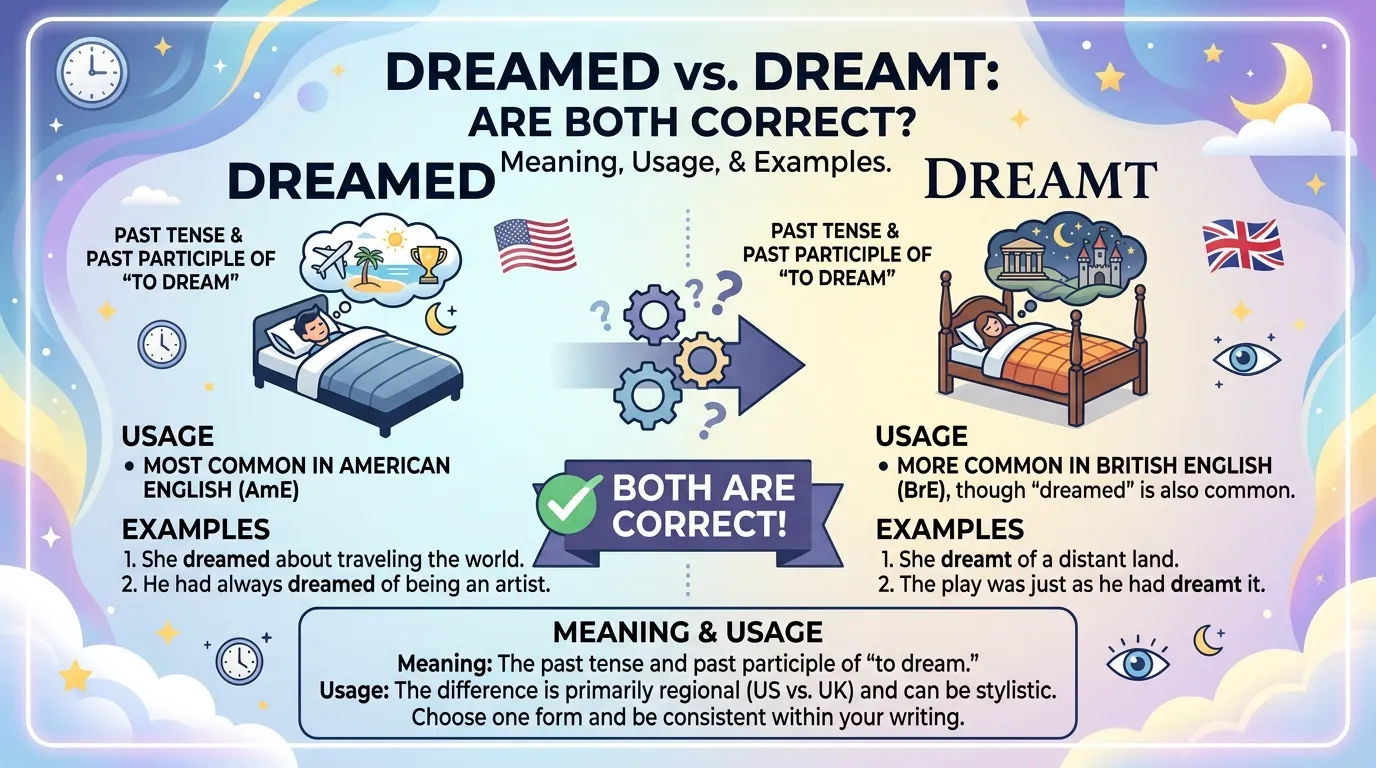
Have you ever wondered whether dreamed vs dreamt is the correct way to describe something you imagined while sleeping? The good news is that both dreamed and dreamt are correct forms of the verb dream. The main difference is regional and stylistic. Dreamed is more common in American English, while dreamt is especially common in British English and other varieties of English. However, British speakers also use dreamed, and American speakers may understand and occasionally use dreamt.
This is why dreamed vs dreamt can be confusing. Both words describe the past of dream, and both can be used as a past tense or past participle. The choice often depends on where you are, the style you prefer, and the type of writing you are doing.
So, if you are learning English, writing an email, preparing an essay, or checking a sentence, you do not need to worry about one form being completely wrong. Understanding the grammar difference and the UK vs US English preference will help you choose the most natural form.
Quick Answer
| Form | Correct? | Common usage |
|---|---|---|
| dreamed | ✓ Correct | More common in American English |
| dreamt | ✓ Correct | More common in British English |
| dreamed in British English | ✓ Correct | Also widely used |
| dreamt in American English | ✓ Correct | Less common but understood |
Quick rule: Use dreamed if you want the safest and most common choice for American English. Use dreamt if you are writing in British English and want the traditional British form.
There is no incorrect form between dreamed and dreamt.
What Does Dreamed Mean?
Dreamed is the simple past tense and past participle of the verb dream.
The verb dream means to experience thoughts, images, or feelings while sleeping. It can also mean to imagine or hope for something while awake.
For example:
- I dreamed about my childhood.
- She dreamed that she was flying.
- We have dreamed of owning a house.
- He dreamed about becoming a doctor.
The word can describe both literal sleep experiences and figurative hopes.
Grammatical role
Dreamed can work as:
- A simple past verb: I dreamed last night.
- A past participle: I have dreamed about this before.
The basic forms are:
| Verb form | Example |
|---|---|
| Base form | dream |
| Present | dream / dreams |
| Past | dreamed |
| Past participle | dreamed |
| Present participle | dreaming |
In American English, dreamed is generally the more common form.
What Does Dreamt Mean?
Dreamt is also a correct past tense and past participle of dream.
It has the same basic meaning as dreamed.
For example:
- I dreamt about the ocean.
- She dreamt she was back at school.
- They had dreamt of traveling abroad.
The main difference is not meaning. It is mostly usage and regional preference.
Dreamt is particularly common in British English. It also appears in Australian, New Zealand, and other varieties of English influenced by British usage.
The verb forms can be shown like this:
| Verb form | Example |
|---|---|
| Base form | dream |
| Present | dream / dreams |
| Past | dreamt |
| Past participle | dreamt |
| Present participle | dreaming |
Dreamed vs Dreamt: Main Difference
The biggest difference between the two forms is regional preference, not grammar or meaning.
| Feature | Dreamed | Dreamt |
|---|---|---|
| Meaning | Past of dream | Past of dream |
| Grammar | Past tense and past participle | Past tense and past participle |
| American English | Very common | Less common |
| British English | Common | Very common |
| Formal writing | Correct | Correct |
| Informal writing | Correct | Correct |
| Meaning difference | Usually none | Usually none |
| Pronunciation | /driːmd/ | /drɛmt/ |
| Related verb | dream | dream |
Therefore, the correct usage depends more on your variety of English than on a strict grammar rule.
Dreamed vs Dreamt Examples in American English
American English generally favors dreamed, especially in everyday speech and writing.
Here are examples:
- I dreamed about my old school last night.
- She dreamed that she was walking through a forest.
- He dreamed of becoming a professional musician.
- We dreamed about taking a long vacation.
- They dreamed about buying their first home.
- I dreamed that I won the competition.
- My brother dreamed about flying.
- She has dreamed of visiting Europe for years.
- I never dreamed that I would get the job.
- He dreamed about his childhood friends.
In American English, these sentences sound completely natural.
Dreamed vs Dreamt Examples in British English
British English often prefers dreamt, especially when referring to dreams during sleep.
Examples include:
- I dreamt about my old school last night.
- She dreamt that she was walking through a forest.
- He dreamt of becoming a professional musician.
- We dreamt about taking a long holiday.
- They dreamt about buying their first home.
- I dreamt that I won the competition.
- My brother dreamt about flying.
- She has dreamt of visiting Europe for years.
- I never dreamt that I would get the job.
- He dreamt about his childhood friends.
However, dreamed is not wrong in British English. You may see both forms in British books, newspapers, websites, and everyday communication.
Is Dreamed Wrong?
No. Dreamed is not wrong.
It is a standard English word and a regular past form of dream.
For example:
I dreamed about you last night.
This sentence is grammatically correct.
Likewise:
I dreamt about you last night.
is also grammatically correct.
The difference is mainly one of style and regional usage.
If you are writing for an American audience, dreamed will usually sound more natural. If you are writing for a British audience, dreamt may sound more natural.
Is Dreamt Wrong?
No. Dreamt is also correct.
Some learners mistakenly believe that dreamt is an old-fashioned or incorrect spelling. It is neither.
It is a legitimate irregular past form of the verb dream.
For example:
I dreamt about the sea.
is correct.
The form may sound less familiar to American readers, but that does not make it grammatically wrong.
Incorrect and Correct Examples
Because both forms are correct, the common mistake is usually not choosing one over the other. Instead, learners sometimes create incorrect forms.
| Incorrect | Correct |
|---|---|
| I dream last night. | I dreamed last night. |
| I dreamt last night about it. | I dreamt about it last night. |
| She has dream yesterday. | She dreamed yesterday. |
| He have dreamed about it. | He has dreamed about it. |
| I am dreamt about flying. | I am dreaming about flying. |
| They dreams about success. | They dream about success. |
| She dreaming last night. | She dreamed last night. |
Remember that dreamed and dreamt are both correct past forms. The important point is choosing the correct verb form for the sentence.
Pronunciation: Dreamed vs Dreamt
The two words are pronounced differently.
Dreamed
IPA: /driːmd/
It sounds roughly like:
dreemd
The ending is pronounced with a /d/ sound.
Dreamt
IPA: /drɛmt/
It sounds roughly like:
dremt
The ending contains a /t/ sound.
Why are they confused?
They are confused because they come from the same verb and have the same basic meaning.
Learners may also expect English verbs to follow one fixed past-tense pattern. But English contains many verbs with more than one accepted past form.
For example:
- learned / learnt
- burned / burnt
- dreamed / dreamt
- smelled / smelt
- spelled / spelt
This pattern is one reason dreamed vs dreamt causes uncertainty.
Word Origins and Etymology
The English verb dream has a long history.
The modern word developed from Old English drēam, which referred to joy, music, or delight. Over time, the meaning shifted toward the experience of visions or thoughts during sleep.
The verb became associated with the sleeping experience in Middle English.
The two past forms developed through different grammatical patterns.
Dreamed follows the regular English pattern:
dream + ed = dreamed
Dreamt developed as a shorter irregular form, similar to other verbs that developed contracted past forms.
English has preserved both forms. As English spread into different regions, their popularity also varied.
American English gradually favored regular forms such as dreamed, while British English retained stronger use of forms such as dreamt.
Today, both remain standard.
Dreamed vs Dreamt Synonyms
There is no perfect dreamed vs dreamt synonym because the best alternative depends on the meaning.
| Word or expression | Meaning | Example |
|---|---|---|
| imagined | Created an idea in your mind | I imagined a different life. |
| envisioned | Imagined a future situation | She envisioned a successful career. |
| fantasized | Imagined something unlikely | He fantasized about becoming famous. |
| hoped | Wanted something to happen | We hoped for better results. |
| wished | Wanted something strongly | She wished for a peaceful life. |
| aspired | Wanted to achieve something | He aspired to become a writer. |
| pictured | Formed a mental image | I pictured myself living there. |
For a sleep experience, however, dreamed or dreamt is usually the best choice.
For a goal or ambition, dreamed of, hoped for, aspired to, or envisioned may be more precise.
Seven Common Mistakes With Dreamed and Dreamt
Using dream as the past tense
Incorrect: I dream about it last night.
Correct: I dreamed about it last night.
Or:
Correct: I dreamt about it last night.
The time expression last night requires a past form.
Assuming dreamt is incorrect
Incorrect idea: Dreamt is not a real English word.
Correction: Dreamt is a standard English past form.
Assuming dreamed is only American
This is also too simple.
British speakers use dreamed too. It is simply less strongly preferred than dreamt in many British contexts.
Mixing present and past forms
Incorrect: She dream yesterday.
Correct: She dreamed yesterday.
Using dreaming after have
Incorrect: I have dreaming about this.
Correct: I have dreamed about this.
After have, use the past participle.
Using dreamed after am
Incorrect: I am dreamed about flying.
Correct: I am dreaming about flying.
After am, the present participle dreaming is normally needed for the progressive form.
Changing forms without considering your audience
If you are writing American English, using dreamed consistently may create a smoother style.
If you are writing British English, dreamt may fit the regional style better.
Real-Life Examples
Emails
American English:
I dreamed about the project after our meeting.
British English:
I dreamt about the project after our meeting.
Offices
I never dreamed I would get this promotion.
I never dreamt I would get this promotion.
Both are correct.
Banking
I dreamed of saving enough money to buy my first home.
Invoices
The word is less common in financial documents, but it can appear in a personal or business story:
We dreamed of building a company that could serve small businesses.
Schools
I dreamed of becoming a teacher when I was young.
Social media
I dreamed I was back in high school last night!
A British speaker might write:
I dreamt I was back in school last night!
Rent payments
I dreamed of the day I could finally afford my own apartment.
Everyday conversation
I dreamed about my grandparents last night.
Or:
I dreamt about my grandparents last night.
Both work.
Ten Dreamed Examples for American English
- I dreamed about the beach last night.
- She dreamed that she could fly.
- We dreamed of owning a small house.
- He dreamed about becoming a doctor.
- I never dreamed this would happen.
- They dreamed of traveling around the world.
- She has dreamed about this opportunity for years.
- I dreamed about my childhood yesterday.
- He dreamed of starting his own business.
- We dreamed that we had won the lottery.
Ten Dreamt Examples for British English
- I dreamt about the beach last night.
- She dreamt that she could fly.
- We dreamt of owning a small house.
- He dreamt about becoming a doctor.
- I never dreamt this would happen.
- They dreamt of travelling around the world.
- She has dreamt about this opportunity for years.
- I dreamt about my childhood yesterday.
- He dreamt of starting his own business.
- We dreamt that we had won the lottery.
Grammar Rule Behind Dreamed and Dreamt
The easiest grammar rule is this:
Dreamed and dreamt are both past forms of dream.
You can use either one when talking about something that happened in the past.
Simple past
I dreamed last night.
I dreamt last night.
Past participle
After have, has, or had, either form can be used.
I have dreamed about this.
I have dreamt about this.
She had dreamed of success.
She had dreamt of success.
Present participle
Neither dreamed nor dreamt is used here.
Use dreaming:
I am dreaming about the future.
This is an important distinction for beginners.
Parts of Speech and Related Forms
Dream is primarily a verb when it describes an action or mental experience.
It can also be a noun.
Verb
I dreamed about my family.
Noun
I had a strange dream.
Adjective forms
There is no common adjective formed directly by changing dreamed or dreamt.
However, related expressions include:
- dreamlike
- dreamy
- dream-filled
For example:
The landscape had a dreamlike quality.
Dreamed vs Dreamt Compared With Related Expressions
These expressions are related but not identical.
Dreamed of
Usually means wanted or imagined achieving something.
She dreamed of becoming a writer.
Dreamed about
Usually refers to the content of a sleeping dream.
I dreamed about my old house.
However, native speakers can use both of and about in broader ways, so context matters.
Dreamed that
Introduces the situation experienced in a dream.
I dreamed that I was flying.
Had a dream
This is a very common alternative.
I had a strange dream last night.
Five Memory Tricks
Remember the American preference
Think:
America → dreamed
The regular -ed ending is very common in American English.
Remember the British preference
Think:
Britain → dreamt
This can help you remember the common British form.
Both belong to dream
Think:
dream → dreamed / dreamt
You do not have to memorize them as completely different words.
Think of learned and learnt
If you already know that learned and learnt can both be correct, remember that dreamed and dreamt work in a similar way.
Use the audience rule
Ask:
Who am I writing for?
For US readers, dreamed is usually the safest choice.
For UK readers, dreamt is often the more natural choice.
Dreamed vs Dreamt in Formal and Informal English
Both forms can appear in formal and informal writing.
Formal
The company had dreamed of expanding into international markets.
Informal
I dreamed I was late for work!
British English can use dreamt in both settings:
The company had dreamt of expanding internationally.
So this is not a formal versus informal distinction.
It is mainly a regional and stylistic distinction.
Which Form Should ESL Learners Use?
If you are an ESL learner and need one form to remember first, dreamed is a practical choice because it is regular and especially common in American English.
However, you should recognize dreamt when reading British English.
Do not assume that one is a mistake.
For exams, academic writing, or professional work, follow the variety of English requested by your teacher, employer, client, or style guide.
The most important rule is consistency.
FAQs About Dreamed vs Dreamt
Is dreamed or dreamt correct?
Both are correct. Dreamed is more common in American English, while dreamt is especially common in British English.
What is the meaning of dreamed?
Dreamed is the past tense and past participle of dream. It can describe a sleeping experience or an imagined goal.
What is the meaning of dreamt?
Dreamt has the same basic meaning as dreamed. It is another accepted past form of dream.
Is dreamt British or American?
Dreamt is strongly associated with British English, although it is understood in American English and can occasionally be used there.
Is dreamed used in British English?
Yes. British speakers use dreamed too. Dreamt is simply a common traditional alternative.
What is the pronunciation of dreamed?
Dreamed is pronounced /driːmd/.
What is the pronunciation of dreamt?
Dreamt is pronounced /drɛmt/.
Which is better: dreamed or dreamt?
Neither is universally better. Choose according to your audience and preferred variety of English.
Can I use dreamt in American English?
Yes. American readers will understand dreamt, although dreamed is generally more natural in American English.
Is dreamt formal?
Dreamt is not specifically formal. It can be used in both casual and formal writing.
People Also Ask
Is dreamt a real word?
Yes. Dreamt is a standard English word and an accepted past tense and past participle of dream.
Do Americans say dreamed or dreamt?
Americans generally use dreamed more often. Dreamt is still understood and is not grammatically wrong.
Do British people say dreamed?
Yes. British speakers use both forms, although dreamt is often more characteristic of British usage.
Which is more common, dreamed or dreamt?
Usage varies by region. Dreamed is generally more common in American English, while dreamt is especially common in British English.
Can I say I have dreamt?
Yes.
I have dreamt about this before.
This is grammatically correct.
Can I say I have dreamed?
Yes.
I have dreamed about this before.
This is also correct.
Final Verdict
The answer to dreamed vs dreamt is simple: both forms are correct.
Dreamed is the regular past tense and past participle of dream, and it is especially common in American English. Dreamt is an accepted alternative that is particularly common in British English.
Neither word is inherently more grammatical than the other. The main grammar difference is not a difference in grammatical function. Both can function as the past tense and past participle.
For US English, choose dreamed when you want the most natural everyday form. For UK English, dreamt is often a natural choice, but dreamed is still perfectly acceptable.
The key is to understand your audience, use the correct verb form, and stay consistent. Once you remember that dreamed and dreamt are both correct, this common English question becomes much easier. Whether you write I dreamed about it or I dreamt about it, your sentence can be completely correct.


