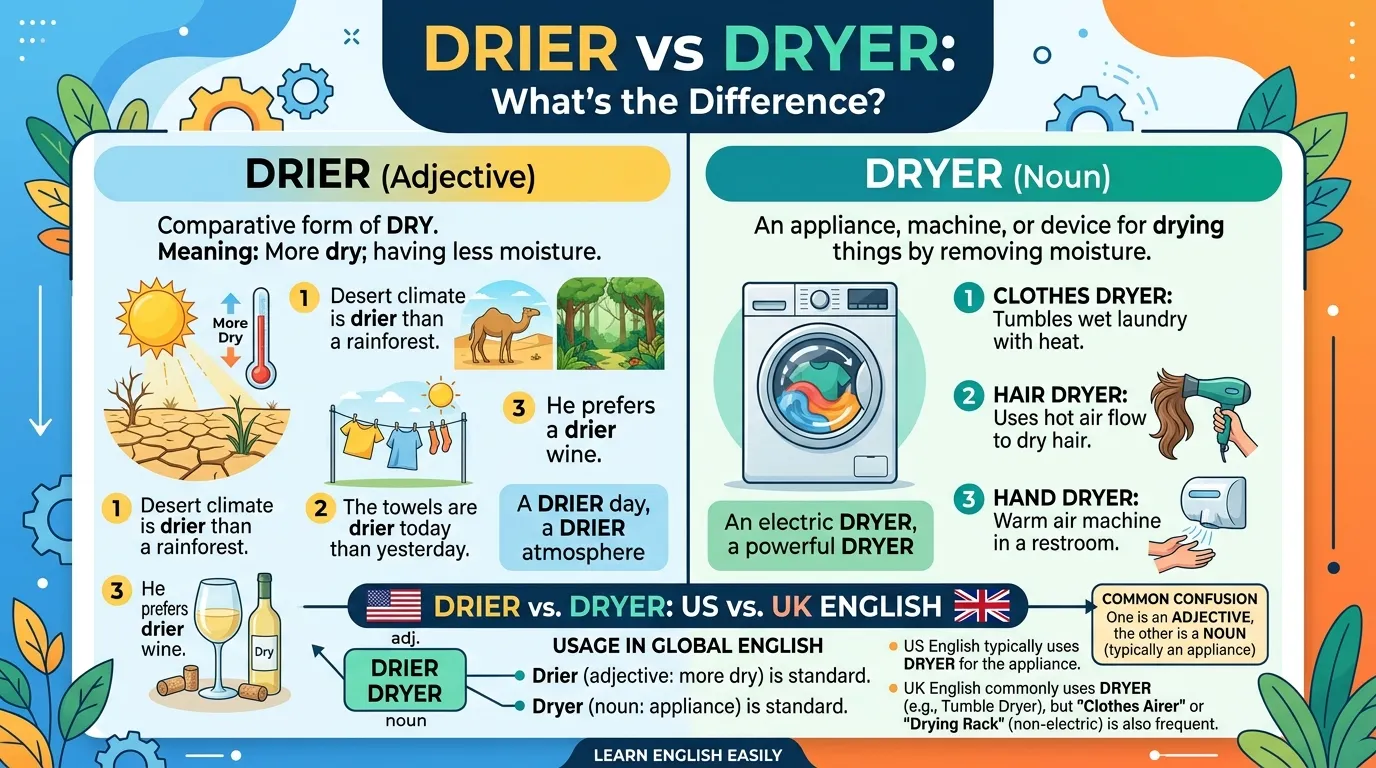
If you have ever wondered about drier vs dryer, you are not alone. These two words look almost identical, sound the same in many accents, and both are connected to the word dry. However, they do not always have the same grammatical job. The main difference is simple: drier is normally the comparative form of dry, while dryer is most commonly a noun for a machine or device that dries something. For example, “Today is drier than yesterday” uses drier as an adjective. “Put the clothes in the dryer” uses dryer as a noun.
There is also an important point about UK vs US English. In both varieties, drier is standard for the comparative adjective. For a drying machine, dryer is very common in American English, while British English commonly uses dryer too, especially in modern dictionaries, although drier is also accepted. Cambridge and Oxford list drier as an alternative noun spelling for dryer.
So, the answer depends on what you mean. Let’s make the drier vs dryer grammar difference easy to remember.
Quick Answer: Drier vs Dryer
Here is the easiest rule:
- ✅ Drier = more dry; the comparative form of dry
- ✅ Dryer = a machine or device that dries something
- ✅ Drier = can also mean a drying machine, because it is an accepted noun variant
- ❌ Dryer = usually not the comparative adjective of dry
Quick examples
- ✅ “The air is drier today.”
- ❌ “The air is dryer today.” (Not the usual standard choice when comparing dryness.)
- ✅ “I put my clothes in the dryer.”
- ✅ “I put my clothes in the drier.” (Correct, but less common in many contexts.)
Merriam-Webster lists drier as the comparative of dry and also lists dryer as a variant spelling of the noun drier.
What Does Drier Mean?
Drier is mainly the comparative form of the adjective dry.
The basic pattern is:
dry → drier → driest
- dry = having little or no moisture
- drier = having less moisture than something else
- driest = having the least moisture among three or more things
Grammatical role
In this use, drier is an adjective.
It describes a noun:
- a drier climate
- drier weather
- drier soil
- drier conditions
- drier clothes
It can also appear after a linking verb:
“The weather is drier this month.”
Why does dry become drier?
The usual spelling rule is to change the final y to i before adding -er:
- dry → drier
- happy → happier
- easy → easier
- busy → busier
This is why drier is the natural comparative spelling.
Drier examples in American English
- “This summer is drier than last summer.”
- “The desert has drier air than the coast.”
- “My skin feels drier in winter.”
- “We need drier soil before planting.”
- “The weather became drier after the storm.”
Drier examples in British English
- “The south of England is often drier than the north.”
- “We need a drier day to paint the fence.”
- “The towels will be drier by this afternoon.”
- “This room feels drier with the heating on.”
- “The garden needs drier conditions for some plants.”
The meaning does not change between American and British English.
What Does Dryer Mean?
Dryer is most commonly a noun. It refers to something that dries another thing.
The most familiar example is a machine that dries clothes.
Examples include:
- clothes dryer
- hair dryer
- hand dryer
- grain dryer
- tumble dryer
Oxford describes dryer as a machine used for drying something and gives examples such as hair dryer and a clothes dryer.
Dryer in a sentence
“I put the wet towels in the dryer.”
Here, dryer is a noun because it names a machine.
Another example:
“The bathroom has a hand dryer.”
Again, dryer names a device.
Why Is Dryer Sometimes Confusing?
The confusion happens because drier and dryer have the same pronunciation in many forms of English.
They also come from the same basic word:
dry + -er
That creates two visually similar words with different common uses.
Compare:
“The climate is drier.”
Here, drier means more dry.
“The clothes are in the dryer.”
Here, dryer means a machine that dries clothes.
The context tells you which meaning is intended.
Drier vs Dryer: Detailed Comparison Table
| Feature | Drier | Dryer |
|---|---|---|
| Main meaning | More dry | A device that dries |
| Common part of speech | Adjective | Noun |
| Basic word | Dry | Dry |
| Grammar | Comparative adjective | Noun |
| Example | “The air is drier.” | “The dryer is broken.” |
| Main use | Comparing dryness | Naming a drying device |
| American English | Standard | Very common |
| British English | Standard | Very common; drier is also accepted as a noun |
| Pronunciation | Usually /ˈdraɪər/ | Usually /ˈdraɪər/ |
| Comparative meaning | Yes | Normally no |
| Machine meaning | Yes, as a noun variant | Yes, very common |
| Typical phrase | drier weather | clothes dryer |
Cambridge specifically lists drier as the comparative of dry and also recognizes drier as a noun meaning dryer.
Drier vs Dryer Pronunciation
The pronunciation is one reason learners find these words difficult.
Drier
IPA: /ˈdraɪər/ or /ˈdraɪ.ə(r)/
It sounds roughly like:
DRY-er
Dryer
IPA: /ˈdraɪər/ or /ˈdraɪ.ər/
It also sounds roughly like:
DRY-er
American English may use a pronunciation such as /ˈdraɪɚ/, while British pronunciation is commonly shown as /ˈdraɪə/.
So, when you hear someone say drier or dryer, you often cannot tell which spelling they mean without context.
Drier vs Dryer: Word Origins and Etymology
Both words are built from the older word dry.
The word dry has very old English roots. Merriam-Webster traces it to Middle English dry and Old English drȳge. The word has been part of English for many centuries.
The ending -er has long been used in English to create:
- comparative adjectives, and
- nouns referring to people or things that perform an action.
That explains the two forms.
Drier as a comparative
dry + -er → drier
The meaning is:
more dry
Dryer as a noun
dry + -er → dryer
The meaning is:
something that dries
Oxford traces dryer to Middle English, with the sense of a person who dries, formed from the verb dry plus -er.
Over time, the noun became strongly associated with machines and devices used for drying.
Is Drier or Dryer Correct?
Both can be correct, but they are not interchangeable in every sentence.
Use drier for comparison
“The climate is drier here.”
You are comparing the climate with another climate or with an earlier condition.
Use dryer for a machine
“The dryer is making a strange noise.”
You are naming a machine.
But drier can also mean a machine
This is an important detail that many simple explanations leave out.
Dictionaries recognize drier as a noun meaning a device that dries. Cambridge and Oxford both list drier as an alternative to dryer.
Still, dryer is often the clearer choice when you mean a household appliance.
Why “Dryer” Is Usually Wrong as the Comparative of Dry
Consider:
❌ “This room is dryer than the other one.”
Many readers will understand the meaning, but drier is the standard comparative form:
✅ “This room is drier than the other one.”
The grammar rule is straightforward.
For many adjectives ending in -y, change y to i and add -er:
- dry → drier
- noisy → noisier
- cloudy → cloudier
- messy → messier
- healthy → healthier
Therefore:
dry → drier
not normally:
dry → dryer
The spelling dryer is already strongly associated with the noun for a drying machine.
Common Mistakes With Drier and Dryer
Mistake 1: Using dryer for “more dry”
❌ “The air is dryer today.”
✅ “The air is drier today.”
Mistake 2: Thinking drier is always wrong
❌ “You can only spell the machine dryer.”
✅ “Drier is also an accepted noun spelling.”
Mistake 3: Confusing the parts of speech
❌ “The dryer climate is better for hiking.”
If you mean “more dry,” use:
✅ “The drier climate is better for hiking.”
Mistake 4: Treating drier and dryer as exact synonyms
They overlap only when drier is used as a noun for a drying device.
As adjectives, they have different grammatical functions.
Mistake 5: Forgetting the comparative rule
❌ dry → dryer
✅ dry → drier
Mistake 6: Writing “most dryer”
❌ “This is the most dryer room.”
✅ “This is the driest room.”
Mistake 7: Using “more drier”
❌ “The weather is more drier.”
✅ “The weather is drier.”
Do not use more + drier. The -er ending already expresses the comparative.
Drier vs Dryer Synonyms
The best drier vs dryer synonym depends on the meaning.
| Word | Meaning | Best use |
|---|---|---|
| less humid | Having less moisture in the air | Weather |
| arider | More dry; very low in moisture | Formal/descriptive writing |
| parched | Extremely dry | Land, plants, people |
| dehydrated | Having lost water | Food, people, materials |
| drying machine | A machine that dries | General explanation |
| clothes dryer | Machine for drying clothes | American English |
| tumble dryer | Clothes-drying machine | British English |
| hairdryer | Device for drying hair | Everyday use |
| hand dryer | Device that dries hands | Public bathrooms |
In American English, clothes dryer is especially common. In British English, tumble dryer is a very familiar term for a clothes-drying machine. Cambridge notes tumble dryer in its British English definition.
Drier vs Dryer in Real-Life Situations
Emails
“The office will be more comfortable during the drier weather.”
But:
“Please check whether the dryer has been repaired.”
Offices
“The air in this office feels drier than before.”
“The hand dryer in the restroom is not working.”
Banking
“Please submit the form on drier paper.”
This would be unusual but grammatically possible if comparing paper moisture.
A banking context could also include:
“The receipt was placed near the document dryer.”
Here, dryer names a device.
Invoices
“The invoice was printed on drier paper than the previous batch.”
“The supplier included a charge for the industrial dryer.”
Schools
“The classroom became drier after the heater was turned on.”
“The science lab has a small dryer for materials.”
Social media
“This year’s summer feels drier than last year.”
“My clothes dryer finally stopped making that weird noise!”
Rent payments
“The apartment feels drier in winter.”
“The landlord replaced the broken dryer.”
Everyday conversations
“Is the laundry drier now?”
“Yes. Put it in the dryer for another ten minutes.”
This short exchange shows both words perfectly.
Drier vs Dryer: 10 American English Examples
- “The desert air is drier than the coastal air.”
- “My hands get drier in cold weather.”
- “The forecast says tomorrow will be drier.”
- “We need drier soil before planting.”
- “This room is much drier than the kitchen.”
- “Please put the towels in the dryer.”
- “The clothes dryer is full.”
- “I need to buy a new hair dryer.”
- “The dryer stopped working yesterday.”
- “Can you empty the dryer when it finishes?”
Drier vs Dryer: 10 British English Examples
- “The weather should be drier tomorrow.”
- “This part of the country is usually drier.”
- “The soil is becoming drier.”
- “My skin feels drier during winter.”
- “We need a drier day to finish the work.”
- “The dryer has finished its cycle.”
- “Put the washing in the tumble dryer.”
- “The hair dryer is in the bathroom.”
- “The drier needs cleaning.” (Accepted noun variant.)
- “The towels should be drier by this evening.”
UK vs US English: Is There a Difference?
There is no major difference in the comparative adjective.
Both American and British English use:
dry → drier → driest
The main variation is in the noun referring to a drying machine.
American English strongly favors dryer, especially in everyday phrases such as:
- clothes dryer
- hair dryer
- electric dryer
British English also commonly uses dryer, but drier is accepted as an alternative noun spelling. Oxford and Cambridge both show this variation.
British English also commonly uses:
tumble dryer
American English more often says:
clothes dryer
So, the UK vs US English difference is mainly about preference and vocabulary, not a strict grammar rule.
Grammar Rule: Drier or Dryer?
Remember these two grammar patterns.
Pattern 1: Comparative adjective
dry + comparative ending → drier
Example:
“The air is drier.”
Here, drier describes the air.
Pattern 2: Noun for a device
dry + -er → dryer
Example:
“The dryer is broken.”
Here, dryer names a machine.
The ending -er can therefore have two different jobs.
That is why context matters.
Drier vs Dryer in Related Expressions
Some related expressions can make the difference clearer.
Dry
Basic adjective or verb:
“The clothes are dry.”
Drier
Comparative adjective:
“The clothes are drier now.”
Driest
Superlative adjective:
“These are the driest clothes.”
Dryer
Drying device:
“The clothes are in the dryer.”
Drying
Present participle or gerund:
“The clothes are drying.”
Dried
Past participle:
“The clothes have dried.”
These forms belong to the same word family but perform different grammatical jobs.
Five Memory Tricks for Drier vs Dryer
1. Think “comparison = I”
When comparing, remember:
dry → drier
The y changes to i.
2. Think “machine = E”
A machine is a dryer.
Dryer = device
3. Remember “drier weather”
The phrase drier weather is a useful mental anchor.
4. Picture a laundry room
Imagine a machine with a label:
DRYER
That makes the noun easier to remember.
5. Use the sentence test
Ask:
Can I replace the word with “more dry”?
If yes, choose drier.
“The air is drier.”
“The air is more dry.”
If the word means a machine, choose dryer.
“The dryer is broken.”
FAQs About Drier vs Dryer
Is “drier” or “dryer” correct?
Both can be correct. Drier is the standard comparative form of dry. Dryer is commonly used as a noun for a machine that dries something. Drier is also accepted as a noun variant.
Is “drier” the comparative of “dry”?
Yes. The normal comparative form is:
dry → drier
For example:
“Today is drier than yesterday.”
Is “dryer” a real word?
Yes. Dryer is a standard English noun. It commonly means a machine or device that dries something.
Can drier mean a machine?
Yes. Dictionaries recognize drier as a noun meaning a drying device. However, dryer is often the more familiar spelling for household machines.
Do drier and dryer sound the same?
Usually, yes. They are commonly pronounced alike or almost alike, depending on the speaker and accent. This is one major reason the spelling causes confusion.
Which is preferred in American English: drier or dryer?
For the comparative adjective, use drier. For a machine, dryer is the common everyday choice.
Which is preferred in British English: drier or dryer?
For the comparative adjective, drier is standard. For a machine, both dryer and drier are recognized, while tumble dryer is also very common for clothes.
Is “more drier” correct?
No. Say drier, not more drier.
❌ “The air is more drier.”
✅ “The air is drier.”
Is “dryer weather” correct?
If you mean more dry weather, the clearest standard form is drier weather.
“We are expecting drier weather.”
People Also Ask
What is the difference between drier and dryer?
Drier usually means “more dry,” while dryer usually means a machine or device that dries something.
Is it “drier climate” or “dryer climate”?
The standard comparative form is drier climate.
“The region has a drier climate.”
Is it “hair drier” or “hair dryer”?
Hair dryer is the common modern spelling. Hair drier is also recognized as a variant, but hair dryer is the clearer and more familiar choice.
Is a clothes drier correct?
Yes. Clothes drier is grammatically possible, but clothes dryer is the common spelling in American English.
Is “drier” a British spelling?
Not only. Drier is used in both American and British English as the comparative of dry. It is also accepted as a noun in both varieties.
What is the British word for dryer?
For a clothes machine, British English commonly uses tumble dryer. Dryer is also used.
What is the synonym of drier?
Depending on context, possible alternatives include less humid, less moist, more arid, parched, or dehydrated. The best choice depends on what is becoming dry.
Is dryer formal or informal?
Dryer is a normal standard English noun. It is appropriate in everyday speech, business writing, school writing, and formal documents when referring to a drying device.
Final Takeaway
The drier vs dryer difference becomes easy once you focus on grammar and meaning. Use drier when you mean “more dry.” It is the comparative form of the adjective dry: dry → drier → driest. Use dryer when you mean a machine or device that dries something, such as a clothes dryer or hair dryer. However, remember that drier can also be used as a noun for a drying device, and major dictionaries recognize it as a variant of dryer.
The simplest memory rule is this: comparison = drier; machine = dryer. In both UK and US English, drier is the normal comparative spelling. For appliances, dryer is especially common in American English, while British English often uses tumble dryer for clothes. Once you learn these two main patterns, the spelling choice becomes much easier in emails, schoolwork, professional writing, and everyday conversation.


