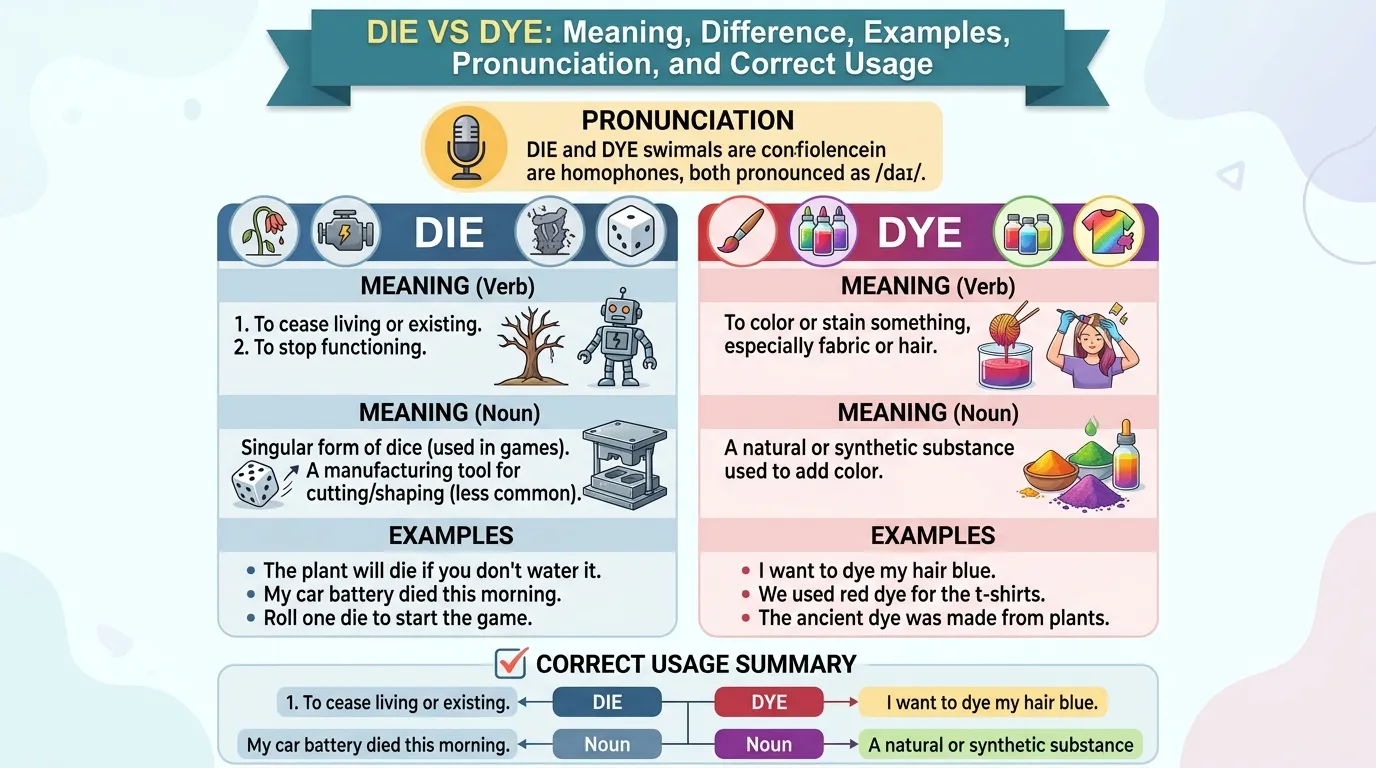
If you have ever wondered about die vs dye, you are not alone. These two words sound exactly the same in most forms of English, but they have completely different meanings. Die usually means to stop living, while dye means a substance or process used to change the color of something. For example, you can say, “Plants die without water,” but “I want to dye my hair.”
The confusion happens because die and dye are homophones. They have the same pronunciation but different spellings and meanings. This is especially tricky for English learners because hearing the word does not tell you which spelling to use.
There is almost no UK vs US English difference in the basic use of these words. American and British speakers pronounce and spell die and dye in the same standard way. The main difference comes from context, not from regional spelling.
In this guide, you will learn the die vs dye meaning, grammar, pronunciation, word origins, common mistakes, synonyms, real life examples, and easy memory tricks.
Quick Answer
Both die and dye are correct English words. Neither is an incorrect spelling. The correct choice depends on what you mean.
- ✅ Die = to stop living, or a single numbered cube used in games
- ✅ Dye = a substance or process used to change the color of something
- ❌ Dye is not the spelling for the verb meaning “to stop living”
- ❌ Die is not the spelling for the verb meaning “to change color”
Simple examples
- ✅ Plants can die without water.
- ✅ She wants to dye her hair.
- ❌ Plants can dye without water.
- ❌ She wants to die her hair.
The easiest rule is simple:
Life ends → die. Color changes → dye.
Die Meaning and Correct Usage
Die is mainly a verb. As a verb, it means to stop living.
For example:
The old tree may die without enough water.
It can describe people, animals, plants, or other living things.
The verb forms are:
| Form | Example |
|---|---|
| Base form | die |
| Third person | dies |
| Present participle | dying |
| Past tense | died |
| Past participle | died |
Notice an important spelling rule: when die becomes dying, the ie changes to y.
- die → dying
- lie → lying
- tie → tying
Other meanings of die
Die can also have other meanings depending on context.
In games, a die is one small cube with numbered sides.
Roll the die and see what number you get.
In manufacturing, a die can be a tool used to shape or cut material.
The word can also appear in phrases such as:
- die laughing
- die of hunger
- die of thirst
- die from an illness
- die peacefully
- die young
Die Examples in American English
Here are natural American English examples:
- My grandfather died peacefully at home.
- Some plants die quickly in extreme heat.
- The fish could die if the water becomes polluted.
- I hope my phone battery does not die before I get home.
- The flowers will die without sunlight.
- He was afraid that the battery would die during the trip.
- The old tradition may die out over time.
- We watched the leaves die and fall in autumn.
- The doctor explained that the plant was likely to die.
- Roll the die to begin the game.
The last example shows why context matters. Here, die is a noun rather than a verb.
Die Examples in British English
British English uses die in the same basic ways:
- The flowers will die without water.
- His grandfather died several years ago.
- The battery might die before we arrive.
- Many wild animals die because of habitat loss.
- The old building could eventually die into disuse.
- The plant began to die during the dry summer.
- She was afraid the fish would die.
- The patient eventually died peacefully.
- The fire began to die down.
- Roll the die and move your piece.
There is no standard British spelling such as dye for the verb die.
Dye Meaning and Correct Usage
Dye is both a verb and a noun.
As a verb, dye means to change the color of something by using a coloring substance.
She wants to dye her hair black.
As a noun, dye means the substance used to give something a particular color.
The company uses natural dye to color its fabrics.
The common verb forms are:
| Form | Example |
|---|---|
| Base form | dye |
| Third person | dyes |
| Present participle | dyeing |
| Past tense | dyed |
| Past participle | dyed |
Pay attention to dyeing. It is different from dying.
- Dying = approaching death
- Dyeing = coloring something
Examples
The leaves are dying.
She is dyeing the fabric.
These words look similar but have very different meanings.
Dye Examples in American English
- She plans to dye her hair brown.
- I used blue dye on the fabric.
- They dyed the shirts red.
- This natural dye comes from plants.
- The fabric is easy to dye.
- He wants to dye his shoes black.
- The company makes its own textile dye.
- We need a darker dye for this material.
- She is dyeing her hair this weekend.
- The artist used a special dye to color the cloth.
Dye Examples in British English
British English uses dye in the same way:
- She wants to dye her hair blonde.
- The fabric was dyed blue.
- They use natural dye to color the wool.
- He bought some black dye.
- The shirt can be dyed a darker color.
- She is dyeing the material today.
- The company produces textile dyes.
- We need a permanent dye.
- The artist used plant-based dye.
- He decided to dye the curtains.
Again, there is no major UK vs US difference here.
Die vs Dye Comparison Table
| Feature | Die | Dye |
|---|---|---|
| Main meaning | Stop living | Change color |
| Part of speech | Mainly verb; also noun | Verb and noun |
| Pronunciation | /daɪ/ | /daɪ/ |
| Past tense | died | dyed |
| Present participle | dying | dyeing |
| Example | The plant may die. | She will dye the fabric. |
| Related noun | death | dye |
| Main idea | Life | Color |
| US usage | Standard | Standard |
| UK usage | Standard | Standard |
| Common confusion | Sounds like dye | Sounds like die |
Die vs Dye Pronunciation
Both words are pronounced /daɪ/ in standard American and British English.
The pronunciation sounds like the word eye with a d sound at the beginning.
- die → /daɪ/
- dye → /daɪ/
Because they sound identical, pronunciation cannot help you decide which spelling to write.
This is why die vs dye is a common spelling problem.
The words are called homophones. Homophones are words that sound alike but have different meanings and spellings.
Other common homophones include:
- there / their / they’re
- to / too / two
- right / write
- hear / here
- sea / see
Why Are Die and Dye Commonly Confused?
The biggest reason is simple: they sound the same.
If someone says:
I want to dye my hair.
You hear /daɪ/. You do not see the spelling.
The same sound appears in:
Plants die without water.
This means English learners must use the meaning and context to choose the spelling.
A useful question is:
Am I talking about life or color?
If the answer is life, use die.
If the answer is color, use dye.
Die vs Dye: Word Origins and Etymology
The two words look similar today, but they have different historical roots.
Origin of Die
The verb die comes from older Germanic language forms and is closely related to Old Norse deyja, meaning “to die.” It developed through Middle English forms before becoming the modern English die.
Over time, its central meaning remained connected to the end of life.
The noun die meaning a single cube used in games has a different history. It comes through French and Latin and is related to the idea of a gaming cube.
Origin of Dye
Dye has a different history. It developed from Middle English forms related to coloring and ultimately connects with Old English words associated with color and coloring.
Its meaning has long been connected with changing the appearance or color of materials.
So, although die and dye sound alike today, they are not simply two spellings of the same historical word.
Die vs Dye Synonyms
The best die vs dye synonym depends completely on the word’s meaning.
| Word | Possible synonym | Meaning |
|---|---|---|
| Die | perish | Stop living |
| Die | pass away | Die, often more gently |
| Die | expire | Die, often formal |
| Die | depart this life | Euphemistic expression |
| Dye | color | Give something a color |
| Dye | tint | Add a slight color |
| Dye | stain | Color or mark a surface |
| Dye | pigment | Coloring material or substance |
American vs British preferences
Both American and British English use die, pass away, perish, and expire.
For coloring, both varieties commonly use dye, color, tint, and stain, although the exact choice depends on the material and context.
In American English, color is the standard spelling.
In British English, colour is standard.
For example:
- US: She wants to color her hair.
- UK: She wants to colour her hair.
However, dye remains spelled dye in both varieties.
Common Mistakes With Die and Dye
Mistake 1: Using dye for death
❌ The plant will dye without water.
✅ The plant will die without water.
Mistake 2: Using die for hair color
❌ I want to die my hair.
✅ I want to dye my hair.
Mistake 3: Confusing dying and dyeing
❌ She is dying her hair.
If you mean coloring:
✅ She is dyeing her hair.
If you mean approaching death:
✅ The plant is dying.
Mistake 4: Writing “died” when you mean colored
❌ The shirt was died blue.
✅ The shirt was dyed blue.
Mistake 5: Writing “dyed” when you mean passed away
❌ His uncle dyed last year.
✅ His uncle died last year.
Mistake 6: Assuming the words are interchangeable
They are not.
❌ I will die the fabric.
✅ I will dye the fabric.
Mistake 7: Choosing spelling from pronunciation
Because both words are /daɪ/, listening alone is not enough.
Instead, identify the meaning first.
Real Life Examples of Die vs Dye
Emails
Please note that the flowers may die if they are left outside.
I would like to dye the fabric before the event.
Office
The old printer may die soon.
We need to dye the sample material.
Banking
The customer said the card machine had died.
Here, died is being used informally to mean the machine stopped working.
Invoices
The invoice template should not die when the system updates.
The supplier charges extra for custom dye colors.
Schools
The teacher explained why plants die without water.
The students learned how natural dyes can color fabric.
Social Media
My phone is about to die! 🔋
I want to dye my hair purple! 💜
Rent Payments
My bank app died just before I could pay the rent.
Here, died means stopped working. It does not literally mean that the app lost its life.
Everyday Conversation
“Why are the flowers brown?”
“They are starting to die.”
And:
“Why is your shirt blue?”
“I dyed it yesterday.”
Die vs Dye in a Sentence
Here are simple examples that make the grammar difference clear.
American English
- The flowers may die without water.
- My phone battery is going to die.
- His grandfather died peacefully.
- The fire began to die down.
- Roll the die.
- I want to dye my hair.
- She dyed the fabric green.
- The company sells textile dye.
- We are dyeing the shirts today.
- This material is difficult to dye.
British English
- The flowers may die without water.
- My phone battery is about to die.
- His grandfather died peacefully.
- The sound began to die away.
- Roll the die.
- I want to dye my hair.
- She dyed the fabric green.
- The company sells textile dye.
- We are dyeing the shirts today.
- This material is easy to dye.
The Grammar Rule Behind Die and Dye
The basic grammar rule is based on meaning and word class.
Die is usually a verb:
Animals die.
Its past tense is:
Animals died.
Its continuous form is:
Animals are dying.
Dye can be a verb:
They dye fabric.
Its past tense is:
They dyed fabric.
Its continuous form is:
They are dyeing fabric.
It can also be a noun:
The dye is blue.
The key point is that the spelling changes with the grammar form, but the meanings remain separate.
Five Memory Tricks for Die vs Dye
Life Ends With Die
Think:
Die = life ends.
The word has die inside it, and you can connect it with death.
Dye Has a Y for Your Color
Think:
Dye = Your color.
The Y can remind you of your hair or clothes.
Dye Goes With Hair
Imagine:
Dye your hair.
Both dye and your contain the idea of changing your appearance.
Die Means Death
Connect:
die → death
That simple association works well for beginners.
Color Has Dye
Think:
Color needs dye.
If you are changing the color of fabric, hair, or another material, you probably need dye.
Die vs Dye Compared With Related Words
The most important related pair is dying vs dyeing.
| Word | Meaning | Example |
|---|---|---|
| die | Stop living | Plants die. |
| dying | Approaching death | The plant is dying. |
| dye | Change color | Dye the fabric. |
| dyed | Already colored | The fabric was dyed. |
| dyeing | Currently coloring | She is dyeing the fabric. |
This distinction is especially important for ESL learners because dying and dyeing are often confused in writing.
Is Die or Dye More Formal?
Neither word is automatically more formal.
Die is a normal everyday word, although expressions such as pass away may sound gentler when discussing someone’s death.
Dye is also a standard everyday and professional word.
For example:
- Everyday: She wants to dye her hair.
- Professional: The textile was dyed using a natural coloring agent.
The context determines the level of formality.
People Also Ask
What is the difference between die and dye?
Die usually means to stop living, while dye means to change the color of something or the coloring substance used to do so.
Is dye the past tense of die?
No. The past tense of die is died. The past tense of dye is dyed.
Is dyeing or dying correct?
Both are correct, but they have different meanings. Dying means approaching death. Dyeing means coloring something.
Do die and dye sound the same?
Yes. Both are normally pronounced /daɪ/.
Is die used differently in British English?
Not in its basic meaning or spelling. British English uses die in the same way as American English.
Is dye American or British English?
Dye is standard in both American and British English.
What is a synonym for die?
Depending on context, synonyms include perish, expire, and pass away.
What is a synonym for dye?
Possible alternatives include color, tint, and stain, depending on what is being colored.
Can die mean stop working?
Yes. Informally, people often say that a phone, battery, computer, or machine has died when it stops working.
Are die and dye homophones?
Yes. They are homophones because they have the same pronunciation but different spellings and meanings.
Final Takeaway
The difference between die vs dye is easy once you connect each spelling with its meaning. Die is mainly a verb meaning to stop living, although it has other meanings in specific contexts. Dye is a verb meaning to change the color of something and a noun referring to the coloring substance.
The two words are pronounced the same, /daɪ/, which explains why they are often confused in writing. However, their grammar, meaning, and usage are different. Remember the simple rule: life ends, so you die; color changes, so you dye.
There is no important UK vs US English difference in the spelling of these words. Both varieties use die, died, dying, dye, dyed, and dyeing in the same basic ways.
When writing, always check the meaning before choosing the spelling. That one habit will help you avoid one of the most common homophone mistakes in English.


